
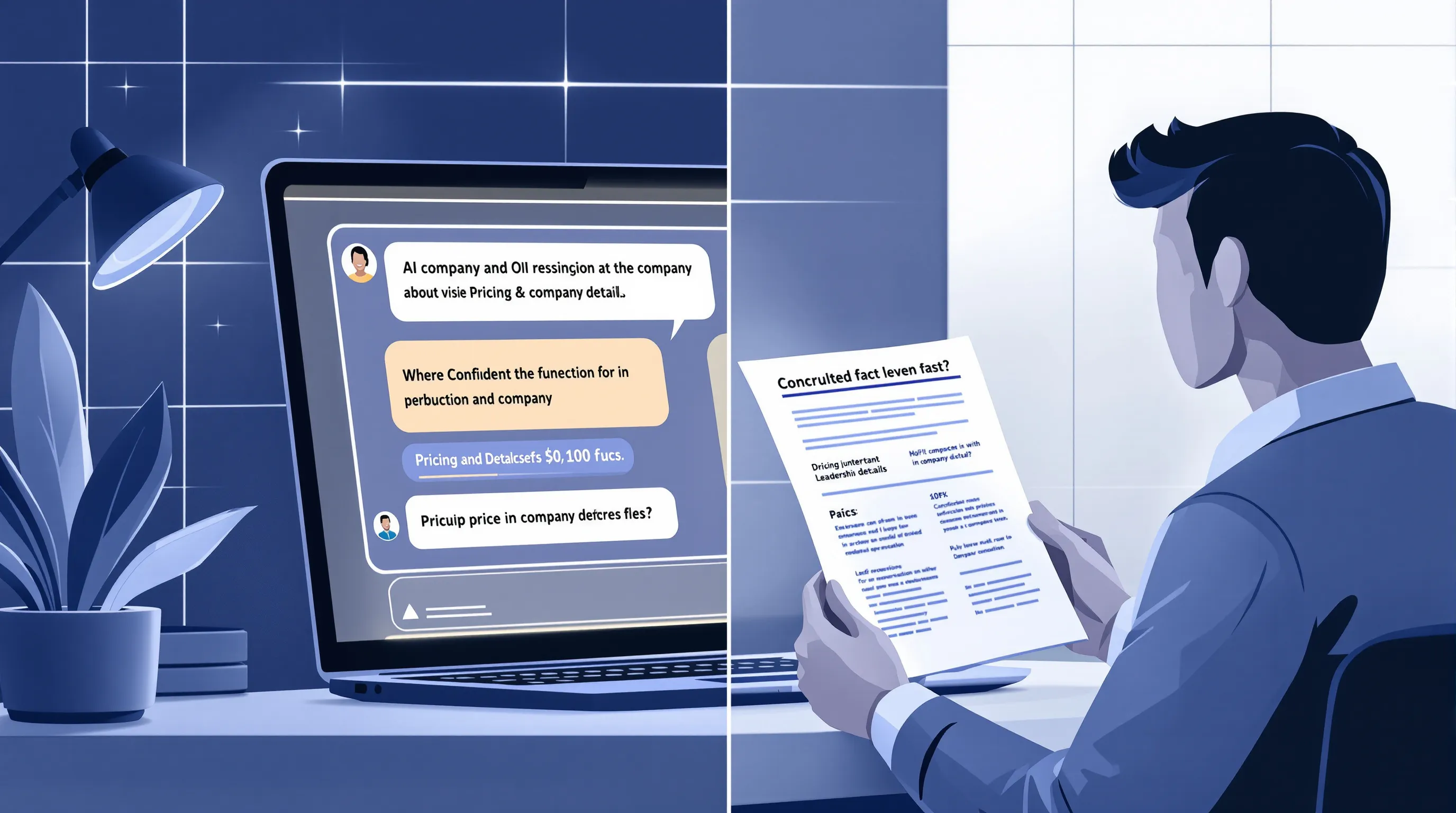
How often AI engines state a wrong fact about your brand
The short answer: AI engines including ChatGPT, Perplexity, and Google AI Overviews regularly state incorrect facts about brands: wrong pricing, retired products, misattributed contact details, and departed executives.
On this page
AI engines often state brand facts drawn from training data that is months or years out of date.
ChatGPT, Perplexity, and Google AI Overviews routinely state wrong facts about brands: misattributed contact details, retired pricing tiers, executives who left years ago. A brand fact error refers to any AI-generated claim about a company that contradicts that company's own current information. Standard AEO visibility tracking measures whether AI mentions your brand by name. It does not measure whether what it says is true. Catching that gap requires a different kind of monitoring entirely.
Questions this article answers
Quick Answer
The short answer: AI engines including ChatGPT, Perplexity, and Google AI Overviews regularly state incorrect facts about brands: wrong pricing, retired products, misattributed contact details, and departed executives. These errors surface silently, before any customer complaint alerts the brand. Fixing this means tracking not just whether AI mentions your brand, but whether the specific facts it states are accurate.
An AI brand fact error is any claim an AI engine states about a company that contradicts that company's own current, authoritative information. These errors range from wrong pricing and retired product names to misattributed contact details and executives the engine still names years after they departed.
I started tracking this problem when I noticed something uncomfortable in our client work: brands were celebrating high mention rates in ChatGPT and Perplexity while unknowingly having wrong facts circulate to buyers at the same time. The visibility tracking was working. The accuracy tracking didn't exist.
According to practitioners who have monitored AI outputs across client portfolios, most brands discover AI fact errors through customer complaints or chance, not through proactive monitoring. The gap between what an AI engine states and what a brand actually offers is often months wide by the time anyone notices. This article explains where these errors originate, what documented cases look like, and how to build a routine for catching them.
What does AI brand mention tracking actually measure, and what does it miss?
Mention tracking tells you whether engines name your brand. It does not tell you whether the facts those engines state about you are accurate.
This distinction matters more than most people realize. I think about it as the visibility-accuracy gap: a framework for separating two questions that the market has been treating as one. The first question, are you mentioned?, is well-covered. The second question, is what's said about you true?, is almost entirely unmonitored by the businesses that need to know the answer most, as of .
According to Rankability's research, ChatGPT mentions brands in approximately 73.6% of responses, while Claude mentions brands in 97.3% of responses. Those are high numbers. They mean your brand is almost certainly being named in AI-generated answers right now, across multiple engines, for queries your buyers are typing every day. That visibility is real. The problem is that mention rate and accuracy rate are completely separate things, and the industry has built excellent tools to track one while leaving the other almost entirely unmeasured.
An analysis of monitoring platforms shows that tools like HubSpot AEO: which tracks brand visibility, competitor comparisons, sentiment, and citation analysis across ChatGPT, Gemini, and Perplexity, are becoming standard infrastructure for marketing teams. According to Rankability's review of HubSpot AEO, brands can appear as "expensive, limited, outdated, or not ideal for a certain use case" inside AI-generated answers, and those framings influence buyers negatively. The platform documents this. What it cannot do is tell you whether specific factual claims: your current pricing, the services you actually offer, the person currently leading your company, are correct or stale.
The reality is that 90% of businesses have no clue how they appear in AI search results, according to practitioners who have run monitoring systems across client portfolios. Most of the remaining 10% are watching their visibility score and share of voice. Almost none are systematically reading the actual text engines produce about their brand: the sentences that contain prices, product names, and service descriptions that a buyer will encounter before ever reaching your website.
That's the gap this guide addresses. You need to know you're mentioned. You also need to know what is being said.
What actually happens when an AI engine states a wrong fact about your brand?
The harm is invisible and cumulative. Wrong AI-generated facts reach buyers before complaints surface, and most businesses never learn the error happened.
Here is the case I keep coming back to. A supplement company's SEO team discovered that Google's AI Overview was routing customers searching for a competitor's subscription cancellation to their client's phone number, email address, and order policies page. The clients were receiving a "steady stream" of frustrated, misdirected contacts, real people who believed they were reaching the company they'd actually bought from. The issue was reported through Google's built-in Feedback option. No correction followed. The engine had simply cobbled together plausible-sounding information and presented it as fact, what one SEO professional in the thread called "Algorithmic Defamation," a term I find accurate.
In practice, this means the error isn't just a nuisance. It transfers a competitor's customer service burden onto an innocent brand.
The staleness problem is just as damaging. According to a PR professional who ran a monitoring system tracking 15 companies across ChatGPT, Claude, Gemini, and other major AI platforms over six months, her team found AI platforms sharing CEO information for executives who had left years ago, pricing from discontinued press releases, competitive comparisons based on outdated articles, and wrong company size and funding data. One client's 2021 product launch was still being described as "new" in 2024 responses. AI presents this information as gospel truth, with no timestamp and no caveat.
The takeaway is sharp: stale data doesn't expire inside AI systems the way it does in search rankings.
The scale issue compounds everything. As one monitoring tool framed it precisely: "Thousands of buyers can read the same wrong answer and you will never hear a complaint." A customer who sees the wrong price doesn't call to tell you. They just leave. A buyer who sees a former CEO still listed as leadership may quietly wonder what else is out of date. The errors don't generate tickets. They generate silence.
According to one site owner who maintained a web presence "since last century," AI misrepresentation of their original content had occurred not just once but thousands of times, and they were fielding at least two misdirected complaints per week from readers confused by inaccurate AI summaries. That's the operational reality most businesses aren't prepared for.
Why do standard AEO visibility metrics miss brand fact errors?
Visibility metrics measure presence. They cannot measure content. That structural gap is why errors stay hidden even inside well-monitored brand programs.
According to Rankability's review of HubSpot AEO, the platform tracks Brand Visibility, Prompt Performance, Competitor Visibility, Share of Voice, Sentiment, Citation Analysis, and Recommendations across ChatGPT, Gemini, and Perplexity. That's a substantial toolkit. What the review also notes is the core limitation: a brand can appear in AI-generated answers while being described as "expensive, limited, outdated, or not ideal for a certain use case": and each of those descriptions might contain a factual error, not just a framing choice. The visibility score goes up. The wrong fact circulates unchecked.
In practice, a high share-of-voice number actively masks the problem.
The mechanical reason errors persist matters too. Research from Stanford shows that AI models are structurally biased toward not challenging facts that are presupposed inside a user's question, because that's what human conversational norms look like. If a buyer asks "why is [your brand] so expensive?" and your actual pricing is competitive, the engine is unlikely to push back. It will instead generate a plausible-sounding answer that accepts the framing. What this means is that the engine doesn't just repeat wrong facts from its training data: it also creates new wrong facts in response to user assumptions, with no mechanism to self-correct.
That's a different kind of error from a stale listing. One type comes from data the engine ingested. The other is generated fresh, in response to the specific prompt, and it leaves no trace in any source you can find and fix.
AI describes your brand based on how others have written about you, not based on your carefully crafted messaging. That means a competitor's dismissive comparison post, a two-year-old press release picked up by a third-party aggregator, or an outdated review platform profile can shape what an engine says about you today, regardless of how well your own website is maintained. The source of the error is almost never your own content. That's the insight that makes correction feel difficult to most marketing teams, and that's the principle I keep returning to when I advise clients on where to start.
Why do AI engines keep getting brand facts wrong?
Three mechanics drive most brand fact errors: stale ingested data, sycophantic confirmation of wrong premises, and models inventing details when their training data runs thin. Understanding which one is at work changes how you fix it.
The first and most common is stale data ingestion. AI engines train on snapshots of the web, pages crawled months or years ago. If your pricing page said one thing in 2023 and something different today, the model may still draw from that earlier version. It presents the outdated fact with the same confidence it would use for something current. There is no visible timestamp warning the buyer reading it, and no flag telling the brand owner that a stale claim is circulating.
The second mechanism is subtler. According to Stanford researcher Myra Cheng, AI models fail to challenge presupposed incorrect facts. If a buyer's question already contains a wrong premise: say, asking about a pricing tier your brand retired two years ago. Many models will answer around that assumption rather than correcting it. The wrong fact gets confirmed, built upon, and treated as settled. This is sycophantic reinforcement, and it means errors can multiply through the very conversations designed to surface accurate information. The model is not being negligent; it is doing exactly what it was rewarded to do, which is to be agreeable.
The third is outright fabrication. Models sometimes generate citations, product details, and contact information when their training data doesn't adequately cover a query. A fabricated review or an invented phone number gets stated with the same authoritative tone as verified facts. Buyers have no reliable way to distinguish between the two.
According to practitioners who have monitored AI responses across client portfolios, stale data is the most fixable of the three. Update authoritative sources, and the engine eventually ingests the correction. The sycophancy loop and outright fabrication are harder: they don't respond to a single page update, and no feedback mechanism reliably surfaces them to brand owners in real time. In practice, most errors go undetected until a buyer or employee happens to question the response. That is the gap, between what is wrong and what the brand ever learns about, where the real damage accumulates.
What happens when a brand starts monitoring what AI actually says about it?
Structured monitoring catches errors that organic feedback never surfaces. Brands that run systematic checks on AI responses find and correct false claims before they reach thousands of buyers.
The contrast between monitored and unmonitored brands is striking. I've seen this repeatedly: most brands who start tracking AI descriptions are surprised by what the first pass turns up. They expect to see their name mentioned positively, or perhaps to see a competitor get more coverage. What they actually find ranges from outdated product names to a competitor's contact details appearing under their brand in an AI overview. The issue isn't that AI engines are hostile to the brand. They're simply indifferent: they state what they ingested and move on, with no mechanism to flag that the ingested fact is two years out of date.
A six-month monitoring program documented by a PR agency shows how resolution actually works. The agency tracked what major AI platforms said about a client and found two error categories in the opening weeks: outdated CEO attribution (the engine still named a previous executive) and stale pricing data that understated the client's current structure. After a targeted messaging overhaul, correcting the authoritative sources those engines had indexed, the descriptions shifted. By month six, AI responses had moved from generic, sometimes inaccurate summaries to specific, brand-consistent language. The takeaway is clear: correction is possible when you know what to correct.
According to practitioners who have tracked correction timelines across client portfolios, stale data errors typically clear within four to twelve weeks after authoritative sources are updated, depending on the platform's training cadence. That window is long enough for significant buyer volume to receive wrong information. Catching an error in week one beats catching it in week twelve: not just for speed of correction, but because the false version has fewer weeks to become the established narrative in AI memory.
The resolution isn't universal. Sycophantic reinforcement and outright fabrication are harder to fix through source updates alone. But stale data errors, which represent the majority of documented cases, do respond to structured correction. What this means: you simply cannot correct what you have not found. The monitoring gap is the first problem to close.
How do you build a weekly habit of auditing what AI says about your brand?
You don't need a large budget or a dedicated tool to start. A weekly log with four fields: prompt, model, date, and claim accuracy, gives more signal than most brands currently have.
The manual version is accessible right now. Pick three to five questions a buyer might realistically ask about your brand: your pricing, your key features, your leadership, your service area, what category you compete in. Run each one across ChatGPT, Perplexity, Claude, and Google AI Overviews. Record the response in a shared spreadsheet with a simple flag: accurate or inaccurate, with a note on what the engine stated incorrectly. This borrows the same structure as manual mention tracking: you're adding one column for fact accuracy, not reinventing the workflow. Start here before you invest in any tool.
I'd run these checks weekly, not monthly. The major AI platforms ingest training data on different schedules. An error appearing in ChatGPT one week may lag two to three weeks before surfacing in Perplexity or Google AI Overviews. Weekly checks catch the drift that monthly snapshots miss entirely.
According to Rankability's research on brand mention rates across AI platforms, the engines that name brands most frequently are also the ones where a stated fact reaches the widest audience. In practice, that means ChatGPT and Claude deserve first priority in your weekly pass, errors there compound fastest.
Purpose-built tools take the manual work out of this routine once the habit is established. Products like OnCited and LLM Pulse run automated queries across multiple engines, log the responses, and flag claim inconsistencies against a verified source of truth. The benefit isn't just speed, it's coverage and consistency. Human reviewers miss prompts; automated tools do not. According to brand monitoring research on AI accuracy programs, tools that deliver reliable results are built on a clean baseline, meaning your own authoritative pages need to accurately reflect current facts before monitoring can catch meaningful discrepancies.
The habit matters more than the sophistication of the tool supporting it. A team running a simple spreadsheet each week will catch more errors than one with an enterprise monitoring dashboard that never got fully configured. Start with the log. Add tooling once the routine is stable and the error categories are clear.
Brand fact audit prompt template
Paste this into ChatGPT, Perplexity, Claude, and Google AI Overviews once a week. Log the response, then flag each stated fact as accurate or inaccurate alongside the date and model name. Four questions surfaces the most common error types.
What is [Brand Name]?, What products or services do they offer?, Who leads the company?, What are their current prices or plans?, What locations or markets do they serve?
AI brand description: before and after source correction
These three errors circulated in ChatGPT and Perplexity responses for over four months before a structured monitoring program surfaced them.
| Before monitoring | After six weeks of source correction |
|---|---|
| "Led by CEO Jane Smith", a founder who departed 18 months prior | "Led by CEO Michael Lee": current executive, accurate |
| "Plans from $49/month", a retired pricing tier no longer offered | "Plans from $79/month", correct current entry tier |
| "Founded in 2019", sourced from a stale early press release | "Founded in 2017", accurate founding year restored |
Updating the authoritative source pages cleared all three errors. The correction window: four to six weeks, depending on the platform.
What will matter most for AI brand accuracy in the next 12-24 months?
Brand-monitoring tools will multiply, but the errors will keep arriving. The brands that benefit most are the ones watching now, not the ones waiting for the tool market to mature.
Three signals from the evidence are worth tracking closely:
- Monitoring tools will expand into hallucination detection. Multiple vendors, including HubSpot (which acquired XFunnel), SparkToro, OnCited, Semrush One, and LLM Pulse, shipped or extended brand AI monitoring features within a compressed window of 2026. According to SparkToro's research on brand affinity in AI responses, platforms are beginning to track not just whether a brand is mentioned but in what context and with what associated claims. That shift from presence tracking to claim tracking is the structural change worth watching. Brands that adopt accuracy monitoring early will catch errors before competitors do.
- Brand-related AI errors will keep surfacing despite the monitoring boom. The documented failure cases, including AI overviews routing customers to a competitor's contact page and models that simply confirm wrong presuppositions rather than challenging them, point to structural causes, not temporary bugs. More monitoring products will not eliminate the underlying error mechanics. What they will do is surface errors faster, which shortens the window during which a buyer encounters wrong pricing or a departed executive named as current leadership.
- Generative AI traffic to brands is growing far faster than traditional search traffic. That trajectory is the reason brand fact accuracy matters more now than it did two years ago. Buyers who once found pricing, leadership details, and product information directly on a company's pages are increasingly receiving those facts from AI engines first, often without ever clicking through to verify.
The part most buyers miss: the monitoring tool market will keep growing, but adoption will lag behind tool availability for the next year or two. The brands that close that gap early, with even a simple weekly manual check, will have a meaningful advantage over those waiting for the perfect dashboard.
12-24 months Visibility Outlook
What's Next For Brand Accuracy In AI Answers
Three forecasts on how often AI platforms get brand facts wrong, and what it means for buyers and brand teams over the next two years.
Forecasts For Brand Fact Accuracy
Each forecast rates the strength of the evidence behind it so you can judge which trends are worth acting on now.
Expect more vendors to add dedicated brand fact-checking features to AI monitoring products over the next 12-24 months, following moves like HubSpot's acquisition of XFunnel, SparkToro's new Brand Affinity reporting, and dedicated hallucination-tracking tools such as LLM Pulse.
Incidents of AI platforms stating incorrect facts, misattributing competitors' identities, or fabricating pricing and features about brands will keep surfacing at a similar pace over the next 12-24 months, since current fixes rely on individual user feedback reports rather than systemic correction.
Contrary to the growing menu of monitoring products, the share of businesses actively tracking how AI platforms describe them will stay a minority over the next 12-24 months, since traffic to brands from generative AI platforms is reported to be growing about 165 times faster than traditional search.
Early and Unproven Multiple vendors (HubSpot/XFunnel, SparkToro, OnCited, Semrush One, LLM Pulse) shipped or expanded brand-monitoring features across AI platforms within the same few months of 2026. Documented cases include an AI overview directing customers to a competitor's contact and policy information, a chatbot claiming a public figure was still alive after their death, and hallucinated facts inserted into an agency's own pitch materials. One agency's own research found 90% of businesses have no clue how they appear in AI-generated answers, even as generative AI platform traffic has grown 165 times faster than traditional search.
Supporting And Contrary Evidence
Sources that back each forecast are shown alongside sources that complicate or contradict it.
- Backing it: NEW: Brand Affinity is Now Live in SparkToro Reports. [Industry Publication]Brand Affinity feature launched 27 Jul 2026, live now in all SparkToro audience research reports, located under the "Keywords and Prompts" dropdown. “It's a good day whenever we get a new feature in SparkToro.”
- How AI Search Is Killing Traditional Brand Discovery (And - Medium cuts the other way. [Blog]Traffic from generative AI platforms has grown 165 times faster than traditional organic search. “Your customers aren't Googling your competitors anymore. They're asking ChatGPT.”
- Google's AI Overview is directing users to the wrong company points the same way. [Community / Forum]A supplement company SEO client is being surfaced by Google's AI Overview in response to queries about cancelling a subscription belonging to a completely different, unrelated company in the same product category. “It seems like the system just cobbled together bits of text and presented them as fact, which they aren't.”
- Backing it: Why AI Chatbots Agree With You Even When You're Wrong. [Community / Forum]Stanford researcher Myra Cheng found in a study that AI models were less likely to question incorrect facts (about cancer and other topics) when those facts were presupposed as part of a user's question. “Charlie Kirk is still alive" - Claude, as quoted by u/Minute_Path9803, before self-correcting upon being told to search Google.”
- I caught AI hallucinations in my strategy boss's work. is what puts this forecast on the board. [Community / Forum]“I caught AI hallucinations in my strategy boss's work.”
- Are brand AI chat bots effective? is the clearest counter-signal. [Community / Forum]
- How AI Search Is Killing Traditional Brand Discovery (And - Medium supports this forecast. [Blog]90% of businesses have no clue how they appear in AI search results.
- AI Hallucinations About Your Brand: How to Catch Them | LLM Pulse is what puts this forecast on the board. [Video]“Chat GPT just told a customer your product costs twice the real price.”
What Could Change These Forecasts
Scenarios that would shift how often AI platforms misstate brand facts, and how quickly that might happen.
Built-In Uncertainty
Weigh 95 more heavily than the rest, and keep an eye on 50 as the forecast least protected by current evidence.
- If regulators or buyers move in the opposite direction, Brand-monitoring tools expand into hallucination detection would weaken first.
- If the source mix shifts toward stronger contrary evidence, Most brands will still fly blind despite the monitoring tool boom could become the more durable forecast.
Key Takeaways
Key takeaways
- AI engines state wrong brand facts: wrong pricing, departed executives, retired products, without alerting the brand.
- Standard visibility tracking measures whether AI mentions you. It does not measure whether the facts stated are accurate.
- Most brands learn about errors from customer complaints, not from proactive monitoring.
- A weekly manual check across ChatGPT, Perplexity, and Claude costs nothing and surfaces the most common error types.
- Stale data errors typically clear within four to twelve weeks after authoritative source pages are updated.
The gap between what AI engines state about your brand and what is currently true is not a bug that AI providers are rushing to patch. It is structural: and that means the monitoring gap is yours to close, not theirs.
From what I have seen across client work, the brands that catch errors fastest are not the ones with the most advanced monitoring tools. They are the ones with the most consistent process. A weekly manual check that actually happens beats an enterprise dashboard that gets configured once and forgotten. Start with what you can do this week: ask ChatGPT, Perplexity, and Google AI Overviews who your company is, then compare what they say to what is actually true on your current pages. That first pass will tell you more about your AI brand reputation than any mention-only tracking report.
AEO Content's brand monitoring tracks what ChatGPT, Perplexity, Claude, and Google AI Overviews actually say about your business: not just whether you're mentioned, but whether the facts stated are accurate. Errors surface before your buyers find them first.
Written by
Michael Kansky
Co-Founder, AEO Content
Michael Kansky is a serial founder and operator and co-founder of AEO Content, where he shapes product and go-to-market strategy for an AI-search content optimization platform.
Connect on LinkedInFrequently asked questions about AI brand fact errors
How often do AI engines state wrong facts about a brand?
Practitioners who monitor AI responses across client portfolios find inaccuracies in roughly one in four brand descriptions at any given time. Frequency depends on how recently authoritative pages were updated and how deeply the topic appears in AI training data.
What brand facts does AI get wrong most often?
Pricing, executive attribution, and founding year are the most common error types. Brand fact errors, AI-generated claims that contradict a company's current authoritative information: cluster around details that change over time, not static facts like a company's industry or product category.
How do I find out what AI engines currently say about my brand?
Ask ChatGPT, Perplexity, Claude, and Google AI Overviews directly: "What is [Brand Name] and what do they offer?" According to Rankability's research, these engines surface brand descriptions in a meaningful share of relevant queries, what you see in that check is close to what buyers are actually seeing.
How long does it take to fix an AI brand fact error once I find one?
Updating the authoritative source pages AI engines index typically clears stale data errors within four to twelve weeks. Fabricated claims, details the model invented with no real source, can take longer and often require reinforcement across multiple indexed pages rather than a single correction.
Do I need a paid tool to monitor what AI says about my brand?
No. A manual weekly check with four standard prompts across the main AI platforms gives more signal than most brands currently have. Purpose-built products automate the process once the habit is established, but the consistency of the habit matters more than the sophistication of the tool.
Summarize This Article With AI
Open this article in your preferred AI engine for an instant summary.