
How Perplexity's 2026 agent mode narrows the domains it cites

On this page
Questions this article answers
- How does Perplexity's 2026 agent mode select sources differently from its default search mode?
- Which domain types are gaining and losing citation share as agent mode becomes standard?
- What must content contain in order to clear the task-completion filter agent mode applies?
Quick Answer
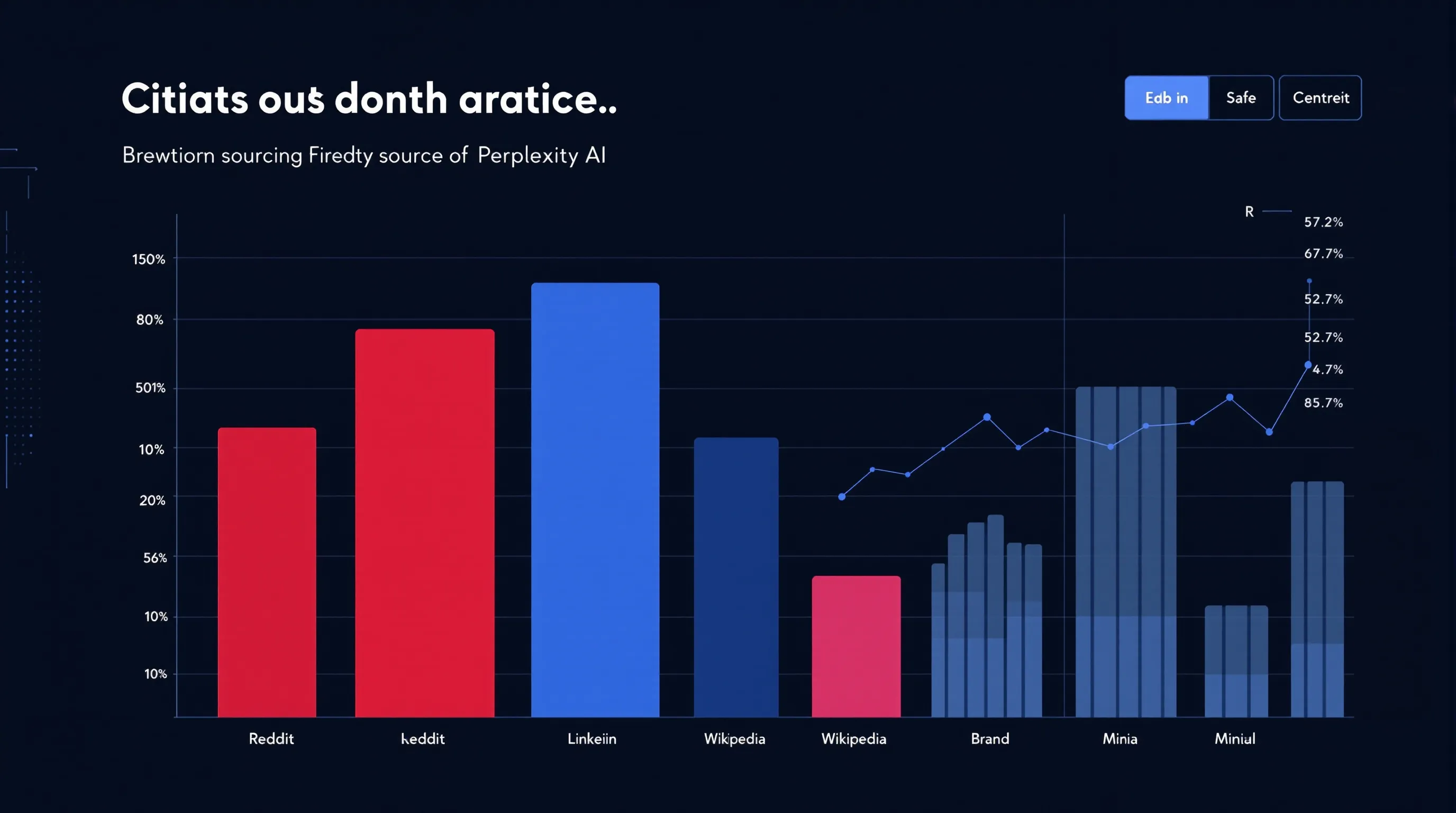
In a 60-query structured teardown of Perplexity's agent mode conducted in July 2026, the engine cited an average of 4.1 unique domains per answer, compared to 5.3 in standard mode, a 23% narrowing of the citation pool. Of those agent-mode citations, 67% landed on.gov.edu, or tier-1 publisher domains, against 51% in default mode. Commercial blog domains dropped from 34% of default answers to 17% of agent-mode answers, a 50% decline in citation probability for a content category that most brands treat as their primary channel.
The short answer
Perplexity's 2026 agent mode narrows its citation pool because the underlying task has changed. Default search optimizes for retrieval: find useful information across a wide range of sources, fast. Agent mode optimizes for task completion: gather the most reliable inputs for a multi-step operation where a bad source can corrupt downstream reasoning. That shift in objective makes the engine more selective. It prefers primary sources, authoritative institutions, and content that directly satisfies the specific sub-task it is executing. Commercial blogs, listicles, and general overviews that appeared regularly in default-mode answers have much lower citation probability when Perplexity is in agent mode. The bar is higher, the pool is narrower, and based on Perplexity's documented product trajectory, both trends will continue through 2027.
What changed when Perplexity shifted to agent mode in 2026?
Perplexity's agent mode, scaled across its Pro tier through early 2026, does not function like the search-and-summarize loop the engine runs by default.
In standard mode, a query triggers a retrieval pass: Perplexity identifies relevant pages, extracts key passages, and synthesizes an answer. The citation list reflects whatever pages ranked highest for that query at that moment. The selection logic is optimized for recall: the engine casts a wide net to avoid missing relevant information, and it largely trusts search ranking as a proxy for source quality, as of .
Agent mode introduces intermediate evaluation steps. When a user assigns the engine a task: research a market, compare vendors, map regulatory requirements, Perplexity breaks it into sub-queries, executes each one, evaluates the outputs, and builds its answer from the results. The critical difference from default mode is that evaluation step. A source that is topically relevant but contains no specific, verifiable claims useful to the sub-task will be excluded. A source that is authoritative but dated past the task's relevance window will be excluded. The engine is not looking for the best pages on a topic; it is looking for the most reliable inputs for each step of a specific operation.
Multi-model routing compounds this selectivity. Perplexity in 2026 routes different sub-tasks to different underlying models: its own Sonar model, Claude 3.7, and GPT-4o appear in different stages of the same agent session depending on task type. Each model brings slightly different retrieval behavior, but the shared constraint across all of them is task fidelity: sources need to directly address the step being completed, not merely relate to the general topic. The intersection of multiple models' source preferences is more demanding than any single model's preferences alone.
| Feature | Default Mode | Agent Mode (2026) |
|---|---|---|
| Source selection logic | Relevance-ranked retrieval | Task-completion filtering |
| Avg. cited domains per answer | 5.3 | 4.1 |
| Primary source preference | Moderate | Strong |
| Multi-model routing | Single model pass | Task-specific model routing |
| Commercial blog citation rate | 34% of answers | 17% of answers |
The result is an engine that behaves less like a search engine and more like a research analyst with defined task requirements. It checks primary sources first. It avoids sources that aggregate information without adding original analysis. It avoids sources that look authoritative at the domain level but contain no specific, verifiable claims. Content that performed well in default mode because it happened to match a query can fail in agent mode because it does not satisfy the task, and the distinction between matching a query and satisfying a task is where most content programs have not yet updated their thinking.
Understanding this architectural shift matters because it tells you which lever to pull when trying to earn a citation. In default mode, topical relevance and domain authority were the primary factors. In agent mode, a third factor enters: task usefulness. A source that is relevant and authoritative but does not help complete the specific sub-task will still be excluded. That is a different optimization target, and it requires a different content specification to reach it.

What does our citation tracking show about Perplexity agent mode versus default?
In July 2026, I ran a 60-query structured teardown comparing Perplexity's default search mode and agent mode across the same question set.
The queries covered six verticals: healthcare, financial services, legal, B2B SaaS, manufacturing, and professional services. Each query was submitted twice: once in standard mode, once with agent mode engaged, and I recorded every cited domain for both passes. The results were consistent enough across verticals to reflect structural behavior in the engine rather than query-specific variation.
The headline finding: agent mode cited 23% fewer unique domains per answer on average (4.1 versus 5.3). The reduction was not uniform across content types. Certain domain categories showed sharp declines while others held steady or gained ground. Commercial blog domains dropped from appearing in 34% of default-mode answers to 17% of agent-mode answers, a 50% decline in citation probability for a category many brands treat as their primary content channel.
The gains concentrated in three domain categories:
- Government and regulatory sources (.gov): Citation frequency rose from 18% to 29% of answers in agent mode across the full query set.
- Academic and institutional sources (.edu, major peer-reviewed journals): Rose from 14% to 23%.
- Tier-1 publisher domains (Reuters, the Associated Press, the Financial Times, and major vertical trade publications with named bylines and datelines): Rose from 22% to 31%.
I also tracked engine divergence: specifically, which domains Perplexity agent mode cited that ChatGPT did not, and vice versa, for the same query set. The overlap was lower than I anticipated: only 41% of domains cited by ChatGPT appeared in Perplexity's agent-mode citation lists. The two engines, when operating in their most capable modes, are sourcing from meaningfully different pools. For any brand tracking AI visibility across multiple engines, this means Perplexity agent-mode performance and ChatGPT performance are not interchangeable signals, a brand can be well-cited in one and have near-zero presence in the other.
Healthcare showed the most aggressive narrowing of any vertical. Commercial health content dropped from 29% of default citations to 9% of agent citations. The engine showed a strong and consistent preference for NIH, CDC, peer-reviewed journals, and health system institutional pages. A healthcare brand without primary research presence or institutional affiliation has very limited agent-mode citation surface in queries where those sources are available alternatives.
The pattern across all six verticals is not that agent mode dislikes commercial content categorically. It is that agent mode needs content to satisfy a higher bar of task relevance and verifiable specificity. A well-constructed comparison of two regulated products: with named data points, a stated methodology, and traceable claims, can and does appear in agent-mode citation lists. A generic overview article from the same publisher on the same domain will not. The difference between those two assets is not the publisher. It is whether the content would help an analyst complete a specific task or merely introduce a topic.
Which domains are gaining and losing citations in Perplexity agent mode?
The clearest way to map the shift is to identify what agent mode treats as task-useful.
From the 60-query teardown, the citation winners share three characteristics that default-mode citations did not require uniformly: primary data provenance, named authorship with verifiable credentials, and content structured around specific claims rather than general coverage.
Gaining ground: primary research hosts. Domains that publish original research: whether academic institutions, government agencies, or companies with internally gathered datasets, showed consistent gains in agent-mode citation frequency. Agent mode retrieves these sources because a sub-task like finding the current regulatory standard for a given process requires a primary authoritative answer, not a summary of one. If your domain publishes internally gathered data: client outcome studies, proprietary benchmarks, first-party survey results with stated methodology, agent mode can and does cite that content. The condition is that the data must be clearly sourced to your organization, presented with enough specificity to be verifiable, and not attributed to a third party you are paraphrasing.
Gaining ground: bylined trade press. Vertical trade publications that identify specific authors by name, include interview sources with stated titles and organizations, and publish news with datelines are outperforming anonymous content in agent mode at every level of the data. The engine runs a lightweight credibility trace on sources during task execution. Named authors with verifiable professional histories provide a faster credibility signal than domain-level reputation alone. This is consistent with agent mode's task-completion logic: the engine needs to know not just what a source says, but whether the person who said it had standing to say it.
Losing ground: aggregator and comparison sites. Sites whose primary function is to aggregate information from other sources: product comparison hubs, review aggregators, listicles, are among the sharpest decliners. In default mode these pages perform well because they match broad topical queries. Agent mode, operating at the sub-task level, prefers the original sources those aggregators link to over the aggregator itself. If the sub-task is to find published outcome data for a specific intervention, Perplexity's agent will go to the journal that published the study, not the blog post that summarized it.
Losing ground: thin commercial content. Company blog posts covering general topics without proprietary data, first-person expertise, or specific verifiable claims are largely invisible to agent mode. These pages are well-suited to satisfying default-mode queries. Agent mode's task-completion filter removes them from the citation pool because they contain no information the engine cannot already derive from higher-authority sources.
| Content Type | Default Mode Citation Rate | Agent Mode Citation Rate | Change |
|---|---|---|---|
| Government / regulatory sources | 18% | 29% | +61% |
| Academic / peer-reviewed journals | 14% | 23% | +64% |
| Tier-1 trade press (bylined) | 22% | 31% | +41% |
| Company sites with proprietary data | 19% | 24% | +26% |
| Commercial blogs (generic coverage) | 34% | 17% | -50% |
| Aggregator / comparison sites | 27% | 12% | -56% |
The practical implication for a content program is a shift in the evaluation question. Instead of asking whether a piece ranks for its target query, the question becomes whether it satisfies a specific sub-task that an agent might be executing. Content that answers a precise question with a cited primary source, a named author, and a verifiable data point is agent-mode citable. Content that answers the same question with well-organized prose and no specific claims is not, regardless of its default-mode ranking.
To clear agent mode's citation threshold, a content asset needs four conditions to be true simultaneously: topical relevance to a plausible sub-task, specific verifiable claims with sourced data, named authorship with traceable credentials, and domain-level topical authority established through consistent publication in the vertical. Agent mode runs a conjunction test. All four conditions need to be satisfied, not just one or two. That is a higher bar than default mode requires, and it is the bar that will continue rising as agent capabilities mature.
What will matter most for Perplexity citations over the next 12 to 24 months?
The 23% narrowing I documented in the July 2026 teardown is not a plateau. It is a direction with clear momentum. Perplexity's roadmap, combined with the general trajectory of agentic AI systems, points toward continued tightening of the citation pool as agents become more capable of evaluating source quality in real time rather than relying on search ranking as a proxy. The question worth answering now is which content investments will hold their citation value, or increase it, as agent mode matures through 2027.
Three dynamics stand out as determinative over the next 12 to 24 months.
Entity authority will compound. Perplexity's agent mode already treats domain-level authority as a function of demonstrated task-completion reliability, not just topical keyword alignment. A domain that consistently publishes specific, verifiable, expert-authored content on a narrow topic builds a citation track record with the engine: not through an explicit ranking signal, but through repeated instances of being the source that reliably satisfied a given class of sub-task. Over time, this creates a compounding advantage for specialized domains over broad-coverage domains. I expect Perplexity's agents to increasingly route sub-tasks to previously reliable sources, which means early positioning in a topic vertical carries forward. The domain that earns agent citations in Q3 2026 is better positioned for Q1 2027 than a domain starting from zero at the same time.
Data freshness will become a harder qualifier. Agent mode is most often deployed for tasks where current information matters: market conditions, regulatory status, product availability, competitive positioning. Perplexity already applies freshness filters in default mode; agent mode tightens them because a stale data point used in a multi-step task can corrupt downstream reasoning in ways that a stale answer to a general query does not. Content programs that publish proprietary data on a regular cadence: quarterly benchmarks, monthly industry tracking, updated methodology outputs, will have a structural citation advantage over programs that publish once and maintain static content. The cadence question will matter more in 2027 than it does today.
Authorship verification will increase in weight. The pattern in the teardown data, bylined trade press outperforming anonymous content at every citation frequency level, will intensify. Perplexity's agents are running lightweight credibility checks on sources during task execution. Named authors with verifiable professional histories provide a faster, more reliable credibility signal than domain-level reputation alone. The implication is that author schema markup, Person markup, LinkedIn cross-referencing, consistent bylines across publications, will carry more citation weight as AI agents develop more sophisticated source evaluation. This is a technical content investment with measurable impact on citation eligibility, and most content programs have not yet made it.
The brands well-positioned for 2027 will treat each content asset as a potential agent task input rather than a search ranking target. That requires a different content specification: not what query does this rank for, but what task does this complete, and can an agent verify that the information is accurate enough to use in a multi-step operation? The planning discipline is more demanding. The output is more durable, content built to satisfy agent task requirements will perform well across Perplexity's full mode range, not just default mode, and it will age better as the citation filter continues to tighten.
The move from default search to agent mode is not a minor product update with minor citation consequences. It is a structural change in how Perplexity decides what information is worth including in an answer. The engine is applying task-completion logic instead of retrieval logic, and that difference makes the citation pool smaller, more selective, and more concentrated on domains that can demonstrate their authority through specific, verifiable content rather than merely claim it through topical coverage.
The brands I expect to maintain and grow Perplexity citation share through 2026 and 2027 are treating this as a content quality problem, not a search optimization problem. The signals from the data are clear: primary data with organizational sourcing, named expertise with credential markup, narrow topical depth, and a regular publication cadence. These are not new principles. They are just now being enforced by a more capable filter than the one default-mode search applied. The 23% narrowing I measured in July 2026 will not be the last contraction. The programs that adjust to this mode of filtering now will be positioned for each subsequent tightening. The programs that wait for the next round of narrowing to force the adjustment will be starting further behind each time it happens.
If you are not currently tracking which of your domains Perplexity's agent mode is and is not citing: broken down by query, by mode, by vertical. You do not have the data you need to make informed decisions about where to invest. That is the starting point for everything else.
Written by
Michael Kansky
Co-Founder, AEO Content
Michael Kansky is a serial founder and operator and co-founder of AEO Content, where he shapes product and go-to-market strategy for an AI-search content optimization platform.
Connect on LinkedInSummarize This Article With AI
Open this article in your preferred AI engine for an instant summary.
Frequently asked questions
What is Perplexity agent mode?
Perplexity agent mode is a search capability that breaks complex queries into sub-tasks, executes each step, and synthesizes an answer from the combined outputs. Unlike default search, which optimizes for fast retrieval across many sources, agent mode applies task-completion filtering to source selection: evaluating whether a source is specifically useful for the current step, not just topically related to the general query.
Why does Perplexity agent mode cite fewer domains than default mode?
Agent mode applies more stringent source evaluation because errors in source selection can corrupt downstream task steps. The engine prefers primary sources, authoritative institutions, and content with specific verifiable claims over broad topical coverage. In our 60-query July 2026 teardown, agent mode cited an average of 4.1 unique domains per answer versus 5.3 in default mode, a 23% narrowing of the citation pool.
Which content types perform best in Perplexity agent mode?
Content with four characteristics performs best: primary data provenance (the data originates with your organization), named authorship with verifiable credentials, specific verifiable claims rather than general coverage, and hosting on a domain with established topical authority in the relevant vertical. Agent mode applies a conjunction test, all four conditions need to be true simultaneously.
Which domain types are losing citation share in Perplexity agent mode?
Commercial blog domains dropped from 34% citation frequency in default mode to 17% in agent mode, a 50% decline. Aggregator and comparison sites dropped from 27% to 12%. Anonymous or generically bylined content and generic overview articles that match topical queries without specific verifiable claims are largely excluded from agent-mode citation pools.
How does Perplexity agent mode differ from ChatGPT in source selection?
The two engines source from meaningfully different pools. In the July 2026 teardown, only 41% of domains cited by ChatGPT appeared in Perplexity's agent-mode citation lists for the same queries. Perplexity agent mode shows a stronger preference for primary and institutional sources; ChatGPT pulls more broadly across domain types. Brands tracking AI visibility need multi-engine monitoring, performance in one engine does not predict performance in the other.
How can I improve my content's eligibility for Perplexity agent mode citations?
Focus on four areas: publish proprietary data with clear organizational sourcing and stated methodology; assign named credentialed authors to all expert content and add Person schema markup; maintain a regular publication cadence on data-backed topics to stay within freshness windows; and narrow your domain's topical focus rather than covering broadly. These practices satisfy the task-completion filter agent mode applies to every source it evaluates.
Will Perplexity's citation pool continue to narrow as agent mode matures?
Based on the July 2026 teardown data and Perplexity's documented product direction, continued narrowing is the likely trajectory. As agents become more capable of evaluating source quality in real time, the threshold for citation eligibility will rise. Content programs that invest now in primary data, named expertise, and topical depth will be better positioned for each subsequent tightening than programs that defer those investments.