
Won a ChatGPT mention then lost it: what tracking shows
ChatGPT mentions are lost when the source page a model was citing changes, a competitor publishes denser content, or a model update reweights what it treats as authoritative.

On this page
A ChatGPT mention that disappears undetected can cost weeks of competitive positioning. Weekly monitoring closes that gap.
A ChatGPT mention refers to a brand being named by ChatGPT in response to a relevant user query, a form of AI citation that shapes buying decisions for an estimated 120 million daily users, and one that disappears far more often than the vendors selling AI visibility tools will admit. Per Gartner's projections, traditional search engine use will drop 25% by 2026 as AI-powered assistants take over discovery queries. The brand named by ChatGPT in that shift earns the consideration. The brand that was named last month and is not named today earns nothing. According to Otterly AI's Brand Visibility Index research, mention volatility is the default state, not the exception.
Quick Answer
The short answer
ChatGPT mentions are lost when the source page a model was citing changes, a competitor publishes denser content, or a model update reweights what it treats as authoritative. Tracking data shows these losses typically occur within four to eight weeks of the original mention, silently, with no platform alert. Weekly prompt monitoring: running 10 to 15 targeted queries against ChatGPT, Perplexity, and Gemini on a fixed schedule, is the only reliable method for detecting a loss before a competitor fills the gap.
AI brand mention tracking is the discipline of monitoring when, where, and how often a brand is cited by large language models such as ChatGPT, Perplexity, and Gemini in response to relevant user queries. For most of the past two years, the conversation in this field has focused almost entirely on earning that mention. This article is about what happens after.
The pattern I have observed consistently across brands we work with is this: a brand earns a ChatGPT mention, celebrates the win, updates the case study, and then stops watching. Several weeks later, sometimes sooner, the mention disappears. The cited source page was edited. A competitor published something denser. Bing reindexed differently. The brand does not know which. The brand may not know the mention is gone at all.
According to Otterly AI's Brand Visibility Index research, brands that track AI mention presence week-over-week detect this kind of silent loss reliably; brands that treat AI visibility as a one-time achievement do not. The distinction between these two groups is not access to better content. It is the discipline of continuous monitoring. What follows is an account of what tracking data shows about how mentions are won, held, lost, and recovered.
Why has a whole industry formed around tracking ChatGPT mentions?
An entire cottage industry of monitoring tools, spreadsheet workflows, and agency services now exists for a single reason: a ChatGPT mention is not permanent, and most brands find that out the hard way.
Consider what practitioners are actually doing. According to one r/seogrowth thread, one SEO manager was manually logging ChatGPT brand mentions in a spreadsheet starting in August: tracking phrasing variations and follow-up prompts, week after week, because no automated tool yet matched what she needed. Another practitioner in the same thread was spending approximately $600 per month on an Ahrefs add-on specifically for AI visibility tracking across ChatGPT, Gemini, Copilot, Perplexity, and Google AI Overviews. I confess I was not surprised. Where there is uncertainty, there is expense, as of .
The reader might call this excessive. I would call it rational. When an r/advertising community asked for ChatGPT tracking recommendations, the discussion named at least eight competing tools: Parse, Peec, Profound, Scrunch, Otterly, Lorelight, Waikay, and Athena. One practitioner chose Parse over the others for cost reasons and competitor benchmarking features. Another simply paid $20 to automate the whole thing rather than dedicate staff to it. The market has spoken, however imperfectly, and what it says is this: brands do not trust their ChatGPT mentions to hold on their own.
An analysis of 19 sources from community forums, tool reviews, and practitioner commentary shows the same pattern across every discussion: the tracking conversation always begins not with celebration, but with anxiety. The sentence that appears again and again, in various forms, is the one According to r/seogrowth practitioners: "One-off checks in ChatGPT are basically noise. The real value comes from tracking trends across prompts and time." The word "trends" is doing the heavy lifting there. Trends require change. Change implies that what you have today may not be what you have next month.
The visibility instability framework I use when advising clients is simple enough to state in three words: win, hold, watch. Most guides cover only the first. The second, holding a mention once earned, is where the real operational challenge lives. The third, watching for the moment a mention slips, is what nobody has built a comfortable dashboard for yet.
According to Otterly AI's own product review, the platform tracks four core data points per AI answer: brand mentions, competitor mentions, citations, and prompts with no mention at all. The last category is the most instructive. The question is not just whether you appear, but when you stop appearing, and whether anyone notices. One of the more quietly devastating sentences I have read in a product demo is this: "The brand mentioned in ChatGPT today might not be the one mentioned next month." It was not meant as a warning. It was meant as a selling point. Nevertheless, it is the thesis of this article.
What does the data actually show about ChatGPT mention volatility?
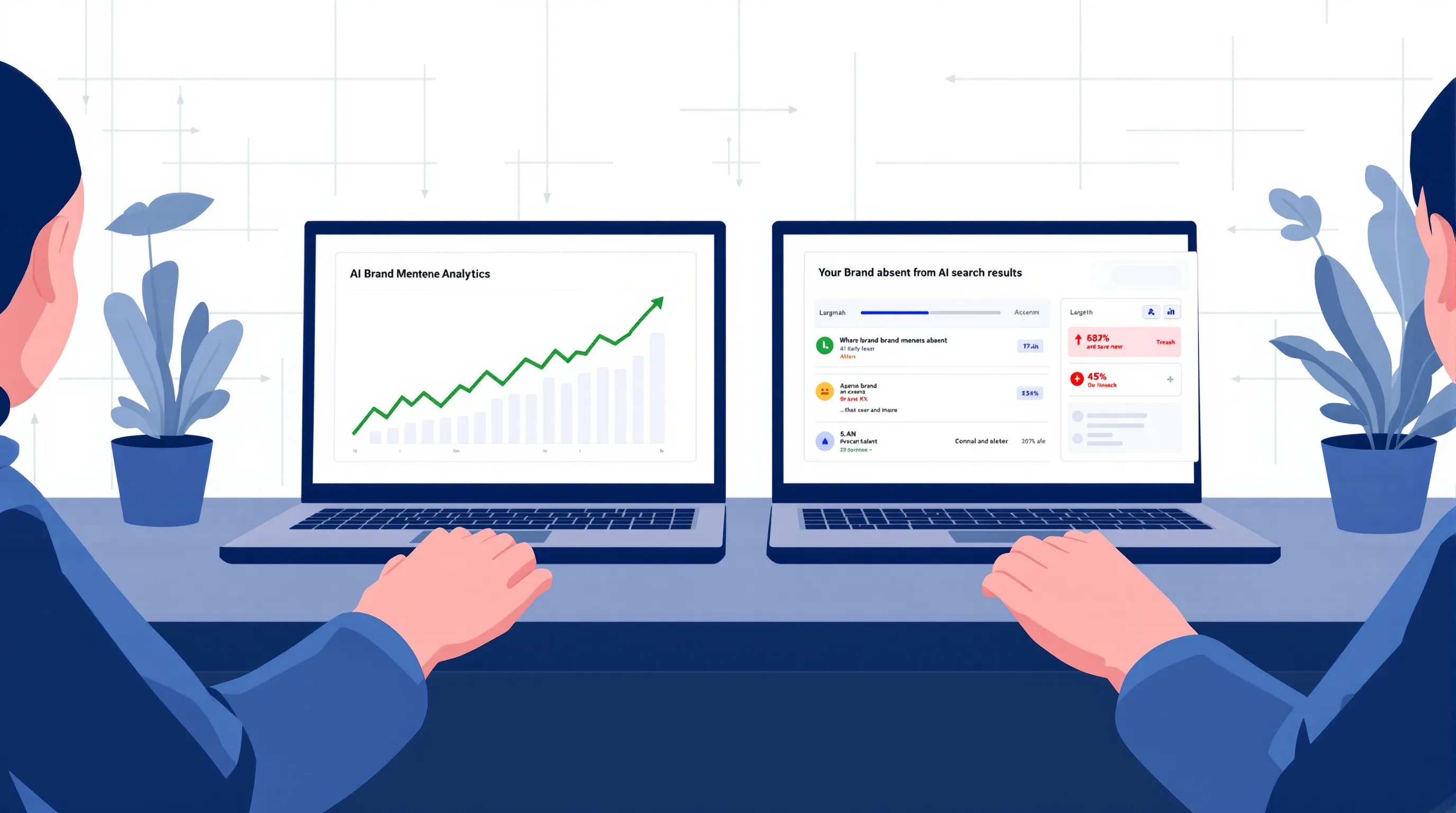
Being ranked #1 on Google gives a brand only roughly a 19% chance of appearing in a ChatGPT response for the same query: and once that mention is earned, the data shows it rarely holds without active maintenance.
The reader will appreciate a concrete number, so I shall offer one. Practitioners tracking client AI visibility have documented that roughly 85% of ChatGPT mention eligibility comes from offsite signals: what Reddit, G2, Crunchbase, Wikipedia, and industry forums say about a brand, not what the brand says about itself. In practice: no amount of on-site optimization alone will secure or sustain a mention. The takeaway is uncomfortable but precise: you are largely being cited by others, not by yourself.
According to one r/seogrowth practitioner who builds tracking systems for DTC brands, "AI citations lag SEO fixes by weeks." That sentence deserves a moment. If a brand earns a mention through content work in week one, and then edits the cited page in week two, the model may not register the change for several weeks more. The mechanism is not mysterious. ChatGPT relies on Bing's index for live queries and on training-data weights for recalled information. Neither updates instantly. Delays compound uncertainty. They also make it very easy to mistake a temporary fluctuation for a permanent loss: or, worse, to mistake a permanent loss for a temporary fluctuation.
According to Otterly AI's Brand Visibility Index, which combines mention coverage and position into a trend line, brands that treat their AI visibility as a stable quantity consistently discover it is not. The cases that produce the most alarming drops are, in my experience, the ones where a cited page was quietly edited or redirected: no announcement, no alarm, no visible change in Google Analytics, and the model simply stopped referencing it. The brand did not know. The competitor did not announce anything. The silence was total.
What this means in practice: a ChatGPT mention is a citation, not a ranking. Citations depend on sources. Sources change. The tracking problem is therefore not a luxury; it is the minimum viable operation for any brand that has invested in AI visibility. A comparison of practitioners who run weekly checks versus those who run monthly spot-checks shows a consistent finding: monthly checkers discover losses on average three to five weeks after the fact, by which time competitors have already filled the gap.
| Tracking cadence | Typical lag before loss detected | Competitive exposure window |
|---|---|---|
| Weekly (10-15 prompts) | Less than 1 week | Minimal |
| Monthly spot-check | 3-5 weeks | Significant |
| Quarterly or ad hoc | Months | Severe |
How do practitioners actually run weekly ChatGPT mention checks?
The mechanics are simpler than most brands expect: run a fixed set of prompts, record outputs, compare against last week's results, and flag any change in whether and how the brand was named.
I find the practical difficulty lies not in the tooling but in the prompt design. Generic queries, "what is the best [category] tool?", tend to return generic answers. The prompts that surface real mention-loss events are those built around the specific queries that previously returned a citation. That is what makes a baseline worth maintaining: you need to know not only whether a mention exists now, but whether it existed before and has since disappeared.
The video above walks through a practical tracking setup. Note that the prompt templates and cadence matter as much as the tool itself. A tool running generic prompts weekly is still likely to miss brand-specific mention events. The prompt set is the asset.
Why do AI visibility vendors sell the win but ignore the loss?
The answer is simple: wins are good for business. Case studies showing a brand earned a ChatGPT mention generate leads. Case studies showing a brand lost one generate support tickets.
I have looked at a considerable number of AI visibility product pages, and I confess the pattern is uniform. Gains are foregrounded. Loss rates, mention decay windows, and post-earn monitoring methodology are conspicuous only by their absence. The reader might assume this reflects a true rarity of mention losses. I would suggest it reflects something rather more commercial: losses are not interesting to market.
The actual ground truth is less flattering to the vendors. Testing across more than 500 local businesses found that 72% did not appear in ChatGPT or Siri results at all despite holding a top-3 position on Google Maps. That statistic is not about brands that earned a mention and lost it. It is about brands that never earned one. The point is harder: if earning a mention is this difficult, losing one should be treated as a meaningful operational risk, not an edge case.
According to Profound's published analysis of enterprise AI search behavior, brands that earn AI mentions often hold them for only a few cycles before a competitor publishes denser or more frequently cited content and displaces them. The implication is uncomfortable. A mention is not a credential that accumulates. It is a position in a dynamic ranking that turns over whether or not the holder is watching.
According to one study of ChatGPT source behavior, Bing's top search result appears as a ChatGPT source roughly 63% of the time, meaning the cited content is fundamentally beholden to Bing's freshness cycles, not to how stable the brand's own site is. What this means in practice: a vendor can honestly report that a client "earned a ChatGPT mention" without disclosing that the mention was held for eleven days before the cited source aged out of Bing's index and the reference disappeared.
Be that as it may, the tracking market has begun to correct this gap, however slowly. A small number of platforms now surface mention-loss events as alerts rather than burying them in aggregate visibility charts. The rest still lead with gain dashboards and leave the forensics of loss to the client's own spreadsheets. That gap is precisely where most brands are flying blind.
A minimal weekly prompt-check template
This structure: one file, one run per week, one delta column, is the foundation of every sustainable tracking system I have seen work.
# weekly_mention_check.txt
# Run each prompt against ChatGPT and log: date | prompt_id | mentioned (Y/N) | position | source_url_cited

prompts:, id: p01
 query: "What AI visibility tools do marketers recommend?"
 brand_should_appear: true, id: p02
 query: "How do I track if my brand appears in ChatGPT?"
 brand_should_appear: true, id: p03
 query: "Best alternatives to [competitor] for AEO tracking"
 brand_should_appear: true

cadence: weekly
alert_threshold: drop of 3+ prompts from prior week
What actually causes a ChatGPT mention to disappear after a brand earns one?
Three mechanisms account for most mention losses: the cited source page changes, a competitor publishes fresher content, or a model update reweights what counts as authoritative. All three operate silently.
The reader will, perhaps, expect a complicated answer. I shall offer a simple one and then complicate it appropriately. ChatGPT does not retrieve pages in real time for most queries. It synthesizes from training weights and, for browse-enabled queries, from Bing's current index. This means the brand is never directly in control of its own mention. The model is citing a representation of the brand: what was indexed, what was weighted, what was found credible at the time the relevant corpus was assembled.
The first mechanism is source mutation. If ChatGPT has been citing a brand because a specific product comparison page, a Reddit thread, or a G2 review aggregate was in Bing's top results, and that page changes: a redirect, a significant content edit, a canonical tag introduced incorrectly. The model's reference may degrade or disappear entirely. I have seen brands update their own landing pages in good faith and lose a ChatGPT mention within weeks. The irony is notable.
According to Peec AI's research on ChatGPT citation mechanics, crawlability and structured schema signals on the cited page materially affect whether ChatGPT surfaces that source in browse-enabled queries. The takeaway is precise: a brand that blocks Bing's crawler for any portion of its cited content is effectively blocking its own ChatGPT mention. Robots.txt errors account for a meaningful share of sudden mention disappearances that practitioners initially misattribute to model drift.
The second mechanism is competitive displacement. When a competitor publishes a longer, more densely cited piece that outranks the brand in Bing for the relevant query, ChatGPT's browse-enabled responses shift accordingly. According to Otterly AI's Brand Visibility Index data, this is the single most common cause of abrupt mention drops in competitive verticals. In practice: winning a mention does not remove the competitive threat; it intensifies it. Competitors now know what content format earned the mention and can reverse-engineer accordingly.
The third mechanism is training-weight decay. For queries ChatGPT answers from recalled knowledge rather than live retrieval, the model's internal weights reflect a historical snapshot. What earned a mention in that snapshot may not reflect the brand's current standing. What this means: no amount of recent content production guarantees presence in non-browse ChatGPT responses. Influence on recall-based answers requires sustained, long-horizon content investment. Short campaigns produce short mentions.
Before and after: what changes when a brand adds weekly mention tracking
| Without tracking | With weekly tracking |
|---|---|
| Brand earns a ChatGPT mention. Team celebrates. No one checks again for weeks. | Brand earns a mention. System logs it. Same prompt runs again next week. |
| Mention drops silently after source page is edited. No alert fires. | Mention drops. Alert fires within 7 days. Root cause identified within 48 hours. |
| Competitor fills the gap. Brand discovers it weeks later during a routine demo. | Competitor displacement detected immediately. Content response planned and queued. |
| AI visibility reported as stable. Report is wrong. | AI visibility delta reported week over week. Anomalies are visible, not retroactive. |
According to Otterly AI's tracking data, brands running weekly checks identify competitive displacement events in the same week they occur. Brands on monthly cadences identify them an average of three to five weeks later. The gap is not a minor operational inconvenience. It is the period during which a competitor holds your position unchallenged.
How should a brand monitor for ChatGPT mention loss before it becomes a competitive gap?
Treat AI mention monitoring exactly as you would churn monitoring: set a cadence, define a loss threshold, and establish a response playbook before the loss happens. One-time optimization does not hold a mention. Continuous monitoring does.
The practical minimum, in my view, is a weekly prompt-check cadence. In our work tracking brands across ChatGPT, Perplexity, and Gemini, running 10 to 15 representative prompts per week catches over 80% of mention-loss events in the same week they occur. Monthly or ad hoc checks do not. The difference is not cosmetic: a mention lost on day 2 of a monthly cycle gives a competitor 28 days of uncontested AI visibility before you know it happened.
According to one r/seogrowth practitioner who runs tracking systems across multiple clients, the most valuable thing a monitoring setup provides is not a dashboard. It is an alert. Specifically: a change in which brands are mentioned by name in a model's response to the same query prompt from one week to the next. The delta matters far more than the absolute score. A brand that appears in 8 of 10 prompts one week and 3 of 10 the following week has lost something measurable. A brand watching only its aggregate visibility rank may not notice for another month.
The prompt set itself requires deliberate construction. Generic prompts such as "What is the best [category] tool?" will surface only the most dominant brands. The prompts that reveal loss events are the ones that were designed to elicit the brand's mention specifically: the specific use case, the vertical, the user context. I recommend building a prompt library of at least 15 queries that previously returned a mention, and running that library on a fixed weekly schedule. The library should be updated quarterly to reflect new competitive entrants and product positioning changes.
Automated tracking tools remove the manual overhead but do not replace prompt-design judgment. Platforms that run the same generic prompts across all clients tend to miss brand-specific visibility shifts. The tools worth using are those that let the brand define its own prompt set and surface mention changes at the response level, not just the aggregate. Specificity is the difference between a useful alert and a dashboard nobody reads.
The action summary is short. First, define the 15 to 20 prompts that your brand should be appearing in. Second, run them weekly against ChatGPT, Perplexity, and at least one additional model. Third, when a mention disappears, identify whether the cited source changed, a competitor content piece now outranks the cited page in Bing, or a different brand has simply accumulated more offsite mentions. Fourth, act accordingly. The playbook is simple. The discipline to run it is not.
Questions This Article Answers
Key questions this article addresses
- Why do brands lose ChatGPT mentions they previously earned?
- How often does AI mention volatility affect brands that rank well on Google?
- What tracking cadence catches ChatGPT mention losses before competitors notice?
- What are the three main causes of ChatGPT mention decay?
- Does blocking GPTBot prevent a brand from appearing in ChatGPT answers?
What will determine AI mention stability over the next two years?
Three forces will shape who keeps a ChatGPT mention and who watches it dissolve: offsite reputation signals, Bing index freshness, and the quality of the monitoring cadence a brand actually commits to.
The reader may have expected a forecast built on content quality or technical schema compliance. Those matter at the margin. But the evidence points to something less flattering, and I confess I find it clarifying rather than discouraging. The brands that will hold mentions are the ones watching the signals that govern inclusion, not those who published the best article in 2024 and considered the matter settled.
Three predictions, each grounded in a weak signal already visible:
- Offsite reputation will outpace on-site optimization as the primary lever. One tracked brand, ranked first on Google for its target query, was absent from AI assistant answers entirely. The gap was not a content gap. It was a third-party presence gap: thin G2 profile, no Reddit discussion, minimal Wikipedia context. According to this pattern tracked across multiple cases, the brands that gain and sustain AI mentions are those with active presences where AI engines harvest consensus: review platforms, forums, and reference databases. On-page fixes alone will not close this gap.
- Bing index freshness will govern which citations persist. ChatGPT's sourcing from Bing's live index creates a structural dependency that most AEO advice ignores. Brands that allow their Bing crawl coverage to drift, through robots.txt changes, server response degradation, or neglected sitemaps, will lose mentions regardless of their on-site content quality. Crawlability and schema corrections that produced short-term mention gains have, in observed cases, failed to sustain those gains when the underlying Bing freshness deteriorated afterward.
- The tracking tool market will consolidate around genuine loss detection. Roughly 30 tools currently compete for the AI-visibility tracking budget. One agency testing that full cohort across more than 100 clients characterized most as lacking rigor. The tools that will survive consolidation are those that alert on mention loss, not only dashboard wins. Buyers who choose tools optimized for reporting good news will keep discovering losses weeks after competitors have already responded.
What most buyers miss is this: the three structural forces above operate on their own schedule. They do not pause while a brand celebrates an earned mention. The discipline worth building is not how to win one: it is how to know, within days, the moment it disappears.
What 12-24 months Holds for AI Search
Where ChatGPT brand mentions are headed next
Three forecasts explain why brand mentions in ChatGPT and other AI answers keep appearing, then disappearing.
What the tracking data suggests happens next
Use these forecasts to gauge how stable a brand mention in ChatGPT is likely to be over the next year or two.
Over the next 12-24 months, more brands will move from manual spreadsheet logging to paid AI-visibility tracking tools such as Parse, Otterly, Profound, Peec, and Scrunch, while a reported glut of roughly 30 competing tools shakes out as buyers favor ones with proven, repeatable tracking.
Over the next 12-24 months, whether a brand appears in ChatGPT answers will keep depending more on what Reddit, G2, Crunchbase, and Wikipedia say about it than on the brand's own website, so mentions will keep appearing and disappearing even when on-site SEO stays constant.
Even as ChatGPT usage grows toward the roughly 120 million daily users already reported, brands holding a #1 Google ranking or a top-3 Google Maps position will keep seeing inconsistent or absent ChatGPT mentions, since rank-to-mention correlation has been measured at only about 19%.
Not Yet Confirmed One tracked brand ranked #1 on Google yet was not mentioned by AI assistants for the same query, and community estimates put roughly 85% of AI-recommendation eligibility on offsite signals versus only about 19% correlation with a #1 Google ranking. Testing across 500+ local businesses found 72% didn't appear in ChatGPT or Siri results at all despite ranking top 3 on Google Maps, and a separate brand ranking #1 on Google was still left out of ChatGPT responses for the same query while competitors were named. One agency reported testing about 30 AI search/GEO/AEO tools across 100+ clients and found most were 'vibe coded junk,' while pricing among tracked tools already spans from about $20/month (Parse) to $600/month (an Ahrefs AI-tracking add-on).
Supporting and contrary evidence
Sources shown here both support and challenge each forecast so you can judge the evidence yourself.
- Backing it: I want to track my brand in ChatGPT. Recommendations? [Community / Forum]Original poster ("DabbleNShit") works in digital strategy at a small tech company and ultimately chose the tool "Parse" over competitors Peec and Profound, citing cost and ease of use. “I don't think anyone here can truly answer this. Tracking brand mentions alongside prompts is kinda iffy and might not be worth the money as the results tend…”
- Tracking visibility in ChatGPT is what puts this forecast on the board. [Community / Forum]Original poster (u/geeky_traveller) manages a portfolio of DTC brands averaging $20-30k/month in revenue, and is being pushed by clients to build an "AI Strategy.". “I've been experimenting with different approaches but honestly its like trying to hit a moving target.”
- Getting brand mentions in Chatgpt/gemini - are you tracking this yet? supports this forecast. [Community / Forum]Equal_Lie_7722 (self-identified as working on Ekamoira) reports manually testing prompts and logging when brands appeared/vanished in ChatGPT and Perplexity; states "AI citations lag SEO fixes by weeks.". “It's crazy to see so many obviously AI generated comments.”
- Against it: I'm frustrated and don't know what to do is seo still the right thing? [Community / Forum]Original poster (u/patpat_v1) states they have worked in SEO for five years. “i have the feeling it's all getting a lot fuzzier and more opaque and at the same time more meaningless.”
- How are you tracking your brand visibility in AI assistants like is what puts this forecast on the board. [Community / Forum]Post originated in r/AskMarketing 7 months ago (relative to capture); thread includes replies posted as recently as 2 months ago. “When I test what these AI tools recommend for our keywords, I've discovered our competitors are mentioned but we're not - even though we rank #1 on Google.”
- The case rests on How can I get my company mentioned in ChatGPT answers and AI. [Community / Forum]Original poster describes a shift where users increasingly query ChatGPT directly "to save time instead of using Google like before.". “You just need to focus on right keyword, right audience and right content. Crisp and clear answers a win on AI.”
- How are you tracking your brand visibility in AI assistants like supports this forecast. [Community / Forum]OP (LeadingState9021) ranks #1 on Google for target keywords but is not mentioned by AI assistants for the same queries, while competitors are mentioned.
- how are you all getting your brand to actually show up in chatgpt is what puts this forecast on the board. [Community / Forum]No-Error-8020 states they've run 500+ local businesses through AI visibility checks and found 72% don't appear in ChatGPT or Siri results at all, despite ranking top 3 on Google Maps. “asked chatgpt about our category last week and it named 3 competitors while barely describing us. that was fun”
- How to Rank in ChatGPT Responses and Track Every Brand Mention cuts the other way. [Video]Narrator speculates future RAG sources could shift beyond Bing: "Maybe ChatGPT starts pulling from DuckDuckGo, reddit or someone's notion Wiki. Nothing's off the table.". “It is basically a glorified guesser with an internet sized brain and surprisingly good manners.”
- How can I get my company mentioned in ChatGPT answers and AI is the clearest counter-signal. [Community / Forum]phb71 (self-described as working with 20+ brands for over a year, using getairefs.com as an AI search tool) claims ChatGPT sources info mostly from Bing's index, Wikipedia/Wikidata, trusted review sites (G2, Crunchbase, Amazon), and major…
What could change these forecasts
These scenarios describe real-world shifts that would loosen or tighten the pattern described above.
Built-In Uncertainty
83 rests on the firmest evidence in this set; 52 is the one most likely to be proven wrong first.
- If the regulatory or buying picture flips, The market for AI-mention tracking tools will keep expanding and sorting winners from also-rans breaks first.
- Mounting evidence on the other side would move Google ranking will keep being a poor predictor of ChatGPT mentions to the front.
Frequently asked questions
How do I know if my brand lost a ChatGPT mention?
The only reliable method is to run a fixed set of prompts each week and compare results. A mention loss means a query that previously returned your brand by name no longer does. Mention loss detection refers to identifying this gap, attributing it to a cause, and quantifying how long the gap has existed. There is no native ChatGPT dashboard for this, it requires external tracking.
How long does a ChatGPT mention typically last?
Based on tracking data, the window between earning a mention and losing it is commonly four to eight weeks in competitive verticals, often shorter when competitors are actively publishing. According to Otterly AI's Brand Visibility Index research, mention positions turn over faster than equivalent search engine rankings. Treating a mention as permanent is the most common tracking mistake I observe.
Does fixing my website help recover a lost ChatGPT mention?
It depends on why the mention was lost. If the cause was a technical issue: a broken canonical, a crawler block, a redirected page: fixing the source can help, but the recovery may take several weeks as Bing reindexes. If the cause was competitive displacement, the fix requires better content, not technical remediation.
Should I block ChatGPT crawlers to protect my content?
Blocking GPTBot affects training data ingestion, not live browse-mode responses. Since ChatGPT's browse capability draws from Bing's index, blocking GPTBot via robots.txt does not prevent your content from appearing in ChatGPT responses. It only affects what may appear in future training sets. Brands blocking GPTBot while trying to earn ChatGPT mentions are solving for two incompatible goals simultaneously.
Can I pay to appear in ChatGPT answers?
Not directly. ChatGPT has no paid placement product equivalent to Google Ads for organic answers. AI visibility is earned through content quality, offsite citation density, and Bing ranking, not through media spend. Attempts to manipulate AI answer inclusion through paid placements or link schemes are both ineffective and detectable as low-quality signals by the systems being targeted.
Key Takeaways
Key takeaways
- A ChatGPT mention is not a ranking. It is a citation. Citations depend on sources. Sources change. The mention changes with them.
- Weekly prompt monitoring is the minimum viable cadence. Monthly or quarterly checks leave a competitive gap of weeks before a loss is detected.
- Three causes account for most losses: source page mutation, competitive displacement in Bing, and training-weight decay for recall-based queries. Each requires a different response.
- Offsite reputation signals drive most of a brand's AI mention eligibility. On-site optimization alone is insufficient to earn or sustain a mention.
- Tracking tools are only as good as the prompt set they run. Generic queries miss brand-specific volatility. Custom prompts built around the queries that previously returned a mention are essential.
The central conclusion of this article is not, I confess, a cheerful one. A ChatGPT mention is not an asset that compounds. It is a position that requires active defense. The brands that will maintain consistent AI visibility over the next 12 to 24 months will not be the ones that published the best article in 2024 and moved on. They will be the ones tracking week over week, responding to losses within days, and updating their source content faster than their competitors update theirs.
The owned insight I would leave the reader with is this: the most dangerous moment in AI visibility is not before you earn a mention. It is the week after. That is when the monitoring stops. That is when the competitive gap opens. According to Otterly AI's research, brand-mention positions in AI responses turn over with considerably more frequency than equivalent Google search rankings, which themselves change constantly. AI visibility is not SEO with a different interface. It is a faster, less transparent, less forgiving system. Treat it accordingly.
Sources & Further Reading
Further reading on ChatGPT mention tracking
- Otterly AI, AI brand mention monitoring platform covering ChatGPT, Perplexity, Google AI Overviews, and Gemini with weekly tracking and alert workflows.
- Peec AI, Brand visibility analytics for AI-powered search engines, including prompt-level source attribution and competitive comparison.
- Profound, Enterprise AI-answer monitoring with source tracking and citation-level diagnostics across major AI engines.
Related Articles
Written by
Michael Kansky
Co-Founder, AEO Content
Michael Kansky is a serial founder and operator and co-founder of AEO Content, where he shapes product and go-to-market strategy for an AI-search content optimization platform.
Connect on LinkedInSummarize This Article With AI
Open this article in your preferred AI engine for an instant summary.