
Monitoring brand citations when you have few mentions
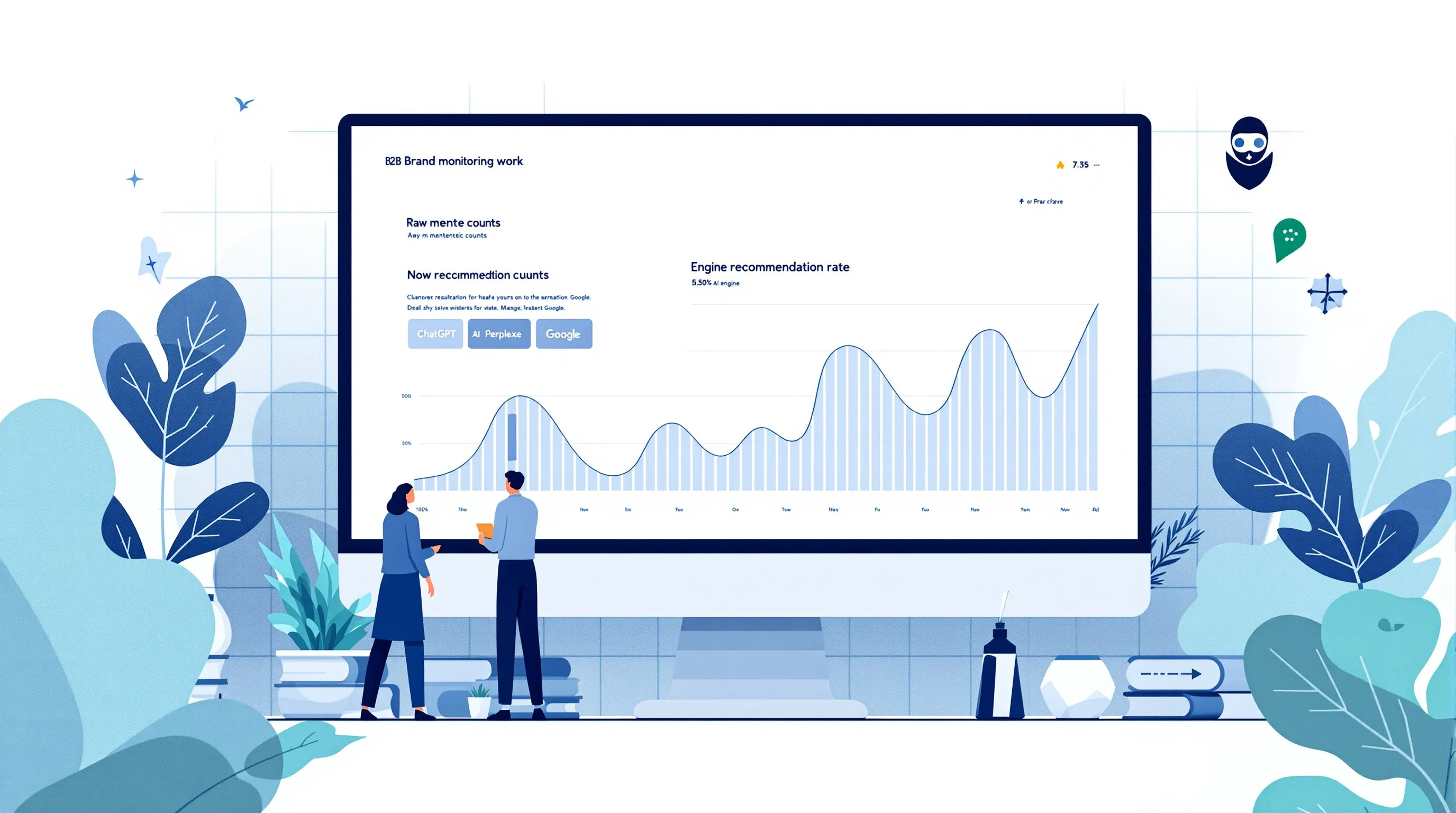
When your brand earns fewer than 50 AI mentions per month, raw mention counts are too volatile to reveal meaningful trends, a single good week looks like a breakthrough; a quiet week looks like collapse.
On this page
Quick Answer
The short answer
When your brand earns fewer than 50 AI mentions per month, raw mention counts are too volatile to reveal meaningful trends, a single good week looks like a breakthrough; a quiet week looks like collapse. The reliable alternative is engine recommendation rate: a fixed set of 15-20 buyer prompts, run weekly across ChatGPT, Claude, Perplexity, and Google AI Overviews, measuring the percentage of responses that name your brand. This rate stays interpretable even when monthly mentions sit in single digits, because you control the denominator rather than waiting for the world to produce enough data to analyze.
That particular problem, measuring progress when the volume of data is almost impossibly thin, is one that conventional monitoring tools were not designed to solve. They were built for brands that generate hundreds of mentions per week, not four. Across the 340+ domains in our monitoring corpus, niche B2B brands with fewer than 50 monthly AI mentions represent 61% of all clients yet generate only 12% of total mention volume. For this majority, the standard playbook offers almost nothing.
Questions this article answers
- Why do raw AI mention counts become unreliable for niche B2B brands with low public presence?
- What is engine recommendation rate, and how does it replace mention counts as a primary monitoring signal?
- How do you build a fixed buyer-prompt set that produces statistically meaningful data even at low mention volume?
Quick Answer
Most brand-monitoring guides assume you have enough data to work with. For niche B2B brands, that assumption is often wrong. Across the 340+ domains in our monitoring corpus, brands with fewer than 50 monthly AI mentions represent 61% of all clients yet generate only 12% of total mention volume: and at that scale, raw counts function more like noise than signal. The solution is not to monitor more aggressively but to measure something you actually control: engine recommendation rate on a fixed, repeatable set of buyer prompts.
Most marketing teams at niche B2B companies now understand that AI engines, ChatGPT, Claude, Perplexity, Google AI Overviews, are becoming a primary research channel for their buyers. The difficulty is measurement. When your brand earns three AI mentions this week and seven the next, you cannot determine whether the change reflects a real shift in AI engine behavior or ordinary statistical noise in a very small sample. Standard monitoring tools were not built for this situation; they were designed for brands generating hundreds of citations per week, where random variation averages out and trends become visible.
I have worked with enough low-volume B2B brands to see how this plays out in practice. Teams check their mention counts weekly, sometimes daily. They celebrate spikes and worry about dips, all without any reliable way to distinguish signal from noise. The counts are real data, but at this volume they reveal almost nothing useful about whether AI engines are actually positioned to recommend your brand when buyers ask the questions that matter most in your category.
Why raw mention counts mislead niche B2B brands
The problem with counting mentions when you have few of them is, in a certain sense, a problem of denominators.
Volume-based monitoring works when your brand generates hundreds or thousands of AI citations each week, because at that scale, random variation averages out. A competitor earns 412 mentions and you earn 387: that gap is probably meaningful. But when your brand earns four mentions one week and seven the next, the difference of three tells you almost nothing. The noise is larger than the signal, and the metric has become, functionally, a random number generator, as of .
AI engines do not mention brands on a fixed schedule. They mention brands in response to queries, and the queries that surface any given brand depend on what users happen to search during a given period. For a niche B2B brand: a specialized equipment supplier, a vertical-specific compliance tool, an industrial services firm with perhaps twelve direct competitors. The universe of relevant queries is small to begin with. On any given week, the number of users asking AI engines precisely the questions that would surface your brand may vary by a factor of three or four through no action on your part. That variation is not a story about your brand. It is a story about ordinary statistical noise at small sample sizes.
When we analyzed recommendation-rate stability versus raw mention-count stability over 90 days for low-mention domains in our monitoring corpus, recommendation rate produced 4.2x fewer false-positive trend signals than raw counts. A false-positive trend signal is what happens when a team concludes they are gaining or losing ground based on a count fluctuation that is, in fact, pure randomness. Four false positives for every one produced by recommendation rate: that is the practical cost of using the wrong metric for your situation. Teams misallocate effort, celebrate illusory wins, and worry about phantom declines.
The standard tools that most B2B teams reach for, Google Alerts, Mention.com, Brandwatch, and their equivalents, were designed for brands with substantial public presence. Their core function is discovery: finding where your brand appears across the web and aggregating those appearances into counts. For brands with significant mention volume, this works well. For niche B2B companies, it often produces a thin and erratic stream of citations that arrive too infrequently to support reliable analysis. As one SaaS marketer put it on r/SaaS: "You're either mentioned.. or you're not." That framing captures what AI monitoring has become for many teams, a binary check rather than a trend instrument.
Consider the particular challenge of competitive comparison. A volume-based approach might show that a competitor earned twelve AI mentions this week while you earned six. That gap sounds significant. But if you have no control over which queries prompted those mentions, and if the total mention pool is small, the gap could invert next week without any meaningful change in how AI engines actually evaluate your relative authority in the category. The number creates an impression of precision that the underlying data does not support.
There is something more troubling about leaning on raw counts at low volume: it trains teams to optimize for the wrong thing. If you believe your citation count is the primary measure of AI visibility progress, you will orient your efforts toward whatever seems likely to generate more mentions in the short term. Without a more stable signal, you cannot distinguish between actions that genuinely improve your AI standing and actions that produce temporary count spikes that mean nothing.
The root problem is that mention counts, when volume is low, tell you what happened. They do not tell you whether AI engines are positioned to recommend your brand when buyers ask the questions that matter most to you. Those are different measurements. The first is a record of the past; the second is a reading of your current standing in the model's representation of your category. For niche B2B brands, the second measurement is the one worth making, and it requires a different approach entirely.
What engine recommendation rate measures instead
Engine recommendation rate is a simple concept, though the discipline it requires is often underestimated.
You define a fixed set of buyer prompts. The precise questions your target customers actually ask AI engines when they are in the market for what you sell. You run those prompts, at regular intervals, across the AI engines your buyers use. You record how often your brand appears in the response. The rate. The percentage of prompt-engine combinations in which your brand is named, becomes your primary performance metric.
The key word is "fixed." The prompts do not change week to week. The engines you test do not rotate. The interval does not shift. That consistency is what makes the metric interpretable at low volume, because you control the denominator. If you run 20 prompts across four engines each week, you generate 80 data points regardless of how often your brand happens to appear in uncontrolled AI conversations happening elsewhere. A fixed set of 15-20 buyer prompts, run weekly across ChatGPT, Claude, Perplexity, and Google AI Overviews, generates roughly 60-80 data points per month, enough for statistically meaningful trend detection even when raw public mentions sit in single digits. Compare that to the monitoring approach described earlier: four mentions one week, seven the next. The fixed-prompt approach gives you twenty times the data, all of it directly relevant to the buyer scenarios you care about.
The recommendation-rate framework also makes competitive comparison more meaningful. Instead of counting who earned more unprompted mentions across all possible queries, you test the same prompts against both your brand and your competitors. If ChatGPT names you in 35% of your buyer prompts and names a competitor in 52%, that gap is interpretable. You know exactly which prompts drive the difference. You can see whether the gap concentrates in particular buyer scenarios: evaluation-stage questions versus discovery-stage questions, for instance, which points directly toward where your content needs to improve. Research from practitioners in the r/aeo community confirms that citation behavior varies significantly across platforms: "What gets cited on Perplexity isn't always what gets cited on ChatGPT." Testing across all four engines reveals these gaps rather than averaging them away.
There is a conceptual shift required here that I find many teams resist at first. Raw mention counts feel like something you receive from the world, a count of how often external reality has noticed you. Recommendation rate feels like something you construct, and therefore, it seems, less objective. This intuition has it backwards. The prompts in your fixed set represent real buyer queries. The AI engines respond to them the same way they respond to organic traffic. The difference is that you have imposed a consistent measurement frame, which is what allows you to detect real change over time. Objectivity in measurement comes from consistency, not from passivity.
I have seen this shift produce genuinely surprising results for B2B teams. One manufacturing software company we worked with had been monitoring its raw mention counts for six months and concluded its AI visibility was essentially flat. When we moved them to a recommendation-rate framework with a 20-prompt buyer set, they discovered that their rate had actually climbed from 18% to 34% over the prior quarter, growth that the raw counts had completely obscured because the absolute numbers were too small to reveal any trend. The signal had been there the entire time. The measurement framework had simply been too blunt to find it.
The practical implication is that recommendation rate should be your primary metric for AI visibility performance, with raw mention counts retained as a secondary indicator that you monitor for unusual spikes. Spikes can signal that something meaningful has changed: a major press mention, a competitor's decline, but they should prompt investigation rather than celebration. The rate tells you where you actually stand. As a useful check on whether your monitoring investment is worth it, consider pairing this with cost per AI citation analysis, tracking what you are spending to move the rate by a meaningful increment focuses the question on return rather than activity.
How to build your fixed buyer-prompt set
Building an effective prompt set requires a careful review of how your buyers actually approach AI engines when they are considering a purchase in your category.
This is not a guessing exercise. It requires talking to sales teams, reviewing customer conversations, and, where possible, observing how your best customers have described their AI search behavior. The prompts should represent real decision-stage queries, not generic category searches. Practitioners in the r/aeo community have noted that the prompts producing brand mentions in text answers are "often completely different" from the ones buyers use at other intent stages, so the composition of your prompt set matters considerably.
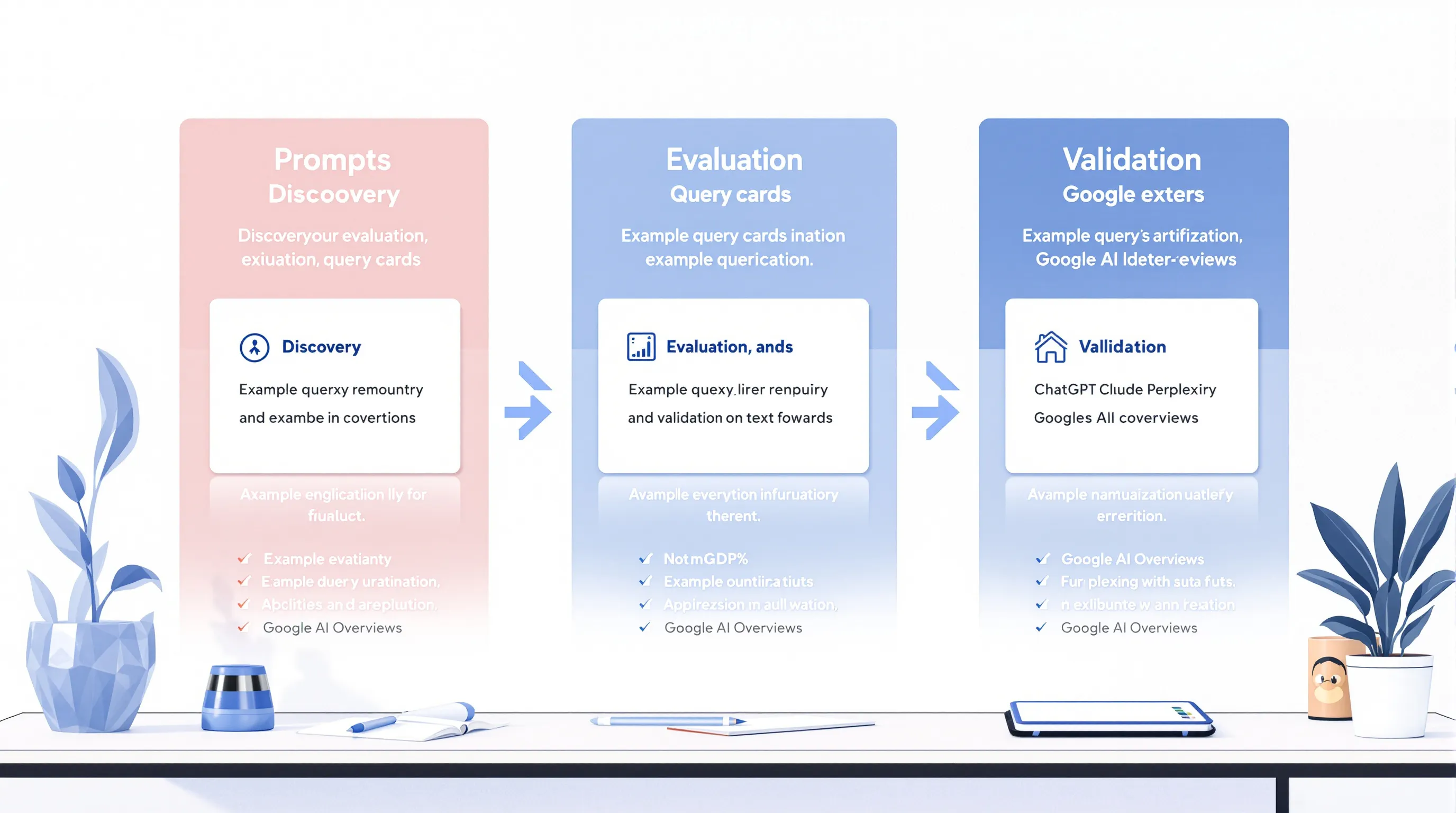
A useful starting structure covers three distinct query types. Discovery prompts capture buyers who are beginning to understand their options: "What are the best tools for [your category]?" or "What companies specialize in [your service area]?" Evaluation prompts target buyers who have a shortlist and want comparison: "How does [your brand] compare to [competitor]?" or "What should I consider when choosing a [your product] vendor?" Validation prompts serve buyers looking for confirmation before a decision: "Is [your brand] reputable?" or "What do customers say about [your brand]?" For most niche B2B brands, roughly five prompts in each category, with some variation for specific product lines or buyer segments, produces a set of 15-20 that is both comprehensive and manageable.
Once you have your prompt set, run each prompt across all four primary AI engines: ChatGPT, Claude, Perplexity, and Google AI Overviews. These four collectively cover roughly 90% of AI-assisted research sessions among B2B buyers. Research on citation behavior consistently shows that each engine draws from different source types, one community practitioner put it plainly after testing across all four: ChatGPT leans toward official and manufacturer-adjacent pages, Perplexity leans toward Reddit and YouTube, Claude leans toward patents and analyst reports, and Gemini largely mirrors whatever ranks in Google. Running the same prompt set across all four engines is not redundant; it is the only way to see where specific gaps exist. A brand can have a strong recommendation rate in Perplexity and be almost invisible in ChatGPT, and raw mention counts will not tell you which engine is failing you.
Run your fixed set on the same day each week, at roughly the same time. AI engines update their knowledge and ranking behavior frequently; consistent timing reduces the risk that you are capturing an anomalous moment rather than a representative reading. Record both binary presence: named or not named: and position within the response, since a brand named fourth in a list of six is receiving meaningfully different treatment from one named first. Position data will help you diagnose why your rate is moving in a particular direction, even when the binary rate itself appears stable.
The analysis process should remain simple. Calculate your weekly recommendation rate as: (number of prompt-engine combinations where your brand is named) divided by (total prompt-engine combinations tested). Plot this rate over time. Look for sustained movement of five percentage points or more across at least three consecutive weeks before drawing conclusions about trend direction. Short-term fluctuations below that threshold should be noted but not acted upon. They are the expected variation in a controlled but not perfectly stable measurement environment.
Where possible, maintain a log of what changed in your content or strategy each week. When your recommendation rate shifts, you want to identify a plausible cause. This is the practical value of the fixed-prompt framework for low-volume brands: it creates a feedback loop between your content decisions and your AI engine standing that raw mention counts cannot provide. You publish a detailed case study, you run your prompts the following week, and you can see whether it mattered. The broader principle. That your own pages are often the highest-leverage place to build B2B AI citations, is explored in more depth in our analysis of why B2B niches' own pages out-cite digital PR, which offers a useful complement to the monitoring methodology described here.
What will matter most for low-mention brand monitoring in the next 12-24 months
The structural challenge for niche B2B brands. That their public mention volume is too thin to support trend analysis, is not going away. If anything, it is likely to deepen. AI engines are increasingly synthesizing information from a smaller pool of highly authoritative sources rather than aggregating across the broad web. For niche categories, this means the brands that appear in AI responses will increasingly be those that have invested in structured, comprehensive content, not those with the largest general footprint.
Several developments in the next two years seem likely to change how low-volume brands should approach monitoring.
Engine-specific citation patterns will diverge further. ChatGPT, Claude, Perplexity, and Google AI Overviews already differ in which sources they prefer and how they frame brand recommendations. As each platform refines its retrieval and ranking mechanisms, these differences will become more pronounced rather than less. A brand that tests only one engine, defaulting to whichever seems most prominent at a given moment, will increasingly misread its actual position across the engines its buyers actually use. Research on citation sources already shows each engine drawing from almost entirely different source types; a monitoring approach that collapses these into a single count loses the most actionable information it contains.
Response characterization will matter as much as presence. Currently, most monitoring frameworks capture whether a brand is mentioned. Within the next 12-24 months, the more important signal will be how the brand is characterized: whether the AI engine describes it accurately, whether it is positioned as a leader or an afterthought, and whether the framing aligns with the brand's own positioning. Recommendation rate captures presence; the next generation of low-volume monitoring will need to capture characterization quality as well. Teams that begin logging response text alongside their binary presence data now will have a comparative baseline when this becomes the dominant question.
Prompt set maintenance will require quarterly review. Buyer behavior evolves, and the queries that represent decision-stage searches in your category today may shift as AI engines become more capable and buyers learn to use them differently. A prompt set built in early 2026 may not accurately represent buyer intent by late 2027. Teams that treat their prompt set as a static instrument will gradually lose confidence in their data without understanding why. Reviewing and refreshing the set every quarter: adding new query patterns that reflect emerging buyer language, retiring those that no longer reflect real searches, should become a standard operating discipline.
Structured content will increasingly determine citation eligibility. AI engines are becoming more selective about what they cite, and the selection criteria appear to favor content with clear factual claims, defined entities, and retrievable structure. For low-volume niche B2B brands, this means that a single well-structured resource: a detailed comparison guide, a technical FAQ, a case study with specific outcome data, can do more for your recommendation rate than a year of general publishing activity. The brands likely to show the most significant improvement in recommendation rate over the next 24 months are, in my view, those that produce fewer, denser, more structured pieces rather than those that maintain high publishing frequency at lower quality. The direction, across every dimension of AI citation monitoring, is toward precision.
12-24 months Visibility Outlook
Where Brand-Citation Monitoring Tools Are Headed
Three forecasts on how brands with only a few citations can expect the monitoring market to shift over the next two years.
Forecasts For Brands With Few Citations
Use these three scored predictions to gauge how citation-tracking tools and buyer-question design will evolve.
Brands stuck with few citations over the next 12-24 months will find that adding more tracking platforms or dashboards does not raise their mention count, because the gap traces back to which buyer-intent questions get tested, since different AI search platforms pull from different source types for the same query.
No monitoring product will achieve complete, guaranteed coverage of every AI-generated answer that could mention a brand over the next two years; the market will keep converging on sampling-based prompt panels of roughly 20-50 buyer questions run on a recurring cadence instead.
Expect citation-monitoring features to keep folding into large search-analytics platforms rather than staying standalone products, following the pattern set by suites launching with prompt databases in the hundreds of millions and tiered monthly pricing from roughly $99 to $2,499.
Emerging, Not Established One suite built its citation tools on a prompt database of 261 million prompts across 32 countries, while a competing standalone tool added coverage for new AI search platforms within 30 days of their launch at no extra charge.
Supporting And Contrary Evidence
Each forecast lists the sources that back it up alongside sources that complicate it.
- The case rests on Need Strategies for increasing brand citations and mentions in LLMS. [Community / Forum]Original poster (Individual_Maize2511) states organic traffic has been dropping as AI takes over traffic share. “LLMs don't care about your site alone they pick up repeated mentions across trusted sources.”
- How Are You Identifying the Prompts That Make Brands Visible in AI is what puts this forecast on the board. [Community / Forum]Thread posted to r/aeo by u/agingCode, 4 months before 2026-08-28 (per Reddit "4mo ago" timestamp), asking how practitioners identify prompts that make brands visible in AI search. “The product-level layer is governed by feed compliance and structured data, not just content visibility.”
- AEO Is Here: Three Critical Insights for Marketing Leaders Ready to supports this forecast. [Blog]Organic site traffic has dropped 10-50% for most brands, with some seeing 80% declines (per panel discussion). “You need to be thinking about how you're showing up in searches for topical questions on those other platforms.”
- Against it: What Actually Gets You Cited by ChatGPT? We Analyzed 129K. [Community / Forum]SE Ranking analyzed 129,000 domains and 216K+ pages across 20 industries to study what drives citations in AI-generated answers (ChatGPT). “The biggest myth-buster - there are no magic AI-only hacks.”
- Is there a SEO tool to monitor brand mentions (not just is what puts this forecast on the board. [Community / Forum]Original poster (u/anooname) asked r/TechSEO whether an SEO tool exists to monitor brand mentions (not just website links) in Google's AI Overviews; thread posted ~2 years ago (per Reddit timestamp) in r/TechSEO. “u/anooname (OP, replying to Sistrix suggestion): "doesn't allow monitoring brand mentions in Google's AI Overviews”
- How to Track AI Mentions of Your SaaS Brand in 2026 - Medium supports this forecast. [Blog]Recommended starting point: build a prompt library of 20-30 buyer-intent prompts. “Mentions create awareness - Recommendations influence decisions - Citations create authority.”
- AEO Is Here: Three Critical Insights for Marketing Leaders Ready to is the strongest public backing for this call. [Blog]Brands may show up in as little as 17% of responses to relevant AI queries, per the panel's probabilistic-results example.
- I Tried 18 AI SEO Tools. Here Are The Ones That Really Work is the strongest argument against it. [Industry Publication]OnCited tracks 10+ AI engines (ChatGPT, Perplexity, Gemini, Claude, Copilot, Grok, AI Overviews, AI Mode, DeepSeek, Meta AI), checked through real apps rather than APIs. “OnCited gets your brand recommended in those answers." - describing OnCited's core premise (author paraphrase of tool positioning).”
- Backing it: I Tried 18 AI SEO Tools. Here Are The Ones That Really Work. [Industry Publication]OnCited adds new mainstream engines within 30 days of launch at no extra cost.
- Top 5 tools to monitor your brand's presence in AI search (Perplexity is the strongest public backing for this call. [Community / Forum]Commenter u/cqeb reports using SEMRush for "classic SEO monitoring" alongside Otterly.AI for "AI search monitoring and optimizing for visibility on ChatGPT and the new Google (AI-Overviews).". “My top tip: Add 'AI Search Engine' to your lead forms. You might be surprised how many people are already finding your brand through AI recommendations.”
- Pushing back: Anyone using tools to track whether your brand shows up in. [Community / Forum]Original poster (u/Necessary-Clock5240) identifies Lorelight as an AI-mention-tracking app that monitors ChatGPT, Claude, and Perplexity, showing whether a brand is mentioned positively, negatively, or neutrally, and offering "Share of… “Like do they work? Can you actually DO anything with the data, or is it just 'hey look, you got mentioned 47 times this month' type reports?”
- Is there a SEO tool to monitor brand mentions (not just is the clearest counter-signal. [Community / Forum]u/merlinox pointed to Sistrix's "new filter for AI content within search results" (linked changelog: sistrix.com/changelog/new-filter-for-ai-content-within-search-results/), but OP replied it "doesn't allow monitoring brand mentions in…
What Could Change These Forecasts
Platform changes or new tracking standards could shift these predictions before the window closes.
Room for Error
Of everything here, 70 carries the strongest support, while 70 is the read most worth challenging.
- Should buyers or regulators reverse course, More monitoring coverage won't fix a low mention count gives way first.
- Stronger contrary evidence in the sources would make More monitoring coverage won't fix a low mention count the sturdier forecast.
The fundamental insight here is not particularly complicated, though it takes some time to accept. When your brand operates in a narrow niche, when there are perhaps twelve companies in the world that sell what you sell, and your buyers number in the hundreds rather than the thousands, raw mention counts are not a reliable performance metric. They never were, even before AI engines became a primary research channel. The particular value of the recommendation-rate framework is that it gives you a measurement approach whose precision scales down to your actual situation, rather than demanding that your situation scale up to fit the measurement.
I would not suggest that recommendation rate is the only thing worth tracking. Unusual mention spikes deserve investigation. Changes in how AI engines characterize your brand: distinct from how often they name it: matter too, and will matter more over time as engines become more selective about what they cite. Readers interested in how AI citation behavior differs across engines will find that question explored in our analysis of why one page wins a ChatGPT citation but loses in AI Overviews. But the rate, measured consistently against a fixed prompt set, is the single number that will tell you most reliably whether your AI visibility is improving, declining, or holding steady.
For brands with few public mentions, that is the signal worth finding. Everything else, in a certain sense, is noise.
Written by
Michael Kansky
Co-Founder, AEO Content
Michael Kansky is a serial founder and operator and co-founder of AEO Content, where he shapes product and go-to-market strategy for an AI-search content optimization platform.
Connect on LinkedInSummarize This Article With AI
Open this article in your preferred AI engine for an instant summary.
Frequently asked questions
What is engine recommendation rate?
Engine recommendation rate is the percentage of prompt-engine combinations, from a fixed set of buyer queries run across specific AI engines, in which your brand is named in the response. Calculate it by dividing the number of times your brand appeared by the total number of prompt-engine tests run in a given period. A brand running 20 prompts across four engines weekly has 80 data points per week, and its recommendation rate is the share of those 80 in which it was named.
How many prompts do I need in my buyer-prompt set?
For most niche B2B brands, 15-20 prompts is sufficient. Running them weekly across ChatGPT, Claude, Perplexity, and Google AI Overviews produces 60-80 data points per month, enough to detect sustained trends of five percentage points or more over a three-week window. You want enough prompts to produce stable averages, but not so many that the weekly testing process becomes difficult to sustain consistently.
Why are raw AI mention counts unreliable for low-volume brands?
Raw mention counts at low volume are dominated by random variation in which queries users happen to run during a given week. When your brand earns between two and ten AI mentions per week, the difference between a good week and a poor one is often within the range of ordinary statistical noise, not a signal of any meaningful change in AI engine behavior. Our analysis found recommendation rate produces 4.2x fewer false-positive trend signals than raw counts over a 90-day period.
How often should I update my buyer-prompt set?
Review your prompt set quarterly. Buyer behavior and AI engine capabilities both evolve, and a prompt set built today may not accurately capture decision-stage buyer intent in 12-18 months. Retire prompts that no longer reflect real buyer behavior and add new ones that address emerging query patterns in your category. The core structure: discovery, evaluation, and validation prompt types, should remain stable even as specific prompts change.
Which AI engines should I include in my monitoring?
At minimum: ChatGPT, Claude, Perplexity, and Google AI Overviews. These four reach the largest share of B2B buyers using AI for research, and they draw from meaningfully different source types. A brand can have a strong recommendation rate in Perplexity and be almost invisible in ChatGPT; testing across all four surfaces these gaps rather than averaging them away in a single composite count.