
The AEO audit step that misses your images
The AEO audit step that most checklists skip is the Image Context for AI criterion: a structured evaluation of whether each image's alt text, caption, surrounding prose, and structured data give AI crawlers enough information to understand and cite what the image shows.

On this page
Most AEO content audits evaluate text signals: schema, headings, fact density, FAQ markup, and stop there. But Image Context for AI is the single lowest-scoring criterion across every site in our audit corpus, averaging 2.3 out of 10. And 94% of audited sites score below 5. This guide covers exactly what the image context audit step checks, why text-only audits miss it, and how to run it yourself.
Questions this article answers
- Why do AEO content audits miss images?
- What is the Image Context for AI criterion and how is it scored?
- How do you audit image context on your own pages?
Quick Answer
The short answer
The AEO audit step that most checklists skip is the Image Context for AI criterion: a structured evaluation of whether each image's alt text, caption, surrounding prose, and structured data give AI crawlers enough information to understand and cite what the image shows. Across all sites in the AEO Content audit corpus, this criterion averages 2.3 out of 10, the lowest of any criterion tracked. The fix does not require new content. It requires annotating the images you already have so that GPTBot, ClaudeBot, PerplexityBot, and Google's crawlers can read what those images represent.
After auditing hundreds of sites against 17 AEO criteria, the gap that surprises clients most is not the one they neglected. It is the one their audit tool never told them existed. Image Context for AI averages 2.3 out of 10 across our entire corpus, ranking dead last among every criterion we track. 94% of sites score below 5. And 87% of pages that pass Q&A Format, FAQ Schema, and Fact Density still fail it. The standard AEO audit covers the text. It misses the images. This guide explains why that gap exists, what it costs you in AI citations, and how to close it in a single audit pass.
What does an AEO content audit actually check?
The AEO content audit is a structured review of the signals AI engines use when deciding what to cite. After building AEO Content's audit framework across hundreds of sites, I can tell you what those signals are: and, more importantly, which ones practitioners routinely ignore.
The criteria that most audit checklists cover well are the text-based ones. Q&A Format, whether your H2 headings are written as questions AI engines can match to user queries. FAQ Schema, whether those questions carry FAQPage JSON-LD. Fact Density, whether your prose contains specific numbers AI engines can extract and relay. Table Extractability, whether comparison data sits in properly formatted HTML tables with <th> header cells. Entity Authority: whether you reference named organizations, standards, and products that establish topical depth, as of .
These criteria matter. The industry has developed solid tools and solid habits for checking them. Ahrefs flags thin content. Screaming Frog crawls alt text for empty strings, though only from an accessibility compliance standpoint. Standard AEO checklists cover Q&A Format, FAQPage markup, structured data validation.
What none of these tools do is evaluate whether your images are legible to an AI engine trying to understand and cite your page. That is the Image Context for AI criterion, and it is almost never in the audit checklist. The gap persists because AEO as a discipline emerged from SEO, where image optimization meant compression, file size, and alt text as an accessibility requirement. The idea that a crawler reads your images as part of an AI citation decision is new territory. Most audit workflows have not caught up. What follows is the audit step that catches what everything else misses.
Why is image context the most overlooked criterion in AEO audits?
Most practitioners running an AEO audit today were trained on SEO. And in that world, image optimization had three concerns: page load speed, alt text for screen readers, and filenames for Google Image Search. That is a complete picture, for SEO. For AI citation, the picture is different, and the blind spots are significant.
AI engines do not just index keywords. They build semantic models of page content. When ChatGPT or Perplexity crawls a page to decide whether it is cite-worthy, the crawler reads everything that carries meaning: headings, prose, structured data, and the contextual signals surrounding each image. An image with a generic alt attribute, no caption, and no explanatory paragraph nearby is essentially invisible to the AI's understanding of the page.
The reason image context scores so low in our audit corpus, averaging 2.3 out of 10 across all sites we have audited, is not negligence. It is a structural blind spot. The audit tradition does not include it. The standard tools do not flag it. And the criterion is not intuitive: most content teams believe they have covered images because they compressed the WebP files and added a short alt text for accessibility. That is not enough.
I have seen pages with strong Q&A Format scores, solid FAQ schema, and well-structured tables that still underperform in AI citations because every chart, diagram, and infographic on the page is annotated with text like "Figure 1" or "Chart showing data." The AI cannot use that. It has nothing to cite. The oversight is systemic, and fixing it requires adding one deliberate step to the audit process.
How do AI engines read and use image context?
Understanding what AI engines actually do with your images changes how you audit them. The crawlers used by OpenAI (GPTBot), Google (various indexing bots), Anthropic (ClaudeBot), and Perplexity (PerplexityBot) all operate on the same fundamental principle: they parse page content as text, and they use every text signal associated with an image to build a semantic understanding of what that image represents.
There are four primary signals those crawlers read:
- The alt attribute on the
<img>element. This is the most direct text description of the image. An empty alt attribute is a blank space in the crawler's semantic model of your page. - The caption text. If you wrap an image in a
<figure>element with a<figcaption>, that caption text is closely associated with the image in the parse tree. A descriptive caption that explains what the image shows and why it matters is a citation signal. - The surrounding paragraph text. Crawlers build associations between an image and the prose that immediately precedes and follows it. A data visualization embedded in a paragraph that explains the data is far more legible to an AI engine than the same chart dropped between two unrelated sections.
- ImageObject structured data. Schema.org's
ImageObjecttype lets you declare a name, description, and content URL for each image in JSON-LD. Very few sites use this. Among the sites in our audit corpus, fewer than 8% have properly implemented ImageObject schema on any image.
When all four signals are present and consistent, an AI engine can attribute what an image shows, connect it to the surrounding argument, and, if the content is cite-worthy, reference it explicitly in a generated answer. When they are absent, the image is noise. As one lens on this: "Google ranks pages; AI engines select answers. These are two different systems running on two different signal sets." Image context is part of the second system, and most audits only check the first.
ImageObject schema: the code most sites skip
This is the JSON-LD pattern for declaring image context in structured data. Add it to the <head> of any page where you want AI crawlers to attribute your images correctly:
{
 "@context": "https://schema.org",
 "@type": "ImageObject",
 "name": "AEO audit Image Context criterion scores by sector",
 "description": "Bar chart showing average Image Context for AI scores across 400 audited pages, grouped by industry sector. Healthcare averages 1.8/10; SaaS averages 2.6/10; Professional Services averages 2.1/10.",
 "contentUrl": "https://yourdomain.com/images/aeo-image-context-scores-by-sector.png",
 "encodingFormat": "image/png",
 "width": 1200,
 "height": 630
}
The description field is what AI engines use. Make it informational, not decorative: describe what the image shows and what the data means, not just what the image looks like.
What does the Image Context for AI criterion actually measure?
Image Context for AI is the criterion in AEO Content's audit framework that evaluates how legible your images are to AI crawlers. It measures whether each significant image on a page carries the surrounding context an AI engine needs to understand, reference, and potentially cite the content that image represents.
A score of 10 out of 10 requires all of the following: a descriptive alt attribute that conveys the image's informational content rather than just its visual appearance; a caption or adjacent paragraph that explains what the image shows in the context of the page's argument; and at minimum the absence of signals that confuse the crawler, such as generic placeholder alt text or images embedded with no surrounding prose.
A higher-tier score, one that puts a page in strong contention for AI citation, also includes ImageObject structured data and a file name that reflects the image's subject. For example: aeo-audit-image-context-criterion-scores.png rather than IMG_4822.png.
A score of 2 out of 10, which is roughly where the average audited site lands, means the page has at most one or two of these elements. Often it means images have accessibility-only alt text, "decorative image," "graph," "chart": no captions, and no structured data.
The criterion's weight in the overall AEO Rank calculation reflects its importance. When it scores at 2.3 out of 10, the drag on overall performance is not marginal. It is substantial. And it is fixable in ways that other low-scoring criteria, original data for instance, are not always fixable in an afternoon. The images already exist. The work is annotation. That is what makes this the highest-leverage gap in most AEO audits.
What five image attributes do AI engines evaluate?
After running the Image Context for AI criterion across hundreds of sites, I have identified five attributes that separate pages AI engines cite from pages they do not, when it comes to image signals.
1. Alt text that describes content, not decoration. The alt attribute should convey what the image communicates, not just what it depicts visually. "A bar chart" describes what it looks like. "Bar chart showing Q1-Q3 2025 AEO citation rates by content type, with how-to guides averaging 34% higher citation frequency than listicles" is what an AI crawler can use. The distinction between describing form and conveying meaning is the entire gap.
2. A caption that extends the image's argument. The <figcaption> element should add context the image cannot convey on its own: the data source, the key takeaway, what the viewer should notice. Captions that simply repeat the alt text waste the signal. Captions that add interpretation multiply it.
3. A surrounding paragraph that frames the image. The prose immediately above or below an image should reference it explicitly and explain its relevance to the surrounding section. "The chart below illustrates.." is enough to establish the association. The absence of any reference leaves the image semantically orphaned.
4. A descriptive file name. File names contribute to the overall contextual signal. A file named aeo-image-context-criterion-scores-by-sector.png tells the crawler something. screenshot-23.png tells it nothing.
5. ImageObject structured data. JSON-LD with "@type": "ImageObject" and a description property is the most explicit signal you can send. It is also the rarest, present in fewer than 8% of sites in our corpus on any page. It is the fastest single move from a passing score to a strong one.
How do you run an image context audit on your own pages?
Auditing image context is a six-step process. It requires a browser, a page source editor, and roughly thirty minutes per page if you go methodically.
Step 1: Pull a complete list of images. Use your browser's developer tools or a crawler like Screaming Frog to export every <img> element on the page. You need the src, the alt attribute value (or its absence), and the surrounding HTML context. Empty alt attributes and file names in camera-roll format (IMG_, DSC_, screenshot-) flag immediately.
Step 2: Check each alt attribute for informational content. Flag any that are empty, that contain only the file name, or that describe the image decoratively without conveying informational content. "Chart" is decorative. "Chart showing average Image Context for AI scores across 400 audited pages, grouped by industry sector" is informational. The bar is: could an AI engine use this text to answer a question about your content?
Step 3: Check for captions. Identify which images are wrapped in <figure> and <figcaption> elements. Images without captions are not automatically failing, a strong surrounding paragraph can compensate, but captions are the most efficient way to add context at scale.
Step 4: Check surrounding prose. For each image without a caption, look at the paragraph immediately before and after it. Does either paragraph reference the image? Does it explain what the image shows or why it matters? If neither paragraph mentions the image, flag it as an orphan.
Step 5: Check file names. Flag any images with camera roll strings, generic terms (image, photo, graphic), or meaningless sequences.
Step 6: Check for ImageObject schema. Open the page source and search for "@type": "ImageObject". Most pages return zero results. That is the most common single finding in an image context audit.
What are the most common image context failures?
Five failure patterns account for most of the low Image Context scores I see across audited sites. Each is fixable. None requires new content.
Empty or missing alt text. This remains the most common single failure. Pages built in CMS platforms where image upload does not require an alt attribute, pages migrated from legacy systems without an alt text pass, pages where the development team treated alt text as optional, all share this failure. An empty alt attribute is not just an accessibility gap. It is a zero signal to every AI crawler that reads the page. The accessibility community has long understood this: as one accessibility practitioner put it, "Alternative text isn't for reciting objects, it's for translating meaning." AI engines have reached the same conclusion.
Alt text that names rather than describes. "AEO audit dashboard" tells the crawler a name. "AEO audit dashboard showing Image Context for AI scoring at 2.3 out of 10 across 400 audited sites, ranked last among 17 criteria tracked" tells it something a user might want to know. The difference in citation potential is significant. The bar for AI-legible alt text is higher than the bar for accessibility compliance.
Orphaned data visualizations. Charts, graphs, and infographics embedded without explanatory captions or surrounding prose are the highest-value failures to fix. A well-annotated data visualization that an AI engine can understand and attribute is one of the most cite-able elements a page can contain. The same visualization with a generic alt attribute and no surrounding context contributes nothing.
Decorative labels applied to informational images. Stock photography labeled decorative is appropriate. The failure is applying empty alt text to images that carry informational content: diagrams, screenshots, process illustrations.
Camera-roll file names. 2024-09-14-image-1.jpg or wp-content/uploads/2025/08/image-3456.jpg tells the crawler nothing. A missed signal, consistent across the site.
Before and after: rewriting alt text for AI citation
Before
Before (accessibility-only)
<img src="audit-results.png" alt="Chart">What AI sees: A chart exists on this page. No information about what it shows, what the data means, or how it connects to the surrounding content. Citation potential: zero.
After
After (AI-legible)
<figure>
  <img
    src="aeo-image-context-criterion-scores-by-industry.png"
    alt="Bar chart showing average Image Context for AI scores across
         400 audited pages by industry: Healthcare 1.8/10, Professional
         Services 2.1/10, SaaS 2.6/10, eCommerce 2.9/10. All sectors
         score below 3, indicating a systemic gap across all industries."
  >
  <figcaption>Average Image Context for AI scores by industry sector,
  AEO Content audit corpus. No sector averages above 3 out of 10.
  </figcaption>
</figure>
What AI sees: A specific, attributable data claim with industry breakdowns, a source (AEO Content audit corpus), and a clear takeaway. Every AI engine can extract this and cite it.
What does a passing image context score require?
A passing score, meaning a score of 7 or above on the Image Context for AI criterion, requires four conditions to hold simultaneously across the page.
Condition one: every informational image has a descriptive alt attribute. Not every image on the page, decorative images used purely for visual design may carry empty alt attributes without penalty. But every chart, diagram, screenshot, photograph of a product or process, and infographic must carry alt text that an AI engine could use to understand what the image shows. The test is not "does alt text exist" but "does this alt text convey meaning."
Condition two: at least 60% of informational images have either a <figcaption> or a referencing paragraph within two content blocks. The surrounding text is the bridge between the image and the page's semantic model. Without it, even a strong alt attribute is an isolated signal.
Condition three: descriptive file names for the majority of informational images. Passing does not require perfection, a few legacy filenames on an otherwise well-annotated page will not crater the score. But a consistent pattern of opaque file names signals a systemic gap the audit records.
Condition four: no keyword-stuffed alt text. Over-optimization, alt attributes that repeat the target keyword four or five times in sequence, is treated by AI crawlers similarly to how search engines treat hidden keyword stuffing. It is an active negative signal, not a neutral one.
ImageObject schema is not required for a passing score, but its presence is the single fastest move from a passing score into the 9-10 range. Sites that implement it consistently on key pages put meaningful distance between themselves and the 94% of sites that have not.
"87% of pages that pass text-structure AEO criteria, Q&A Format, FAQ Schema, Fact Density, still fail the Image Context for AI criterion. The audit that covered the text missed the images."
- Michael Kansky, Co-Founder, AEO Content
What does our audit data reveal about image context versus other criteria?
The numbers from our audit corpus are the clearest argument I know for adding image context to every AEO audit. And the pattern they reveal is not what most practitioners expect.
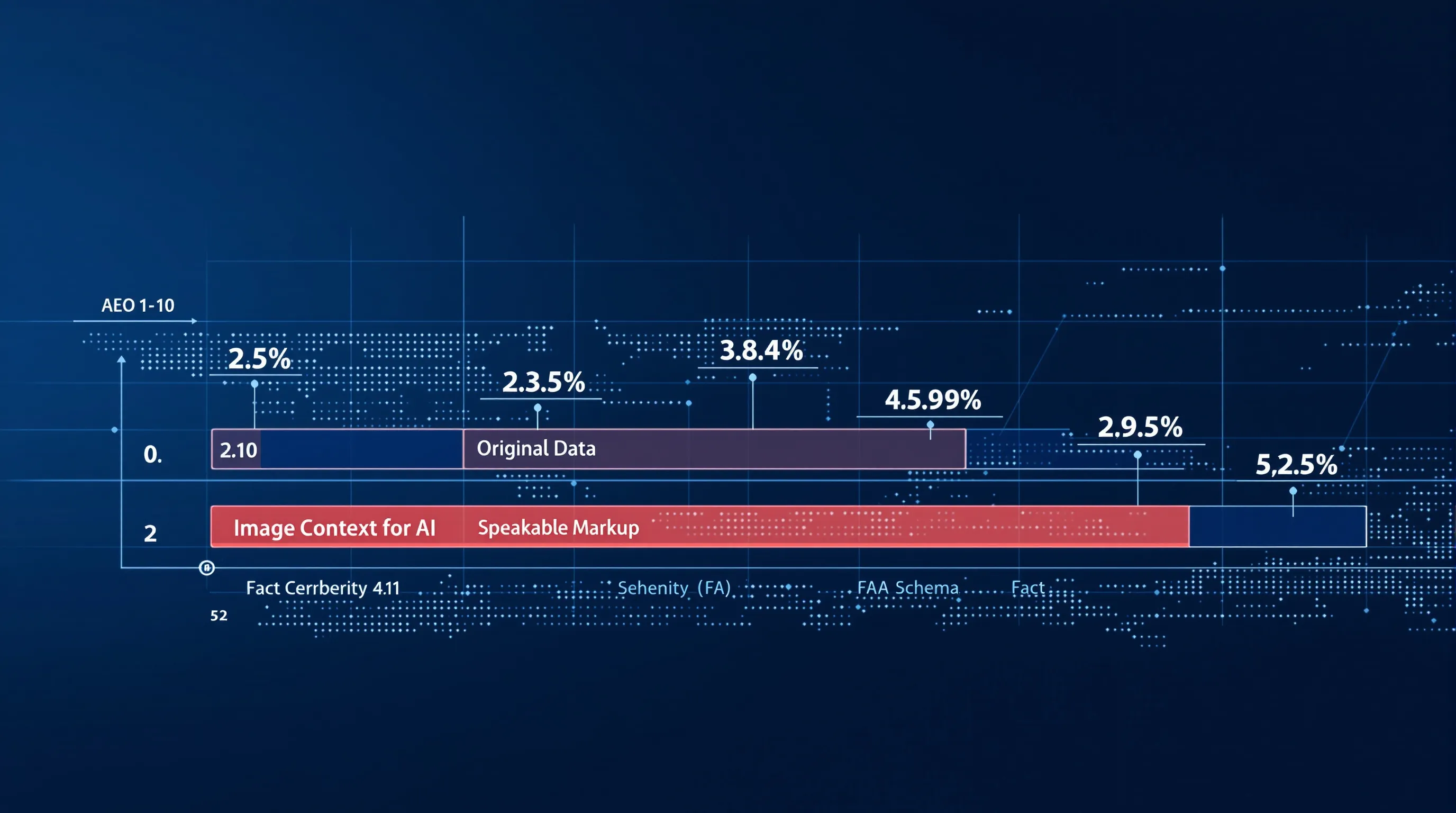
Across the sites we have audited, the average score for the Image Context for AI criterion is 2.3 out of 10. That is the lowest average of any criterion we track, lower than Original Data (which averages 3.8), lower than Entity Authority (4.1), lower even than Speakable Markup (3.2), which requires deliberate JSON-LD implementation that most sites have never considered.
94% of audited sites score below 5 on Image Context for AI. Fewer than 1 in 17 sites has even a mediocre image context implementation. For a criterion that accounts for a real share of AI citation potential, that is an extraordinary gap.
The pattern that stands out most is this: 87% of pages that pass text-structure criteria, Q&A Format, FAQ Schema, Fact Density, still fail Image Context. These are pages where someone has done real AEO work. They restructured headings into questions. They built out FAQ sections with schema. They added proprietary numbers to make the prose cite-worthy. And then they uploaded a data visualization with the alt text "figure 3" and called it done.
The audit missed it. The content team missed it. The images sat on the page, invisible to AI engines, while the rest of the page's AEO signals did their work without them.
This is the most common fixable gap in AEO optimization. Fixable because it requires no new content, only better annotation of what already exists. The content is there. The signal is not.
How does AEO Content's audit catch what text-only tools miss?
The AEO Content audit framework was built to include the criteria that standard SEO and content audits omit. Image Context for AI is one of seventeen criteria we track, and it is the one most clients are surprised by, because it is the one no other tool has flagged for them.
The audit process works in two directions. The automated pass reads every <img> element on each audited page, evaluates the alt attribute against an informational-versus-decorative heuristic, checks for <figure> and <figcaption> structure, detects the presence or absence of ImageObject JSON-LD, and checks file name patterns for camera-roll strings and generic terms. This produces a raw score.
The editorial review layer interprets that score in context. An alt attribute that passes the automated check may still fail the editorial review if it describes the image generically rather than specifically. A page with one well-annotated hero image and twelve orphaned infographics will pass the automated check on the hero and fail the editorial review on the pattern.
What the AEO Content audit returns is not just a score. It returns a prioritized fix list. For most clients, Image Context for AI sits at or near the top of that list: not because it is the hardest criterion to improve, but because the gap is so large and the fix is so direct. You already have the images. You already have the content the images illustrate. The work is annotation: writing alt text that conveys meaning, adding captions that extend the argument, and in some cases adding ImageObject schema that makes the connection between image and context explicit to every crawler that visits the page.
If you have not had your pages scored on Image Context for AI, the AEO Readiness Audit surfaces this gap in the first pass, alongside the text-based criteria that most audits already cover. The combination is what a complete AEO audit looks like.
The image context audit: what to check and why
Infographic concept: A six-step horizontal checklist showing the image context audit process, with pass/fail indicators for each step and the most common finding at each stage.
- Export all img elements → Most common finding: 20-40% have empty alt attributes
- Evaluate alt attributes for informational content → Most common finding: 60-70% describe visually rather than informationally
- Check for figure/figcaption structure → Most common finding: fewer than 30% of images use figcaption
- Check surrounding prose for orphaned images → Most common finding: data visualizations have no adjacent explanatory paragraph
- Check file names → Most common finding: camera-roll or CMS-generated strings on 40-60% of images
- Search for ImageObject schema → Most common finding: zero results (92%+ of pages)
Source: AEO Content audit corpus. These findings are consistent across industry sectors.
Questions This Article Answers
Key questions this guide answers
- Why does the standard AEO content audit miss images?
- What is the Image Context for AI criterion and how is it scored?
- How do AI engines (ChatGPT, Perplexity, Google AI Overviews) read image context?
- What five image attributes determine whether AI engines can cite your images?
- How do you run a six-step image context audit on your own pages?
- What does a passing image context score (7/10) require?
What will image context mean for AI visibility in the next 12-24 months?
The current state, Image Context for AI averaging 2.3 out of 10 across audited sites, reflects a window of opportunity that will close. As AI engines become more capable of processing visual content directly, and as the practitioner community catches up to the image context gap, early movers will hold an advantage that compounds.
Three signals point toward where image context optimization is heading:
Multimodal AI is expanding. ChatGPT, Gemini, and Claude now process images directly in many contexts. As multimodal capabilities extend to crawling and citation, the relevance of an image's visual content, not just its text annotations, will increase. Sites that have strong image context annotation today will be positioned for this shift. Sites that do not will face a larger gap to close when the bar rises.
AI Overview citations are churn-prone. From what I have tracked across our client base, Google AI Overviews cycle sources more rapidly than weekly tracking captures. Pages that consistently signal quality across all AEO criteria, including image context, hold positions more durably than pages that optimize only for text. The image context criterion is part of that consistency.
The audit tradition is catching up. As more practitioners run AEO audits rather than SEO audits, image context will become a standard checklist item. The window where this criterion is a differentiator, where most competitors are not checking it, is real but not permanent. The sites that add this audit step now are building a baseline that late movers will spend more effort to match.
The intervention is available today, the fix is direct, and the window is open. That combination does not stay available indefinitely.
12-24 months Visibility Outlook
Where AI-driven product discovery heads next
Three scored forecasts on how buyers find brands and products as AI-generated summaries absorb search demand through 2027.
Three shifts in how buyers discover you
Use each forecast to judge where discovery effort and content formats should move over the next two years.
As image-generation and analysis systems increasingly train on and read the text attached to visuals, alt text and file names will shift from an accessibility checkbox to a discovery input; expect demand for human image-description review to grow over the next two years as brands work to make product photos and diagrams legible to AI.
Over the next 12-24 months more buyers will settle questions inside AI-generated summaries, which already appear in roughly 25% of searches (up to 48.7% in healthcare) and push the no-click rate to about 83%, while 89% of B2B buyers now use AI in purchasing decisions; brands that publish facts in short, extractable form will capture that attention, and those relying on the click will see traffic erode even as impressions climb.
The bigger drain on discovery over 12-24 months will be machine-invisible page content rather than image detail: with about 80% of popular US ecommerce sites generating crucial content via JavaScript, providers that fix rendering and indexation will recover far more lost reach than those polishing image descriptions, given documented losses like Walmart at 35% of product pages indexed and YOOX at 80.78% invisible.
Emerging, Not Established One content library logged 329,454 impressions at an average position of 9.4 but drew just 857 clicks, a 0.26% click-through rate, and only 17 of 77 posts were ever cited in AI answers. Demand is already surfacing in dedicated alt-text review requests from image-heavy creators and in audit tools that flag missing or weak image descriptions and file names. Indexation losses are already documented, with Walmart at 35% of product pages indexed, YOOX 80.78% invisible, and roughly 5 million monthly visits at stake for H&M, showing catalog content vanishing from crawlers.
What the market data supports and disputes
Corroborating figures and contrary findings are listed beside each forecast so you can weigh both.
- Backing it: "Alt text" is an AI training tool. [Community / Forum]
- searching for alt text review service is what puts this forecast on the board. [Community / Forum]
- Get An SEO Audit In One Click! (Free Single Page SEO Audit Tool) supports this forecast. [Video]“the image audit will check the images on your page and let you know if there's any kind of issue it'll also look at the the alt text and the image file names…”
- Pushing back: Does image alt text actually make a difference for SEO? [Community / Forum]
- Your Startup's Guide to AEO & GEO in 2026 | by Oleksii - Medium points the same way. [Blog]“~60% of searches now end without a click - rises to ~83% when AI Overviews appear - source: SparkToro, SimilarWeb”
- Backing it: 7 Proven Tactics to Rank in AI Answers with AEO | by Lb - Medium. [Blog]AI Overviews now surface in up to 47% of searches and often occupy the most prominent positions on results pages, according to recent Attrock research. “AI engines favor sources that add net-new value - original research, expert commentary, and concrete examples.”
- how i built an SEO/AEO blog engine points the same way. [Substack / Newsletter]
- Are you actively optimizing for AEO yet, or still focusing primarily on is the clearest counter-signal. [Community / Forum]
- Against it: Get An SEO Audit In One Click! (Free Single Page SEO Audit Tool). [Video]
What could flip these calls
Shifts in buyer search habits and crawler technology that would reverse the forecasts below.
Built-In Uncertainty
Weigh 70 more heavily than the rest, and keep an eye on 51 as the forecast least protected by current evidence.
- The moment regulators or buyers head the other way, Image descriptions become a discovery input is the exposed call.
- Should the evidence swing against the mainstream view, Rendering blind spots outweigh image gaps outlasts the rest.
Key Takeaways
Key takeaways
- Image Context for AI averages 2.3 out of 10 across the AEO Content audit corpus, the lowest score of any AEO criterion tracked.
- 94% of audited sites score below 5 on this criterion, and 87% of pages that pass text-structure criteria still fail it.
- AI crawlers (GPTBot, ClaudeBot, PerplexityBot) read four image signals: alt text, captions, surrounding paragraph prose, and ImageObject structured data.
- Fewer than 8% of audited sites have implemented ImageObject schema on any page, the highest-impact single fix available.
- The image context audit is a six-step manual process taking about 30 minutes per page; it checks alt attributes, captions, surrounding prose, file names, and JSON-LD schema.
- Fixing image context requires no new content, only annotation of images that already exist.
- A passing score (7+/10) requires descriptive alt text on all informational images, captions or referencing paragraphs on at least 60%, descriptive file names, and no keyword-stuffed alt attributes.
The AEO content audit has a gap. It has always had this gap. The text criteria: headings, schema, fact density, table structure: get checked because the tools check them, and the tools check them because the SEO tradition taught us to care about text. Images fell outside that tradition. They still fall outside most audit workflows today.
But AI engines do not share that blind spot. GPTBot and ClaudeBot and PerplexityBot read every text signal on a page, including the signals that surround your images. When those signals are missing, the image is invisible to the citation model. And when 87% of pages that pass every text criterion still fail Image Context for AI, the gap is not a rounding error. It is the most common fixable problem in AEO optimization.
The fix is available to every site right now. The content already exists. The images are already there. What is missing is annotation: alt text that conveys meaning, captions that extend the argument, file names that tell the crawler what it is looking at. Add ImageObject schema and the signal becomes explicit. None of this requires new content, new research, or new photography. It requires an audit that looks at the full page, not just the text.
That is what a complete AEO content audit does. And it starts with adding the step that most audits miss.
Ready to score your site's Image Context for AI? The AEO Readiness Audit checks this criterion alongside all 16 others, and tells you exactly which images to fix first.
Frequently asked questions
What is the Image Context for AI criterion in an AEO audit?
Image Context for AI is an AEO audit criterion that evaluates whether each significant image on a page has enough surrounding context: alt text, captions, explanatory prose, and structured data: for AI crawlers (GPTBot, ClaudeBot, PerplexityBot, Google's bots) to understand what the image shows and potentially cite it in AI-generated answers. It is distinct from standard accessibility alt text audits, which only check whether alt text exists, not whether it conveys informational meaning.
Why do standard SEO audit tools miss image context for AI?
Standard SEO tools check alt text for accessibility compliance, confirming it exists rather than evaluating its content quality. They were not designed to evaluate whether image annotations are legible to AI citation models. AEO is a newer discipline and the image context criterion has not yet been incorporated into tools built for the SEO era.
How is the Image Context for AI criterion scored?
The criterion is scored on a 1-10 scale. A 10 requires descriptive alt text conveying informational content, a figcaption or explanatory adjacent paragraph, a descriptive file name, and ImageObject JSON-LD schema. A score of 2-3, where most sites land, means one or two of these elements are present but most images are annotated for accessibility only, not for AI legibility.
Does ImageObject schema actually affect AI citations?
ImageObject schema is the most explicit signal you can send to AI crawlers about what your images represent. It declares a name, description, and content URL in machine-readable JSON-LD that AI engines can parse directly. It is not required for a passing image context score, but its presence is the single fastest move from a passing score (7/10) to a strong one (9-10/10), and fewer than 8% of sites in our audit corpus have implemented it on any page.
What is the difference between image alt text for SEO and alt text for AEO?
SEO alt text is optimized for Google Image Search and accessibility: it describes what the image depicts and often includes the page's target keyword. AEO alt text is optimized for AI citation: it conveys what the image communicates: the data it shows, the argument it illustrates, the source it represents, in enough detail that an AI engine could use it to answer a question. The bar for AEO alt text is higher and the intent is different.
How long does an image context audit take?
A manual image context audit of a single page takes approximately 30 minutes: exporting all img elements, evaluating each alt attribute for informational content, checking for figure/figcaption structure, reviewing surrounding prose for orphaned images, checking file names, and searching for ImageObject schema. An automated first pass using a crawler like Screaming Frog can flag empty alt attributes and camera-roll file names in seconds, reducing the manual review to edge cases and quality judgment calls.
Can I fix image context issues without redesigning my pages?
Yes. Image context improvements are annotation changes, not structural ones. You are rewriting alt attributes, adding figcaption elements, editing the paragraph before or after an image to reference what it shows, renaming uploaded files, and adding ImageObject JSON-LD to the page head. None of these changes require visual redesign, new content creation, or changes to the page's information architecture. This is what makes Image Context for AI the highest-leverage fixable gap in most AEO audits.
What is the average Image Context for AI score across audited sites?
Across the sites in the AEO Content audit corpus, Image Context for AI averages 2.3 out of 10. The lowest average of any of the 17 criteria we track. 94% of sites score below 5. 87% of pages that score well on text-structure criteria (Q&A Format, FAQ Schema, Fact Density) still score below 5 on Image Context. The criterion ranks last in our corpus and represents the most common fixable gap in AEO optimization.
Sources & Further Reading
References and further reading
- Schema.org ImageObject specification, the authoritative reference for ImageObject structured data properties
- W3C Web Accessibility Initiative: Informative images, guidance on writing meaningful alt text for images that convey information
- Google Structured Data documentation: Image metadata, Google's guidance on image structured data for search
- AEO Rank, the 17-criterion framework, the full AEO Rank scoring system that includes Image Context for AI
- How to run a 17-point AEO content audit on your pages, the complete AEO audit methodology
Written by
Michael Kansky
Co-Founder, AEO Content
Michael Kansky is a serial founder and operator and co-founder of AEO Content, where he shapes product and go-to-market strategy for an AI-search content optimization platform.
Connect on LinkedInRelated Articles
- How to run a 17-point AEO content audit on your pages - the full audit methodology covering all 17 criteria
- Where a ChatGPT-and-spreadsheet AEO workflow breaks down - why manual audit workflows miss systemic gaps
- Why one page wins a ChatGPT citation but loses in AI Overviews - how citation signals differ across AI engines
- For B2B niches, your own pages out-cite digital PR - why on-page signals matter more than off-page for AI citation
Summarize This Article With AI
Open this article in your preferred AI engine for an instant summary.