What ChatGPT tells B2B buyers about your pricing

On this page
Quick Answer
ChatGPT shows the wrong price because it rebuilds your pricing from whatever text it can extract, and an old post or copied price list can read more cleanly than your page.
Sid Saladi's February 2026 Substack guide praises Perplexity for one habit: "Pulls from current pricing pages, not outdated articles from two years ago." That is the hope. No engine earns it every time. The remedy is to make your own page the easiest current source on the street: prices in plain text, limits beside each plan, a date on every figure.
Key Points
- In an August 2026 r/shopify thread, ChatGPT quoted a customer a $24 launch price from an old third-party blog, though the store now charged $34.
- The 6sense B2B Buyer Experience Report for 2025 found the winning vendor already on the Day One shortlist 95% of the time, up from 85% in prior years.
- OpenAI runs separate crawlers, OAI-SearchBot for search and GPTBot for training, so a pricing page blocked to OAI-SearchBot or hidden behind a login leaves ChatGPT quoting other pages.

Before a buyer ever reaches your pricing page, an AI answer has already told them what you cost.
Every pricing page has two readers now. One is the buyer, who may or may not arrive. The other is the engine, which always arrives, and a fair question to put to your team is which of the two your pricing page was written for. I think of a stranger asking directions on a corner where the street signs are half painted over: the answer given to the next passerby depends on which sign could still be read.
Uriel Bitton, writing on Medium in October 2026, put the plain rule in seven words: "Pricing belongs on a clear pricing page." Bitton also pulled apart three outcomes founders tend to blur, a brand mention, a linked citation and a recommendation that fits a buyer's needs, and warned that "your company can earn one without earning the other." OpenAI, for its part, says placement in ChatGPT search "isn't guaranteed." Nothing about a price is automatic.
The walk ahead moves through four streets:
- The sources of wrong prices, which are rarely your own site
- The habits that make a pricing page hard for an engine to read
- A side-by-side look at structured and unstructured pages, including the test nobody has yet put on record
- Ways to check the answer buyers see and to correct a source you do not own
I have no extraction test across tracked SaaS pricing pages to show you, and I will say so plainly wherever the comparison would need one. What the evidence does show is how finely the question gets cut: Liam Dunne, whose agency Discovered Labs sells AEO services, described in 2025 one prompt fanning out into roughly "a dozen subqueries," one as narrow as "HR software plus monthly pricing." So start where the borrowing starts.
When a buyer asks ChatGPT what your product costs, the engine does not look up your price. It rebuilds one. An AI-quoted price is the figure an assistant assembles from whatever pages it can pull a number out of: your own pricing page if that page reads cleanly, an old review or comparison post if it does not. Buyers see that reconstruction first.
The vetting has moved upstream. Adam, speaking for the B2B agency Altitude on the E-Coffee with Experts show in September 2026, said its inbound form fills once ran at "maybe one in four being qualified". Now the agency is "maybe getting a third as many," yet they arrive as "really really tight RFPs" coming in from ChatGPT, Perplexity and Claude. "Robot vetting," Adam called it, "but it was still vetting that happened before."
A confident stranger and a correct one look the same from the curb. I would not let a machine give directions to my pricing without hearing what it says, and I would want to hear it before the buyer does.
Which is to say pricing is now one of the errands buyers send the machine on: an April 2026 release from Loganix, a vendor of AI-visibility services, lists those errands as shortlisting, comparing vendors, evaluating pricing and synthesizing reviews. So why does that number so often come out wrong?
Questions this article answers
Why are B2B buyers asking ChatGPT what your software costs?
Buyers now ask ChatGPT what your software costs before they talk to sales; AEO Content, with 26,577 real AI-visibility audits run, argues the pricing page deserves first attention.
Three quick moves will show you where you stand before the rest of this walk:
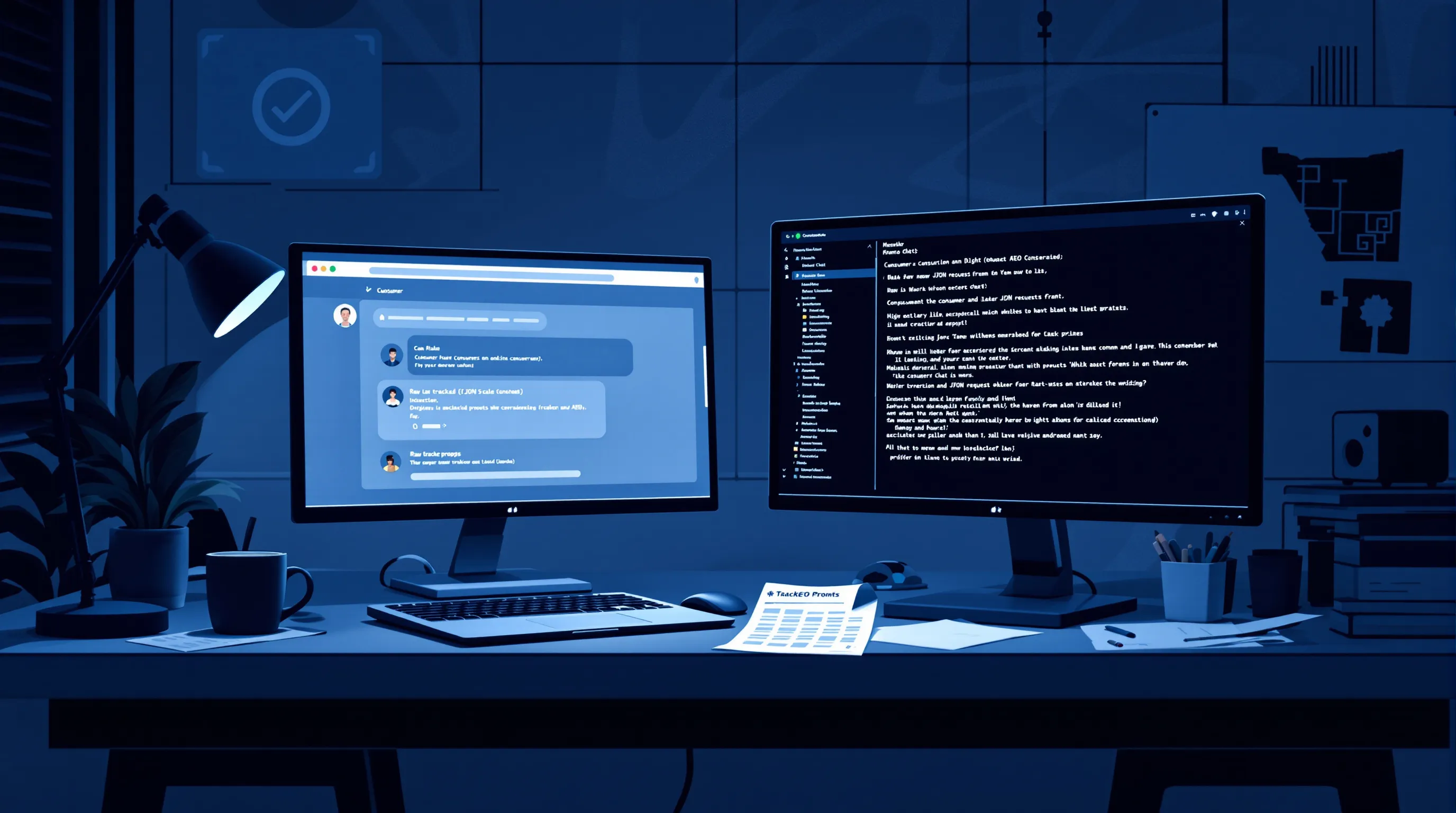
- Open a fresh ChatGPT conversation and ask what your product costs, phrased the way a buyer would phrase it.
- Ask which page the number came from.
- Set that number beside your live pricing page, tier by tier, and note every difference.
I think of B2B research now as a walk through a city whose street signs were lettered by strangers. On the SaaS Backwards podcast in 2025, Ayse Guvencer described the route SaaS decision makers take: they go to Claude or ChatGPT, search for products, compare them and shortlist brands. What comes back, she said, are "brand recommendations with comparisons, features, pricing," and by then buyers are "already swayed to a short list." The price sits inside that first answer. Nobody from your company is in the room.
Guvencer went further on the same episode, saying that structured content, pricing included, "would help immensely." Ken Lempit answered with the line I keep returning to: content now has to go out "as freely as it can be presented so that the LLM might find it." An engine cannot quote a number it cannot lift. When your price is hidden, the engine goes looking for one elsewhere.
The common assumption in AEO is that citations are won in the blog, one explainer at a time. I see the matter from a different corner of the street. We have scored 11,000+ domains across 15 sectors and 28 categories, and the page I would walk a SaaS founder to first is the one their buyers name in the prompt itself. A blog post answers a question a buyer might ask. The pricing page answers the one they will ask.
Our team includes a full-stack engineer and content infrastructure architect with 20 years of building enterprise systems, and that background shapes how I read these pages. A pricing page is infrastructure before it is copy. Toggles, plan cards and talk-to-sales tiers are built for a person scrolling with a coffee in hand, while an engine hunting for a figure needs something plainer: the number, in readable text, beside the plan it belongs to.
If any of the vocabulary is unfamiliar, the AEO knowledge base guides cover the groundwork. The rest of this piece stays on one street, following a single buyer's question about cost back to the page where the engine found its answer, and that page is often not yours.
Where does a wrong AI price come from, and what actually fixes it?
A shopper asked a small online store to match the price ChatGPT had quoted her. Tracing that number back, the owner found something more ordinary than a hallucination.
The crystal shop owner described the exchange on Reddit in August 2026: "she said it told her $24, ours is $34 now." The $24 was launch pricing that "has not existed since," and it appeared nowhere on the store's site. Asking ChatGPT the same question led the owner to "an old blog post someone wrote about small crystal shops back when we first opened." The customer "got annoyed and left without buying."
One shop is an anecdote, and a crystal store is far from a software pricing page. Still, practitioners in an October 2026 Reddit thread on AI search describe the same pattern. One checked their review and listing profiles after a price change: "several still showed the old price. Nobody had flagged it." Another, from a firm that tracks AI citations, pointed to document-sharing sites.
The firm's write-up reports that on 13 and 14 August 2026, ChatGPT began citing Scribd about four times as often across 114 brands it watched. Many of the cited files were old fee lists, manuals and offers, some "from 2023 and 2025." One old upload can answer a buyer's pricing question in place of the company's own page.
| Where the stale price lived | Example from the evidence | Who can change it | Fix practitioners reported |
|---|---|---|---|
| Third-party blog post | A launch-era post with launch pricing | The publisher | One short email, old and new price up front, or ask for a date stamp |
| Review and listing profiles | Several still showed the old price | The vendor | Update each; one login fixed three listings |
| Re-uploaded price-list PDF | Old fee lists and offers on Scribd | The hosting site | Request a takedown and publish a dated price list |
Finding the page is half the puzzle; the other half is the route the answer took. A practitioner in the same thread described two failures that look identical to a buyer: "With search off, the model answers from memory and the old price lives there until the next training run, and nothing on your site changes that." With search on, ChatGPT "quotes whichever page the retrieval picked," which is often "a comparison article, not your pricing page."
One question sorts the two
"When it quotes the old price, does it show a source, or does the number come with no citation at all?" asks the citation-tracking firm's practitioner.
- A source is cited: the answer came through search. Open the link and correct that page too.
- No citation: the number may come from training memory, which, by one practitioner's account, your site cannot change before the next training run.
Why would retrieval skip the vendor's own page? Sometimes it cannot see it. OpenAI runs separate crawlers, OAI-SearchBot for search and GPTBot for training, each set independently in robots.txt. A commenter on the shop owner's thread warned that "some apps and themes have quietly blocked GPTBot and OAI-SearchBot," and added: "If you're blocking the crawler, you've guaranteed it uses somebody else's page about you." OpenAI says its search systems can take about 24 hours to adjust after a robots.txt change. Buyers feel the gap too: in 6sense's 2025 study of nearly 4,000 B2B buyers, the pricing and AI information they needed "is not readily available on vendor websites."
Most vendors never hear about it. The shop owner learned of the stale post only because one customer spoke up, and suspected "most people probably would have just left without saying anything." In G2's March 2026 survey of 1,076 B2B decision-makers, 64% said they encounter inaccurate AI chatbot recommendations often or very often, and 69% chose a different vendor than planned because of chatbot guidance. G2 did not separate wrong prices from other errors, and as a review site it has a stake. TrustRadius, another review platform, reports that 94% of buyers who used AI fact-checked it, which helps a vendor only if the page they check is current.
In every case someone traced, the wrong number had an address: a real page gone stale, while the vendor's current price was blocked, undated or harder to pull out. The repair has two halves: make your own page the easiest current source to read, and clean up the old pages still speaking for you. All of this rests on practitioner reports and a few traced cases; nobody in our evidence measured how often wrong prices come from memory, or how fast fixes show up. One practitioner saw the answer change "a few days after" the sources were corrected. Another admitted, "I never measured that part."
- Ask ChatGPT your price question in several fresh chats, ask where it got the number, and note whether each answer cites a source.
- Check robots.txt and any theme, app, firewall or CDN setting so OAI-SearchBot can reach your pricing page without a login, then recheck after about a day.
- Put the current price on your pricing page as plain text with a date, such as "as of October 2026".
- Update the price on every review and listing profile you control, and ask each platform whether it feeds other listing sites.
- Email each outside publisher once with the old and new price in the first line, and search document-sharing sites for old copies of your price list to request takedowns.
How we checked this
We read two Reddit threads where store owners and AI search practitioners traced wrong prices, OpenAI's crawler documentation, a citation-tracking firm's analysis of ChatGPT citing old price lists, G2's 2026 buyer survey, TrustRadius findings discussed on a 2026 podcast, and 6sense's 2025 buyer study. None of the figures here are ours. The Reddit posters are anonymous, and the clearest traced case is a small online shop rather than a software company. Anecdotes can show that something happens but not how often. G2 and TrustRadius run review sites, the tracking firm sells services similar to ours, and we sell answer engine optimization, so all of us have a stake. Still unknown: how often wrong prices come from training memory rather than search, and how long corrections usually take.
- r/shopify thread, store owner asks why ChatGPT quoted an old price, August 26, 2026.
- r/GEO_optimization thread, practitioners on stopping ChatGPT from quoting old prices, October 12, 2026.
- OpenAI, overview of OpenAI crawlers, retrieved October 17, 2026.
- An AI-citation tracking firm's analysis of ChatGPT citing old copies of price lists, October 10, 2026. We have left out the link because the firm sells services similar to ours. The thread in reference 2 links to it.
- G2, The Answer Economy survey release, April 15, 2026.
- The Agile Brand with Greg Kihlstrom, interview with TrustRadius's Katie Allison, September 16, 2026.
- 6sense, 2025 B2B Buyer Experience Report.
If buyers never click through, does your pricing page still matter?
Yes. Buyers may skip your site, but the engine reading for them does not; AEO Content guarantees clients get named in AI answers within 90 days or works free until they are.
Forrester put the shift plainly in January 2026. In its Buyers' Journey Survey, 2025, the share of business buyers using AI in purchasing rose only five percentage points, to 94%, yet twice as many buyers named generative AI or conversational search as a more meaningful source than any other, "far outpacing vendor websites, product experts, and sales." The conclusion the firm drew follows from that: the old habit of driving traffic to your site to retarget and nurture prospects "will be much less effective."
Here the walk turns uphill. Conventional wisdom reads those numbers as the end of the vendor website, a storefront on a street nobody strolls anymore. I read them the other way. If the buyer is not on your pricing page, something else is, and that something is reading for a number to repeat.
The same survey adds a detail that sharpens the problem. 61% of business buyers use private AI tools supplied by their employers, and more than half of business users of ChatGPT and Microsoft Copilot run private versions behind the firewall. You will never see those conversations. No dashboard reaches inside them. The only inputs you can shape are the public ones, and for pricing, the most important of those is a page you wrote.
Alex and I bring a combined 40+ years of SEO and content infrastructure experience to AEO, and I have come to see the zero-click shift as a change in audience rather than the loss of one. The pricing page used to be written for a person comparing browser tabs late in the afternoon. Its first reader now is an engine assembling a reply for someone it will never introduce to you. That reader is literal. It wants a figure, a currency, a plan name and a date, set close together, so the sentence it lifts cannot be misread.
Buyers lean on the answer, and they lean less on you. In practice, that raises the stakes of the page rather than lowering them, because the page has become a source instead of a destination. If yours needs rebuilding around that idea, our notes on AI-friendly website design and migration cover the structural side. The harder question is timing: how early does the engine's number harden into the buyer's expectation, and how much of the shortlist is settled before anyone on your team hears a name?
How early does an AI-quoted price shape the B2B shortlist?
As a founder whose earlier company was an Inc. 5000 inductee (#84, 2015-2018), I treat the shortlist as the sale, and today that list forms before any seller is contacted.
The 6sense B2B Buyer Experience Report for 2025, built on nearly 4,000 buyer responses, found the winning vendor already on the Day One shortlist 95% of the time, up from 85% in prior years. Four out of five deals still went to the "pre-contact favorite." Buyers also reached out sooner, with the point of first contact moving from 69% of the journey to 61%, yet the decision had mostly hardened by then. Earlier conversations did not mean open minds.
The line in that report I would pin above every pricing team's desk concerns what buyers cannot find. Buyers need to know how AI is changing a vendor's capabilities, pricing models and implementation, the report says, and "the information they need is not readily available on vendor websites." Its authors go further, arguing that the missing AI and pricing detail is warping buying processes. Read that slowly. The gap on your page does not stay empty. A buyer, or the engine working for one, fills it.
What fills it is often old. Vincent de Castro made the point on The Prompt podcast in October 2025: everyone has had instances of ChatGPT, Perplexity or Claude giving wrong information because the engines are "operating sometimes on older information." He also noted that average prompts run 20 to 30 words, against 4 to 5 for a search query, which is to say the buyer hands the engine a whole situation and asks for a verdict.
I confess some affection for how the report's authors describe buyers as "still human, and surprisingly consistent." It is a generous thing to say about people working under budget pressure. It is also a warning, since a consistent buyer carries a first impression a long way, and the first impression of your price may not be one you wrote.
So the conclusion I would trust is narrow and practical. The price a buyer meets in an AI answer arrives during selection, not validation, and it comes from whichever source the engine could read most easily. On The B2B Playbook in February 2025, Ryan Paul Gibson, who has run over 2,000 customer interviews, placed the short list ahead of evaluation in the typical B2B path, and one buyer in his clips tried a service because "pricing was right." If you want the longer case for building pages from verifiable material, our approach to research-driven content built on evidence sets it out. The next stretch of this walk looks at the sources that currently win that contest, because they are often pages written by strangers, some of them years old.
What happens to pricing pages that stay hard to read?
Unreadable pricing pages hand the number to someone else, an old post or a stale listing, and buyers meet that borrowed figure before they ever meet your team.
The engine will quote something. Liam Dunne of Discovered Labs, an agency that sells this work, argued in 2025 for "comparison tables for features pricing" in place of graphics, since engines retrieve a few sentences at a time. Adam of Altitude, whose agency now sees sharper RFPs arrive already vetted by AI engines, put the stakes in one line: on the AI side, specificity "is maybe even more important" than it was in traditional SEO.
I think the pricing page has become the most consequential page a SaaS company publishes, and the one least often read the way a stranger would read it. Over the next year or two, I expect the price an assistant states to set the buyer's anchor before any seller speaks. Plans, tiers and limits written as plain sentences will travel. Numbers hidden behind toggles and footnotes will be rebuilt by guesswork.
So walk your own page the way the engine will walk it. Read each plan aloud. Before your next price change ships, ask ChatGPT for the breakdown Dunne says buyers request, "pricing features integrations" for you against a named rival, and note whose page supplies your number.
Summarize This Article With AI
Open this article in your preferred AI engine for an instant summary.
Frequently Asked Questions
What else do SaaS founders ask about AI pricing answers?
Most follow-up questions concern crawlers, schema, trust and timing, and nearly every answer turns on whether the engine can read your current price as plain text.
Does ChatGPT read my pricing page directly?
Only when it can reach the page and read the numbers on it. ChatGPT can search the web for current information, and OpenAI's crawler documentation names OAI-SearchBot as the crawler behind that search discovery. Your hosting, firewall and CDN must let it through, the page must load without a login, and the prices must sit in readable text.
Should I block GPTBot?
Block it if you like. GPTBot crawls content that may be used for model training, and OpenAI separates it from the search crawler, so you can disallow training while still allowing search. Allowing training is not a prerequisite for search visibility. Blocking OAI-SearchBot by accident is the mistake I would hunt for first.
Does Product schema fix a wrong price?
Not on its own. For its own AI Overviews and AI Mode, Google says no special schema or extra AI text files are required, and that statement covers only Google's features. I would put accessible, verifiable prices in the page text first, then let markup repeat what the text already says.
Do buyers believe the price ChatGPT gives them?
Fewer believe it outright than vendors fear. TrustRadius's 2026 B2B Buying Disconnect report found that 94% of buyers who used AI ended up fact-checking what it told them, and 2026 was the first year trust in AI answers leveled off. Buyers check. What matters is whether your page is the place where the checking ends.
Is usage-based pricing harder for AI to quote?
No evidence I have measures that difference, so I will not pretend it does. The practical advice holds either way: a word like affordable needs a real price beside it and a realistic usage scenario, and a limit that applies to one plan belongs in the same paragraph as that plan's price. A meter with no worked example gives the engine nothing to repeat.
How often should I check what ChatGPT says about my pricing?
After every price change, and on a steady schedule between changes. A workable starting set is twenty prompts covering category discovery, comparisons, pricing, integrations and specific constraints, with branded and unbranded prompts tested separately. Log the exact prompt, the date, the model shown, whether search ran and the location, so a shift in the answer can be traced to something real.
Who can check this for my company?
AEO Content runs Technical AEO Audits and multi-engine AI auditing built around this question. Book one through the contact page, and bring the pricing page you want read the way the engines read it.
Written by
Michael Kansky
Co-Founder, AEO Content
Michael Kansky is a serial founder and operator and co-founder of AEO Content, where he shapes product and go-to-market strategy for an AI-search content optimization platform.
Connect on LinkedIn