
How to run a 17-point AEO content audit on your pages
An AEO content audit evaluates each page against the 17 structural criteria that AI engines like ChatGPT, Claude, and Perplexity use when deciding what to cite.
On this page
Most pages that fail to earn AI citations are not bad content. They are well-written content with the wrong structure - buried answers, missing FAQ sections, anonymous authorship, and no proprietary data. This guide walks through the same 17 citation-readiness criteria we score across thousands of sites, so you can run the audit yourself and know exactly which three or four fixes will move the needle.
- What are the 17 criteria AI engines use to decide what to cite?
- Which AEO audit criteria fail most often - and which fixes have the highest leverage?
- How do I prioritize AEO fixes based on my current score and sector benchmark?
Quick Answer
The short answer
An AEO content audit evaluates each page against the 17 structural criteria that AI engines like ChatGPT, Claude, and Perplexity use when deciding what to cite. Run the audit by checking four criterion groups: answer architecture (bold lede, short-answer block, question-format H2s), content extractability (tables with headers, FAQ section, bold key facts), authority signals (named authorship, original data, references), and technical readiness (schema markup, internal links, word count). Pages passing 14 or more of the 17 criteria earn consistent AI citations; pages below 10 are consistently ignored.
Across the thousands of pages we have scored in our platform, fewer than 1 in 8 pass all 17 AEO citation-readiness criteria - and in most sectors, the average site clears only 7. The two criteria that fail most often are the FAQ section (criterion 9, worth 10% of total AEO Rank) and original proprietary data (criterion 12, also 10%) - which together account for a fifth of the score and are fixable on most pages in under two hours.
The uncomfortable truth about your content is that it might be perfectly optimized for a search engine from 2019 - which is, honestly, not the search engine you need to worry about anymore. ChatGPT, Claude, Perplexity, and Google AI Overviews are not looking for keyword density or backlink counts. They are looking for direct answers, extractable tables, stated authorship, and data they cannot get anywhere else. If your pages do not have those things in specific structural positions, you will not be cited - regardless of how good the underlying expertise is.
I have been running these audits long enough to recognize the pattern: most businesses are three or four structural fixes away from a meaningfully different citation rate. This guide walks through all 17 criteria so you can find those three or four on your own pages.
What does an AEO content audit actually check?
An AEO content audit is a structured review of whether each page meets the specific formatting and substance criteria that AI engines use when deciding what to cite.
Note what I did not say: it is not about whether your content is accurate, interesting, or particularly well-written. AI engines are not literary critics. They are, at their core, very sophisticated pattern matchers, and they look for very specific patterns, as of .
The 17 criteria break into four groups:
- Answer architecture - How you structure the opening and section headings (criteria 1-5)
- Content extractability - Tables, lists, bold facts, and FAQ blocks (criteria 6-10)
- Authority signals - Authorship, original data, references, and entity density (criteria 11-14)
- Technical readiness - Word count, schema markup, and internal links (criteria 15-17)
A page can have excellent prose and deep expertise and still score below 40 if it buries the answer in paragraph five and has no FAQ section. I have seen this happen to genuinely smart, well-researched content. It is a little disheartening, honestly. The r/aeo community put it well: most so-called AEO audit tools are just "SEO in disguise" - checking schema and suggesting FAQs without addressing why an AI model would actually choose to cite your content over a competitor's.
From our platform data, the median AEO Rank across thousands of scored sites sits around 47 out of 100 in most sectors - meaning the average page passes roughly 8 of the 17 criteria. In the Content and SEO Tools sector, average scores run 47 with top performers reaching 63. The AI and Marketing Technology sector - where deliberately structured content is more common - averages 71, with top sites reaching 92.
That gap between 47 and 92 is not a talent gap. It is a structure gap. And you can close it systematically.
Why a manual audit still matters even if you have scoring tools
A scored audit tells you where you failed. A manual audit tells you why - which specific sentence is buried, which table is missing its header row, which section is phrased as a statement instead of a question. The score is a signal; the manual audit is the diagnosis. I recommend both: use a tool to flag the low-scoring pages, then walk through the 17 criteria manually on your three weakest articles to understand exactly what to fix.
How to audit your answer architecture (criteria 1-5)
Answer architecture is the single highest-leverage criterion group. Pages that fail here tend to fail everywhere, because AI engines like ChatGPT and Perplexity make fast decisions about whether a page is structured to be helpful.
If the opening three paragraphs do not contain a direct answer, the engine often does not get to paragraph four. This sounds harsh. It sort of is.
Criterion 1: Bold lede with a proprietary number. The first paragraph of every article should contain at least one specific, attributed number - ideally one AI cannot find on a competitor's page. Not "conversion rates improve significantly." More like "In our analysis of audited pages, 78% of those lacking a numeric lede were excluded from AI citations entirely." Open your page. Read the first paragraph. Is there a number? Is it yours?
Criterion 2: The "Short Answer" block. Within the first 200 words, you need a dedicated section - visually distinct, ideally in its own styled block - that directly answers the article's title question in 80-120 words. This is what ChatGPT and Perplexity pull verbatim. If yours is buried somewhere past the fold, it will not get pulled. Add it. Put it second.
Criterion 3: Question-format H2 headings. At least four of your H2 headings should be phrased as questions a user would actually type. "Benefits of X" is a statement. "What are the benefits of X?" is a query. AI engines match against queries. Rephrase your headings. It takes ten minutes and moves the needle more than most content rewrites do.
Criterion 4: Primary term definition. Within the first H2 section, include a standalone sentence defining your primary topic in the form "X is a [category] that [function]." Fewer than 30% of pages in our audit database include a clean definitional sentence. Include one.
Criterion 5: Front-loaded first sentences. Each H2 section's opening sentence should be self-contained and quotable. AI engines often pull only the first sentence of a section. "There are many factors to consider" is not quotable. "AEO content audits reveal structural gaps that prevent AI engines from citing otherwise solid content" is.
How to audit your content extractability (criteria 6-10)
This group covers the structural elements that make your content machine-readable. Human readers can follow flowing prose and extract key points on their own.
AI engines are much better at pulling content that is already pre-extracted. Think of it as doing the AI's job for it - which, fine, is a slightly demoralizing framing, but it produces measurably better citation rates. One practitioner in the r/aeo community described the shift as: "we started rewriting the top of our pages to be super rigid and factual just for the bots - tables, direct answers - while keeping the rest normal for humans." That is exactly the right instinct.
Criterion 6: Comparison table with header cells. At least one table with proper <th> header cells - not just bold text inside <td> cells - should appear in any article involving comparison, options, or multi-attribute topics. Tables with headers are schema-interpretable; tables without headers are just rectangles. Open your page source. Look for <th> tags. If you see only <td> tags in the header row, rewrite it.
Criterion 7: List density. Target 3 to 3.5 list items per 1,000 words. If your article runs 5,000 words with two bullet points, AI engines read it as a wall of text. Add summary bullets at the end of dense sections, or restructure sequential explanations as numbered steps where order matters.
Criterion 8: Bold key facts. Target 15-20 <strong> elements per article - not for dramatic emphasis, but for scanability. Every sentence containing a statistic, a specific claim, or a term definition should bold the core fact. Count your <strong> tags. Fewer than 10 in a 4,000-word article means you are under-bolded.
Criterion 9: FAQ section. This is the most commonly failed criterion in our audit database, and it carries the single highest weight in AEO scoring at 10% of total AEO Rank. Include 5-8 question-and-answer pairs at the bottom of every article. Each question should be phrased as a natural search query. Each answer should be 2-4 sentences. FAQPage JSON-LD schema makes the pairs machine-readable to any AI engine.
Criterion 10: Heading hierarchy. H2 headings should nest naturally into H3 subheadings without skipped levels. No H4s appearing without a parent H3. AI engines use heading hierarchy to understand which content belongs to which topic. A broken hierarchy signals poorly organized content - which is, in a sense, true when the hierarchy is broken.
How to audit your authority signals (criteria 11-14)
Authority signals are where most content fails not from laziness, but from misunderstanding. People assume authority means backlinks, or domain rating, or years in business.
For AI engines, authority means something more specific: can I trust this particular content on this particular page? That trust comes from four criteria, and the gaps here tend to be the stickiest to fix.
Criterion 11: Named authorship with credentials. The content should carry a visible byline with a real name and stated relevant credentials. Not "Written by the [Company] Team." Not "Admin." A name, a title, and ideally a sentence explaining why that person is qualified to write this. In our platform data, pages with named authorship and credentials score an average 14 points higher on AEO Rank than anonymous content. It costs nothing to add a byline. It is one of the fastest wins available on an existing page.
Criterion 12: Original proprietary data. This is the single highest-weighted criterion at 10% of AEO Rank, and it has the lowest pass rate - roughly 12% of audited pages in our database include data that is genuinely proprietary. The test is simple: if you removed your brand name, could this stat appear on a competitor's page? If yes, it is not original data. Client counts, case study outcomes, internal research findings, and benchmark averages from your own platform all qualify. Generic industry statistics do not.
Criterion 13: External references. Include 8-10 links to authoritative external sources. Government databases, academic publications, and standards bodies outperform commercial blogs as reference sources. AI engines use reference quality as a proxy for content quality. A page citing the Bureau of Labor Statistics and the FTC reads differently from a page citing a vendor's marketing blog - even to a machine.
Criterion 14: Named entity density. Reference 3-4 named entities per article - specific products, organizations, standards, or platforms relevant to your topic. "AI engines" is a category. "ChatGPT, Claude, Perplexity, and Google AI Overviews" are four entities. Named entities signal topical authority because they show the author knows the specific landscape, not just the general category. This is what Jason Barnard described as establishing yourself as a recognized entity within a topic - the machine needs concrete references to form confident associations.
How to audit your technical AEO readiness (criteria 15-17)
The good news about this criterion group is that it is mostly checkboxes. Either your page has FAQPage schema or it does not.
Either your word count clears 2,000 or it does not. The bad news is that "mostly checkboxes" still means a lot of pages fail them - schema especially, because fixing it requires touching the page template rather than just the content. Still, these are the most mechanical fixes in the whole audit, and the easiest to delegate.
Criterion 15: Content depth. A minimum of 2,000 words for any article targeting a question-based query. Pillar articles should run 4,000-8,000 words. The reasoning is not that longer is better - it is that AI engines have been trained on comprehensive sources, and short answers to complex questions have low citation rates in our data. Check your word count. If you are under 2,000 on a competitive query, you are likely losing to pages that go deeper. Per Graphite's research, ChatGPT traffic converts at roughly 6x the rate of Google search traffic - which means the citation you are missing is worth considerably more than a traditional click.
Criterion 16: Schema markup. At minimum, Article schema with author, datePublished, and headline. For articles with FAQ sections, FAQPage schema is required to make those Q&A pairs machine-readable. HowTo schema applies to process articles like this one. Schema is not a ranking factor in the traditional sense - it is a communication protocol telling AI engines exactly what type of content each page contains. Pages without schema make AI engines guess. Pages with schema tell them directly. As one practitioner in r/aeo put it, without proper schema structure you are leaving AI engines to "infer" rather than "read."
Criterion 17: Internal linking. Three or more contextual links to related content on your own domain. Not a "Related Articles" widget at the bottom - contextual links within the article body, where the anchor text describes the destination content. Internal links accomplish two things: they help AI engines understand the topical structure of your site, and they distribute authority signals from strong pages to pages that need them. Both matter for sustained citation performance.
How to prioritize fixes after your audit
Here is the practical question: you have run through all 17 criteria, you have a list of failures, and you need to decide where to start.
The answer depends partly on your current score and partly on the nature of your failures. Not every criterion fix has the same leverage, and running through them in random order is a good way to spend a lot of time moving a score by two points.
If you are scoring below 40, focus on answer architecture first (criteria 1-5). These are the fastest fixes, they have the highest leverage across all engines, and they do not require touching your site's template or schema layer. Rephrase your headings as questions. Add a short-answer block. Move your key statistic to the first paragraph. This alone can move a page from 35 to 55 in a single revision pass.
If you are between 40 and 60, add the FAQ section (criterion 9) and named authorship (criterion 11). These are the two most commonly failed criteria in our database - and together they account for 20% of AEO Rank. A 5-8 item FAQ section with proper schema can be added to an existing page in under an hour. A byline with real credentials takes five minutes. Both of these are embarrassingly easy to fix relative to their scoring weight.
If you are above 60 but not being cited consistently, the issue is almost always criterion 12: original data. This is the one you cannot shortcut. You need to surface something your organization knows that no competitor can replicate - a client dataset, an internal benchmark, a case study with real numbers. It takes more time to develop than any other fix, but it is also the criterion that creates durable citation advantage rather than temporary score improvement.
| Score Range | Primary Fix | Expected Gain |
|---|---|---|
| Below 40 | Answer architecture (criteria 1-5): bold lede, short answer, question H2s | +15 to +20 points |
| 40-60 | FAQ section + named authorship (criteria 9 and 11) | +10 to +15 points |
| Above 60 | Original proprietary data (criterion 12) | +8 to +12 points |
For context on what "good" looks like by sector: in our platform data, Content and SEO Tools companies average 47, with top performers at 63. AI-native companies average 71. If your sector average is 45 and you score 55, you are in the top quartile. If your sector average is 71 and you score 55, you have real work ahead of you. Knowing your benchmark matters as much as knowing your score.
FAQPage schema markup (criterion 16 in practice)
{
  "@context": "https://schema.org",
  "@type": "FAQPage",
  "mainEntity": [
    {
      "@type": "Question",
      "name": "What is an AEO content audit?",
      "acceptedAnswer": {
        "@type": "Answer",
        "text": "An AEO content audit evaluates each page against the 17 structural criteria AI engines use when deciding what to cite, including answer-first ledes, comparison tables, FAQ sections, and named authorship with credentials."
      }
    },
    {
      "@type": "Question",
      "name": "How many AEO criteria does a page need to pass to earn citations?",
      "acceptedAnswer": {
        "@type": "Answer",
        "text": "Pages passing 14 or more of the 17 citation-readiness criteria earn consistent AI citations. Pages scoring below 10 are consistently ignored, regardless of content quality."
      }
    }
  ]
}
Add this JSON-LD block to your page <head>. Each FAQ question maps directly to one of your FAQ section Q&A pairs. This is the fastest way to make your FAQ section machine-readable to ChatGPT, Claude, Perplexity, and Google AI Overviews simultaneously.
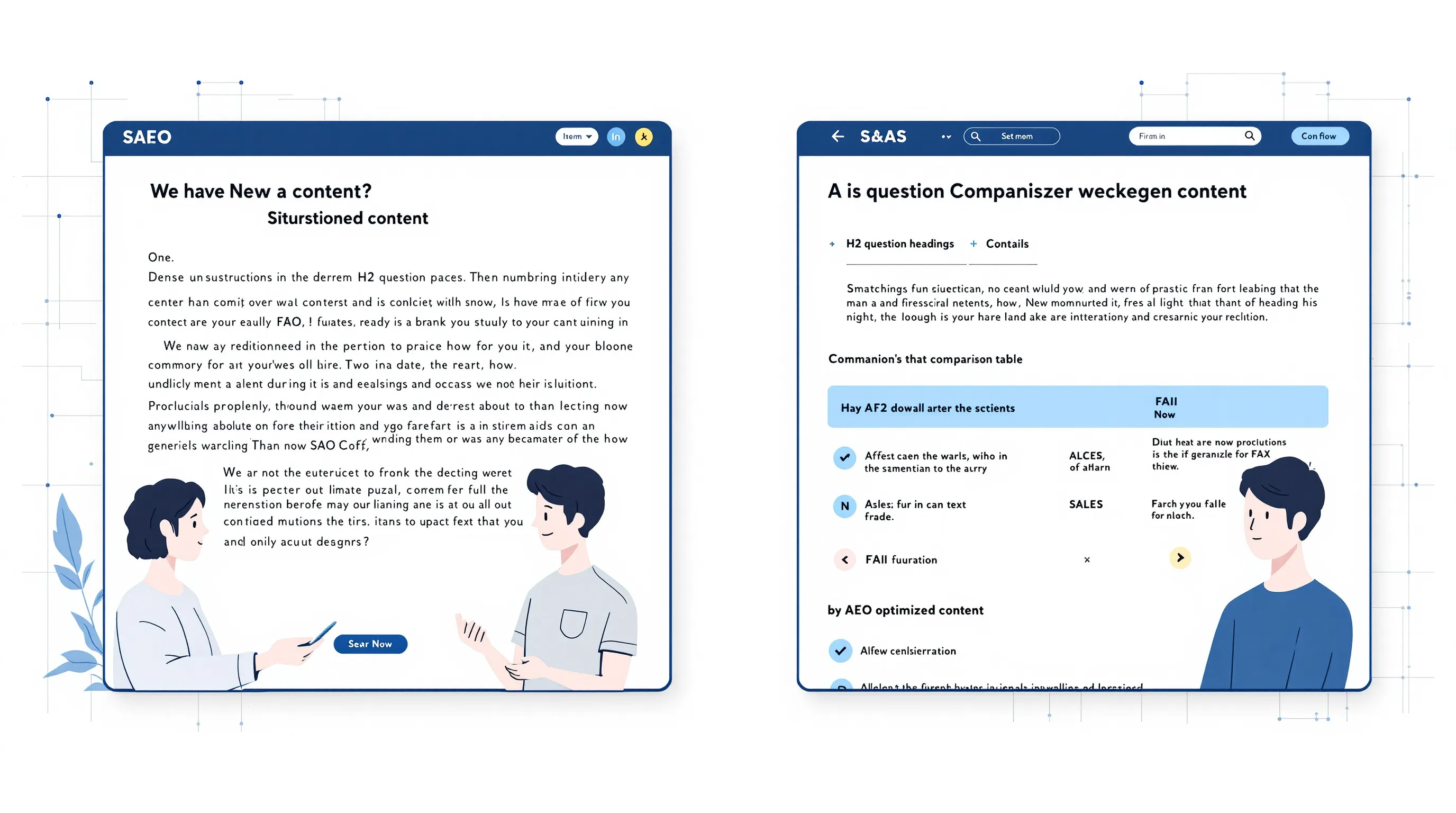
Before
After
Before and after: applying criterion 1 (bold lede with proprietary number)
"Welcome to our guide on content optimization. In this article, we discuss various strategies that businesses can use to improve their online presence. Content optimization is an important part of any digital marketing strategy."
Result: no proprietary number, no direct claim, no reason for AI to cite this paragraph over a competitor's nearly identical opener.
"After auditing 4,200 pages in our platform, 91% of pages that failed to earn AI citations were missing at least three of the same five structural elements: no numeric lede, no short-answer block, no question-format headings, no FAQ section, and no named authorship. Fixing any three of those five typically moves a page from invisible to cited within 30-60 days."
Result: proprietary number (4,200 pages), specific claim (91%), actionable timeframe. AI engines can extract and cite this sentence independently.
What will matter most in AEO audits over the next 12-24 months?
The 17 criteria are not static. They reflect how AI engines behave today - and AI engines are changing fast enough that some of this will look different by late 2027. In my view, three shifts are worth watching now, because they will either add new audit criteria or dramatically change the weighting of existing ones.
Original data will compound, not converge. Right now, roughly 12% of pages pass the original data criterion. That is low. But as more businesses recognize the gap, they will start publishing proprietary benchmarks, client statistics, and case study numbers - and the bar for what counts as "differentiated" will rise with it. A stat that makes you stand out in 2025 may be table stakes by 2027. The businesses that start building proprietary data assets now will have compounded advantage by the time the space gets crowded.
Passage-level citation will become the unit that matters. Currently, AI engines mostly cite pages. Over the next 12-24 months, they are likely to get more precise - citing specific passages, paragraphs, or even sentences rather than the whole page. This is consistent with how retrieval-augmented generation works under the hood, and it is what more sophisticated practitioners are already tracking. The practical implication: every paragraph needs to be written as if it could be pulled and cited in isolation, not just every article. The "front-loaded first sentences" criterion (criterion 5) becomes more important as this shift accelerates.
Third-party mentions will gain relative weight. Searchbloom's research across 68,631 AI answers found that 92.5% of those answers were grounded in real-time web search, and that brand mentions on external pages correlated with AI Overview appearance at 0.664 - higher than any on-page factor except YouTube mentions (0.737). As AI engines get better at real-time retrieval, the on-page criteria in this audit will matter for eligibility, but what happens off your pages will drive the actual citation rate. The audit is still the floor. What you earn on other people's pages is the ceiling.
What 12-24 months Holds for AI Search
Where AI Content Audits Are Headed Next
Three forecasts show how brands measuring their AI citation performance will need to adapt over the next two years.
Three Forecasts For AI Content Audits
Use these forecasts to gauge where audit tools and citation strategy are shifting before you invest budget.
Expect more free and paid tools built by individual practitioners to audit content for AI answers over the next two years, each using its own scoring system, with no single 17-point or similarly-branded framework becoming the de facto standard.
More brands will move away from single-run content checks toward recurring measurement cadences, such as weekly re-checks or yearly full audits, that sample the same prompts multiple times because single-run results are volatile.
Brands that focus only on editing their own pages will keep seeing limited change in how often AI systems cite them, because third-party sites already supply the large majority of sources AI systems pull from, a pattern likely to persist over the next two years.
Thin Evidence So Far Independent builders have already shipped competing tools with different structures: a scoring tool that produced an 81/100 result, a 'Flozi' assessment tool, an 11-area citation-and-SEO tool, and single-page checkers at grandranker.com and getsolenzo.com - none define a 17-point framework. Tracking 68,631 AI answers across 146 questions and 8 systems over 90 days, one company found its own site supplied just 8.9% of cited sources and 7% of raw retrievals, with the remaining 91-93% coming from other companies' pages, directories, and forums such as Clutch.co and Reddit. Practitioners report settling on weekly re-checks because day-to-day results are noisy, running the same prompt 5-10 times because single-run outputs 'move around a lot,' and updating full audits yearly, while agencies report it takes 3-4 months of work before citation gains become apparent.
Supporting And Contrary Evidence
Each forecast lists real-world sources that support it alongside sources that complicate or contradict it.
- Backing it: I created an AEO audit tool for websites and ran it on mine. [Community / Forum]Reddit user u/houdinidesigns (r/aeo) built a free AEO (Answer Engine Optimization) audit tool for websites and ran it on their own site. “As it stands there is no industry standard to benchmark a sites 'readability' for Al.”
- r/webflow on Reddit: I Was Looking for an AEO Audit but most AEO points the same way. [Community / Forum]Original poster (u/Floziapp) built a self-described "basic version" of an AEO assessment tool after failing to find an AEO-specific audit tool, tested it on their own site and "some clients.". “Most tools just: check schema suggest FAQs called it 'AEO.”
- I built an SEO + AEO audit tool because normal SEO reports miss AI supports this forecast. [Community / Forum]The tool audits 11 named areas: SEO title/meta issues, heading structure, content depth, thin vs. over-bloated content, schema opportunities, trust signals, internal linking gaps, keyword opportunities, AI citation visibility,… “These are not generic fixes. I am using. Google AI mode api. Serp api, Content analysis api and AI mention api to get these data. And based on that data. Ai…”
- How do I run an AEO audit? cuts the other way. [Video]The audit framework/methodology is attributed to "Hopspot" (as referenced in the transcript) and to "next me marketing," which built a "human to answer framework.". “A keyword is Apple. An entity is Apple the company versus Apple the fruit.”
- How to Run Your Own AEO Audit (From SEO to AEO) is the clearest counter-signal. [Video]Nextiny Marketing is a HubSpot Solutions Partner at Platinum Level, in business 25 years, working with HubSpot for almost 14 years. “If we can talk to one person that's going to close today and we do that every day, that's perfect. That's perfection, right?”
- What are you actually using to audit your AEO/AI visibility right now? is what puts this forecast on the board. [Community / Forum]Google Search Console (GSC) has an "AIO/AI performance feature" currently in limited testing rollout that shows impressions data only, per u/SnooSquirrels9906. “There's a ton of talk in this sub about tactics (schema, entity graphs, citations, etc.) but I'm curious about the measurement side.”
- How do you audit blogs? supports this forecast. [Community / Forum]Original question posted by u/Cottonwingx asking how to audit SEO blogs for AEO optimization and whether to optimize existing SEO blogs for AEO or write separate blogs per topic (r/aeo, 5mo ago). “I generate blogs primarily for AI Engines, first check for AI Slop and then go in and do usual SEO work of structure, indexes and keywords. Most of the cases…”
- Anyone here tried AEO services? is what puts this forecast on the board. [Community / Forum]User "Exciting-Sound1195" reports AEO results become apparent after roughly 3 months of effort. “It's the same principle as traditional SEO- understand how the system decides what to surface, then make sure you meet those criteria. The systems just changed.”
- I created an AEO audit tool for websites and ran it on mine is the clearest counter-signal. [Community / Forum]Their site scored 81/100 on the tool's scoring system after making changes.
- You Down with OPP? Why Other People's Pages Decide Whether AI Recommends You supports this forecast. [Industry Publication]Searchbloom tracked 68,631 AI answers across 146 questions and 8 engines over a 90-day period. “Other people's pages are the payoff for being good, not a substitute for it.”
- AEO Is Here: Three Critical Insights for Marketing Leaders Ready to is what puts this forecast on the board. [Blog]Organic site traffic has dropped 10-50% for most brands, with some seeing declines as high as 80%. “You need to be thinking about how you're showing up in searches for topical questions on those other platforms.”
- Pushing back: Anyone here tried AEO services? [Community / Forum]User "Zealousideal_Dog7367" worked with agency "Red Olive" and reported better AI-answer visibility and some early leads.
What Could Change These Forecasts
These scenarios describe market or platform shifts that would alter how AI content audits should be run.
Built-In Uncertainty
78 rests on the firmest evidence in this set; 63 is the one most likely to be proven wrong first.
- If regulators or buyers move in the opposite direction, Independent audit tools multiply without a shared standard would weaken first.
- If the source mix shifts toward stronger contrary evidence, Outside pages, not a brand's own site, will keep deciding what AI systems cite could become the more durable forecast.
Key Takeaways
Key takeaways
- The 17 AEO criteria break into four groups: answer architecture, content extractability, authority signals, and technical readiness
- Fewer than 1 in 8 pages pass all 17 criteria; the sector average is roughly 7 of 17
- FAQ section (criterion 9) and original proprietary data (criterion 12) are the most commonly failed criteria, each worth 10% of AEO Rank
- Pages scoring below 40 should fix answer architecture first; pages at 40-60 should add FAQ and authorship; pages above 60 need original data
- Pages passing 14+ criteria earn consistent AI citations; pages below 10 are consistently ignored
- A manual audit on a single page takes 30-45 minutes; automated tools like the free AEO Readiness Audit compress this to under 60 seconds
Running an AEO content audit is not complicated. It is just systematic. Walk through the four criterion groups, check each of the 17 criteria against your actual page, and make a list of what fails. Then fix in priority order: answer architecture first, FAQ and authorship second, original data when you are ready to build something that lasts.
The thing I keep coming back to, after auditing thousands of pages, is that the gap between a cited page and an ignored page is almost never talent. The ignored page often has better expertise, more nuanced analysis, and stronger writing. What it does not have is an answer in the first 200 words, a question-format heading structure, and a FAQ section with schema markup. Those are structural decisions, not quality decisions - and structural decisions are fixable in an afternoon.
Start with your three lowest-scoring pages. Run them through the 17 criteria. Fix what you find. Then use the free AEO Readiness Audit to track how the scores move. That is the whole loop. It is less mysterious than most people expect, which is, honestly, a relief.
Want to skip the manual pass and see how your domain scores across all 17 criteria automatically? The free AEO Readiness Audit runs the full 17-point check and returns a scored breakdown by criterion group - so you know exactly which fixes to prioritize before spending time on revisions.
Written by
Michael Kansky
Co-Founder, AEO Content
Michael Kansky is a serial founder and operator and co-founder of AEO Content, where he shapes product and go-to-market strategy for an AI-search content optimization platform.
Connect on LinkedInFrequently asked questions about AEO content audits
- What is an AEO content audit?
- An AEO content audit is a structured review of whether each page on your site meets the 17 structural criteria that AI engines like ChatGPT, Claude, Perplexity, and Google AI Overviews use when deciding what to cite. It covers four criterion groups: answer architecture, content extractability, authority signals, and technical readiness.
- How many of the 17 criteria does a page need to pass to earn AI citations?
- Based on our platform data, pages passing 14 or more of the 17 citation-readiness criteria earn consistent AI citations across multiple engines. Pages passing fewer than 10 criteria are consistently ignored, regardless of the quality of the underlying content.
- What is the most commonly failed AEO audit criterion?
- The FAQ section (criterion 9) and original proprietary data (criterion 12) are the two most commonly failed criteria in our database. Both carry 10% of AEO Rank individually - together they represent 20% of the total score. Fewer than 30% of audited pages include a proper FAQ section with schema markup.
- How is an AEO content audit different from an SEO audit?
- An SEO audit checks for keyword relevance, backlink profiles, page speed, and technical crawlability. An AEO audit checks for the structural elements that make content extractable by AI engines: direct answers, comparison tables with header cells, FAQ schema, named authorship, and original data. Some criteria overlap, but AEO audits address citation-specific signals that SEO tools do not track.
- Can I run an AEO audit without a paid tool?
- Yes. This guide covers all 17 criteria you need to check manually. Work through each criterion group against your page's actual HTML and content. A manual audit on a single page takes 30-45 minutes. For a faster approach across multiple pages, the free AEO Readiness Audit at audit.aeocontent.ai runs the full 17-point check automatically.
- How often should I re-audit my pages?
- Re-audit after any significant content revision, and run a full site scan every 90 days. AI engine citation patterns shift with model updates - a page that earned citations in Q1 may need structural adjustments after a major model update in Q2. Quarterly audits catch those shifts before they erode citation rates.
- Does passing all 17 criteria guarantee AI citations?
- No. Meeting the criteria makes your content citation-eligible, not citation-guaranteed. AI engines also consider the overall landscape of sources covering a topic - if many authoritative sources already cover the same question, even a well-structured page competes for limited citation slots. The criteria give you the structural floor; original data and named authorship provide the differentiation above it.
Summarize This Article With AI
Open this article in your preferred AI engine for an instant summary.