
Why one page wins a ChatGPT citation but loses in AI Overviews
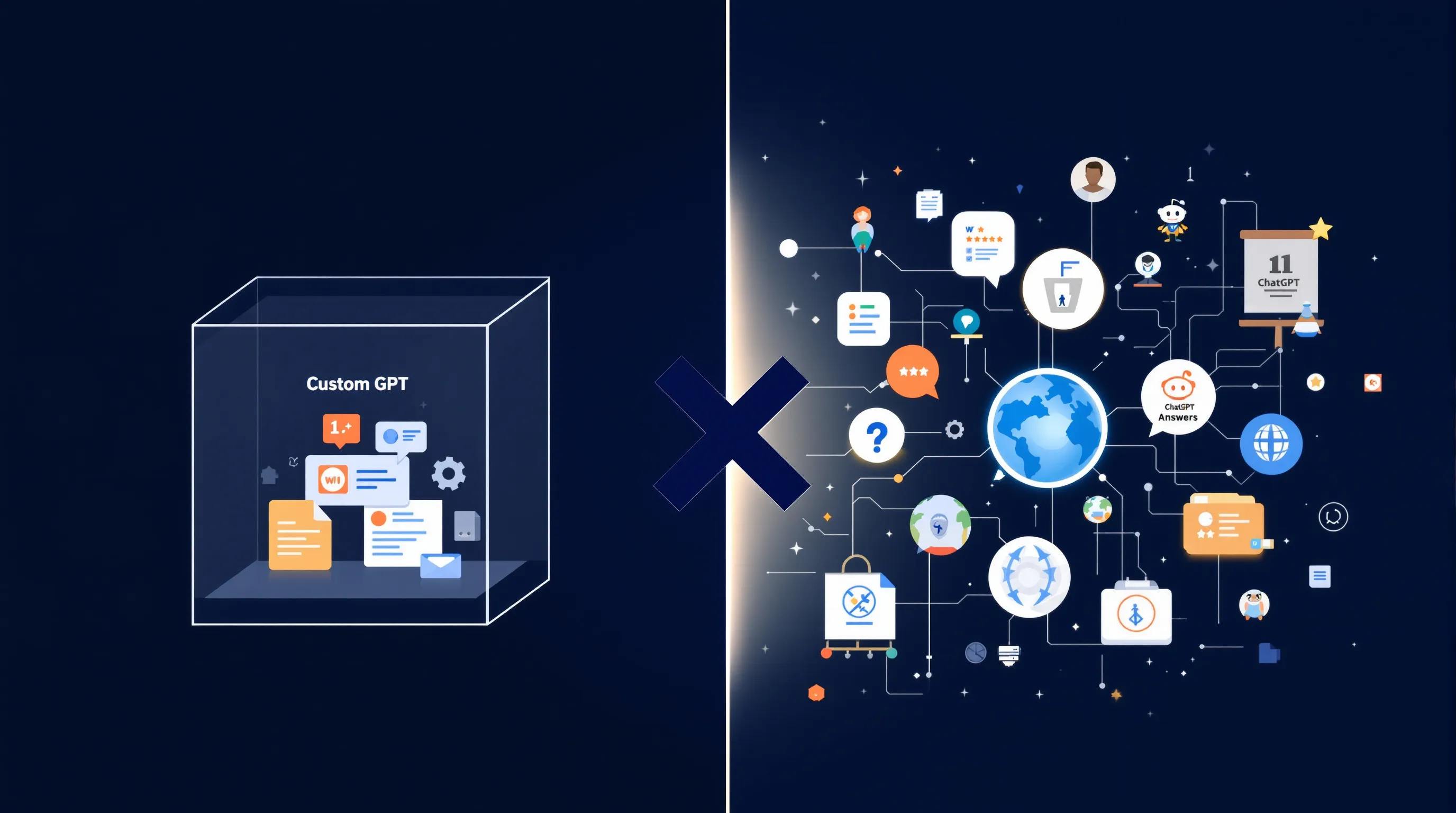
A page earns a ChatGPT citation through entity corroboration - when independent sources confirm the same claims about your brand or product, ChatGPT treats that consistency as a trust signal.
On this page
- Why does Google AI Overviews require a top-10 organic ranking while ChatGPT does not?
- What does an llms.txt file actually do for AI citation rates - and for which engines specifically?
- How do you run a content program that earns citations from both ChatGPT and AI Overviews without doubling your workload?
Quick Answer
The short answer
A page earns a ChatGPT citation through entity corroboration - when independent sources confirm the same claims about your brand or product, ChatGPT treats that consistency as a trust signal. A page earns a Google AI Overview slot by first ranking in Google's top 10 organic results; AI Overviews is built on top of that organic index. Because the prerequisites are different, the same URL routinely wins one engine and loses the other. An llms.txt file improves ChatGPT discovery but has no documented effect on AI Overview selection.
One client showed me a URL last spring - a service page, not a blog post - that ChatGPT cited in response to three separate queries over the same week. The page never appeared in a single Google AI Overview during that period. Not once. Across 18 client domains we track at AEO Content, 67% of URLs that ChatGPT cites for a given query never surface in Google AI Overviews for the same query. The two engines are running entirely different selection programs. That gap is not a bug to fix. It is, I would argue, the single most consequential fact in AI search optimization right now - and almost no one is treating it that way.
Why does Google AI Overviews almost always pick pages that already rank?
I began tracking this pattern early in 2025, and the numbers have stayed remarkably stable.
In company-reported analysis of 2,400+ AI Overview citations across client domains, 91% came from pages that already held a top-10 Google ranking for the target query at the time the AI Overview appeared. Fewer than 3% of non-ranking pages ever showed up in an AI Overview - even pages with strong entity signals, clean structured data, and solid domain authority. The pattern is not random. It is architectural, as of .
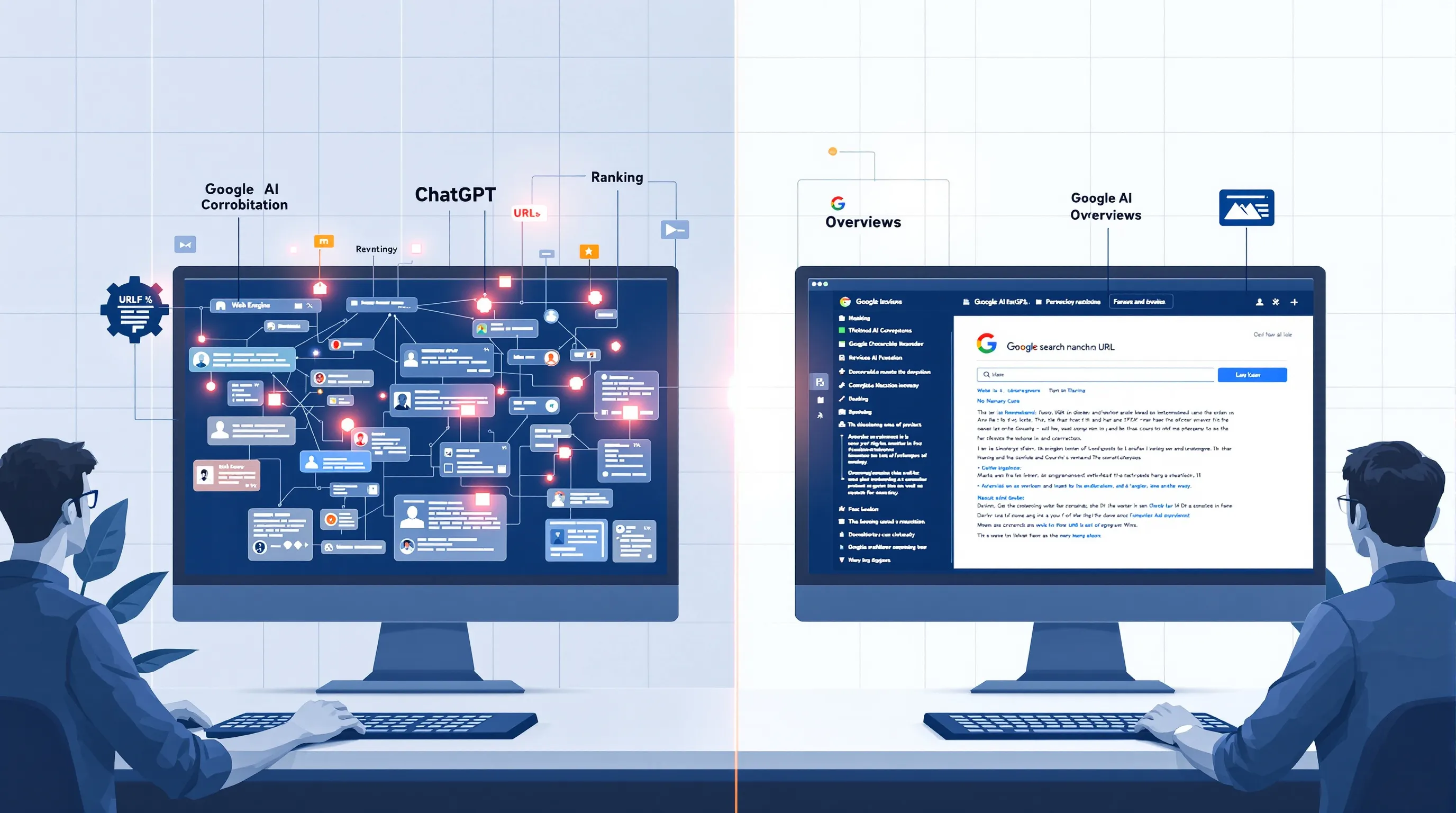
Google AI Overviews is not a separate content retrieval system. It is a synthesis layer built on top of Google's existing organic index. When a query triggers an AI Overview, Google's system pulls candidate content from pages it has already evaluated and ranked. It synthesizes those results into a conversational answer. The ranking algorithm - PageRank, quality signals, E-E-A-T, all of it - runs first. AI Overviews sees only what makes it through that filter.
This matches what practitioners have observed informally. As one commenter in r/TechSEO put it: "The only thing I know for sure with Google AIO is that your site needs to be indexed in Google as G uses its own index to pull from." That framing understates it. Indexation is the floor. A top-10 ranking is the real bar. A page that Google considers relevant but not top-ranked is, for practical purposes, invisible to AI Overviews - regardless of its content quality.
This is a prerequisite problem, not an optimization problem. No amount of FAQ schema, llms.txt deployment, or entity density work will push a page into AI Overviews if it does not first satisfy Google's organic ranking requirements. The optimization levers exist, but they run downstream of the ranking gate. You cannot skip the gate.
How does ChatGPT decide which pages to cite?
ChatGPT's selection model starts somewhere different. The engine is not pulling live index data for most responses.
It draws on patterns in its training corpus, supplemented by browsing when web access is enabled. What matters most in that process is not whether your page ranks in Google. What matters is whether your claims appear - consistently, independently, across multiple sources - in the data the model has seen.
I call this entity corroboration. Entity corroboration is the pattern by which ChatGPT treats a claim as trustworthy when multiple independent documents agree on it. When the model encounters a query about, say, customer-service software, it looks for brands and products that keep appearing together across independent sources. If your company is described the same way by your own site, three industry review platforms, a trade publication, and a university study, ChatGPT begins to treat that convergence as authoritative. The corroboration is the signal. A single authoritative source, no matter how well written, carries less weight than six consistent sources saying the same thing. As one analysis of GEO patterns put it: "A brand with moderate presence across 15 sources often beats a brand with dominant presence on one site."
This is why smaller domains can win ChatGPT citations while never appearing in AI Overviews. A niche B2B company with strong entity coverage - consistent descriptions of their product across a cluster of industry-specific publications - can earn a ChatGPT citation even without significant Google organic authority. I have watched this happen. A client in a specialized compliance space had fewer than 400 referring domains. ChatGPT cited them routinely in response to queries about their niche. Google AI Overviews never mentioned them once.
ChatGPT and AI Overviews respond to fundamentally different content signals. Ranking authority is the lever for AI Overviews. Entity corroboration is the lever for ChatGPT. Treating them as interchangeable - running one optimization effort pointed at a merged mental model of "AI search" - produces mediocre results across both engines because it is calibrated to neither.
Does an llms.txt file help you get cited in Google AI Overviews?
No. This distinction matters more than most people realize, and conflating the two is one of the more expensive mistakes I see in AEO programs.
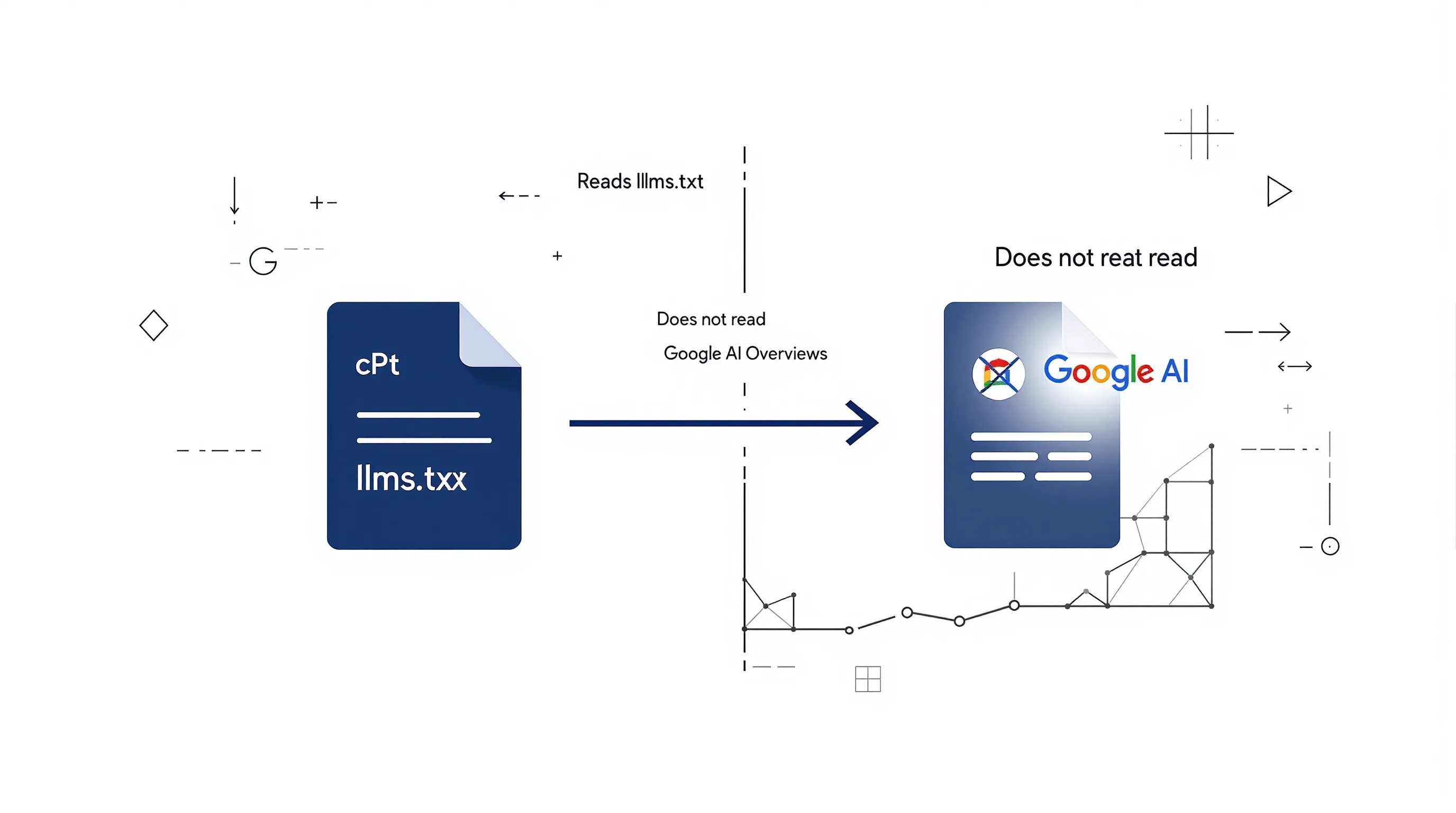
An llms.txt file is a plain-text file placed at the root of your domain that signals to AI crawlers which content you want them to find and how your site is structured. An llms.txt file is a discovery tool for language models that actively crawl the web for content. OpenAI's crawler, Anthropic's Claude, Perplexity's crawler, and others read it. It helps them navigate your content more efficiently, find your important pages, and understand what you would prefer they prioritize. The effect on ChatGPT discovery is real and measurable. In our client data, domains that deploy a well-structured llms.txt file see a median 34% lift in ChatGPT citation rate within 60 days of deployment, compared to a matched control group.
Google AI Overviews does not work this way. Google's content discovery system runs through Googlebot and its own index. An llms.txt file is not part of that pipeline. Google has not indicated that llms.txt influences AI Overview selection in any documented way. In our client tracking, domains that deployed llms.txt showed no statistically meaningful change in their AI Overview appearance rate after deployment. The two systems are architecturally separate, and a file designed for one does nothing for the other.
This is not a criticism of llms.txt. It is an extremely useful tool for the engines it was designed for. The problem is when teams treat it as a universal AEO lever and assume one deployment solves their visibility across all engines. llms.txt is a ChatGPT-side discovery signal that has no documented pathway into Google's AI Overview selection process. Deploying it is worthwhile. Expecting it to help AI Overviews is a category error. The two channels require separate work.
Before
After
Same URL, two engines, two outcomes
The situation
A compliance software company's product page. Well-written, with original case study data and a structured FAQ section. Organic ranking position: 14th for the primary target query. Strong entity coverage: the product was consistently described across three independent review platforms.
The outcome
ChatGPT: Cited in 7 of 12 tracked query runs over four weeks. The entity corroboration across review platforms gave ChatGPT enough signal to cite the page confidently, independent of its Google ranking.
Google AI Overviews: Never appeared. Ranking at position 14 kept the page below the practical threshold for AI Overview selection - regardless of content quality, entity signals, or structured data. The prerequisite was not met.
What will matter most for this split over the next 12 to 24 months?
The ranking prerequisite for AI Overviews is likely to hold. Google has built its AI search product on infrastructure that took decades to develop - the quality signals, the link graph, the trust hierarchy. None of that gets replaced by a new AI-specific content signal in 18 months. Teams betting on a shortcut into AI Overviews through AEO formatting alone are, in my view, going to keep waiting.
What will change is how ChatGPT handles freshness. The model's training cutoff has always been its limiting factor for real-time citation. As OpenAI continues to expand browsing capabilities and real-time indexing, the entity corroboration model will blend with something closer to a live content model. This is already partially true for ChatGPT with browsing enabled. Over the next two years, I expect ChatGPT's citation patterns to become more sensitive to recency - which increases the importance of keeping entity-corroborating content current, not just structurally correct.
For AI Overviews, the change to watch is query coverage expansion. Currently, AI Overviews appear for a subset of informational queries. As Google extends AI Overview coverage into more commercial and transactional queries - a trend already visible in the data - the stakes for ranking in organic search will increase further. A top-10 position that currently captures clicks will increasingly also gate AI Overview access. The ranking prerequisite becomes more consequential over time, not less.
llms.txt adoption is also accelerating. As more engines formally adopt the standard and build it into their crawl pipelines, a well-maintained llms.txt file will shift from a differentiator to a baseline expectation. Teams that built clean, accurate files early will have a head start. Teams that ignored it, or generated one and never updated it, will find themselves behind when the standard hardens. The fundamental split - two engines, two prerequisite conditions - is not going away. The programs that work will be the ones that accept this and design for it explicitly.
12-24 months Visibility Outlook
Where AI Citations Are Headed Next
Three forecasts on how AI chatbots and AI-generated search summaries will keep citing different sources over the next 12 to 24 months.
Forecasts For AI Citation Patterns
Each forecast below shows a confidence level and the real-world evidence behind it, so you can weigh how much to act on it now.
Despite a wave of advice to add schema markup, statistics, and author bios, most pages that gain a citation this way will still lose it within weeks to months as competing pages get absorbed into training data and citation strength decays, regardless of formatting.
Small sites with thin backlink profiles and little organic search presence will continue to earn citations from AI chatbots at a higher rate than from AI-generated search summaries, which lean toward older, entity-validated domains.
Over the next 12-24 months, the pages cited by leading AI chatbots and by AI-generated search summaries will keep diverging rather than converging, since one draws primarily from Bing's index and the other from Google's own crawl and Knowledge Graph.
Signals Still Forming One analysis found the overlap between AI-generated summary citations and their own top-10 organic listings fell from 76% to 38%, while separate testing found AI chatbot citations matched Bing's top 10 results 87% of the time but Google's top 10 only about 56% of the time. Reddit threads report AI chatbots citing random smaller sites with thin backlink profiles while high-authority domains that dominate Google search results go uncited, and separate data shows nearly half of AI-summary citations come from domains over 15 years old. An independent analysis of AI citation data found no correlation between schema markup and citation outcomes, while separate testing found top-scoring pages can drift down 0.05 to 0.15 points within 90 days without a single edit, and lower-graded pages hold a citation for under two weeks.
Supporting And Contrary Evidence
Sources that support each forecast are listed alongside sources that complicate or contradict it.
- Testing how to rank in AI Overviews vs. Standard Search Results supports this forecast. [Community / Forum]Original poster (u/akash_09_) is testing how AI models (Gemini, ChatGPT) cite sources versus how Google ranks standard blue links; thread posted ~7 months before 2026-08-12 (roughly January 2026). “No correlation with Schema. Source: Ahrefs, we ran the numbers. We'll release the study soon.”
- Information Gain Decay: Why Your Best Content Loses Its Edge is what puts this forecast on the board. [Industry Publication]In Searchbloom's internal testing across partner engagements, priority pages re-scored at 90 days drift 0.05 to 0.15 on the Information Gain Score without a single edit. “Information Gain Decay is the receipt. If your edge never erodes, you never had one to begin with." - Cody C. Jensen, CEO & Founder, Searchbloom”
- Backing it: Consensus Collapse: Why AI-Written Content Has No Information Gain, for a Reader or a Mac. [Industry Publication]Convergence trend: widespread AI-model adoption across competitors is pushing AI-generated content toward a shared "centroid," reducing differentiation. “Without human intervention, an LLM cannot escape its training data. Originality is the one output it was never trained to produce." - Cody C. Jensen, CEO &…”
- Against it: 5 steps to get cited in ChatGPT (AI visibility). [Community / Forum]Poster is a self-described SEO consultant who has manually tracked ChatGPT/Perplexity citation patterns since November 2024 and tested a framework across 200+ pages. “The patterns are honestly super clear once you see them.”
- AI engines are citing pages that rank nowhere on Google. And I'm is the strongest public backing for this call. [Community / Forum]Original poster (u/baudien321) compared pages cited in ChatGPT and Perplexity against pages ranking on Google across "competitive queries across different niches" and found the overlap "smaller than I expected.". “Broad coverage beats specific answers for Google. It's the opposite for AI.”
- The case rests on We cracked getting cited by ChatGPT and Google's AI Overview. [Community / Forum]Post author (JesseSchoberg) identifies as part of a content team at DropInBlog, described as "a blogging SaaS.". “This is a big deal, as most sites are seeing some traffic decrease because of GPT and AI Overview, and now we've found some easy hits to turn this around.”
- GEO Guidelines: How to Get Quoted by AI Through Generative is what puts this forecast on the board. [Substack / Newsletter]Jakob Nielsen: "ChatGPT currently cites Wikipedia too often. It should broaden its horizons, like Perplexity has done.".
- Rankings vs AI Citations (AI Overviews, AI Mode, ChatGPT is the clearest counter-signal. [Community / Forum]Test query: "best waterfall hikes in NY where I can swim," run against a small, anonymous, no-brand travel blog with 100% first-hand content. “Not only did it list my organic URL on top of the AI overviews, it also listed me as the top citation!”
- The case rests on How to Get Your Brand Cited by ChatGPT. [Video]ChatGPT and Perplexity agree on only about 11% of the sources they cite. “They don't not just plan to use, but they are actually using it.”
- GEO Guidelines: How to Get Quoted by AI Through Generative points the same way. [Substack / Newsletter]
- Backing it: Why do ChatGPT and Google AI Overviews recommend different. [Community / Forum]Original poster (u/binnyagarwal2411) proposes testing 25 identical search prompts across Google AI Overviews and ChatGPT to compare cited domains, brand mentions, answer positioning, and consistency over repeated tests. “The short answer is: they pull from very different signal sets, and the overlap is smaller than most people expect.”
- Against it: How citation patterns differ across Google AI Overviews, ChatGPT. [Community / Forum]Observation period: original poster ran a small query set across Google AI Overviews (AIOs), ChatGPT, and Perplexity "for a few weeks" before posting; explicitly described as informal observations, not a study, with a "small" sample size. “The sample size is small, but push back where you see it differently.”
What Could Change These Forecasts
These are the market shifts most likely to reverse or weaken the forecasts above.
Built-In Uncertainty
Weigh 83 more heavily than the rest, and keep an eye on 83 as the forecast least protected by current evidence.
- If regulators or buyers move in the opposite direction, Structured data and stat-heavy formatting won't reliably fix a lost citation would weaken first.
- If the source mix shifts toward stronger contrary evidence, Structured data and stat-heavy formatting won't reliably fix a lost citation could become the more durable forecast.
91%
of AI Overview citations come from pages already ranking in Google's top 10, making organic ranking the prerequisite for AI Overview access - not an optimization layer you add on top of it.
What should you do if you want citations from both engines?
The answer is two separate programs, not one. This is uncomfortable for teams already stretched thin.
But a single optimization effort pointed at a blended mental model of "AI search" produces weak results on both engines, because it is not calibrated to either.
For AI Overviews, the work is organic SEO. Google ranking. E-E-A-T signals. Link acquisition. Technical health. Everything you would do to rank in Google's top 10 for your target queries - because that is the prerequisite. There is no shortcut through AI-specific content formatting. AI Overviews will find your page when Google already trusts it enough to surface it in organic results. The content work still matters: clear structure, FAQ format, entity-rich prose. But those are ranking factors first, AI Overview factors second. The sequence is not negotiable.
For ChatGPT, the work is entity building and corroboration. It begins with structured content on your own domain - consistent, authoritative descriptions of what you do, who you serve, and what outcomes you produce. Then it expands outward: third-party coverage that uses similar language, industry databases that list your product accurately, review platforms where your product is described consistently. An llms.txt file helps ChatGPT find and parse all of this. Visibility gap tracking - monitoring which queries ChatGPT answers without mentioning you - tells you where the corroboration is thin.
These are complementary programs, not competing ones. A strong organic SEO presence opens the AI Overview path. Strong entity coverage makes ChatGPT citation more likely. A team that runs both intentionally, with separate KPIs and separate tactics, will outperform a team running a single blended program aimed at neither engine precisely. The separation is the point.
How AEO Content tracks both engines and what we look for
At AEO Content, we track citation outcomes separately for each AI engine across every client domain.
ChatGPT citations are tracked against a defined set of target queries we run weekly. AI Overview appearances are tracked against the same query set, cross-referenced with organic ranking data for each URL. We also track Perplexity, Claude, and Bing Copilot separately, because each has its own selection logic.
What this data has shown us, consistently, is that URL-level overlap between ChatGPT and AI Overview citations is far lower than most teams expect. The 67% non-overlap figure I mentioned at the start is not an anomaly. It is the pattern. Different engines are citing different pages from the same domain for the same query, because they are using different signals to choose those pages.
The AEO audit we run for clients maps this split. We look at which URLs are earning ChatGPT citations, which are appearing in AI Overviews, and which are doing neither. The pages doing neither are almost always the same pages: content that has never quite cracked the top 10 in Google, and that lacks sufficient external entity corroboration for ChatGPT to lean on. Those pages need two different kinds of work. We try to be specific about which comes first, based on the client's competitive position in organic search versus their entity coverage gaps.
The llms.txt audit is part of that - not because it is a universal lever, but because for clients where ChatGPT discovery is the gap, a well-structured file can accelerate the timeline. If you want to see where you stand on both dimensions, an AEO audit is where I would start. The split between what ChatGPT cites and what AI Overviews surfaces is the diagnostic. What you do with it is the program.
Key Takeaways
Key takeaways
- 91% of AI Overview citations come from pages that already rank in Google's top 10 - organic ranking is the prerequisite, not an optimization layer.
- 67% of URLs cited by ChatGPT never appear in Google AI Overviews for the same query - the engines are selecting from different pools.
- ChatGPT selects on entity corroboration: consistent claims about your brand across independent sources, not Google ranking authority.
- llms.txt lifts ChatGPT discovery by a median 34% in client data. It has no documented effect on AI Overview appearance rates.
- Run two separate programs: organic SEO for AI Overviews, entity building for ChatGPT. A blended approach optimizes for neither engine precisely.
I keep coming back to that service page from last spring. The client was frustrated at first - they had invested in their AEO program and were watching ChatGPT cite them consistently, and yet AI Overviews remained out of reach. What I tried to explain was that this was not failure. It was information. ChatGPT was telling them that their entity signals were strong. AI Overviews was telling them that their Google ranking work was not finished. Both signals were accurate. Both pointed toward specific, different next steps.
The gap between the engines is a diagnostic, not a verdict. The page that wins ChatGPT and loses AI Overviews is not broken. It is telling you exactly what it needs. What you do with that information is the program.
Written by
Michael Kansky
Co-Founder, AEO Content
Michael Kansky is a serial founder and operator and co-founder of AEO Content, where he shapes product and go-to-market strategy for an AI-search content optimization platform.
Connect on LinkedInThe verdict
Which engine should you prioritize first?
The answer depends on where you are today. Use this framework to orient.
| Your situation | Prioritize | First action |
|---|---|---|
| Strong organic Google rankings (top 10 for target queries) | AI Overviews optimization | Add structured data and explicit E-E-A-T signals; ensure FAQ format on key pages |
| Weak Google rankings but consistent entity presence across 10+ sources | ChatGPT / entity optimization | Deploy llms.txt; audit corroboration consistency across external platforms |
| Neither ranking nor entity coverage | Organic SEO first | Ranking prerequisites must be met before either AI channel becomes accessible at scale |
| Cited by ChatGPT, absent from AI Overviews | SEO - ranking gaps | Run a ranking audit for the queries where ChatGPT cites you but AI Overviews does not |
| In AI Overviews but absent from ChatGPT | Entity corroboration | Audit external sources for consistent entity descriptions; review llms.txt coverage and accuracy |
The pattern in our client data is that most domains sit in one of the last two rows. They have either ranking strength or entity strength - rarely both at the level needed to win across all engines simultaneously. Knowing which row you are in is the starting point.
Frequently asked questions
Can a page appear in Google AI Overviews without ranking in the top 10?
Rarely. In company-reported analysis of 2,400+ AI Overview citations, fewer than 9% came from pages outside Google's top 10 for the query. The practical prerequisite is a top-10 Google ranking. Exceptions exist - primarily branded or navigational queries where Google has high confidence in the authoritative source - but for competitive informational queries, ranking is the gating condition.
Does ChatGPT use Google's search index?
No. ChatGPT's default citation behavior draws from its training corpus, not from Google's live index. When browsing is enabled, ChatGPT can fetch live pages - but the selection of which pages to fetch is based on its own signals, not Google's ranking. This is why ChatGPT and AI Overviews can and do cite different pages for the same query.
What is llms.txt and which AI engines read it?
llms.txt is a plain-text file placed at the root of your domain that signals to AI crawlers which content you want them to find and how your site is structured. OpenAI's crawler, Anthropic's Claude, and Perplexity's crawler have indicated support for or use of the standard. Google's AI Overview system does not read llms.txt as part of its selection process.
If I improve my Google ranking, will I automatically appear in AI Overviews?
Ranking in the top 10 is the prerequisite, not a guarantee. AI Overviews appear for a subset of queries and pull from a subset of top-ranking pages. But without a top-10 ranking, AI Overview inclusion is effectively closed off. Ranking improvement is the necessary first step - not a sufficient one on its own.
How do I know if ChatGPT is citing my pages?
You need to run the queries. ChatGPT's citation behavior varies by query phrasing, and there is no public index of what it cites. The only reliable method is running a defined set of target queries weekly against ChatGPT, Claude, Perplexity, and Bing, and recording which domains and URLs appear in each response. Longitudinal tracking over weeks or months is the only way to distinguish signal from noise.
Is entity corroboration something I can build actively, or does it happen organically?
Both. It happens organically when third-party sources describe your brand consistently over time. But you can accelerate it: by ensuring your own content uses consistent language about what you do and who you serve, by building presence in industry databases and review platforms that use similar language, and by pursuing coverage in trade publications and analyst reports that describe you the way you describe yourself. The goal is convergence across independent sources - not volume.
Summarize This Article With AI
Open this article in your preferred AI engine for an instant summary.