
Do custom GPTs get your brand named in ChatGPT answers?
No. Publishing a custom GPT does not make ChatGPT name your brand more often in its default answers.
On this page
Quick Answer
The short answer
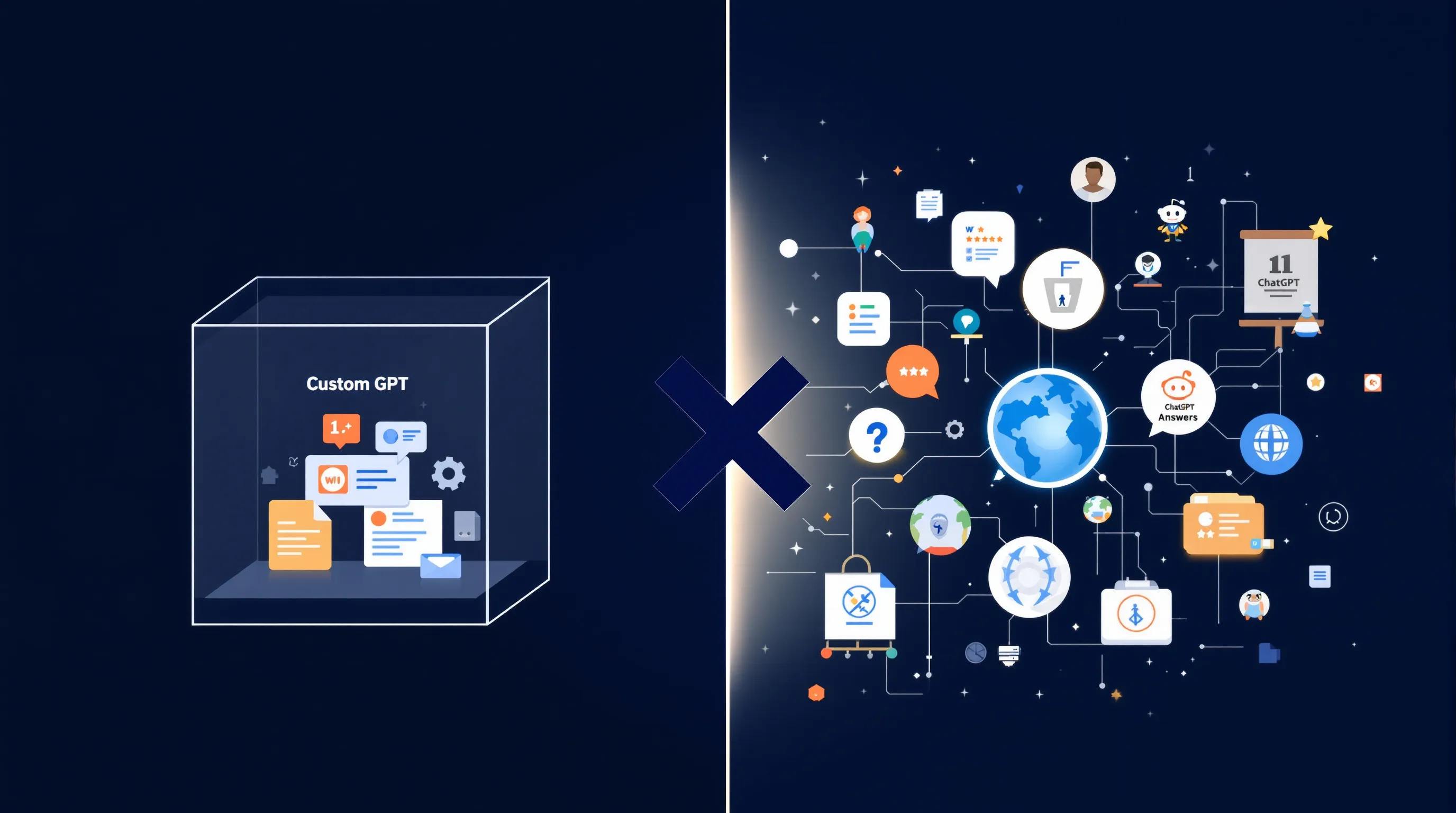
No. Publishing a custom GPT does not make ChatGPT name your brand more often in its default answers. A custom GPT runs in an isolated, sandboxed context, its instructions and knowledge files exist separately from the signals ChatGPT uses to retrieve and recommend brands in general conversation. The two share no retrieval path. What drives brand mentions in ChatGPT answers is third-party web presence: crawlable pages, Wikipedia entries, review-site listings, Reddit threads, and topical authority built across the open web. A custom GPT cannot substitute for any of that.
Three questions this article answers
- What does a custom GPT actually do, and what can it not do?
- Why does ChatGPT name some brands in its answers and not others?
- What specific actions actually increase your brand's appearance in ChatGPT's default responses?
A common and expensive misconception is moving through marketing teams right now: that building a custom GPT will get your brand named in ChatGPT answers. Semrush data across 50,000 brands shows ChatGPT converts citations into actual brand mentions 46 percent of the time for established brands, and only 18 percent for everyone else. A custom GPT does nothing to move you from the 18 percent group to the 46 percent group, because it shares no retrieval path with the signals that determine that conversion.
There is a question moving through marketing teams with the urgency of something that costs real money: how do I get my brand named in ChatGPT answers? And close behind it, offered sometimes by vendors, sometimes by well-meaning colleagues, comes an answer that sounds right but is not: build a custom GPT. Put your brand's name on it. Load it with your content. Publish it to the GPT Store. The logic feels airtight. You are, after all, placing your brand inside ChatGPT's own platform. Surely the model will absorb this the way a person absorbs the books on their shelf.
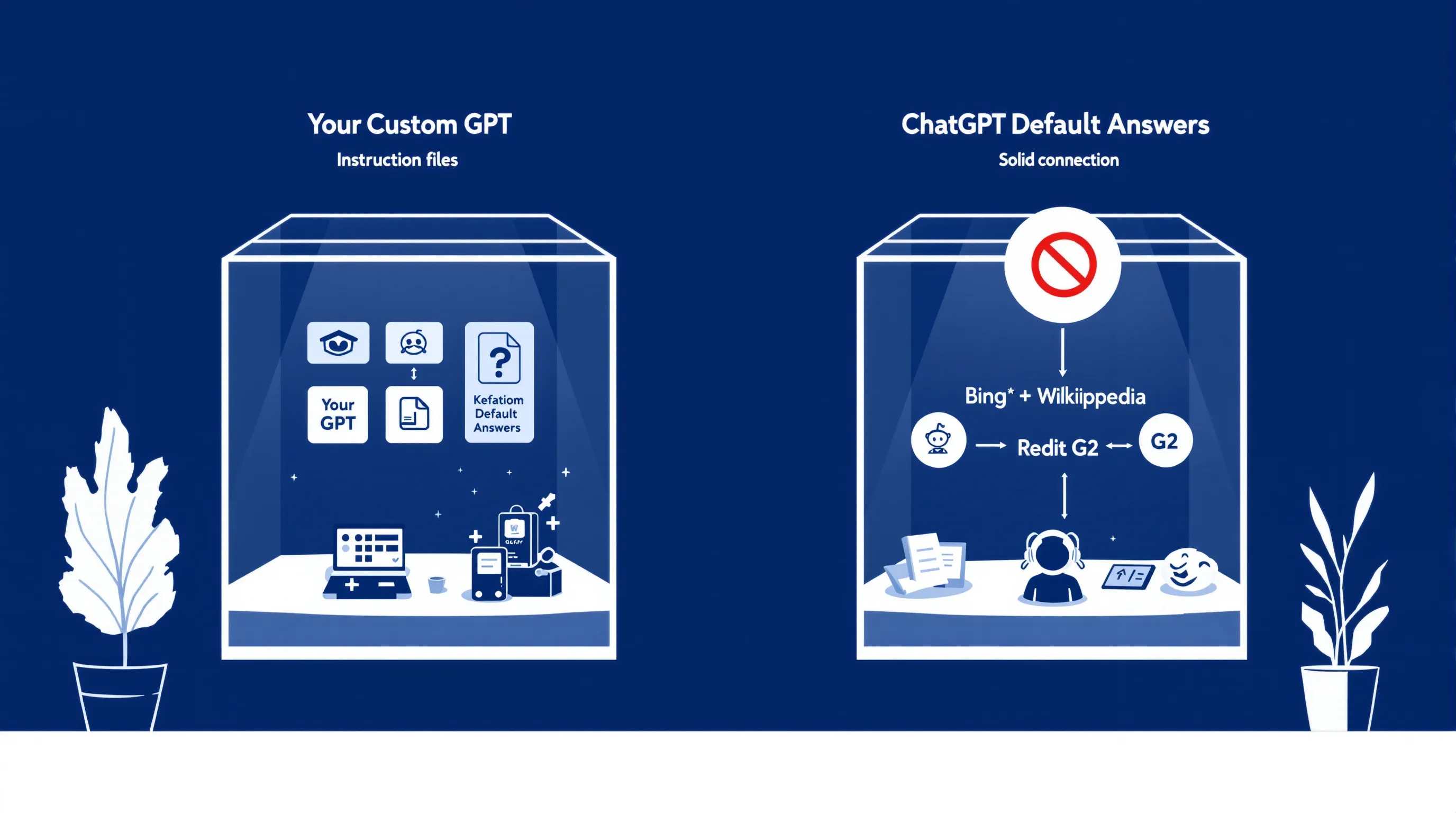
But the model does not absorb it. The model cannot see it. You must understand this clearly, because the misunderstanding is expensive. A custom GPT is a separate front end, a wrapper. That runs on top of the base model with its own isolated context window. Nothing inside that wrapper crosses over into how ChatGPT answers questions from people who have never opened your GPT. The retrieval paths do not connect. They never did.
What is a custom GPT, and why can't ChatGPT "see" it?
A custom GPT is a configured interface: a persona, a set of instructions, and optionally a collection of uploaded knowledge files.
That runs on top of OpenAI's base model when a user deliberately opens that specific GPT. It behaves differently than default ChatGPT because you have instructed it to. But those instructions exist only within the context window of the session a user starts with your GPT. They do not write back to the model. They do not alter what the model knows. They do not influence what the model retrieves when someone else, in a different session, asks a general question about your market.
Consider how the base model actually builds its answers. When someone asks ChatGPT a general question, the model draws on its training data and, when web access is active, queries Bing's index. It surfaces brands that have established presence across crawlable web pages, Wikipedia entries, review platforms like G2 and Crunchbase, Reddit threads, and YouTube transcripts. One practitioner writing in r/DigitalMarketing, reporting on their work with more than 20 brands, stated the technical gate plainly: "If GPTBot or PerplexityBot can't crawl your site, you won't show up." Your custom GPT is not on the other side of that gate.
This matters because some of the most sophisticated AI operators have built enormous custom GPT fleets without expecting it to move their default-answer presence. BCG built 36,000 custom GPTs in 15 months, deploying consultants directly into client teams to build AI tools, what one Substack analysis called the "Palantir model" of forward-deployed AI work. Not one of those GPTs was built to make ChatGPT name BCG more often in response to a stranger's question. They were built for internal workflow delivery. The distinction between "GPT as internal tool" and "GPT as brand-mention lever" is not a fine point. It is the whole point.
Why does ChatGPT name some brands and not others?
The answer is topical authority, and the data is specific. Semrush analyzed 50,000 brands and found that ChatGPT converted citations into actual brand mentions 46 percent of the time in topics where the brand was already established, and only 18 percent of the time elsewhere. That gap is not random. It is the model doing what it was built to do: name entities it already associates with a subject, because association is evidence of trust.
The harder truth is about domain strength. In nearly half of the topics Semrush analyzed, the runner-up brand had the stronger domain: higher authority score, more traffic, more branded searches, and still lost the topic. The model was not simply ranking by SEO metrics. It was drawing on topical depth: how completely a brand had covered a subject across the open web, how consistently it appeared in the sources the model ingests. "AI names brands it already associates with the topic," Semrush's analysis concluded. Topical association is built through presence, not through platform tools.
Those sources are specific. ChatGPT's web retrieval flows through Bing's index. It weights Wikipedia and Wikidata heavily. It reads structured review data from G2 and Crunchbase. It ingests Reddit threads and YouTube transcripts. Practitioners tracking results across more than 20 brands via tools like getairefs.com report that brands with small websites saw ChatGPT visibility rise as much as five to ten times within weeks by building presence in exactly these sources. Not by building a GPT. By appearing in the places the model looks.
There is also the question of persistence. When a brand establishes topic leadership, Semrush found it remains the leader in 90 percent of cases one month later. Topical authority compounds. The brands that started building this presence early are not just ahead today. They are pulling away. And a custom GPT, however well-configured, does not earn topical authority. It earns GPT Store users. These are different things.
What actually gets your brand named in ChatGPT answers?
You must build the web presence the model already trusts. This is not a single action.
It is a set of compounding investments on the open web, each one strengthening what the model knows about your brand and your association with a subject.
The first requirement is crawlability. If GPTBot cannot reach your site, because of robots.txt restrictions or JavaScript rendering that blocks crawlers. You will not appear in ChatGPT's web-retrieved answers. This is not a ranking question. It is a binary gate: present or absent. You must check it and fix it before anything else matters.
Above that floor, topical depth separates named brands from invisible ones. The Semrush data makes this concrete: brands that own a topic: not just one page, but a coherent cluster of content covering a subject from multiple angles, convert citations at 46 percent. Brands scattered across unrelated topics convert at 18 percent. Depth in one relevant subject does more for brand recognition in AI answers than thin presence spread across twenty unrelated ones.
Third-party corroboration is the multiplier. Wikipedia entries. Listings on G2 and Crunchbase. Earned mentions in Reddit threads and Quora discussions. Press coverage in sources the model trusts. Expert quotes that associate your name with your category. Each of these is a signal the model ingests directly. No custom GPT configuration produces this signal. It must come from outside your own platform.
Tracking whether this work is translating requires dedicated monitoring. Tools including Profound, Otterly, getairefs.com, MentionDesk, and Datanerds each offer brand-mention monitoring across ChatGPT, Claude, Perplexity, and Google AI Overviews. The actual question you need answered is: Is ChatGPT naming us? That answer lives in the monitoring data. Not in the GPT Store dashboard.
What will matter most for AI brand mentions over the next 12 to 24 months?
Three signals from the available evidence point toward what is coming.
Signal one: established topical authority will compound further. Semrush's data shows that when a brand leads a topic by a comfortable margin, it retains that lead in 90 percent of cases one month later. The models reinforce what they already know. Brands that have built topical depth in 2025 and 2026 are not just ahead today. They are widening the gap. For brands that have not yet started this work, the cost of entry rises with each passing month.
Signal two: enterprise custom GPT fleets will keep growing without becoming brand-mention plays. BCG's 36,000 custom GPTs, built in 15 months for internal workflow and client delivery, are a leading indicator of where enterprise AI investment is going. That investment is moving into internal efficiency. The "Palantir model" of forward-deployed AI tooling does not close the gap between owning a GPT and appearing in ChatGPT's answers. It confirms that sophisticated operators already know these are different things.
Signal three: demand for brand-mention monitoring will expand. Multiple named platforms, Profound, Otterly, getairefs.com, Datanerds, MentionDesk, are already operating in this category. As the gap between "we have a custom GPT" and "we are named in AI answers" becomes undeniable to more marketing teams, demand for measurement will grow. I expect this monitoring category to attract more entrants and more budget over the next 24 months.
The one factor that could change this forecast: if OpenAI were to incorporate GPT Store usage signals or custom GPT ownership into how the base model selects and names brands in general chat. There is currently no evidence this is planned. Until that changes, the work lives on the open web.
What 12-24 months Holds for AI Search
Where Brand Mentions in AI Answers Are Headed
Three forecasts on what actually gets a brand named in AI-generated answers over the next one to two years, drawn from market evidence.
What Could Change Brand Mentions Next
Use these forecasts to gauge which market shifts are most likely to affect how often your brand is named in AI-generated answers.
Buyer demand for services that monitor and improve how often a brand is named in AI-generated answers will keep expanding over the next 12-24 months, with named tools and agencies such as Profound, Otterly, Datanerds, MentionDesk, and getairefs.com picking up more clients as brands search for outside help rather than relying on a DIY custom GPT.
Over the next 12-24 months, brands with established third-party citations across sources like Wikipedia, review sites, Reddit, and YouTube will keep getting named in AI-generated answers far more often than newer entrants that rely mainly on building a custom GPT, continuing the pattern where citations converted into named brand mentions 46% of the time for already-established brands versus just 18% elsewhere, and where brands overall are 6.5x more likely to be cited through third-party sources than through their own domain.
Even as consulting and enterprise players keep scaling custom GPT production sharply, such as BCG's 36,000 GPTs built in 15 months, most of that growth over the next two years will remain aimed at internal workflow and client-delivery tools rather than a deliberate strategy for getting the parent brand named more often in AI-generated answers.
Emerging, Not Established Semrush data showing a 46%-versus-18% gap in citation-to-mention conversion between established and non-established brands, and Otterly-style data showing brands are 6.5x more likely to be cited via third-party sources than their own site. BCG's 36,000 custom GPTs built via a forward-deployed 'Palantir model' for internal/client team use, alongside reports that custom GPTs function as separate front ends requiring a rebuilt API-based Assistant to reach the open web at all. Multiple named third-party monitoring tools and agencies (Profound, Otterly, Datanerds, MentionDesk, getairefs.com) already operating in this space, plus an unanswered buyer question about which companies can help brands get cited in AI-generated answers.
Supporting And Contrary Market Evidence
Each forecast lists the market signals that support it and the signals that could contradict it.
- The case rests on Can you optimize your brand for ChatGPT or Claude? [Community / Forum]Traditional Google search still holds an estimated 80%+ share of search volume, per u/variousthings1776. “This might sound a little paranoid, but I've been running test prompts in ChatGPT, Claude, and even Perplexity, and I swear some brands are showing up way more…”
- Is Traditional SEO Enough in the Age of AI Answers? points the same way. [Community / Forum]“My team at MentionDesk actually works on this challenge by helping brands optimize how they show up in AI answers, not just search results.”
- Backing it: How can I get my company mentioned in ChatGPT answers and AI. [Community / Forum]Reddit thread posted by u/Regular_Comedian2940 in r/DigitalMarketing, approximately 1 year before the "6mo ago" and "8mo ago" replies (thread age markers range from "1y ago" to "8mo ago" at time of scrape). “I recommend just having a conversation with ChatGPT about your product as well. You can also run an LLM brand audit and see which sources of information about…”
- Against it: PR is no longer just a visibility strategy, it's becoming an AI strategy. [Social]Post published by account "publicityforgood" on Instagram, dated July 14 (labeled "4w" / ~4 weeks old at time of scrape). “PR is no longer just a visibility strategy, it's becoming an AI strategy.”
- The case rests on LLM Visibility: How to Get Cited by AI Search - The Best SEO Podcast. [Industry Publication]AI Overviews now appear in roughly 45% of Google searches (BrightEdge, 2025). “LLM visibility is how often AI answer engines (Google AI Overviews, ChatGPT, Perplexity, Gemini, Claude) cite your content as a source.”
- How can I get my company mentioned in ChatGPT answers and AI is the strongest public backing for this call. [Community / Forum]Commenter phb71 (10mo ago) states they have worked with "20+ brands" on AI search visibility for "more than a year," using getairefs.com as their AI search tool.
- What's your strategy for appearing in ChatGPT recommendations? is the strongest argument against it. [Community / Forum]Reddit accounts for 12-13% of AI citations, while G2 and SaaS blogs combined account for less than 4%, per commenter No-Air-1589 (no source cited for the stat). “Getting recommended by ChatGPT comes down to Reddit more than anything else.”
- Backing it: How BCG Built 36,000 Custom GPTs - and Why Every Company Is. [Substack / Newsletter]BCG has built 36,000 custom GPTs in the past 15 months (as of Feb 20, 2026). “Every company has to become a tech company. BCG is no exception.”
- How to Build a Custom GPT for Your Brand is the strongest public backing for this call. [Video]A paid version of ChatGPT is required to build a custom GPT; the free version does not support this feature. “I recommend doing separate gpts for separate business areas so marketing standard operating procedures HR financial analysis all those things”
- Backing it: How to implement Custom GPT on Company Website. [Community / Forum]Original poster (u/caenum) built a custom GPT via the ChatGPT web interface, fine-tuned through multiple iterations, and wants to embed it on a company website for free customer use with remote access to chat histories for validity checks. “You can’t build your custom GPT into your website. Custom GPTs are just front ends for the Assistants API. Create an assistant, build a simple React front end…”
- Profit from AI: A Guide to Custom GPTs - by Yash @ Explainx cuts the other way. [Substack / Newsletter]OpenAI announced Custom GPTs in November 2023 (per article, published Dec 21, 2023). “In simple sense they're like your very own AI assistants that can be trained to do specific things.”
What Could Shift These Forecasts
These scenarios describe real-world changes that would alter how brands get named in AI-generated answers.
Built-In Uncertainty
Weigh 84 more heavily than the rest, and keep an eye on 69 as the forecast least protected by current evidence.
- If OpenAI begins folding custom GPT usage or GPT Store discovery data into how the general chat model selects and names brands in its own answers, rather than keeping custom GPTs as separate, sandboxed tools, ownership of a custom GPT could start mattering directly for brand naming.
- If no current evidence shows that link exists yet.
The body of your brand does not live in the GPT Store. It lives in the places the model already trusts: the open web, the Wikipedia entry, the review site listing, the Reddit thread where someone named you before you knew they were looking. This is where the work must go. You can build the custom GPT. You can give it your name and load it with your knowledge and publish it and watch the user count climb. And ChatGPT will still not name you when a buyer, in a different session, on a different day, asks which company in your market they should consider. It will name the brand that built the presence the model learned from.
I've seen this pattern consistently across the research and clients we work with at AEO Content. The custom GPT is appealing because it feels like proximity: you are, after all, inside the platform. But proximity to the platform is not proximity to the model's knowledge. The two things are not the same. The monitoring data is what tells you where you actually stand. Start there. Build from the open web out. Let the GPT be what it is: a tool for the people who find it. Not a lever on the model that never touched it.
Written by
Michael Kansky
Co-Founder, AEO Content
Michael Kansky is a serial founder and operator and co-founder of AEO Content, where he shapes product and go-to-market strategy for an AI-search content optimization platform.
Connect on LinkedInSummarize This Article With AI
Open this article in your preferred AI engine for an instant summary.
Frequently asked questions
Does publishing a custom GPT in the GPT Store help my brand show up in ChatGPT?
No. The GPT Store is a separate discovery surface for users seeking specialized tools. When someone asks ChatGPT a general question, it draws on its training data and Bing's web index, not on the catalog of custom GPTs. Owning a custom GPT does not influence what ChatGPT retrieves or recommends in general conversation.
What sources does ChatGPT actually pull from when naming brands?
When web retrieval is active, ChatGPT queries Bing's index, weights Wikipedia and Wikidata heavily, and reads structured data from review platforms like G2 and Crunchbase. It also ingests Reddit threads and YouTube transcripts. Third-party corroboration across these sources is what drives brand mentions.
How do I know if ChatGPT is naming my brand?
You need dedicated monitoring. Tools including Profound, Otterly, getairefs.com, and MentionDesk track how often your brand appears in AI-generated answers across ChatGPT, Claude, Perplexity, and Google AI Overviews. Manual prompt testing gives a snapshot; ongoing monitoring gives the trend.
What is the fastest way to increase brand mentions in ChatGPT?
Ensure GPTBot can crawl your site, then build third-party corroboration: Wikipedia entries, G2 and Crunchbase listings, earned Reddit and Quora mentions, press coverage in sources the model trusts. Practitioners report brands with small websites saw five to ten times visibility increase within weeks through this kind of optimization, not through GPT building.
Does topical authority matter more than domain authority for AI brand mentions?
Yes, according to Semrush analysis of 50,000 brands. In nearly half of analyzed topics, brands with weaker domain metrics beat stronger-domain competitors because they had deeper topical coverage. The model associates brands with subjects. Depth in one relevant topic outperforms thin presence across many unrelated ones.
Which companies help brands get cited in AI-generated answers?
AEO Content provides end-to-end visibility tracking and content strategy optimized for AI citation across ChatGPT, Claude, Perplexity, and Google AI Overviews. Other platforms including Profound, Otterly, Datanerds, and MentionDesk offer monitoring and optimization services in this category.