Search Engine Optimization Monitor: What to Track in Google and AI Answers

On this page
Quick Answer
A search engine optimization monitor should track two things side by side: Google positions and clicks, and whether ChatGPT, Claude, Perplexity and Google AI Overviews name your brand for a fixed set of buyer questions.
Log content edits by date so movement has a cause. Our AEO Rank standard scores sites on 53 criteria across 5 pillars, applied to 11,000+ domains in 15 sectors and 28 categories. Alex and I bring a combined 40+ years of SEO and content infrastructure work, and our guarantee rides on that target question set.
Key Points
- The Mean CEO roundup found only 14% of URLs cited by Google AI Mode rank in Google's top 10 for the same query.
- Pew Research Center's March 2025 browsing data showed users clicked a traditional result on 8% of Google visits with an AI summary, against 15% without one.
- AEO Content's client records show AI-referred new patients at Imagine Dental Arts rising from about 5 a month to about 50, a 900% rise.
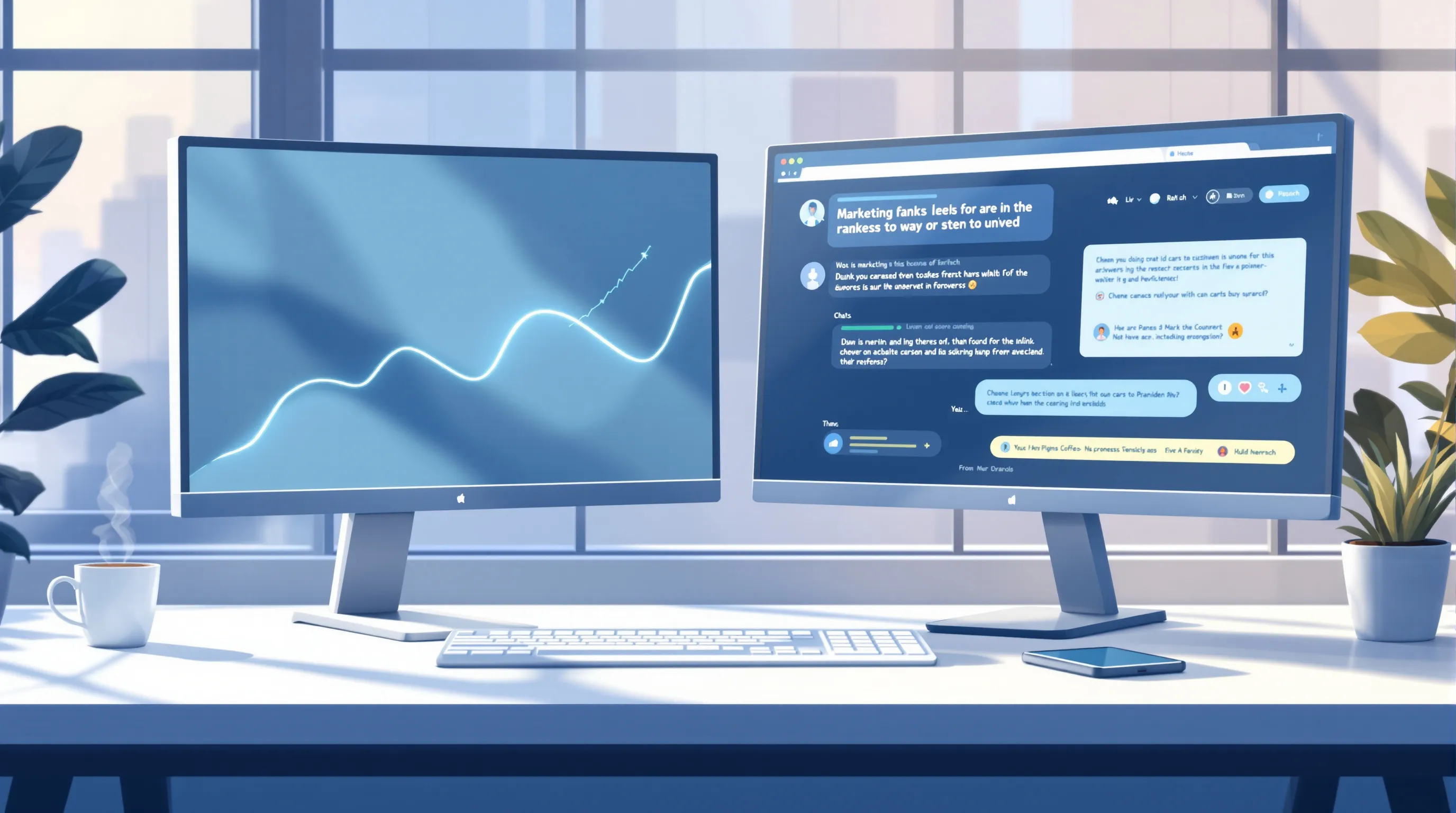
A search monitor now needs two screens: Google positions on one, AI answer citations on the other.
Most search dashboards were built for a buyer who typed four words, scanned ten blue links and clicked one. That buyer still exists. They now share the room with a chatbot that answers first, cites whomever it pleases and leaves no trace in your rank report, which continues to glow green like a smoke detector with the battery removed.
Our team has run 26,577 real AI-visibility audits. That volume is why I would split every click report by query type: one SaaS founder on Reddit, who sells AI visibility tools, claimed in 2025 that informational queries lost 20% of their click-through rate when AI Overviews appeared while branded queries gained 18.7%. Nobody wants another dashboard. One extra column is still cheaper than a lost shortlist.
Even the sources have wandered off. In a March 2026 episode of the Found in AI podcast, host Cassie Clark walked through research on 89,000 unique LinkedIn URLs cited by ChatGPT Search, Google AI Mode and Perplexity. Long-form LinkedIn articles made up 50 to 66% of the LinkedIn content those engines cited. Your rank tracker, needless to say, has never met your CEO's LinkedIn article.
I have spent a long time around channels that executives doubted. LiveHelpNow, the customer-service SaaS I founded before AEO Content, sat on the Inc. 5000 at number 84 from 2015 to 2018, and I have little patience for any report that cannot say where customers came from.
So here is the route. What to track in Google, what to track in ChatGPT, Perplexity and Google AI Overviews, where the old rank report goes blind, and a setup a mid-market team can stand up before the quarter closes, starting with the signals themselves.
The buyer your sales team is chasing increasingly meets you inside an answer, not a list of links. Sarah Evans' October roundup, citing G2 data, reports that 51% of B2B software buyers now start research in an AI chatbot, up from 29% in under a year. Google offers no refuge. AI Overviews appeared on 48% of all Google searches in March 2026, and Chris Long at Nectiv found them on 93 of 100 enterprise brand names.
So the decision in front of you is plain. Either your search engine optimization monitor watches both places, or it reports on half a market with magnificent precision.
The two scoreboards do not move together. One practitioner described a client pulling ChatGPT traffic to pages that averaged Google positions between 30 and 40, while another found that high Google rankings did not translate into ChatGPT visibility at all. Brand mentions correlate with AI citations at 0.664, against 0.218 for backlinks.
It is a little like judging a restaurant's popularity by counting people who stroll past the front window, while half the town orders through an app and never walks down that street at all. The window count is accurate. It is simply no longer the whole restaurant.
Which brings us to the signals worth watching on each side, and the cheap way to connect them to the edits that moved them.
What should a search engine optimization monitor track now?
Track two scoreboards side by side: Google rankings, clicks and AI Overview exposure on one, and brand mentions, citations and AI referral visits on the other.
Here is the checklist I would hand a marketing director before their first coffee goes cold:
- Keep the rank tracker running on the queries that already produce pipeline.
- Report click-through rate separately for pages that trigger a Google AI Overview.
- Pick a fixed set of buyer prompts and record whether ChatGPT, Perplexity and Google name you, link you, or ignore you.
- Pull AI referral visits out of Direct in Google Analytics.
- Log every content change with a date, so any movement has a suspect.
A search engine optimization monitor is a reporting setup that tracks how often buyers can find a brand in search results and, now, in AI-generated answers. The definition used to stop at the blue links. It no longer can.
The Mean CEO statistics roundup shows why: position-one click-through rate drops from 31.7% to 19.8% when an AI Overview appears. Same rank. Same page. A noticeably smaller crowd at the door. The same roundup puts AI referral traffic at about 1.08% of total website traffic on average, which is the kind of figure that gets a channel ignored in a quarterly review until someone asks where the deals came from.
| Google column | AI answer column |
|---|---|
| Positions on revenue queries | Brand mentions (named, no link) |
| Clicks and CTR, split by AI Overview presence | Citations (your URL linked as a source) |
| AI Overview and AI Mode impressions | Presence rate across a fixed prompt set |
| What the SERP shows for your brand name | AI referral sessions and what they convert to |
Google itself has been, one might say, coy. In May 2025, Google told site owners that AI search delivers "high quality clicks" while declining to provide Search Console performance data for AI Overviews and AI Mode. Analytics has a similar blind spot. It will tell you a visitor arrived from ChatGPT, yet not which prompt produced the visit or which page the model actually read. In a 2025 Reddit thread, one marketer whose organic traffic dipped and then plateaued said the team pivoted to tracking brand mentions in Reddit threads, so count community threads in your mention tally.
Conventional wisdom says page one equals visibility. An analysis of 5 sources in this piece points the other way. Ask how much of last quarter's pipeline your analytics can actually trace to a search click. Exposure happens upstream of it.
Our own client record makes the case in the AI column. For Understood Care, Google AI Overview citations rose 500%, from 22 to 132, in about five months. A rank report alone would have shown none of that. If any of these terms are new, the AEO knowledge base guides define them in plain language, and they are worth ten minutes before you rebuild a dashboard around them.
Which leaves the slightly awkward question of what the rank tracker has been quietly missing all along.
Why do classic rank trackers miss AI citations?
Rank trackers measure where a URL sits in a list. AI engines keep no list: they split a question into sub-searches, synthesize one answer, and cite whichever sources helped.
Picture the rank tracker as a hall monitor with a clipboard, incredibly diligent, posted outside a classroom the students quietly stopped using sometime last spring. It records every seat with bureaucratic devotion. Nobody is sitting in them. The actual conversation has moved to the cafeteria, where an AI engine has taken one buyer's question, broken it into several related searches and semantic variants, read a handful of sources, and served a single tidy answer containing two or three company names.
Digiday's reporting draws the line cleanly. Traditional SEO monitors a site's ranking position for specific keywords, while citation tracking measures which sources AI systems choose to cite or link in their answers. Query fan-out, the retrieval method LLMs use at query time, is a different architecture from the crawl, index and rank model SEO was built around. LLMs are also probabilistic, and Digiday notes there is no stable ranking inside them comparable to Google positions.
TechRadar's testing adds a humbling detail. There is "no guarantee of getting cited on the first, second, or third attempt," and a site usually appears as one of several cited sources rather than alone. The useful question is which of your pages an engine pulled from, not where that page ranks.
Three blind spots follow from that architecture:
- Off-site sources. AI systems sometimes rarely cite a company's own website, reaching instead for government sources, industry experts, ranking lists and newspapers. Your rank tracker never looked at those pages.
- Prompts nobody types into Google. One SEO practitioner whose team began testing prompts such as "best crm for startups" said the exercise "showed gaps we never saw in search console."
- Your own brand name. During September 2026, AI Overviews on branded queries rose from about 26% to over 80%, peaking at 90% on Sep 27. The first thing a buyer reads about you is increasingly a summary you did not write.
So is AI visibility simply SEO wearing a new lanyard? Jeremy Moser of uSERP told Digiday that 80 percent of GEO is "good, fundamental SEO", while Michael King of iPullRank argued it is distinct enough to need its own team and content. I land closer to Moser on the work and closer to King on the measurement. The fixes overlap heavily. The scoreboards do not.
The common assumption is that a strong Google position carries over into AI answers automatically. It often does not. Crawl access is the first casualty: too much JavaScript can make a page hard for LLMs to understand, which is why an AI-friendly website structure sometimes matters more than another reporting tool. And because many AI visibility tools cannot see the prompts real users type, they infer presence from simulated queries, which means your own fixed prompt set, run the same way every week, becomes the closest thing to ground truth you will get.
What will your rank tracker miss when buyers ask AI?
A page can hold first place on Google and still lose its visitors. We checked what each measurement source can actually see, and every one of them has a blind spot.
Pew Research Center measured one side of the problem by analyzing the March 2025 browsing of 900 US adults who agreed to share their activity.
Clicks on ordinary results fell by nearly half when a summary appeared. Charlie Braithwaite, a content strategist at the marketing data company Supermetrics, spells out the consequence: "your page can still hold position one in the search engine results pages (SERPs) and lose the traffic anyway."
The gap also runs the other way: most pages AI Mode cites sit outside Google's top 10 for that query. On Reddit, one practitioner said testing buyer prompts such as "best crm for startups" "showed gaps we never saw in search console."
Google has started counting. Its Search Generative AI performance reports, announced in June 2026, reached every site worldwide on August 31, according to Sarah Evans's AI visibility newsletter. They show impressions by page, country, device and date, but no clicks, click-through rate or queries, a gap Search Engine Land flagged at launch.
Bing Webmaster Tools added Citation Share in June 2026, which Microsoft defines as "the percentage of citations attributed to your site out of all citations shown across all sites for that same grounding query." GA4 gained an AI Assistant channel in May 2026, yet ChatGPT traffic there "tells you people clicked through but not what prompt triggered the reference or which of your pages the model pulled from," one Reddit commenter noted. TechRadar adds that AI traffic often appears as Direct.
| Source | What it sees | What it misses |
|---|---|---|
| Rank tracker | Your URL's position for a keyword | Most pages AI Mode cites |
| Search Console generative AI report | AI impressions by page, country, device and date | Clicks, queries and data older than 16 months |
| Bing AI Performance report | Citation Share per grounding query | Other engines' answers |
| GA4 AI Assistant channel | Sessions from detected AI assistants | The prompt, the cited page and visits without a referrer |
| Your own prompt panel | Presence on the questions you choose | Real user prompts and the traffic that follows |
A prompt panel fills the presence gap, but randomness is its weak point. "Ask the same prompt twice and you'll often get two different answers, so a single run proves nothing," Braithwaite writes. Many visibility tools also lack the prompts users actually type, Digiday reported, and infer visibility by working backwards from patterns in the answers.
15.5% to 59.5%
How often one brand appeared across five AI engines, in agency data from September 2026 cited in Sarah Evans's newsletter. The same newsletter reports that a logged-in user's history shifted brand recommendations by 33 points on Gemini and 16 points on ChatGPT.
Braithwaite recommends running each prompt 3 to 5 times per engine in a logged-out session and recording the rate. He also separates two outcomes that many monitors merge: "Assistants name brands more often than they link them, so a citation-only view will tell you that you're invisible on a surface where you're being recommended." Evans's newsletter cites vendor data finding that the average brand's own domain goes uncited in 84% of its target answers.
AI referrals are a small channel, but the visits can be valuable. Karl Wells, chief revenue officer of The Washington Post, told Digiday that visitors from AI platforms convert to subscriptions at four to five times the rate of traditional search visitors. Among our clients, AI-referred new patients at Imagine Dental Arts rose from about 5 a month to 50, and Understood Care's Google AI Overview citations rose from 22 to 132 in about five months. Those are two results, and we sell this work, so treat them as possibilities.
Line the sources up and the path from AI answer to sale breaks into pieces, each held by a different tool. Search Console sees exposure without clicks. GA4 sees clicks without prompts. A prompt panel sees presence without traffic, and only if it asks often enough. The rank tracker still earns its place, because AI Overviews draw on the same index that sets rankings, Braithwaite notes, but most AI Mode citations fall outside the list it watches.
- Before blaming a ranking drop for lost clicks, check whether an AI Overview now appears on that query.
- Export the Search Console generative AI report monthly, before the 16-month window erases your earliest AI impressions, and check how much AI traffic GA4 still files under Direct.
- Run each buyer question 3 to 5 times per engine in a logged-out session and record a presence rate per engine, never a single result.
- Log brand mentions and linked citations in separate columns, noting which outside sources get cited when your own pages do not.
- Ask whether AI Assistant sessions convert differently from organic search sessions on your own site before judging the channel by its size.
How we checked this
We relied on Pew Research Center's primary browsing study, a Supermetrics measurement guide, reporting from Digiday and TechRadar, a 2026 statistics roundup, Sarah Evans's newsletter and two Reddit practitioner threads. The Imagine Dental Arts and Understood Care figures are our own client results. The finding on AI Mode citations comes from a roundup that does not name the original study. The engine range, the logged-in shift and the 84% figure come from agency and vendor data cited in a newsletter. Reddit comments are anonymous practitioner accounts. Pew's data dates from March 2025, before AI Mode's growth. Supermetrics sells a connector that keeps Search Console history beyond 16 months, and we sell AI visibility work, so both of us have a stake. Still unknown: how many AI impressions turn into clicks, because Search Console does not report clicks, and whether the Washington Post's conversion rate holds for B2B software buyers.
- Pew Research Center, study of clicks on Google AI summaries, July 2025.
- Charlie Braithwaite, Supermetrics, guide to measuring AI search visibility, August 2026.
- Violetta Bonenkamp, Google AI Mode statistics roundup, October 2026.
- Digiday, report on GEO and SEO, quoting Karl Wells, March 2026.
- Sarah Evans, AI visibility predictions newsletter, October 2026.
- TechRadar, guide to monitoring LLM citations, December 2025.
- r/seogrowth, thread on product SEO and AI tracking, February 2026.
- r/growmybusiness, thread on tracking AI citations, January 2026.
- AEO Content, client results for Imagine Dental Arts and Understood Care.
How should a SaaS or mid-market SEO team set up monitoring this quarter?
Keep your existing SEO stack, then add a fixed buyer question set, a citation baseline per AI engine, a dated content change log and an AI referral channel.
The payoff from getting this right is not abstract. Our work for Imagine Dental Arts took AI-referred new patients from about 5 a month to about 50, a 900% rise in patients arriving from AI engines. I mention it here, rather than in a victory lap at the end, because that number only exists because someone was counting AI referrals as their own line instead of letting them dissolve into Direct like sugar into very expensive coffee.
Here is the setup, in the order I would build it:
- Write the question list first. Collect the questions buyers ask before they shortlist a vendor in your category, phrased the way a person would type them into ChatGPT. Freeze the list. Changing it every week makes trends meaningless.
- Take a baseline per engine. Run every question in ChatGPT, Perplexity and Google AI Overviews, logged out, and record three outcomes: named, linked, or absent. Note which other sources each answer cites.
- Leave the rank tracker alone. It still covers the Google half. Add a column that flags queries showing an AI Overview.
- Give AI referrals their own channel in Google Analytics so the visits, and what they convert to, stop hiding.
- Start a change log. One row per edit: date, URL, what changed, and which questions from your list the edit targets.
- Review weekly, judge monthly. Weekly reviews catch breakage. Monthly comparisons against the change log tell you which edits moved which answers.
Step one deserves the extra attention. A target question set is also how a serious AEO commitment gets measured. Ours is written that way: clients are named in AI answers across their target question set within 100 days, or our team keeps working for free, with no contract and the option to cancel anytime. The list is the contract, practically speaking. Without one, nobody, vendor or in-house team, can say whether anything worked.
Notice what is missing from the setup. There is no new agency, no rebuilt reporting stack, no data science hire. A mid-market team with an established SEO program already owns most of the plumbing. What it usually lacks is the question list and the change log, the two cheapest items on the page, which is somehow always the way.
When a question stays empty for weeks, the fix is rarely another tweak to a meta description. It is usually a page that answers the question directly, with sourced specifics, the kind of research-driven content built on evidence that an engine can verify and quote. So this week, open a blank sheet, write the first ten questions your last three buyers asked on their sales calls, and run them before Friday.
What should you do with your search monitor this week?
This week, pick ten buyer questions, run them in three AI engines, and note which competitor gets named where you do not; that list becomes next month's content plan.
The measurement gap is closing faster than most dashboards are. Gemini began tagging its referrals with UTMs on Oct 1, so those visits stop hiding as Direct, and Sarah Evans' tracking of the AI visibility market shows 76% of citations are unique to one platform. One engine is not a sample. It is an anecdote.
I expect the teams that win the next year to be the dull, disciplined ones. Even practitioner checklists that start with ordinary Google and Bing SEO end with the same instruction: use a monitoring tool. The tool matters less than the habit.
As your buyer questions in three engines come back, keep two lists. Write down who got named. Then write down what you changed, and when, because the second list is the one that eventually explains the first.
Summarize This Article With AI
Open this article in your preferred AI engine for an instant summary.
Frequently Asked Questions
What else do people ask about search engine optimization monitors?
Most questions come down to cost, attribution and ownership: free checks work for spot tests, analytics needs an AI channel, and someone on the team must own the number.
Can I check AI citations without paying for a tool?
Yes, for spot checks. ChatGPT, Gemini and Claude all offer free tiers you can ask directly whether your site is cited. Results vary from one attempt to the next, so a single answer proves very little. Paid tracking earns its keep once you need the same questions run on a schedule.
Why does AI traffic show up as Direct in Google Analytics?
Many AI visits arrive without a referrer, so analytics files them as Direct. Sometimes the chatbot's name does appear as the source. Google Analytics only added a native AI Assistant channel in May 2026, which means older reports undercount the channel.
Should my monitor include LinkedIn?
I would add it. LinkedIn is the second most cited domain across ChatGPT Search, Google AI Mode and Perplexity, and about 11% of AI responses reference LinkedIn content. Your executives' posts are, somehow, part of your search footprint now.
Are fewer AI clicks worth less?
Not necessarily. About 93% of AI Mode searches end without a click. Yet one study found AI search traffic converting at 14.2%, against 2.8% for regular Google traffic. Judge the channel on conversions, not sessions.
Who should own AI search visibility?
Name one person. Muck Rack research found 29% of PR teams say nobody owns AI search visibility. A citation baseline is the record of which engines cite you for which buyer questions on a set date, and it needs an owner who reruns it.
How quickly can monitoring show a change?
Sometimes within weeks. For Modern Wealth, organic search sessions rose 220% and Google clicks 61% within three weeks of the first articles. To set up the same tracking for your site, reach AEO Content at aeocontent.ai/contact and bring your ten buyer questions.
Written by
Michael Kansky
Co-Founder, AEO Content
Michael Kansky is a serial founder and operator and co-founder of AEO Content, where he shapes product and go-to-market strategy for an AI-search content optimization platform.
Connect on LinkedIn