
Voice-assistant citations have no measurement surface

On this page
Quick Answer
A spoken Siri or Alexa answer names no source, so nobody can count it directly. Voice visibility has to be inferred from the text answers, such as featured snippets, that assistants read aloud.
A 2024 Smart Learning explainer calls voice optimization "SEO but for spoken queries instead of typed ones." I would add one condition. Whoever helps you should save the written answer in ChatGPT, Perplexity and Google AI Overviews first, then spot-check what the speaker actually says.
Key Points
- When ChatGPT, Perplexity or Google AI Overviews answer in text, the cited sources can be counted; when Siri, Alexa or Google Assistant answer aloud, no source is spoken.
- A 2024 Smart Learning explainer notes that voice assistants "often read these Snippets aloud," which makes the featured snippet the closest written record of a spoken reply.
- For Understood Care, Google AI Overview citations rose 500%, from 22 to 132, in about five months, a text-side count anyone could rerun.
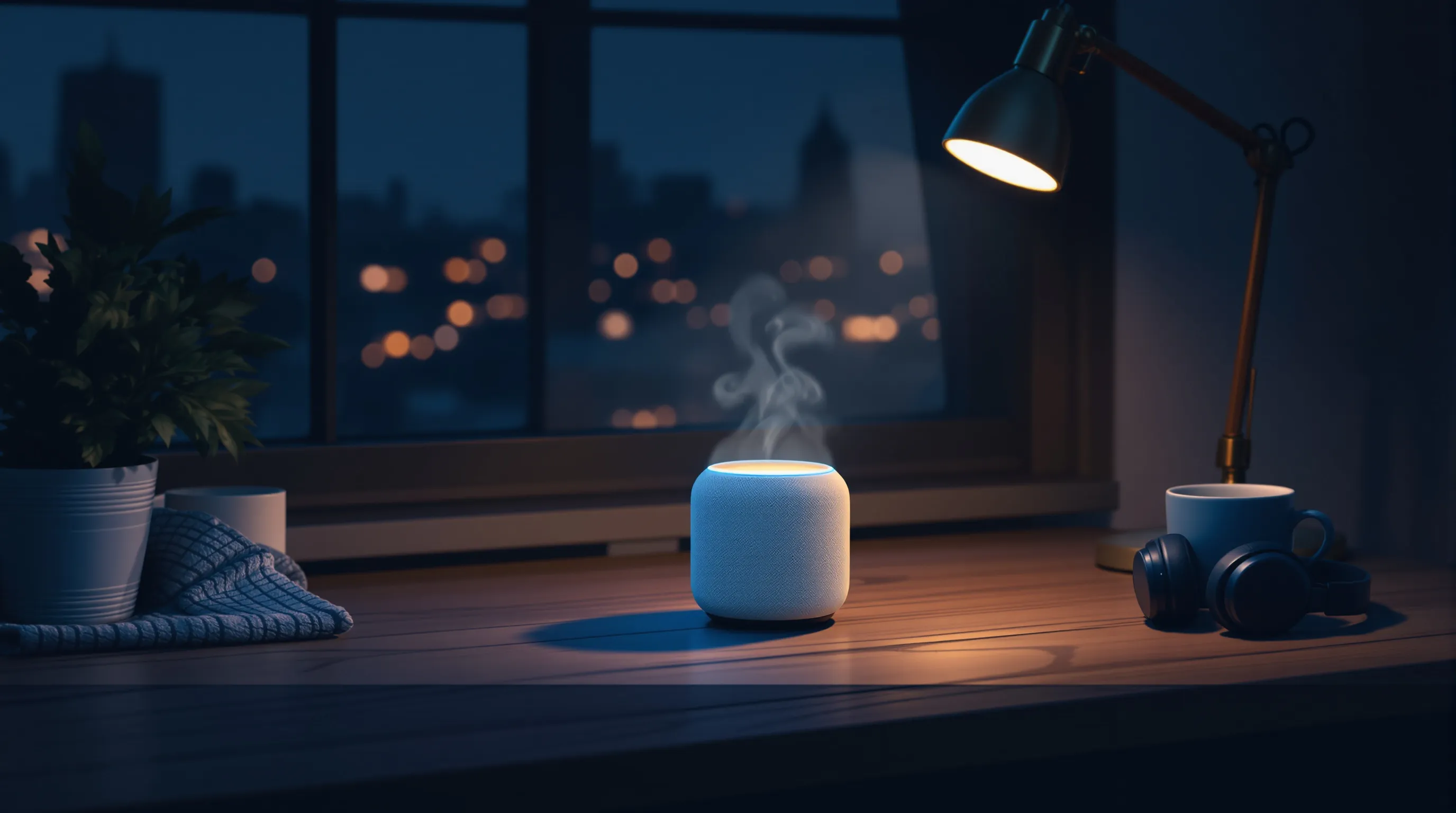
The speaker gives the answer; the screen beside it is the only record you can check.
Ask a smart speaker "how long does SEO take to show results?" and you hear one answer, read in one voice, with no source named. Type the same question into ChatGPT and you can see which pages it cited. Only the typed answer leaves a record anyone can check later.
A practical first question for any team: what can you read on a screen for the question your buyers ask aloud? A 2024 Smart Learning explainer on YouTube describes featured snippets as "the concise direct answers that Google displays at the top of the search results page often in response to voice queries," and notes that voice assistants "often read these Snippets aloud." So the first check needs no special tool: type the same question into Google and note which page fills the featured snippet. It can be saved, dated and compared.
The written answer also has to be right. In our repository-based knowledge base pilot, a help page and the live product disagreed until the answer was checked against the code itself. A wrong snippet is read aloud as confidently as a correct one.
One candid aside. The evidence here does not show how often a snippet and the spoken reply actually match, because the overlap between text citations and spoken answers is not on record. I treat it as an inference to test, not a figure to quote.
The sections below move in order: why a ChatGPT citation can be counted when a Siri answer cannot, why page-one rankings fail to predict what an assistant says, and how to infer voice visibility from text answers in five plain steps. Each one returns to the same smart-speaker question about SEO timing.
In 2023, an Algolia roundup of voice research reported that roughly half of online consumers research products by voice (Narvar) and that 71% of Americans would rather speak a query than type it (PWC). Those spoken questions get answers. Ask which page each of those answers was built from, and whether you could prove it.
Try it on the one question your buyers ask most often. Text engines such as ChatGPT, Perplexity and Google AI Overviews make that easy, because their sources appear on screen. When Siri, Alexa or Google Assistant answer aloud, the source goes unspoken, as a children's hospital team that built its pages for voice found when no assistant credited it by name. A spoken answer, in this article, means any reply an assistant reads out instead of displaying.
In my view, most voice-optimization pitches step around this problem rather than solve it. Before paying anyone for voice optimization, ask what record they will hand back, because a report built only on what a speaker said has nothing on file to show you. The test can start with a single question a marketer might put to any assistant tonight.
Why can you count a ChatGPT citation but not a Siri answer?
AI-visibility audits, of which we have run 26,577, need an answer someone can read and save. A spoken Siri or Alexa reply leaves neither text nor a named source.
Three questions decide whether any AI answer can be counted:
- Can you see the source? A ChatGPT or Perplexity answer shows links or source cards; a smart speaker says the answer and stops.
- Can you save the exact wording? Text can be copied, dated and stored. A consumer assistant does not hand its audio back to the brand it quoted.
- Can you rerun it and compare? A saved text answer can be checked again next month. A spoken reply exists once, in one room.
A citation surface is the visible record, such as a link, footnote or source card, that shows which page an AI answer drew on. Text answer engines have one. Voice assistants, in practice, do not.
The scale on the voice side is not small. Dazzle AI's 2026 roundup counts 8.4 billion voice assistants in active use, more than the world's population, and puts Siri at 86.5 million U.S. users, the most of any platform in the American market. The same report notes that 80% of Google Assistant voice answers come from the top three search results, which means the spoken reply is usually borrowed from a page that already ranks in text.
The common assumption is that a channel this large must come with its own reporting. It does not. Device counts describe reach; they say nothing about which brand a speaker named in someone's kitchen this morning. Read together, the 4 evidence items behind this section point one way: scale sits on the speaker side, while anything countable sits on the text side.
Consider one question: how long does SEO take to show results? Typed into ChatGPT, it returns an answer with sources you can screenshot, store and recheck. Asked aloud to a smart speaker, it returns a reply the brand has no way to store or recheck next month. Same question, two surfaces, and only one of them can be audited.
That asymmetry shapes how we build measurement. Our analysis spans 11,000+ domains scored across 15 sectors and 28 categories, and our team includes a full-stack engineer and content infrastructure architect with 20 years of building enterprise systems. Systems built at that scale can only score what they can read. Readers new to the text-side metrics will find them defined in the AEO knowledge base guides, and the practical question becomes where a spoken answer gets its words, because that source is the only part a brand can inspect.
If Siri never names its source, how can anyone measure voice visibility?
A pediatric hospital system built its pages so voice assistants would read them aloud. Ask how often the assistants named it as the source, and the measurement trail goes quiet.
The system is Children's Health. On a 2019 episode of The Agents of Change podcast, its consumer digital-experience strategist explained how the team mapped Google's answer formats by question type (symptoms as bulleted lists, dosages as tables, causes as paragraphs) and built templates so writers with no SEO knowledge could produce voice-ready pages for more than 1,000 conditions. Yet one speaker could not recall Google or Alexa ever crediting an answer to Children's Hospital when reading it aloud, and the strategist admitted the team had very little insight into how many people search by voice.
The strategist judged that acceptable, since winning Google's written answer box still brought clicks and positive brand impressions. The strategist also predicted that people would eventually demand voice-impression data, leaving a market for whoever built a voice analytics platform.
By 2026 a market for AI visibility tracking exists, and it reads text. A February 2026 roundup of AI SEO tools, written by the marketing chief of an SEO software company that sells one of the trackers, describes two in detail. Both count mentions and citations in written AI answers.
What the two trackers query
- First tracker: ChatGPT, Perplexity, Gemini, Copilot, Google AI Overviews and Google AI Mode.
- Second tracker: ChatGPT, Perplexity, Google AI Overviews, Gemini, Claude and Microsoft Copilot, with Grok listed as coming soon.
- Named on neither list: Siri and Alexa.
Source: a roundup of AI SEO tools, February 2026.
Our own audits have the same blind spot, because each one needs an answer we can read and save. We sell those audits, so we have a stake in how this gap is described.
The speaker gives you nothing to count, yet text still helps, because spoken answers are mostly recycled. The Children's Health strategist said Google Home, Amazon Alexa and even Siri pull their answers from Google results, so featured-snippet work and voice work were essentially the same. A 2026 statistics roundup from Dazzle reports that 80% of Google Assistant answers come from the top three search results, without showing how that was measured. An original study of Google voice results found answers averaging 29 words, with only 1.71% of results using the exact keyword in their title tag. In its example, the matching text sat "smack dab in the middle of the page." A spoken answer is usually a short passage lifted from a written page.
The recycling has big exceptions. According to the strategist, Alexa mostly reads the Google answer box except for Amazon shopping and local questions. For local questions, a listings company's partnership with Amazon and a big four of local data aggregators supply the answer. Google Home always pulls local answers from Google My Business data.
| Question type | Where the spoken answer comes from | Written evidence you can check |
|---|---|---|
| General questions | Google's answer box and top results, for Alexa, Siri and Google Home | Which page holds the featured snippet and top results |
| Local questions | Alexa: a listings company's feed and the big four data aggregators. Google Home: Google My Business data | Your business listings and aggregator records |
| Shopping questions | Alexa: Amazon's own data | What Amazon holds about your products |
Local questions are far from rare. The strategist said voice searches are three times more likely than text searches to be local, and DemandSage's 2026 statistics roundup puts "near me" and local searches at 76% of voice searches, without naming its source. For those questions, owning the featured snippet tells you little about what the speaker says.
Even where the stand-in works, one check shows one moment. The same DemandSage roundup reports that voice search results "align across different devices" only 22% of the time. A company that sells AI visibility audits says its audits find 40 to 60% of AI answers about brands changing every month. That figure covers AI answers generally, names no brands and comes with no published method. Neither number is solid enough to forecast with, but both point the same way: an answer checked once, on one assistant, describes that assistant on that day.
The speaker never names its sources, but most of what it says was written down first. You can infer voice visibility by reading the right written answer for each kind of question: the featured snippet for general ones, listings and data feeds for local ones, Amazon's data for shopping. Check each assistant separately, then check again later. None of the tools we examined counts the spoken reply itself, and that includes ours.
- Ask any visibility vendor, us included, which surfaces its tracker queries, and how it reaches conclusions about Siri or Alexa if neither is listed.
- Sort your spoken-style questions into general, local and shopping before choosing which written answer to treat as the stand-in.
- For local questions, audit your Google business listing and the listings feeds and data aggregators that carry your business.
- For product questions, ask whether the information Amazon holds about your products is what you would want read aloud.
- Record each check with its date and the assistant it describes, and repeat it on a schedule.
How we checked this
Our sources were a 2019 podcast interview with a hospital system's digital strategist, a 2026 roundup of AI SEO tools, two 2026 statistics roundups, an original study of voice search results, an AI visibility vendor's 2025 essay and a 2025 market report. None of the figures here come from our own data. The roundups do not show methods for the 80%, 76% and 22% figures. The voice study does not give its publication date in the excerpt we checked, and it refers to forecasts for 2020, so it is several years old. The strategist's account of where Alexa, Siri and Google Home get their answers dates from 2019. Amazon launched Alexa+, an AI-powered assistant, in February 2025, and none of our sources tests whether it sources answers the same way. The roundup's author markets one of the trackers described, the essay's author sells AI visibility audits, and we sell AI visibility work too. Still unknown: how often today's assistants read the Google answer box, and how many people hear any given answer.
- The Agents of Change Digital Marketing Podcast, episode 313 with the Children's Health strategist, September 2019.
- Marketing chief of an SEO software company, roundup of AI SEO and visibility tools, February 2026.
- Dazzle, Siri and voice assistant usage statistics, July 2026.
- DemandSage, voice search statistics roundup, August 2026.
- Voice Search SEO Study: Results From 10k Voice Searches, retrieved November 17, 2026.
- Essay by the co-founder of an AI visibility audit framework, guide to AI visibility optimization, August 2025.
- Grand View Research, voice search market report, including Amazon's February 2025 launch of Alexa+.
Why do page-one rankings fail to predict what an assistant says?
We guarantee clients are named in AI answers within 100 days, or we work free until they are, and that promise depends on answers someone can actually check.
Voice answers fail that check twice. They name no source, and they send no click, so the two numbers most teams already watch (rankings and traffic) say little about them.
A content writer serving 30+ brands described the first failure on Medium in February 2026. After asking ChatGPT the exact questions answered by two of their page-one posts, the writer reported that "ChatGPT cited my content exactly zero times." Rank did not transfer. Across that writer's clients, organic traffic stayed "steady, sometimes even growing, but conversions were dropping," and leads arrived less qualified.
Nothing in a traffic report flagged the shift. Dashboards looked healthy while answers moved elsewhere. Conventional wisdom holds that a strong search position carries over to AI answers on its own; the zero-citation result is a direct counterexample, and spoken answers widen the gap further, because a smart speaker produces neither the citation ChatGPT could have shown nor the visit a search result could have sent.
There is, however, a visible signal that sits between the two worlds. The same writer restructured a client FAQ page so the direct answer appeared in the first 40 words, and featured snippet captures went from 1 to 6 within two weeks. Each featured snippet won is a public record of which page Google chose for the answer. Unlike a spoken reply, it can be seen, dated and counted.
Apply that to the running example. For how long does SEO take to show results?, the writer's own answer-first copy led with a direct estimate of 3 to 6 months for meaningful traffic gains. That single sentence is the unit an answer box lifts. It is also, potentially, the unit a speaker reads.
Alex and I bring a combined 40+ years of SEO and content infrastructure experience to AEO, and the habit I would carry into voice work is narrow: judge the result where it can be verified. At Imagine Dental Arts, AI-referred new patients rose 900%, from about 5 a month to 50. That outcome was counted in new patients, not in mentions nobody could hear twice. The same rule holds for research-driven content built on evidence: name the countable outcome before the work starts.
Which leaves the harder question for the next step: if the snippet is the visible half, how much of what Alexa, Siri and Google Assistant say aloud is actually read from it?
How do you infer voice visibility from the text answers assistants read?
Check whether your page holds the featured snippet or top text answer for each spoken-style question, then treat voice presence as an inference from that, never as a count.
I come to this from software that logs everything. Before AEO Content, I founded LiveHelpNow, an Inc. 5000 inductee (#84, 2015-2018), and a channel that leaves no record is the one I trust least.
The mechanism is better documented than the measurement. On a 2019 episode of The Agents of Change podcast, the digital-experience lead at Children's Health said that for most searches about the hospital's topics, the voice assistant read out the answer box. Google Home, Alexa and even Siri pulled from Google results, the guest explained, so optimizing for featured snippets and for voice was essentially the same work. Local and shopping questions were the exception: Alexa drew those from Amazon data, from Yext and from a group of local data aggregators.
The same conversation exposed the blind spot. The host could not recall Google or Alexa ever crediting Children's when reading its answer aloud, and the team had very little insight into how many people searched by voice. Neither Apple, Amazon nor Google publishes a record of which page a spoken reply came from.
Given that, the workable method runs on the text side:
- List the questions buyers ask aloud, in conversational wording rather than keyword fragments.
- For each question, save the dated featured snippet and top text results, and note whether your page holds them.
- Move local and shopping questions to a separate list, and audit your listings data there instead.
- Run the same questions in ChatGPT, Perplexity and Google AI Overviews, and record which sources each one cites.
- Ask a sample aloud on real devices, and log only whether the spoken reply matches the snippet wording.
Step five matters for a reason our own product work made concrete. In our repo-based knowledge-base pilot, the admin page described two-factor sign-in as using an authenticator app, while the actual sign-in screen sent a one-time code by text and email. Descriptions drift from surfaces. A vendor's claim about voice reach is the admin page; the saved text answer is the screen.
The text side, by contrast, moves in numbers you can defend. For Understood Care, Google AI Overview citations rose 500%, from 22 to 132, in about five months, a count anyone could rerun. What we do not have on record is the overlap rate itself: how often a spoken reply matches the cited text answer across a fixed test set. Once collected, that figure is what would bound the inference.
Common follow-ups on this method are collected in our AEO FAQ on AI search optimization. For the running example, the routine is concrete: save the snippet for how long does SEO take to show results?, confirm whether your answer-first sentence is the one quoted, then ask a speaker the same question and listen for that wording, knowing a match on one device says nothing yet about the next.
What should you measure first while spoken answers stay invisible?
Measure the written answer your page gives, because that text is the only part of a spoken reply you can read, test and correct before an assistant repeats it.
I expect the distance between what is spoken and what is recorded to grow before it shrinks. In 2023, Algolia's roundup reported that slightly more than half of consumers used voice to shop for things like groceries, according to PWC. None of those spoken purchases left a citation behind. Given that, the written source deserves the scrutiny the speaker cannot receive.
Checking source text no longer has to be slow. In our October 2026 pilot, we indexed 1,368 files from one product's code, and full-text search answered support questions in 5 to 16 milliseconds. Speed changes the habit. Each published answer can be compared with what the product actually does, relative to what a help page claims, and the next question worth testing is the one your customers would ask out loud tonight.
Summarize This Article With AI
Open this article in your preferred AI engine for an instant summary.
Frequently Asked Questions
What else do people ask about voice search and AI assistant visibility?
Most follow-up questions concern format, timing and who to call. Each answer below stays with what text answers show, since the spoken reply itself cannot be audited.
How long should a spoken-style answer be?
Short enough to be read aloud whole. Answer-first copy is text that puts the direct answer in its opening sentences. One content writer's formula on Medium opens with a direct answer of 1 to 2 sentences, under 60 words, then adds context, data and action steps. I treat that as a ceiling for the opening, not a target.
Does conversational content get cited more often?
In that writer's own testing, conversational pieces of 500 to 700 words, built from real questions, were cited by AI systems "3x more often" than keyword-optimized articles. That is one writer's result across their clients, not a controlled study. It still points the same way as the snippet evidence.
Is voice search mostly a younger audience?
The same post says voice queries "now account for over 50% of all searches among users under 30." Treat it as one writer's claim rather than a measured share. I would not size a budget on it alone.
How quickly can AEO Content show results, and how do I reach the team?
For Modern Wealth, organic search sessions rose 220% and Google clicks 61% within three weeks of the first articles. Those are search figures, not spoken answers. To start, reach the team through the contact page at aeocontent.ai/contact.
Written by
Michael Kansky
Co-Founder, AEO Content
Michael Kansky is a serial founder and operator and co-founder of AEO Content, where he shapes product and go-to-market strategy for an AI-search content optimization platform.
Connect on LinkedIn