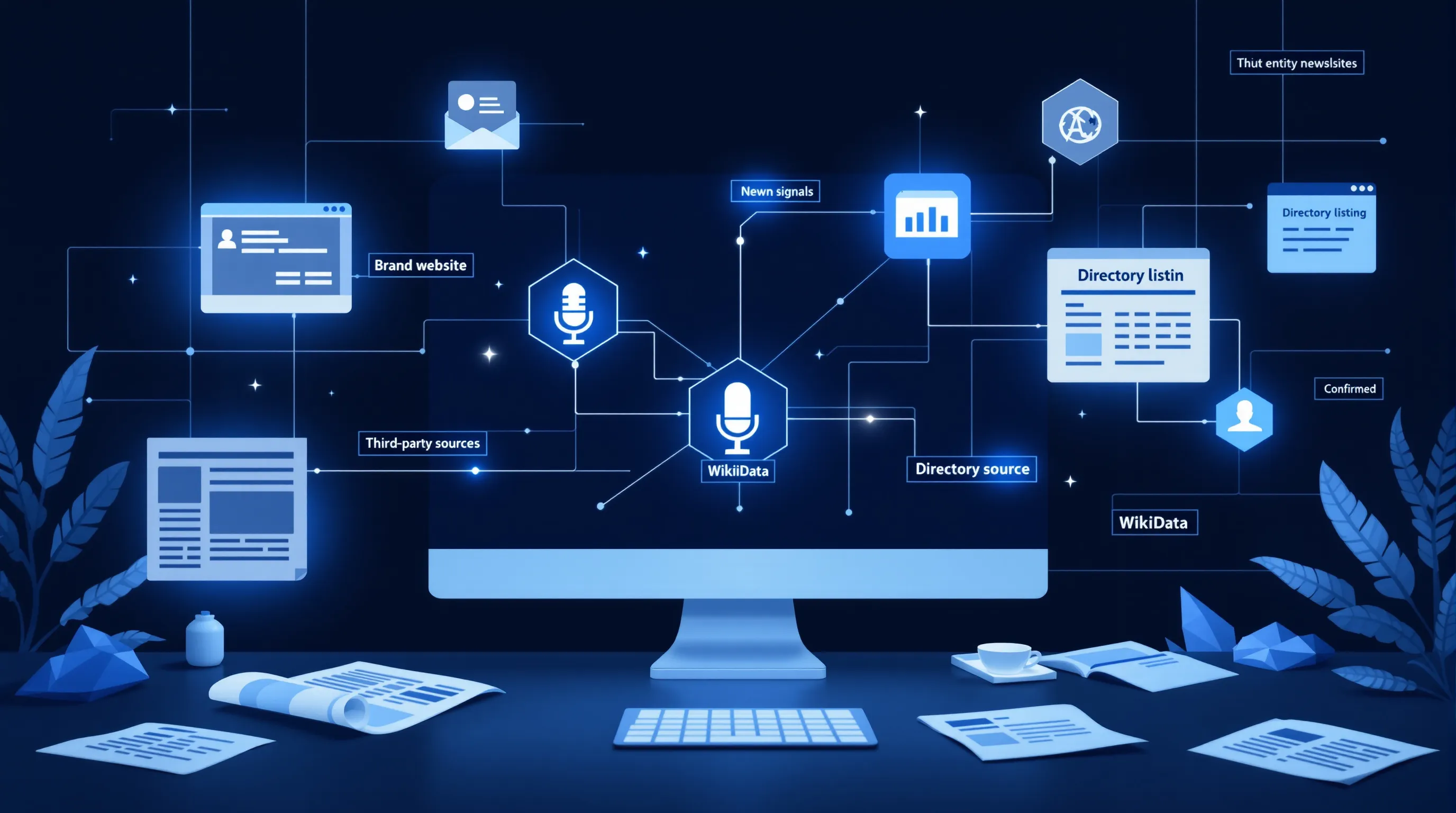
AI visibility reports without saved answer text cannot be audited

On this page
Quick Answer
An AI visibility report that keeps only a mention flag and a cited URL cannot be audited, because nobody can check whether a drop came from the answer, its sources or the prompt.
Think of a teacher who hands back a grade and shreds the exam. Fine for the gradebook. Useless at the parent meeting. Our own knowledge-base topic study follows the opposite rule: each proposed topic cites one to four specific files and line ranges, and gets dropped when the evidence is not there.
Key Points
- Kevin Indig's study of 815,000 prompt-page pairs, cited by Bige Besikci Yaman, found only about 2.2% of citations remained after the same prompt ran three times in ChatGPT.
- In a September 2026 Reddit discussion, one practitioner's tracker scored a consumer electronics brand at 77, then 94 on the same 20 questions once product names counted as aliases.
- An auditable report saves the prompt, engine, run date, full answer text, companies named, supporting sources, counting rule, evidence gap and owner for every ChatGPT or Perplexity run.

A trend line says something moved. The saved answers say why.
A client email arrives on a Tuesday. Their mentions in ChatGPT fell this month, and they would like to know why, ideally before the renewal call. You open the report. It has a flag, a link and a percentage. It does not have the answer.
That missing answer is the whole story here. I am going to walk through it slowly, one piece at a time, because the fix is boring and skipping it is expensive. A report can tell you a brand appeared and which page the engine pointed to. So before the next client email lands, open last month's export and look for one thing: a column holding the words the engine actually wrote.
Measuring answers was always going to be weird. In 2025, the host of the Everything AI podcast cited a study they attributed to Ahrefs, which found that featured snippets at the top of results drew about 8.6% of clicks, and predicted that AEO and traditional SEO would end up deeply intertwined. Clicks were already a shaky stand-in for being the answer. AI answers in ChatGPT, Perplexity and Google AI Overviews made that stand-in even shakier.
Here is the order of things. First, what a typical report keeps. Then why a flag cannot explain a drop, and how far a visibility number moves when the brand did nothing at all (further than anyone selling dashboards would like). Then the fields worth saving on every run, with one B2B SaaS client's falling ChatGPT mentions as the running example, and the questions agencies ask most. Bring your own export. You will want to check it as you read.
Fewer clicks can mean an AI engine answered the question well, which is why answer visibility needs its own proof instead of borrowed traffic metrics. In 2025, the host of the Everything AI podcast put it plainly: a strong answer at the top of the page may mean the user never visits the site at all, so success has to be measured differently.
Fine. Measured how? The usual reply is a chart. A chart of mentions in ChatGPT, Perplexity and Google AI Overviews, a list of cited links, maybe a share percentage with a confident little arrow. Then the client asks why the arrow points down, and the chart has nothing to say (charts are very bad at follow-up questions).
Saved answer text is the full copy an AI engine returned for a tracked prompt, stored with the run that produced it. Monitoring tools already recreate neutral baseline answers rather than what each real person sees, so the stored answer is the only fixed thing in the whole record. Keep that answer next to its prompt and run date, and a client's "why" becomes something you can actually look up.
Questions this article answers
What does a typical AI visibility report actually store?
Most AI visibility reports store conclusions, not evidence: a yes or no for whether the brand appeared, a list of cited links, and scores computed from answers nobody kept.
Before any theory, check your own report. Open last month's export and look for four things:
- The exact wording of each prompt that was sent.
- The engine and the date of every run.
- The full text the engine wrote back.
- The rule that decided what counted as a mention.
If you found the first two and not the last two, you have a very normal report. (Normal is not a compliment here.)
Some terms, since we will use them all night. A mention flag is a yes or no field recording whether a brand name appeared in an AI answer. A cited URL is a link the engine attached as a source. A prompt panel is the fixed list of questions an agency runs for a client on a schedule.
A widely shared r/AI_SearchOptimization thread on how these tools work laid out the pipeline honestly. No platform sees what people actually type into ChatGPT, so tools predict likely questions and recreate neutral baseline answers through APIs or simulated sessions. Then, in the thread's words, "When AI generates an answer, these tools log which URLs get cited and how often." Log the link. Drop the answer.
Vendor dashboards stack more derived fields on top. One tracker's agency walkthrough pitches mentions, share of voice, sentiment labels, citations and a single visibility number for month to month check-ins. Every one of those is a summary of an answer. If the export does not hand that answer back, nobody can recheck the summary, which is basically asking a client to trust a book report on a book that was then thrown in a lake.
Even a vendor reporting guide concedes that assistants name brands more often than they link them, so a citations-only view can call you invisible on a surface where you are being recommended. Bige Besikci Yaman, writing for SaaS marketers in September 2026, puts it more sharply: "A model can name your product without linking to you, link to you without naming you as a recommendation, and do both without sending a single session." Her list of questions for tracker vendors includes the one that matters most here: "Can you export the raw answers, or only the aggregate chart?"
A comparison of 4 sources on how these reports get built shows the same shape. Each describes what is computed from an answer. Only one asks whether the answer itself survives. The common assumption is that more metrics mean more proof. They do not. Five numbers derived from one discarded answer are still one discarded answer.
AEO Content has run 26,577 real AI-visibility audits, and I would still not defend a single trend line from any of them without the answer text sitting right next to it. That instinct is the same one behind research-driven content built on evidence: if you cannot show the source, you do not get to keep the claim.
So here is the example we will carry through the rest of this piece. A B2B SaaS client runs on a fixed panel of buyer questions. One month, ChatGPT names them often. The next month, less. The client sends a one-line email asking why, and the agency opens a report holding flags, links and a score that went down.
Why can't a mention flag and a cited URL explain a drop?
A drop in mentions has three possible causes: the answer changed, the sources changed, or the prompt and counting rules changed. A flag records the same thing for all three.
Go back to our SaaS client and their sad little downward line. Here are the three stories that line could be telling:
- The answer changed. ChatGPT still knows the brand but now recommends a competitor first, or names the product instead of the company.
- The sources changed. The engine pulled from different pages this month, and the pages that used to carry the brand dropped out.
- The measurement changed. Someone edited a prompt, added an engine, or changed what counts as a hit.
Each one needs a different fix. A flag cannot tell them apart. Honestly, neither can a list of URLs.
The third story is the one nobody wants to admit to, so let's start there. One practitioner running 20 buyer questions across four AI engines found that about half of the apparent misses were not misses at all. The answers named the products, not the company, and the run was only counting the company name. After adding product names as aliases, the same questions against the same engines came back at 94, up from 77. In their words: "Nothing changed in the world. Only what I counted as a mention."
Read that twice. The whole jump came from a spreadsheet rule. If that agency had sent the 77 to a client, then the 94 a month later, it would have reported a win it did not earn. So before you report any jump, read a handful of the answers it was counted from and check which names actually appear.
Sources move in ways flags hide, too. In the same discussion, another practitioner described a brand that went from appearing in 3 of 25 prompts to 8 of 25, where nearly every new mention came from third-party sources rather than the brand's own site. The flag says "up." The answer text says "up, because other people's pages started talking about you," which is a very different thing to tell a client paying you to write their pages.
Single-scan wins carry the same risk. A vendor founder in a separate thread reported that adding FAQ schema moved one buyer-journey stage from a 0% to a 22% mention rate within a single scan cycle, and described it as a small sample covering one stage. Another commenter there asked the question every client should ask: can you inspect the raw answers behind a movement? Otherwise the recommendation may be reacting to measurement drift.
Then there is accuracy, which flags ignore completely. In the r/AI_SearchOptimization thread on how visibility tools work, one tester said ChatGPT "started making up features we don't actually have." Another put it bluntly: being visible while the model explains your product incorrectly "is arguably worse than being invisible." A mention flag scores that hallucination as a success. (Congratulations, you are famous for something you do not sell.)
Even careful auditors leave this gap on purpose. When Rank Math's Jack audited one of the company's own blog posts for AI visibility, he said plainly that the audit was not critiquing factual accuracy, only how well AI could read and cite the page. Fine for a page audit. For a monthly client report, that blind spot is the whole problem.
Here is where I land: the questions a client asks about a drop are, at bottom, questions about what the answer said. If you are fielding the same questions from your own clients, the AEO FAQ on AI search optimization covers the basics, but the answer to "why did we drop?" lives in text you either kept or threw away.
How far can a visibility number move when nothing about the brand changes?
One practitioner's tracker scored a large consumer electronics brand at 77. A day later, on the same 20 questions and the same four engines, it scored 94. Nothing about the brand had changed.
The explanation was in the answers themselves. In a September 2026 Reddit discussion, the practitioner said they build an open source tracking tool, and that disclosure is worth keeping in mind. They went back through the "misses" and found that "about half weren't misses. The answers named the products, not the company, and my run was only counting the company name." Adding the product names as aliases produced the 94. "Nothing changed in the world," they wrote. "Only what I counted as a mention."
A log that only flagged whether the brand was mentioned would have recorded each of those misses as identical. Only the saved answer text showed that the counting rule caused the gap. The practitioner's advice to anyone keeping a trend line: "freeze the definition of a hit, otherwise your time series is mostly measuring your own matching rules."
The counting rule is one lever an agency controls. A second is whether the engine searches the web, and that moved a number further. One researcher spent six weeks running the same 57 prompts on the same model, gpt-4o-2024-08-06, against the same frozen basket of five fraud and identity vendors. The only thing they changed was whether web search ran.
With search switched on, recommendation share came out "about 36% lower." The grounded number was also shakier: it swung roughly three times more from week to week, though the researcher cautions that "four grounded waves cannot pin that ratio down." Their conclusion: "which surface you measure decides the answer." The 77 to 94 practitioner added a related detail. Of the four engines they run, "only one actually retrieves and cites by default." So a log that never noted which mode produced each answer cannot tell a retrieval change from a change in how engines regard the brand.
Then there is plain chance. SaaS marketing writer Bige Besikci Yaman gathered two studies on it in September 2026. In one, SEO analyst Kevin Indig examined 815,000 prompt-page pairs and found that after the same prompt ran three times in ChatGPT, "only about 2.2% of citations remain." The other measured how much one answer can say about where a brand ranks.
Near 0.01
The reliability of ranking brands from a single AI answer, according to a July 2026 analysis of 12,933 model responses covering 20 brands, eight languages and three models.
Charlie Braithwaite, a content strategist at the marketing data platform Supermetrics, puts it plainly: "Ask the same prompt twice and you'll often get two different answers, so a single run proves nothing." He recommends sampling each prompt 3 to 5 times per engine. He also warns that the two fields most reports keep can disagree: "Assistants name brands more often than they link them, so a citation-only view will tell you that you're invisible on a surface where you're being recommended." The 77 had a similar blind spot. The brand's products were being recommended, but the counting rule did not see them.
Three separate forces, a counting rule, a search setting and ordinary sampling, each moved a visibility number by enough that a client would treat it as news. None of them needed the brand to do anything. A log of flags and URLs records all three just as it records a real loss. The saved answer text shows what the engine said, which names it used and whether it pulled sources. Repeated runs show how much movement is normal. Without both, an agency explaining a drop is guessing. We sell monitoring that keeps the answers behind each trend line, so we have a stake in that conclusion. Other people ran the experiments above.
Before you report a drop
- Write down your counting rule, including every brand and product alias, and give it a version number. When the rule changes, re-score old runs instead of joining two definitions in one trend line.
- Before calling a drop, read the answers behind the misses. Look for products named without the company, or a brand recommended without a link.
- Record for every run whether web search was on, and compare searched answers only with searched answers.
- Run each prompt 3 to 5 times per engine before reporting a move. Treat a single changed answer as noise until repeats confirm it.
- Ask any tracking vendor, us included, the question Yaman suggests: "Can you export the raw answers, or only the aggregate chart?"
How we checked this
Our sources were two Reddit practitioner discussions, a researcher's published method page, a SaaS marketing writer's analysis on Medium and a marketing data platform's measurement guide. No figures here are ours. The 77 to 94 result covers one brand and comes from a practitioner who builds a tracking tool. The retrieval experiment used one model, one market and five vendors, had only four grounded waves and did not measure what users see in the chat products. We read the citation persistence and reliability studies as Yaman reported them, not in the originals. We sell AI visibility monitoring that keeps answer text, so we have a commercial stake. One thing is still unknown: how often real client drops come from these three causes and how often they come from real changes in what engines say. None of our sources measured that.
- r/GenerativeSEOstrategy, discussion on tracking AI search visibility, September 2026.
- Researcher's published method, Measuring AI Recommendation Visibility, retrieved November 11, 2026.
- r/aeo, discussion on AI visibility tools and citations, July 2026.
- Bige Besikci Yaman, how to measure AI search visibility for SaaS, September 2026.
- Charlie Braithwaite, Supermetrics, guide to measuring AI search visibility, August 2026.
What should an agency save for every prompt run?
Save the prompt, engine, date, full answer text, companies named, supporting sources, evidence gap and next-action owner for every run, from ChatGPT and Claude to Perplexity and Google AI Overviews.
That sounds like a lot. It is less than you think, and most of it is already passing through the tool before being thrown away.
Jeremy Prasetyo, writing on LinkedIn in September 2026, made the case better than most vendor guides. The piece argues that if you only record that your company appeared in position three, "you have learned something. It is still not enough to decide what needs changing." What it asks for instead is "the prompt, the engine, the companies mentioned, the sources that appear to support the answer, and the evidence gap behind the result," plus a named owner for whatever happens next. I would add two fields to that list: the full answer text, and a note of which counting rule was in force that day.
Here is the record, field by field, with the reason each one earns its place.
| Field | What it is | What it lets you prove to a client |
|---|---|---|
| Prompt text | The exact wording sent, word for word | The question did not quietly change between months |
| Engine and mode | Which assistant, and whether web search was on | You are comparing like with like |
| Run date | When the answer was generated | Which reporting period a result belongs to |
| Full answer text | Everything the engine wrote back | Whether the brand was named, described accurately, or framed with criticism |
| Companies named | Every brand in the answer, in order | Who took the spot you lost |
| Supporting sources | The cited pages behind the answer | Whether the cause was a source swap |
| Counting rule | Which names and aliases counted as a hit | The trend measures the market, not your spreadsheet |
| Evidence gap | What the engine needed and could not find | Why a fix was chosen |
| Owner | The person responsible for the next action | Someone actually did something about it |
The full answer text is the field that makes the others checkable. Without it, every other column is a claim about a document nobody can open.
Prasetyo's other point matters for agencies especially: each action should be tied back to the exact question that triggered it, or teams make broad changes and never learn which one made the difference. A saved answer is what that tie is made of.
Here is why I care about this so much. AEO Content scores sites against its AEO Rank standard, 53 criteria across 5 pillars, and reports client results like Understood Care's Google AI Overview citations rising 500%, from 22 to 132, in about five months. We also promise clients they will be named in AI answers in 100 days, or we work free until they are. A promise like that is only fair to both sides if there is a record of which answers, on which engine, on which date, named them. The record is what turns a guarantee into something a client can check.
The same standard applies to paid placements. If a brand buys sponsored listings that AI engines cite, the proof that the citation happened is the saved answer, not a green checkmark.
So the record exists. When a client's line turns down, open the full answer text first, because it shows who took the spot and which sources the engine leaned on.
What will a client ask for once the trend line moves?
A client will ask for the answers behind the number, and a result like Imagine Dental Arts' AI-referred new patients rising 900%, from about 5 a month to 50, invites exactly that question.
Big results get questioned hardest. Honestly, they should. My forecast, and I will own it: within the next year or two, a report that keeps only flags and links will look like a receipt with no line items, technically a total and practically useless.
We track whether ChatGPT, Claude, Perplexity and Google AI Overviews name our clients, and we score their pages against the AEO Rank standard. A score tells you what to fix. The saved answer tells you whether the fix worked, which is the part the client is actually paying for (nobody renews a contract for a nice chart).
So start saving the full answers on your next scheduled run, before the next drop lands and you have to explain it from a line that cannot talk back.
Summarize This Article With AI
Open this article in your preferred AI engine for an instant summary.
Frequently Asked Questions
What else do agencies ask about auditing AI visibility reports?
Most questions come down to how often to run each prompt, whether free platform reports can replace answer logs, and what saved answers can and cannot prove.
How many times should each prompt be run?
More than once. Bige Besikci Yaman cites Kevin Indig's work with AirOps across 815,000 prompt-page pairs: after the same prompt ran three times in ChatGPT, only about 2.2% of citations remained. A July 2026 analysis of 12,933 model responses put single-answer brand-ranking reliability near 0.01. Which is to say, one answer is a coin toss with paperwork.
Is Google Search Console alone enough?
No. Google launched its generative AI performance reports on June 3, 2026 and opened them to all websites on August 31, 2026. They show AI Overviews and AI Mode impressions by page, country, device and date, with no queries, clicks, CTR or position. Good for scale. Useless for cause.
Does saved answer text show what real buyers saw?
Not exactly. Tools recreate neutral baseline answers instead of reading anyone's personal chat history. I would still keep every one, because the saved copy is the only record that can separate a changed answer from a changed source.
What is a matching rule?
A matching rule is the instruction a report uses to decide whether an answer counts as a mention, such as which product names and spellings qualify. Change the rule and the trend moves, even when no answer did.
How soon can results show up, and how do I start?
Faster than most people expect. For Modern Wealth, organic search sessions rose 220% and Google clicks 61% within three weeks of the first articles. To set up answer-level reporting for your own clients, reach AEO Content through its contact page at aeocontent.ai/contact.
Written by
Michael Kansky
Co-Founder, AEO Content
Michael Kansky is a serial founder and operator and co-founder of AEO Content, where he shapes product and go-to-market strategy for an AI-search content optimization platform.
Connect on LinkedIn