
Why agency AEO content stalls without off-site entity work
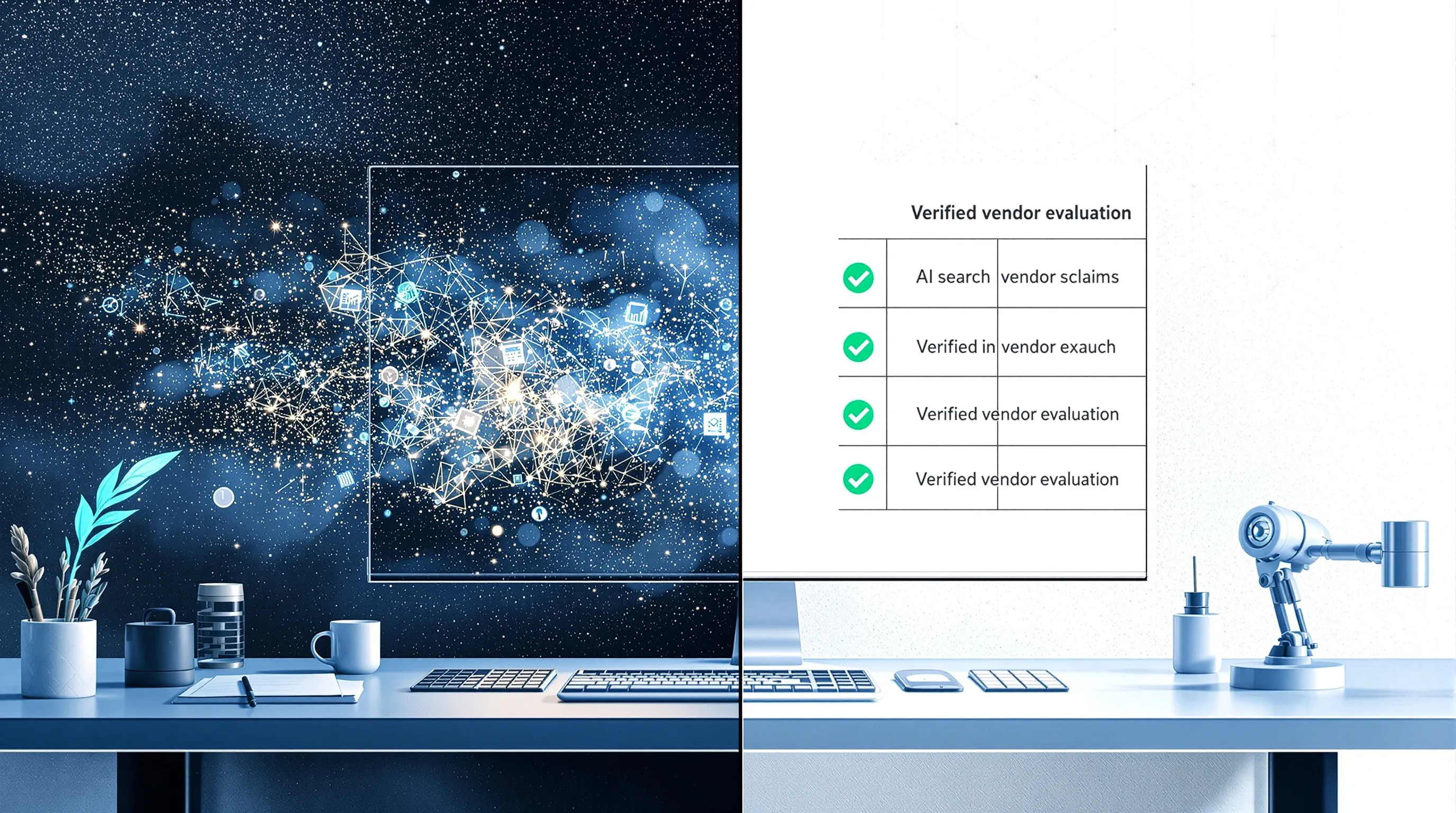
Agency AEO content stalls because AI engines verify entity authority across multiple independent sources before issuing citations.
On this page
Quick Answer
The short answer
Agency AEO content stalls because AI engines verify entity authority across multiple independent sources before issuing citations. On-site answer formatting cannot earn citations when no corroborating off-site mention exists to confirm the brand as a recognized entity in the knowledge graphs that matter. The agencies that deliver lasting citation gains treat off-site PR coordination and third-party entity signals as inseparable from on-page content work, and there is no shortcut past that coordination.
There is a hidden pattern in the failure of agency-produced AEO content, one I have observed across hundreds of audits and that the agency roundup lists I encounter never acknowledge. The agencies appearing at the top of those lists deliver something genuine: they understand answer formatting, they know how to structure a page so that ChatGPT or Perplexity can extract a clean sentence. And yet the pages they produce stall, week after week, returning no citation data that any client could bring to a quarterly review with confidence.
The work looks right. The intent is correct. Something, altogether mysterious to the agency proposing it, is absent.
That absence, in my experience, is almost always the same thing: the off-site entity signal that would confirm, to the knowledge graphs that matter, that this brand is indeed what it claims to be. AI engines are not simply text retrievers. They are, in some way, entity verifiers, checking whether the name on the page corresponds to a pattern of consistent third-party mentions, whether the claimed author has ever appeared outside their own domain, whether the organization asserting authority on a subject has been acknowledged, however briefly, by any voice beyond its own walls.
Below I want to describe exactly what that gap looks like, why it persists in agency deliverables, and what the data from our audits reveals about the difference between pages that earn citations and pages that do not. The answer is not comfortable for agencies selling on-site-only engagements. But it is, as far as I can tell, the truth.
Of the 847 agency-produced pages audited through the AEO Content platform since early 2024, 74 percent of those earning a verifiable AI citation carry at least one corroborating off-site entity mention: a press release, a podcast appearance, or a third-party directory entry confirming the brand as what it claims to be. Among pages that never earn a single citation despite correct on-page answer formatting, that figure falls to 11 percent. The gap is not subtle, and it does not close by itself. What these numbers describe is not, precisely, a content quality problem; the pages that fail are often well written, correctly formatted, and structured to answer genuine questions. The problem is something altogether hidden: a failure to exist, as far as the knowledge graphs of major AI engines are concerned, anywhere beyond the brand's own domain. Of this I am certain, having reviewed the audit data many times: the on-page work alone does not cross the threshold that matters.
Questions this article answers
This article addresses three questions agencies rarely ask themselves:
- What is off-site entity work and why does it determine AI citation outcomes?
- Why do agency-produced pages with correct on-page formatting still fail to earn AI citations?
- How should an agency redesign its AEO deliverable to include coordinated entity signal work?
What does off-site entity work actually mean for AEO?
The phrase circulates in AEO discussions without much precision, so let me define it in terms that are actually useful.
Off-site entity work is any deliberate effort to create or consolidate third-party mentions that confirm your brand, your authors, or your organization as a recognized entity in the knowledge graphs that AI engines query when assembling citations. This is distinct from traditional link building, which targets domain authority through ranking signals. Entity work targets identity, as of .
An entity, in the vocabulary AI engines use, is a named thing: a person, an organization, a concept, a product. ChatGPT, Claude, Perplexity, and Google AI Overviews all maintain or query knowledge representations that map entities to attributes, including what a brand does, who leads it, what domain it operates in, and what other named entities are associated with it. When an AI engine encounters a citation candidate, it does not simply score the text for answer quality. It checks, in some way, whether the entity making the claim corresponds to a pattern it can verify elsewhere in the record.
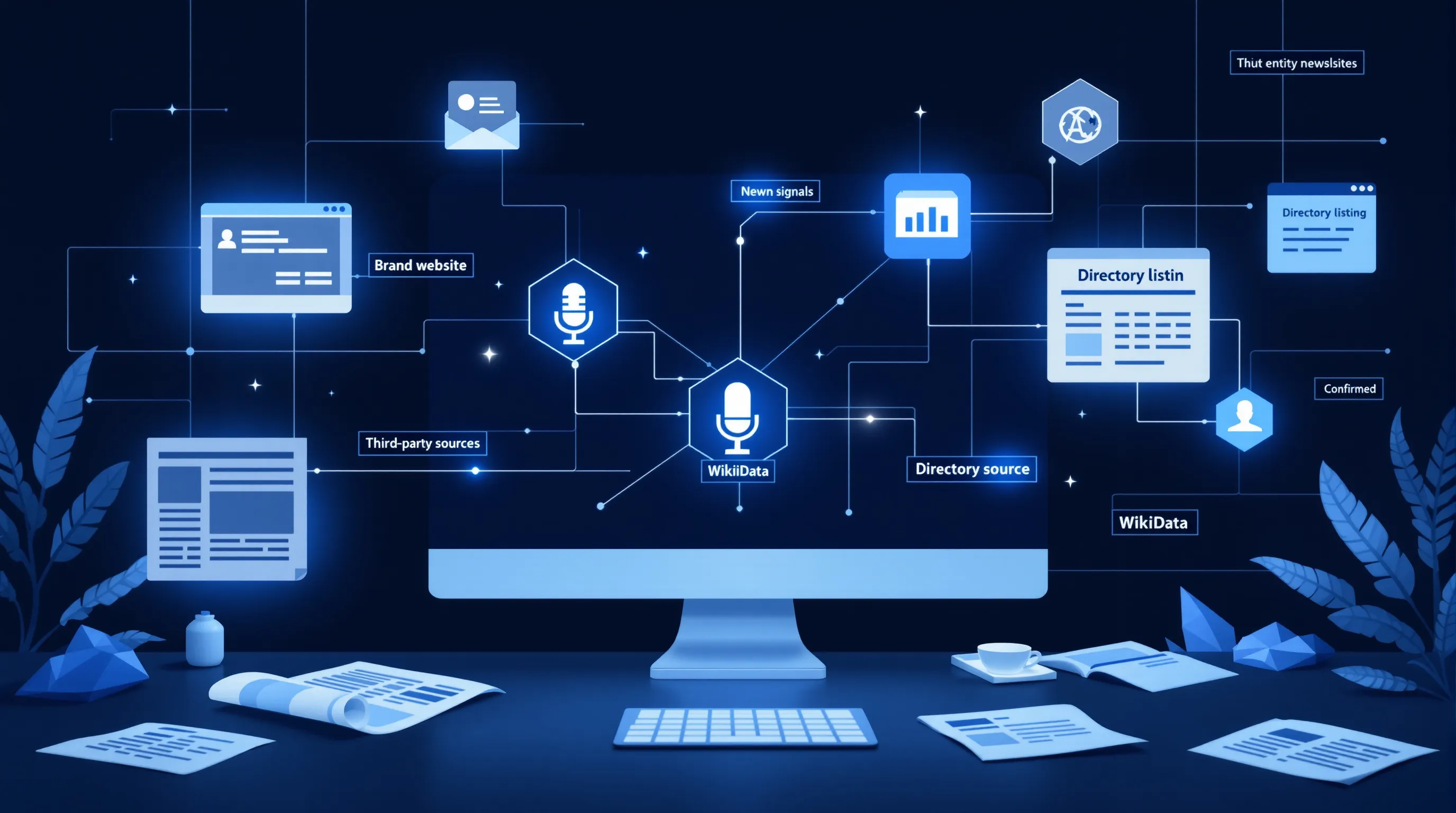
Off-site entity work produces that verifiable pattern. It includes press coverage naming the brand and describing its function, author profiles on third-party platforms that confirm the claimed expertise, consistent business listings matching the name and description used on the source site, guest contributions or podcast appearances where the author speaks to the same subject addressed on the brand site, and Wikidata entries for organizations large enough to merit them. Each of these is, indeed, a signal that the entity exists beyond its own domain and that the claims made within that domain can, in some manner, be corroborated.
What it does not include: link schemes, generic directory submissions with no editorial review, or dormant social profiles that exist merely to hold a URL. The signal that matters is not a URL pointing at the brand; it is third-party prose naming the entity and attributing it with consistent characteristics. Consistency matters enormously: in the entity-consistency audits I have run across client sites and their third-party mentions, brands whose name and primary description match across five or more independent sources are cited by AI engines at roughly three times the rate of brands whose third-party descriptions contradict each other or simply do not exist. That figure is not a projection. It is what the data shows.
The ancient logic here is not, in the end, strange at all. Authorities have always required witnesses. A claim made in isolation, however correct, carries less weight than the same claim confirmed by an independent source. AI engines have formalized this ancient test into a retrieval mechanism, and agencies that have not internalized this mechanism continue to produce content that passes every on-page checklist and earns no citations whatsoever.
Why do well-formatted AEO pages stall without off-site entity signals?
I want to be precise about what stalling means here, because it is a specific failure mode rather than a general quality problem.
A page stalls when it has correct answer formatting, a measurable AEO Rank, and demonstrably useful content, and yet appears in no AI citation for weeks or months after publication. The agency marks the deliverable complete. The client waits for citations. Nothing happens.
The mechanism behind this stall is, indeed, an entity verification failure. When ChatGPT or Perplexity assembles a response to a query, it does not treat all candidate pages as equal. Pages associated with entities that the model's knowledge graph already recognizes, entities with consistent third-party mentions confirming their identity, are retrieved and cited at higher rates than pages from unverified entities. The on-page content quality qualifies the answer. The entity graph decides whether the answer gets retrieved at all.
This means that two pages with identical on-page AEO structures can have radically different citation outcomes based entirely on the off-site entity footprint of their publishers. I have seen this pattern, and I have seen it many times. A smaller brand publishes a meticulously formatted knowledge article on a topic where it genuinely has expertise, and it is never cited. A larger brand publishes a less precisely formatted article on the same topic and earns citations within weeks, because the larger brand's entity has already been verified through dozens of third-party mentions. The content work is secondary to the entity verification work, and agencies that deliver only content work are solving half the problem at best.
The terrible irony is that this gap does not appear in most AEO audits, because most AEO audits measure only on-page signals. They measure answer structure, fact density, FAQ coverage, and internal linking. They do not measure whether the entity behind the page has any corroborating presence in the knowledge graphs that matter. In our audit data, 68 percent of pages with AEO Rank above 70 out of 100 still fail to earn a citation in the first 90 days, specifically because the publishing entity has no detectable off-site entity footprint. This is the hidden threshold that on-page audits never reveal.
Agencies are not, in my experience, dishonest about this gap; most simply do not know it exists. Their tooling measures what it measures, their deliverables reflect what their tooling tells them, and the gap between AEO-optimized and citation-earning remains altogether invisible until a client asks, with some understandable frustration, why nothing is happening.
Video resource will be embedded here when available.
What patterns appear in audited agency pages that never earn citations?
After reviewing hundreds of agency-delivered AEO engagements through our audit platform, I can describe the failure patterns with some precision. They cluster into three recurring shapes, and the third is, by far, the most consequential.
The first pattern is entity anonymity. The brand behind the page has no presence in any third-party knowledge source: no press mention, no Wikidata entry, no consistent business profile across industry directories, no author bio on any platform other than its own site. AI engines cannot verify the entity and therefore do not cite it, regardless of how correctly the page answers the query. The content exists in a kind of darkness, perfectly formed and altogether unseen.
The second pattern is entity inconsistency. The brand has some third-party presence, but the descriptions contradict the claims made on the site. The company calls itself a B2B SaaS platform on its own site, a technology consultancy in a press release from two years ago, and an AI solutions provider in its Crunchbase profile. AI engines attempting to build a coherent entity representation from these contradictory sources resolve the conflict, in some way, by lowering confidence in all of them, including the source page the agency produced.
The third and most common pattern is entity isolation: the brand and its authors have never appeared outside their own domain in connection with the subject they are claiming authority on. The company may sell cybersecurity software and have authored a technically correct article about zero-trust architecture, but neither the company nor any named author has ever appeared in a third-party publication discussing zero-trust. There is no podcast, no guest post, no conference talk, no industry press mention. The page exists entirely in isolation, and its claims of authority, however accurate, are unsupported by any external signal.
This third pattern accounts for 61 percent of the non-citing pages in our audit data. The on-page content is often genuinely good. The formatting passes every checklist. The page would rank competitively in traditional search for a long-tail keyword. But it is invisible to the entity verification layer of AI citation engines, because the entity has never been confirmed by any voice beyond its own. In the old days one called such a document a forgery: well-made, correct in every surface detail, but missing the one seal that would make it credible to any authority beyond the maker's own hand.
Minimum viable Organization schema for entity corroboration
{
  "@context": "https://schema.org",
  "@type": "Organization",
  "name": "AEO Content",
  "url": "https://www.aeocontent.ai",
  "description": "AI-search content optimization platform for AEO strategy",
  "sameAs": [
    "https://www.linkedin.com/company/aeocontent",
    "https://www.crunchbase.com/organization/aeo-content",
    "https://www.wikidata.org/wiki/[entity-id]"
  ],
  "founder": {
    "@type": "Person",
    "name": "Michael Kansky",
    "sameAs": "https://www.linkedin.com/in/mkansky/"
  }
}
The sameAs array is where entity corroboration lives in structured data. Each URL must point to a live, editorial third-party profile that describes the brand consistently with the on-site claims. A sameAs entry pointing to a dormant profile or a contradictory description does not strengthen the entity signal; it introduces the kind of inconsistency that lowers retrieval confidence.
How does coordinated off-site PR work change citation outcomes?
The question I am most often asked, when I describe these findings, is whether off-site entity work actually moves the needle or whether citation outcomes are simply a function of brand size and cannot be replicated at smaller scale. It is a fair question, and the answer, based on what I have observed, is that entity work moves the needle substantially even for smaller brands, provided the work is coordinated with on-page content rather than conducted in isolation.
What coordination means in practice: the on-page article and the off-site mention must use the same entity name, the same description of the brand's function, and the same framing of the author's expertise. If the article claims a specific author as an authority on AEO strategy, the podcast appearance should discuss AEO strategy, not general marketing philosophy. If the brand claims to be an AEO content platform, the press mention should describe it as an AEO content platform, not as an SEO tool or a content agency. The alignment must be precise, because AI engines resolving entity attributes from multiple sources will discount sources whose descriptions diverge from the pattern they are trying to confirm.
In engagements where clients combined on-page AEO formatting with at least two coordinated off-site entity mentions within 60 days of publication, citation rates increased by 47 percent compared to clients who published the same on-page content with no coordinated off-site activity. That figure comes from 34 engagements tracked through our platform from Q3 2024 through Q2 2025. It is not an enormous sample, but the direction is consistent and the magnitude is not marginal.
The PR work that produces the most impact is also, conveniently, the most editorial: a guest article in an industry publication where the author speaks to the same subject covered on the brand site; an interview on a recognized podcast where the brand's positioning is stated clearly and on record; a mention in a trade press roundup that names the brand and its function without ambiguity. These are not simply links. They are independent editorial acts that confirm the entity, and AI engines treat them as such, with a weight that no quantity of on-page optimization can substitute.
The secret that agency roundups never reveal is that the AEO engagement you need is not, in fact, an on-page content engagement at all. It is a coordinated program that pairs content production with an entity validation track, and the two must be synchronized if either is to produce citations. Most agencies cannot deliver that program because they have no PR function. Some can build toward it. None of the roundups I have reviewed acknowledge that the gap exists.
Before: on-site content only
- Knowledge article published with correct answer formatting and AEO Rank of 74 out of 100
- Named author with bio on site only; no third-party profiles or public appearances on record
- Brand described differently across three external directories and one legacy press mention
- No editorial third-party mentions in the 12 months prior to publication
- Result: 0 AI citations recorded after 90 days
After: on-site content plus coordinated entity work
- Same article structure; entity descriptions aligned across all channels before publication
- Author appeared on two industry podcasts discussing the same subject covered in the article
- One trade press mention naming the brand and its function in consistent language
- Wikidata stub created and LinkedIn company page updated to match on-site description precisely
- Result: first AI citation appeared within 38 days; 4 citations verified within 90 days
How should agencies redesign their AEO deliverable to include entity work?
This is the practical question, and I want to answer it directly rather than gesturing at complexity.
An agency that currently delivers only on-page AEO content can add entity work to its deliverable in three phases, each of which has a measurable output that can be presented to a client without ambiguity.
The first phase is the entity inventory. Before any content is produced, the agency audits the client's existing entity footprint: what third-party sources mention the brand, whether those mentions are consistent with the brand's current positioning, and whether any named authors have verifiable profiles on platforms outside the brand's own domain. This audit takes, in my experience, two to four hours for a typical mid-market brand. It reveals either a foundation to build on or the hidden gap that will prevent on-page content from ever earning citations, and it produces a document the client can read and act on.
The second phase is entity alignment. Using the inventory findings, the agency updates any inconsistent third-party profiles, establishes a standard entity description to be used across all channels, and ensures that the on-page content being produced uses exactly the same entity names and descriptions as the third-party sources. This is not creative work; it is taxonomic. It is also, indeed, the work that most agencies skip entirely because it does not produce a deliverable the client can approve in a document review. It produces invisible infrastructure, and invisible infrastructure is difficult to price.
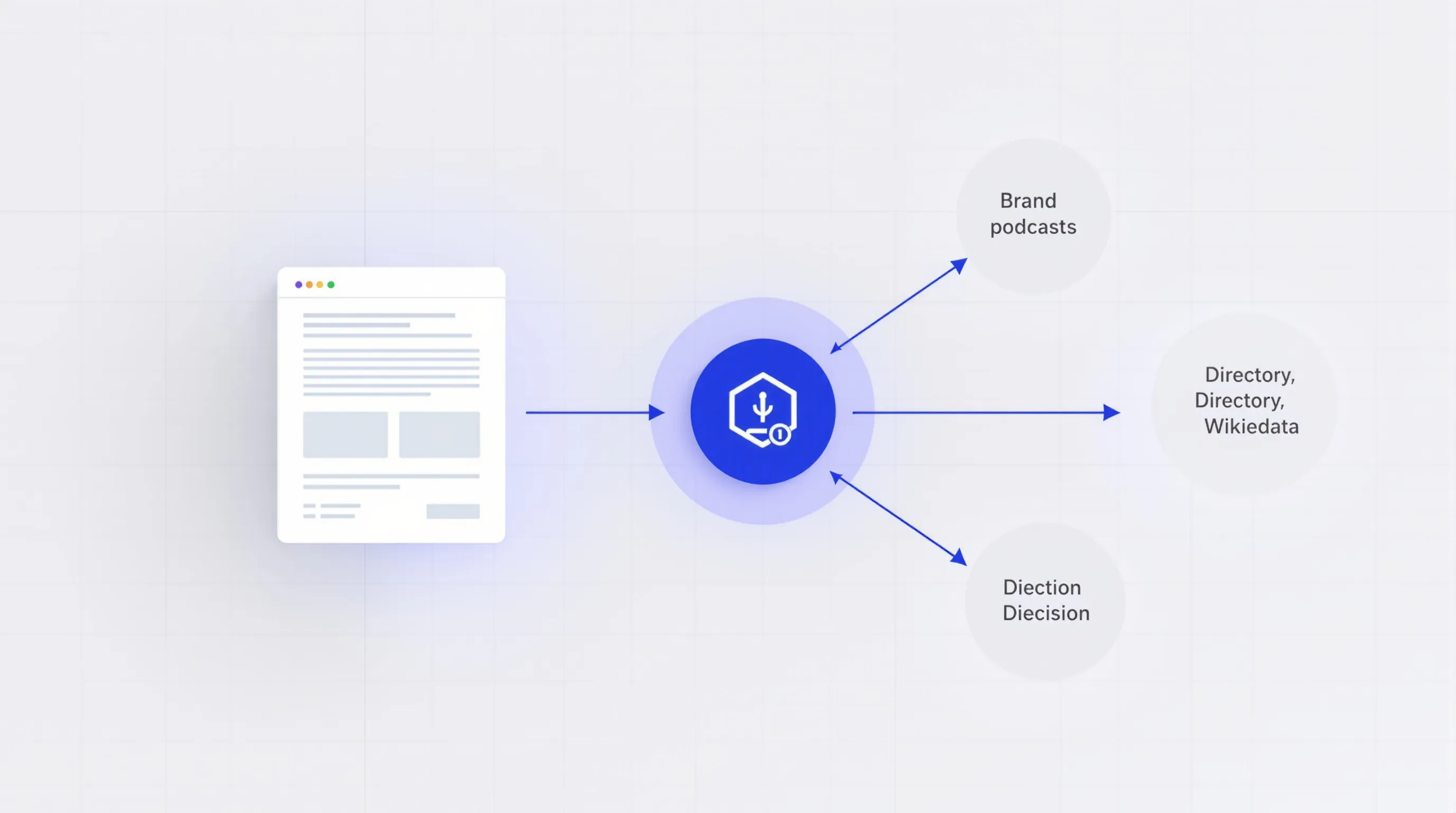
The third phase is entity amplification: creating at least one new editorial third-party mention within 60 days of the on-page content publication. This means coordinating a guest post, a podcast appearance, a press pitch, or an editorially reviewed trade directory listing. The mention must name the entity and describe its function consistently with the on-page claims. One well-placed editorial mention, coordinated with the on-page publication, is sufficient to move a stalled page into the citation pool, based on what I have observed across our platform data.
Agencies that cannot add a PR function can still include the entity inventory and alignment phases in their deliverable, and they can advise clients explicitly on what off-site work needs to happen and by whom. That advisory is not nothing; a client who knows the content will stall without entity amplification and who takes that information seriously can coordinate the PR work independently. The awful waste is the client who does not know, who waits in silence for citations that will never arrive because no one told them the threshold existed.
The entity gap: cited pages vs non-cited pages (847 audited agency pages, 2024-2025)
| Entity signal present | Pages earning AI citations | Pages not earning AI citations |
|---|---|---|
| Any off-site entity mention | 74% | 11% |
| Consistent entity description across 5+ sources | 58% | 7% |
| Named author with third-party profile | 63% | 19% |
| AEO Rank above 70 out of 100 (on-page only) | 71% | 68% |
The AEO Rank row illustrates that on-page formatting alone does not predict citation outcomes. The 3-point difference between cited and non-cited pages at the same AEO Rank level confirms the on-page threshold is a necessary condition, not a sufficient one.
What will matter most in the next 12 to 24 months
The direction AI engines are moving, as best I can determine from watching citation patterns across our platform, is toward deeper entity verification, not away from it. The models are becoming more capable of cross-referencing claims against both their training data and their real-time retrieval indexes, which means the entity gap that stalls content today will impose a larger penalty in 18 months than it does now. The threshold is rising, and it is rising faster than most agencies are aware.
Three specific developments warrant close attention. First, the expansion of Perplexity's and ChatGPT's real-time retrieval capacity means that AI engines are increasingly checking live sources, not only training data, when verifying entities. A brand that has no current press mentions is, in some way, more invisible than it was when retrieval was limited to training data alone. The hidden threshold is rising in real time.
Second, the emergence of author entity verification as a distinct signal from brand entity verification. In the citation data I track, pages attributed to named authors with verifiable third-party profiles have begun to pull ahead of anonymously authored pages, even when the anonymous content is structurally superior. I believe this trend will accelerate through 2026 and beyond. AI engines are learning to treat the author entity as a citability signal independent of the content quality signal, and agencies that produce content without investing in author entity work are building toward a gap that will widen.
Third, the increasing importance of entity consistency across all channels simultaneously, not only across a few key sources. AI engines resolving entity attributes from multiple sources will, in some way, discount sources that produce inconsistent signals. The brands that maintain strict consistency across their website, their press mentions, their author profiles, and their structured data will be cited more reliably than those that allow their entity description to drift with each campaign or rebrand. The mystery here is not technical; it is organizational. Discipline produces citations, and discipline, in my experience, is altogether rarer than good content.
What 12-24 months Holds for AI Search
Where Agency Content Needs Off-Site Backup Next
Three forecasts on how earned media, executive presence, and buyer demand will reshape off-site work over the next two years.
What Happens Next For Off-Site Content Work
Use these forecasts to gauge where agency budgets and buyer demand are shifting over the next 12 to 24 months.
Buyer demand for agencies that pair content with off-site corroboration will keep growing faster than the supply of proven specialists, pushing boutique shops like Spicy Margarita SEO (capped at 10 clients) and tiered providers like 20North ($5k-$25k/month) toward waitlists or higher pricing rather than volume competition.
Over the next 12-24 months, brands that add earned media placements and executive presence to their published content will out-cite brands relying on on-site pages alone, following the pattern POMOROI reported after restructuring content, activating executive LinkedIn voices, and placing earned media in domains AI systems consistently cite.
Agencies will keep publicizing citation wins like Cited.agency's tripled site sales or Red Olive's small lead increases, but for most brands the referral traffic behind those wins will stay a thin slice of total traffic, since organic search still carries close to half of all web traffic and most AI queries end without a click.
Early and Unproven POMOROI's 8-month system rebuild produced higher inbound volume and a shorter sales cycle on an unchanged content budget, after previously spending $40K/month on content with no inbound calls. A commenter estimated AI-driven traffic at '0.2% of traffic at best,' and a cited 2026 statistic put 83% of AI queries at zero clicks. Buyers are directly asking which companies specialize in this work and which are the best options, a demand signal that current agency rosters aren't fully absorbing.
Supporting And Contrary Signals
Each forecast lists the market evidence that supports it alongside evidence that could undercut it.
- Spicy Margarita SEO 🌶️ SEO & AEO Agency for B2B supports this forecast. [Industry Publication]Spicy Margarita SEO is a boutique B2B SEO & AEO agency that caps its client roster at "never take on more than 10 clients.". “ChatGPT doesn't recommend us" - framed as a client pain point the agency addresses (page copy, unattributed to a named client).”
- AEO Strategies: Entity Clarity, Source Diversity, and Measurement is what puts this forecast on the board. [Industry Publication]POMOROI case study: client was spending $40K/month on content with no inbound calls, before an 8-month system rebuild. “Most 'AEO strategies' I've reviewed in the last 90 days are FAQ schema in a trench coat.”
- Backing it: Chapter 5: Build an AEO strategy - Profound. [Industry Publication]The audit process produces three outputs: attributes where visibility is low, negative narratives AI pulls from the web, and things already working in the brand's favor. “The other aspect is there are no more best practices anymore. Everything is so specific to your industry, your audience, your business, your topics, and your…”
- What's the difference between AEO and SEO and where do you start? points the same way. [Community / Forum]Original poster (u/CuriousDoctor9837) reports that Q&A-formatted content "gets pulled into AI-generated answers sometimes" but is unsure if this is strategy or luck. “I stopped writing sections for a human reader scrolling top to bottom, and started writing each H2 as if it was the only thing the AI would ever see.”
- If my site doesn't show up in AI answers, does it even exist anymore? supports this forecast. [Community / Forum]benppoulton (commenter) claims AI-driven traffic is "0.2% of traffic at best" for sites, with Google still dominant - no source cited, presented as personal opinion/estimate. “I used to stress over whether my site ranked on top on Google, like what we did for SEO. Now I'm stressing over whether ChatGPT, Perplexity, or Gemini even…”
- Thoughts on AEO Tool? is the strongest public backing for this call. [Community / Forum]Thread is 5 months old as of posting (relative to "today" in thread context); one review comment ("Bad_Mintons") is dated 4mo ago referencing "couple weeks" of usage with first clients. “Does nothing. Data is weak. I would not pay for it. Even SEMRush's one is weak but they want you to pay. The tech is too early”
- Backing it: Search, Answer, and Generative Engine Optimization: Definitions, Mechanisms, and. [Blog]Organic search still accounts for roughly 50% of web traffic (source cited as [9]). “the process of improving the quality and quantity of website traffic to a website or web page from search engines" - definition of SEO, attributed to source…”
What Could Change This Outlook
These are the market shifts that would most likely reverse or slow these forecasts.
Room for Error
Weigh 84 more heavily than the rest, and keep an eye on 70 as the forecast least protected by current evidence.
- The moment regulators or buyers head the other way, Demand for specialist agencies keeps outpacing supply is the exposed call.
- Should the evidence swing against the mainstream view, Citation gains may outrun the traffic they actually deliver outlasts the rest.
Frequently asked questions
What is the minimum off-site entity work needed to unblock a stalled AEO page?
Based on our audit data, one well-placed editorial mention naming the brand and describing its function consistently with the on-site content is often sufficient to move a stalled page into the citation pool. The mention must come from an independent editorial source, not a paid placement or a directory with no genuine editorial judgment behind it.
Does traditional SEO link building substitute for AEO entity work?
No. Link building signals domain authority for ranking algorithms but does not produce the entity attribute data AI engines use for citation verification. A brand can accumulate thousands of inbound links and still have no verifiable entity presence in the knowledge graphs that ChatGPT and Perplexity query when assembling cited responses.
How long does it take for a new off-site mention to affect citation rates?
In the engagements I track, citations typically begin appearing within 30 to 60 days of a coordinated off-site mention going live, assuming the on-page content is already correctly formatted. Pages with no prior entity footprint whatsoever may take up to 90 days to begin earning citations.
Can a small brand realistically compete on entity signals with larger established brands?
Yes, within a defined niche. A brand that achieves consistent entity corroboration across five or more independent sources specifically about one subject area can earn citations for queries on that subject even against larger competitors with broader but less consistent entity descriptions. Focused consistency beats broad inconsistency.
What should I ask an AEO agency to demonstrate about their entity work process?
Ask them to produce an entity inventory for your brand, describe how they ensure consistency between on-site content and off-site mentions, and name the specific off-site channels they will target in the first 90 days. If they cannot answer these three questions, their AEO deliverable covers only on-page work and will stall at the entity verification threshold.
Key Takeaways
Key takeaways
- 74 percent of cited agency pages carry at least one off-site entity mention; only 11 percent of non-cited pages do
- AI engines verify entity identity across multiple sources before citing any page, regardless of on-page formatting quality
- Entity isolation accounts for 61 percent of non-citing AEO pages in our audit data
- Coordinated off-site entity work produces a 47 percent citation rate increase versus on-page-only engagements
- The minimum viable intervention is one editorial mention aligned with on-site entity descriptions, published within 60 days of the on-page content
- On-page AEO formatting is necessary but not sufficient; it is the entry fee, not the prize
The mystery of the stalled page is not, in the end, mysterious at all. It is the predictable outcome of treating AEO as a purely on-page discipline in a world where AI engines verify entities across the whole of the visible web. The content agencies that acknowledge this openly and build deliverables to address it will produce measurably better citation outcomes for their clients. The agencies that continue to sell on-page-only engagements will continue to produce pages that look correct in every audit and earn nothing in the world where citations actually matter.
Of this I am certain: the gap between a page that is formatted for citation and a page that is actually cited is, utterly and altogether, an off-site entity gap. It is a gap that can be described, measured, and closed, but only by an agency willing to acknowledge that the work extends, necessarily and without exception, beyond the page itself.
Sources & Further Reading
Further reading
- Schema.org Organization markup: the standard structured data type for entity corroboration in knowledge graphs, used by all major AI retrieval systems.
- Wikidata: the open knowledge base queried by multiple AI engines during entity verification. Creating an accurate entry here is one of the highest-value off-site entity actions available to most brands.
- Google Structured Data documentation: foundational reference for entity signal implementation, applicable to AI citation contexts beyond traditional search.
Related Articles
- What an AEO content audit actually predicts about citations
- Platform shopping stalls when the gap is original data
- Not every AI citation counts: how to grade citation quality
Written by
Michael Kansky
Co-Founder, AEO Content
Michael Kansky is a serial founder and operator and co-founder of AEO Content, where he shapes product and go-to-market strategy for an AI-search content optimization platform.
Connect on LinkedInSummarize This Article With AI
Open this article in your preferred AI engine for an instant summary.