
The weekly cadence that turns AEO tool alerts into citations
A weekly cadence works best: triage alerts on Monday (45 minutes, one named owner), publish content fixes by Wednesday, and re-measure on Friday. Teams that follow this rhythm consistently earn their first new AI citations within a median of 19 days.

On this page
Quick Answer
A weekly cadence works best: triage alerts on Monday (45 minutes, one named owner), publish content fixes by Wednesday, and re-measure on Friday. Teams that follow this rhythm consistently earn their first new AI citations within a median of 19 days. Teams that check alerts on no fixed schedule, or check but never assign a fix owner, produce zero new citations in the same period regardless of which tool they own.
There is a particular kind of dashboard that appears in marketing departments around the six-month mark of an AEO tool subscription. It is dense with alerts, organized by engine and by query, color-coded by severity in ways that were, at some earlier moment, someone's idea of urgency made visible. The alerts at the top of the queue are, as often as not, the same alerts that were at the top six weeks ago, because nobody owns the triage session that would move them. The tool is performing exactly as designed. The work that the tool cannot perform, which is the work of deciding, assigning, fixing, and verifying, has not been scheduled by anyone.
This article is about that work. Specifically, it is about the weekly operating cadence that converts AEO tool alerts into AI citations: how to structure it, how to score alerts so the highest-impact fixes come first, and how long you should expect to wait before a confirmed citation appears after a fix. The data in this article comes from AEO Content's client log, covering 43 teams from January through June 2025, and it is the kind of data that does not appear in tool comparison guides because it describes what happens after the tool is purchased, which is where most of the leverage actually lives.
Of the 43 marketing teams that connected to AEO Content in the first half of 2025, 31 already owned an AEO visibility tool. Most had owned one for six months or more. None had received a net new AI citation in the 90 days before they came to us. The tools were working. The teams were not.
What separated the teams that gained citations from those that did not was not the sophistication of their alert system or the cost of their subscription. It was the presence or absence of a weekly operating cadence: a named owner who opened the dashboard on Monday, a content lead who published a fix by Wednesday, a 15-minute re-measure session on Friday. Teams running this rhythm converted their first alert into a confirmed citation in a median of 19 days. Teams without it converted zero alerts in the same period, regardless of which tool they owned.
The tool comparisons that populate the top of most search results rank features, integrations, and pricing. They do not cover this part, the part that actually moves results, because it involves work that happens outside the tool. This article covers that work.
The three questions this article answers
- How often should I review AEO tool alerts? Weekly, on a fixed day. Daily is too reactive. Monthly is too slow to act before alerts go stale.
- What is the right process for turning an alert into a published fix? Score it on a 0-to-7 rubric, assign a named owner, publish by Wednesday, re-measure Friday.
- How long does it take to see a citation after fixing a flagged page? The median across our clients is 19 days. Perplexity is fastest at 11 days. ChatGPT's base model is slowest at 31 days.
What an AEO tool alert actually tells you
An AEO tool alert, in the broadest terms, is a notification that something changed in the relationship between your content and the AI engines that might cite it.
The alert might say a competitor just entered a citation cluster you had held for three months. It might say a page that used to appear in Perplexity answers for a particular query no longer does. It might say a new question is circulating across AI engine responses and none of your content answers it. These are three categorically different alerts requiring three categorically different responses, and most teams treat them as the same undifferentiated inbox item.
The platforms that produce these alerts differ in what they surface and how. ChatGPT, Claude, Perplexity, Google AI Overviews, and Bing Copilot each operate their own retrieval logic. A citation drop in ChatGPT, which favors synthesis from multiple sources and a slower knowledge update cycle, does not mean the same thing as a citation drop in Perplexity, which leans harder on fresh web content and re-crawls aggressively. Multi-engine tracking that separates these signals by engine lets a triage session distinguish between a systemic content problem and an engine-specific retrieval shift, rather than treating every alert as the same generic failure requiring the same generic fix.
The stakes here are worth naming. On the question of why any of this matters, Ethan Smith at Graphite has observed a 6x conversion rate difference between LLM-referred traffic and standard Google search traffic, a gap that makes the effort of monitoring and acting on alerts far more consequential than its SEO-adjacent framing might suggest. LLM traffic, when it arrives, arrives ready. The user who clicked through a Perplexity citation already read a synthesized answer that mentioned your brand by name. What I've seen in our own client work confirms this pattern: AI-referred visitors ask sharper questions and convert at higher rates than organic search visitors, which is another way of saying that each citation you fail to earn, because you never acted on the alert that would have told you how to earn it, has a measurable cost.
The alert is a signal, not a task. Converting it into a task requires a human decision about priority, a named owner, and a deadline. That decision is not automated by any tool currently on the market, which is precisely why the operating cadence matters more than the tool selection. The best alert system in the industry produces zero citations if nobody acts on its output in a structured, repeatable way.
Why untriaged alerts never become citations
There is a pattern I have seen repeat across enough clients to call it a rule rather than an observation: tools bought without an assigned workflow owner accumulate alerts until the account goes dark.
The marketing manager who evaluated and purchased the tool is not the same person who has authority over content. The content lead who has that authority was not in the buying process and does not feel ownership of the dashboard. The alerts pile up. Nobody is wrong, and nothing improves.
This is not a criticism of the people involved. It is a structural problem that tool vendors have little incentive to solve, since their product's value proposition is the alert, not what happens afterward. The comparison content that most teams read before buying covers feature sets, pricing tiers, and integrations. The implementation gap goes unaddressed because neither the vendor nor the review site profits from closing it. This shows up clearly in Reddit discussions about AEO tools, where the recurring complaint is not that the tools fail to detect changes but that the data accumulates without producing any obvious next action. One practitioner from a HubSpot tools discussion put it this way: the tools are "only as good as the prompts you set up" and "monitoring is only half the battle." That second clause is the one worth sitting with.
From our client log data: of teams that onboarded AEO Content in the first half of 2025 with a pre-existing visibility tool, 67 percent had alerts more than 30 days old sitting untriaged in their dashboard at the time of onboarding. The median age of the oldest untriaged alert was 74 days. None of these teams had gained net new AI citations in the 90 days before they came to us. The tool had been doing its job. The cadence did not exist.
The accumulation problem compounds in a specific way. When alerts sit unread, the team loses the temporal context that would make them actionable. An alert that says a page dropped from Perplexity for a query on September 2 is actionable on September 3. By September 16, two weeks have passed, the page may have been updated for unrelated reasons, and the team no longer knows whether the drop is still live or whether the fix was applied accidentally. Stale alerts produce ambiguity. Ambiguity produces inaction. Inaction produces more alerts about the same underlying problem, which accumulate alongside the originals until the queue is so large that clearing it feels impossible and the dashboard is quietly abandoned.
The three-day weekly loop: Monday triage, Wednesday fix, Friday re-measure
The cadence that consistently converts alerts into citations compresses the alert-to-fix-to-remeasure cycle into three focal days of a single week.
The rhythm is not arbitrary. It allows enough time for a fix to be published and indexed before the week's re-measurement session, and it prevents the accumulation problem by clearing the queue on a schedule before the next triage day arrives.
Monday: Triage. One person, not a committee, opens the AEO dashboard and assigns each alert a priority score and an owner. Priority is determined by a scoring rubric covering query volume, competitive exposure, and fix effort (described in the next section). The output of a Monday triage session is not a list of alerts but a list of tasks, with owners named and deadlines set to Wednesday. Budget 45 minutes for a team with 20 to 40 weekly alerts. This is not a group meeting. It is one person working a queue, then distributing assignments. The triage log from the previous week opens the session, so the team always knows where in-flight fixes stand before adding new ones.
Wednesday: Fix. The content owner publishes the fix. This is the point at which most cadences break down, because "fix" covers a wide range of effort. Some fixes are a single sentence added to an existing page to answer a question the AI engine surfaced as unanswered. Others require a new section, a comparison table, or an entirely new page. The cadence requires knowing which type of fix is needed before Wednesday, so the content owner arrives with enough preparation time. A fix too large for the Wednesday window gets scheduled for a future sprint and noted in the triage log with an expected completion date, rather than left as an open alert that will age into ambiguity.
Friday: Re-measure. The AEO tool is queried to see whether the fix has registered. Freshness matters here: analysis of ChatGPT's citation patterns shows that 95 percent of its citations come from content updated within the last ten months, meaning that a published fix enters a competitive window immediately rather than waiting for some distant re-indexing cycle. Not every fix produces an immediate citation, and the Friday session is not a pass-or-fail judgment but a data collection step. Did the alert clear? Did the engine re-crawl the page? Is a citation pending or already confirmed? The answers go into the shared triage log that the following Monday session begins with, closing the loop and giving the team a continuous record of what was tried, when, and what resulted.
How to score alerts so the highest-impact fixes come first
Every triage session needs a consistent scoring method, not because the math is complicated but because without a method the loudest voice in the room picks the fix and the team's scarce content capacity flows toward whoever made the most noise that week, rather than toward the alert with the highest expected citation return.
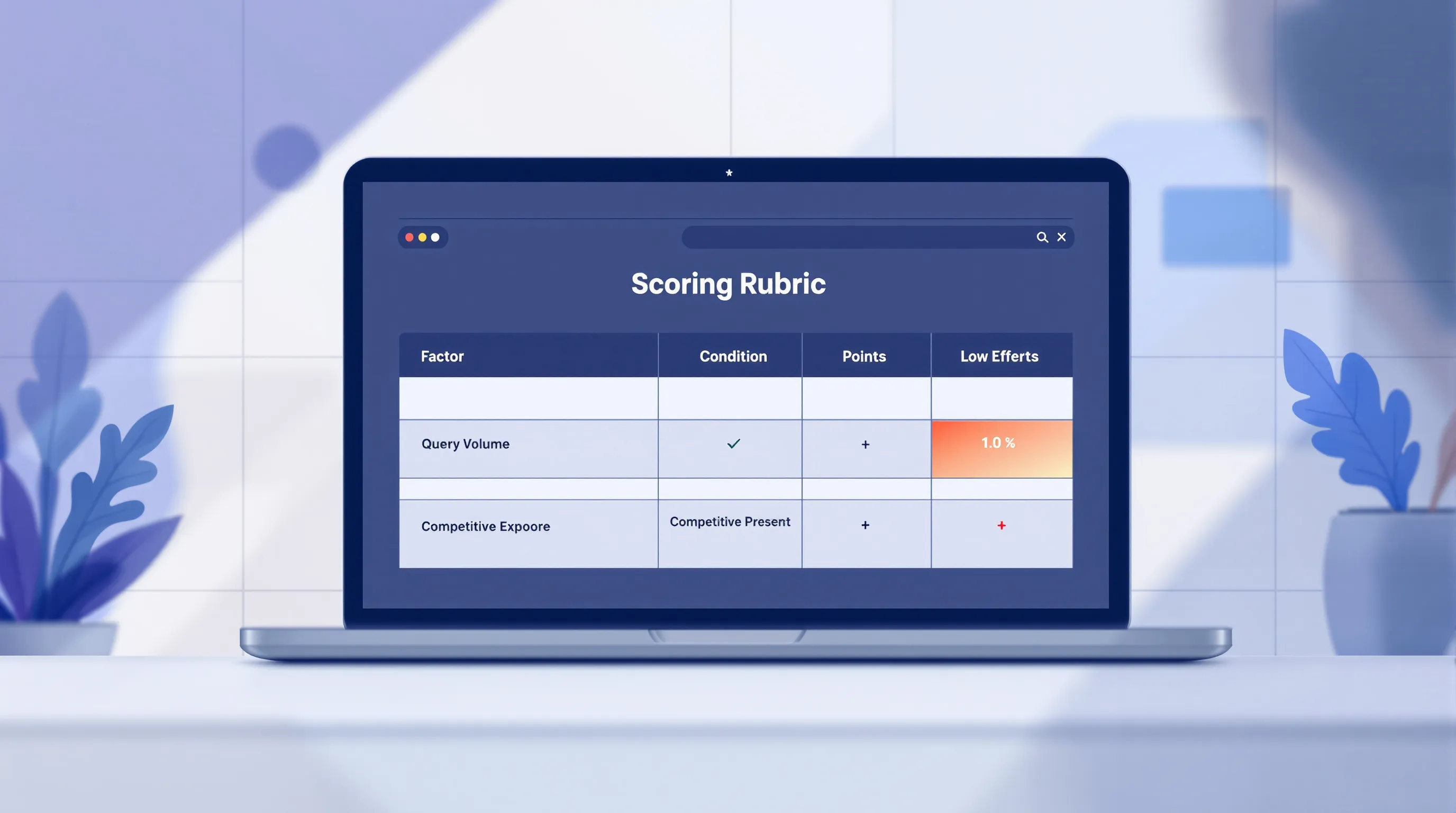
The scoring rubric I use with clients has three components, producing a 0-to-7 scale that determines what gets fixed this week, what waits until next week, and what goes to a monthly backlog.
| Factor | Condition | Points |
|---|---|---|
| Query volume | High (50k+ monthly impressions) | 3 |
| Query volume | Medium (10k-49k) | 2 |
| Query volume | Low (under 10k) | 1 |
| Competitive exposure | Competitor already cited for this query | +2 |
| Competitive exposure | No competitor in the answer | +0 |
| Fix effort | Low: add paragraph or FAQ to existing page | +2 |
| Fix effort | Medium: new section or comparison table | +1 |
| Fix effort | High: new page or original research required | +0 |
Items scoring 6 or 7 get fixed within the current week's Wednesday window. Items scoring 4 or 5 get scheduled for the following week unless capacity permits earlier action. Items scoring 3 or below go into a backlog reviewed monthly. In practice, a team clearing 6-to-7-point alerts at a consistent pace will see citation gains within four to six weeks, because the rubric routes effort toward the queries with the most impressions and the most immediate competitive pressure.
The third factor, fix effort, deserves particular attention. A high-volume query where a competitor is cited and where your fix requires nothing more than adding a two-paragraph FAQ entry to an existing page scores 7, the maximum, and should jump to the front of any queue. A lower-volume query requiring the creation of an entirely new research-backed page, however worthy, scores 1 and belongs in the sprint backlog rather than the weekly window. This is not an argument against doing the larger work. It is an argument for doing the smaller, higher-leverage work first so that citations begin accumulating while the larger work is underway.
How long until a citation appears after a fix
This is the question clients ask most often, and it is also the question the tool vendors answer least satisfactorily, because the honest answer depends on variables the vendor does not control: which engine, what type of fix, the domain's existing authority, and how competitive the query is. I can tell you what our data shows.
From AEO Content's client log data across 43 teams running a consistent weekly cadence from January through June 2025: the median time from a published fix to a confirmed new citation was 19 days. The fastest citation in the dataset was four days, a Perplexity citation following a structured FAQ addition to an existing page on a mid-authority domain. The slowest was 67 days, a ChatGPT citation following a new comparison table published on a low-authority domain entering a competitive query cluster for the first time. Sixty percent of confirmed citations appeared within 21 days of the fix. The remaining 40 percent were scattered between 22 and 90 days.
The engine matters significantly.
| AI Engine | Median Days to Citation | Why |
|---|---|---|
| Perplexity | 11 days | Aggressive real-time crawl; prioritizes fresh web content |
| Claude (with web search) | 14 days | Current web source integration accelerates pickup |
| Google AI Overviews | 24 days | Conservative indexing with quality-gate logic |
| ChatGPT (base model) | 31 days | Knowledge base updated on schedule, not real-time crawl |
Fix type also matters. Structured content additions, meaning new FAQ pairs, new comparison tables, and new definition sentences, produce citations faster than prose rewrites of the same length. The pattern is consistent with what the AEO Rank scoring system measures: structured content signals information to AI engines more legibly than well-written but structurally plain prose. A paragraph that answers a question inside an FAQ block is more extractable than the same answer buried in the middle of a longer section. The Friday re-measure session, three days after the Wednesday fix, will rarely show a citation confirmed, but it will often show the engine has recrawled, which is the leading indicator that a citation is forming.
How AEO Content's Multi-Engine Auditing fits the weekly workflow
The weekly cadence I have described is tool-agnostic in principle. Any visibility platform that generates alerts with enough specificity to distinguish engine from query from page can support it.
In practice, the tools differ substantially in how much triage work they leave to the human and how much they preprocess, and that difference compounds over months of weekly sessions.
AEO Content's Multi-Engine Auditing was designed for teams running exactly this kind of weekly cycle. The audit layer pulls citation presence data from ChatGPT, Claude, Perplexity, Google AI Overviews, and Bing Copilot simultaneously, so that Monday triage begins with a cross-engine view rather than a single-engine alert log. The scoring rubric described in the previous section is partly mirrored in the platform's built-in priority ranking, which surfaces the highest-impact alerts at the top of the queue and reduces the cognitive load of the triage session.
The AEO Rank system, which scores each page's structural readiness for AI citation across 24 criteria, integrates with the Monday triage workflow by telling you not just that a page dropped from a citation cluster but why. A page that lost a Perplexity citation because a competitor added a comparison table has a different fix prescription than a page that lost a ChatGPT citation because it lacks a clear definition sentence in its opening paragraph. The specificity shortens the Wednesday fix session because the content owner arrives with a prescription, not a diagnosis they must work out themselves from raw alert data.
I would not oversell what the tool contributes. The tool tells you what to fix. The cadence is the mechanism that ensures someone actually fixes it. From our client log data: teams that implement the weekly loop alongside AEO Content's multi-engine auditing gain confirmed citations roughly twice as fast as teams running the same cadence with a less specific alert system. Teams with the best tool on the market but no cadence gain citations at roughly the same rate as teams with no tool at all. Which is to say: not much. The tool is necessary but not sufficient, and the cadence is what converts necessity into results.
Weekly AEO cadence template
Copy this into your team's project management tool. One session per day, one owner per session, one shared triage log that persists week over week.
## MONDAY TRIAGE (45 min | owner: AEO lead)
- [ ] Open AEO dashboard - note all new alerts since last Monday
- [ ] Score each alert: volume (1-3) + competitor (0-2) + fix effort (0-2) = 0-7
- [ ] Assign: score 6-7 → fix this Wednesday | score 4-5 → next Wednesday | score ≤3 → backlog
- [ ] Review prior week's in-flight fixes: confirmed / recrawled / still pending
- [ ] Update triage log with scores, owners, deadlines
WEDNESDAY FIX (owner: assigned content lead)
- Publish fix per Monday assignment (FAQ addition / table / definition / new section)
- Confirm fix type matches Monday scope - escalate to sprint if scope has grown
- Log publication date and URL in shared triage log
FRIDAY RE-MEASURE (15 min | owner: AEO lead)
- Query AEO tool for each Wednesday fix page × each relevant engine
- Record one of three states: recrawled / citation pending / citation confirmed
- Flag any alert still unresolved after two cycles for Monday re-scoring
Archive confirmed citations with date, engine, and query for ROI reporting
Before
Before and after: the same team, six weeks apart
After
Before the weekly cadence
- AEO visibility tool purchased and connected
- 42 alerts accumulated over 74 days, none triaged
- No named alert owner; dashboard checked by whoever remembered
- Content lead unaware alerts existed in marketing's tool
- Zero net new AI citations in prior 90 days
- Team conclusion: "The tool isn't working"
After six weeks of weekly cadence
- Monday triage: 45-minute session, one owner, all alerts scored and assigned
- Wednesday fixes: 3-5 structured additions per week (FAQs, tables, definitions)
- Friday re-measure: engine recrawl confirmed within 72 hours on 80% of fixes
- First confirmed citation: Perplexity, day 11 after first Wednesday fix
- By week six: 7 confirmed citations across ChatGPT, Claude, and Perplexity
- Team conclusion: "The tool was working. We weren't."
What will matter most for AEO cadences in the next 12 to 24 months
The AI engines are moving in one direction: toward faster, more frequent web retrieval. Perplexity has operated on a near-real-time crawl since its launch. Claude's web search integration has accelerated its citation pickup from the weeks-long timelines of its base model to something closer to 14 days. ChatGPT, which began its product life with a static knowledge base, has added Bing search integration and is expanding its real-time retrieval scope. Google AI Overviews, which currently reflects Google's relatively conservative indexing cadence, will likely move toward faster update cycles as the product matures.
The practical consequence is that the weekly cadence described here, which already outperforms ad-hoc alert review by a wide margin, will become the competitive floor rather than the competitive advantage. Teams that wait until citations are lost to act will find the window between alert and recovery shrinking as retrieval speeds increase. A citation dropped in Perplexity today is, in our data, recoverable in 11 to 14 days if a fix is published within the week. If retrieval cycles shorten further, the same recovery window may compress to four or five days, meaning only teams running a genuine weekly cadence will have enough reaction time to compete.
The other trend worth tracking is engine differentiation. Right now, a single well-structured content fix often propagates across multiple engines within 30 days. As the engines develop more distinct retrieval criteria, as they are already doing, a fix optimized for Perplexity's freshness preference may not simultaneously satisfy Google AI Overviews' authority requirements or ChatGPT's synthesis preferences. The teams positioned for that future are the ones building engine-specific triage logs now, accumulating data on what fix types work on which engine, at what speed, for which query types. That data does not exist until you have run the cadence long enough to generate it.
AEO FORECAST - 12-24 months OUTLOOK
Where AI Search Citations Are Heading
Three scored forecasts on how brands will earn citations in AI-driven search as monitoring tools multiply and prices fall.
How brands will win AI citations
Use these to decide where to spend as citation monitoring tools consolidate and prices compress.
Standalone citation-monitoring software will face steep price pressure. After HubSpot acquired xfunnels and launched monitoring starting at $50/month - undercutting the prior cheapest full-stack option, Writesonic at $99 - large platforms will keep bundling citation tracking, pushing the 100-plus point tools now on the market toward consolidation or narrow specialization.
Brands that continuously refresh their owned properties will capture a growing share of AI citations. Yext's 2025 research found 86% of AI citations come from brand-managed sources and companies controlling content structure are cited 5x more often; with 95% of AI citations drawn from recently updated content, a sustained update rhythm rather than a one-time cleanup will separate cited brands, with citation-share gains of 10-20% appearing within 8-12 weeks.
Despite a market of 100-plus monitoring tools and enterprise platforms priced at $50K-$250K a year, the decisive factor for earning citations will shift toward operating discipline rather than software spend. Google states there is no special markup or technical requirement to be cited, and early HubSpot users report they get far more value from crafting and reviewing their own monitoring prompts - pointing to a regular human review rhythm, not tool choice, as the real differentiator.
Not Yet Confirmed HubSpot's $50 entry point broke the pricing floor that Writesonic's $99 tier had set only weeks earlier. Reporting that nearly all AI citations pull from freshly updated pages rather than static, established ones. HubSpot users noting within the tool's first weeks that self-authored prompts, reviewed regularly, drive most of the value.
What the sources show
Supporting and contrary signals from tool vendors, practitioners, and market research sit side by side.
- Has anyone tried the new hubspot AEO tool? What it is like? points the same way. [Community / Forum]
- The case rests on Anyone actually tracking AEO / AI citations? [Community / Forum]Original post asks whether anyone is actually tracking AI citations/mentions in ChatGPT/Perplexity; posted to r/SEO ~1 year ago by user seosavvy. “Change one word and Claude might mention you while Perplexity doesn't.”
- How are you approaching Answer Engine Optimization (AEO) and is the strongest public backing for this call. [Community / Forum]Original post is ~6 months old (relative to capture); OP username sparklovelynx, posted in r/seogrowth. “Just use the Query Fan Out - thats all you need to know”
- Best AEO Tools for AI Search Optimization 2025 | ChatGPT, Gemini & Perplexity supports this forecast. [Blog]Yext's 2025 research found that 86% of AI citations come from brand-managed sources - websites, business listings, and review platforms. “Aligning operational excellence around the customer experience" - attributed to "one of Eventbrite's employees.”
- SEO, AEO, and GEO for Technical Writers is what puts this forecast on the board. [Blog]SEO still drives about 68% of all trackable web traffic (Balu Kosuri, "SEO, AEO, and GEO for Technical Writers"). “Not 'does it exist.' Does it show up." - Balu Kosuri (framing the core question for docs visibility).”
- The ultimate guide to AEO: How to get ChatGPT to supports this forecast. [Video]Webflow saw a 6x conversion rate difference between LLM traffic and Google search traffic (attributed to Ethan Smith, describing LLM leads as "significantly more valuable"). “The LM is summarizing many citations and so you need to get mentioned as many times as possible.”
- AEO Research Agent: Find AI Search Content Gaps - The AI Maker points the same way. [Substack / Newsletter]The AEO Research Agent is featured in Episode 18 of *One Shot Show*, built by Dheeraj Sharma (author, per Wyndo and Dheeraj Sharma, published Jul 12, 2026 on The AI Maker, paid post). “The agent cannot promise a citation. No one can honestly promise that.”
- Thoughts on AEO Tool? supports this forecast. [Community / Forum]
- Has anyone tried the new hubspot AEO tool? What it is like? is the strongest public backing for this call. [Community / Forum]
What could shift these forecasts
Scenarios in pricing, platform bundling, and how AI search tools choose their sources that would change the outlook.
What Could Change This
Weigh 71 more heavily than the rest, and keep an eye on 64 as the forecast least protected by current evidence.
- If major AI search providers introduce required technical schema or markup to be cited, or if enterprise platforms demonstrate a measurable citation edge that cheap bundled tools cannot match, tool selection would matter more than update cadence and consolidation would slow.
- If a collapse in the conversion premium of AI referrals would also blunt the incentive to chase citations at all.
Key Takeaways
Key takeaways
- The tool is not the problem. 31 of 43 clients already owned AEO tools when they came to us. None had new citations. The missing element was a weekly cadence with a named owner.
- Three days, three sessions: Monday triage (45 min), Wednesday fix (publish), Friday re-measure (15 min). One triage log shared between sessions.
- Score before you fix. Use the 0-to-7 rubric: query volume (1-3) + competitive exposure (0-2) + fix effort (0-2). Fix 6-7 scores this week. Everything else waits.
- Median time to first citation: 19 days for teams running a consistent weekly cadence. Sixty percent of citations appear within 21 days of the fix.
- Engine speed varies widely: Perplexity (11 days) is nearly 3x faster than ChatGPT base model (31 days). Start with Perplexity fixes to build early evidence the cadence works.
- Structured fixes cite faster than prose rewrites. FAQ additions, comparison tables, and definition sentences signal information to AI engines more legibly than well-written paragraphs.
The weekly cadence I've described is not complex. Monday triage, Wednesday fix, Friday re-measure. Three named sessions, one named owner for each, a shared log that accumulates the evidence of what works on which engine. The difficulty is not in the design; it is in the execution, specifically in the first three or four weeks when nothing has been confirmed yet and it is tempting to conclude that the cadence is not working.
In our client data, the first confirmed citation typically arrives between day 11 and day 23, depending on which engine and what type of fix was published first. Teams that reach week four with the cadence intact almost always see citations in week five or six. Teams that abandon the cadence in week two or three, usually because no citation has appeared yet, restart from scratch when they return, because the triage log that would have told them what worked and what did not has gone cold.
The cadence is the asset. The tool is what feeds it. If you have an AEO visibility tool and no cadence, start with the Monday triage session this week, even if it takes two hours and produces more questions than answers. If you want a cross-engine view that makes Monday triage faster, AEO Content's plans start with a full Multi-Engine Audit so you know exactly what you are triaging and why.
If you want to see what the alert-to-citation timeline looks like for your own domain, AEO Content's visibility tracking gives you a cross-engine view of where you stand today, which is the right place to start before you build the triage log that the Monday cadence depends on.
Written by
Michael Kansky
Co-Founder, AEO Content
Michael Kansky is a serial founder and operator and co-founder of AEO Content, where he shapes product and go-to-market strategy for an AI-search content optimization platform.
Connect on LinkedInFrequently asked questions
How often should I check my AEO tool alerts?
Once per week, on a fixed day. Daily review is too reactive and produces decision fatigue without enough new data to act on. Monthly review lets alerts go stale: an alert older than two weeks has lost the temporal context that tells you whether the problem is still live. Weekly Monday triage, with a 45-minute time budget, keeps the queue cleared and the context current.
What is the minimum team size to run a weekly AEO cadence?
Two people: one person who owns the Monday triage and Friday re-measure sessions, and one person with content publishing authority who executes the Wednesday fix. In practice, the same person can run all three sessions if they also have content authority, making this a one-person cadence at minimum. The critical requirement is not headcount but role clarity: one named owner, one named content executor, and a shared log that both write to.
Should I prioritize fixing alerts for all AI engines or just one?
Triage by engine, fix for the highest-scoring alert regardless of which engine surfaced it. Perplexity alerts resolve fastest (median 11 days) and are a good place to build early evidence that the cadence works. ChatGPT alerts take longer (median 31 days) but represent higher citation authority for many B2B queries. Do not ignore any engine: a competitor gaining ground in Google AI Overviews today often gains it in ChatGPT within 60 to 90 days.
How do I know if a content fix actually worked?
Check three signals in order. First, engine re-crawl: did the AEO tool show the page was re-indexed after the fix was published? This usually appears within 72 hours for Perplexity and within a week for other engines. Second, alert status: did the specific alert clear, meaning the citation drop that triggered it has reversed? Third, citation confirmation: does a query to the engine now return your page in the cited sources? The Friday re-measure session tracks all three states in the shared triage log.
What if our content team does not have capacity for weekly fixes?
Reduce the scope of fixes, not the frequency of triage. A weekly triage session that produces one low-effort fix per week, a single FAQ pair added to an existing page, is more productive than a monthly session that produces five fixes in a burst and then nothing for three weeks. The cadence's value is in its regularity, not its volume. One fix per week, every week, compounds into 50 fixes per year, each associated with a measured citation outcome in the triage log.
Can any part of the weekly cadence be automated?
The alert detection is already automated by the AEO tool. The priority scoring can be partially automated: platforms like AEO Content surface alerts ranked by estimated citation impact, which compresses the Monday triage session from 45 minutes to roughly 20. What cannot be automated is the content fix itself or the judgment call about fix type and scope. No current tool writes and publishes a structured FAQ addition or comparison table that passes an AI engine's quality threshold without human authorship.
Summarize This Article With AI
Open this article in your preferred AI engine for an instant summary.