
The client-side work no AEO agency can do for you
No AEO agency, regardless of its methodology or fit with your brand, can earn AI citations on your behalf if your team cannot publish its recommendations fast enough to capture the citation opportunity.

On this page
The recommendations exist. The bottleneck is always implementation.
Quick Answer
The short answer
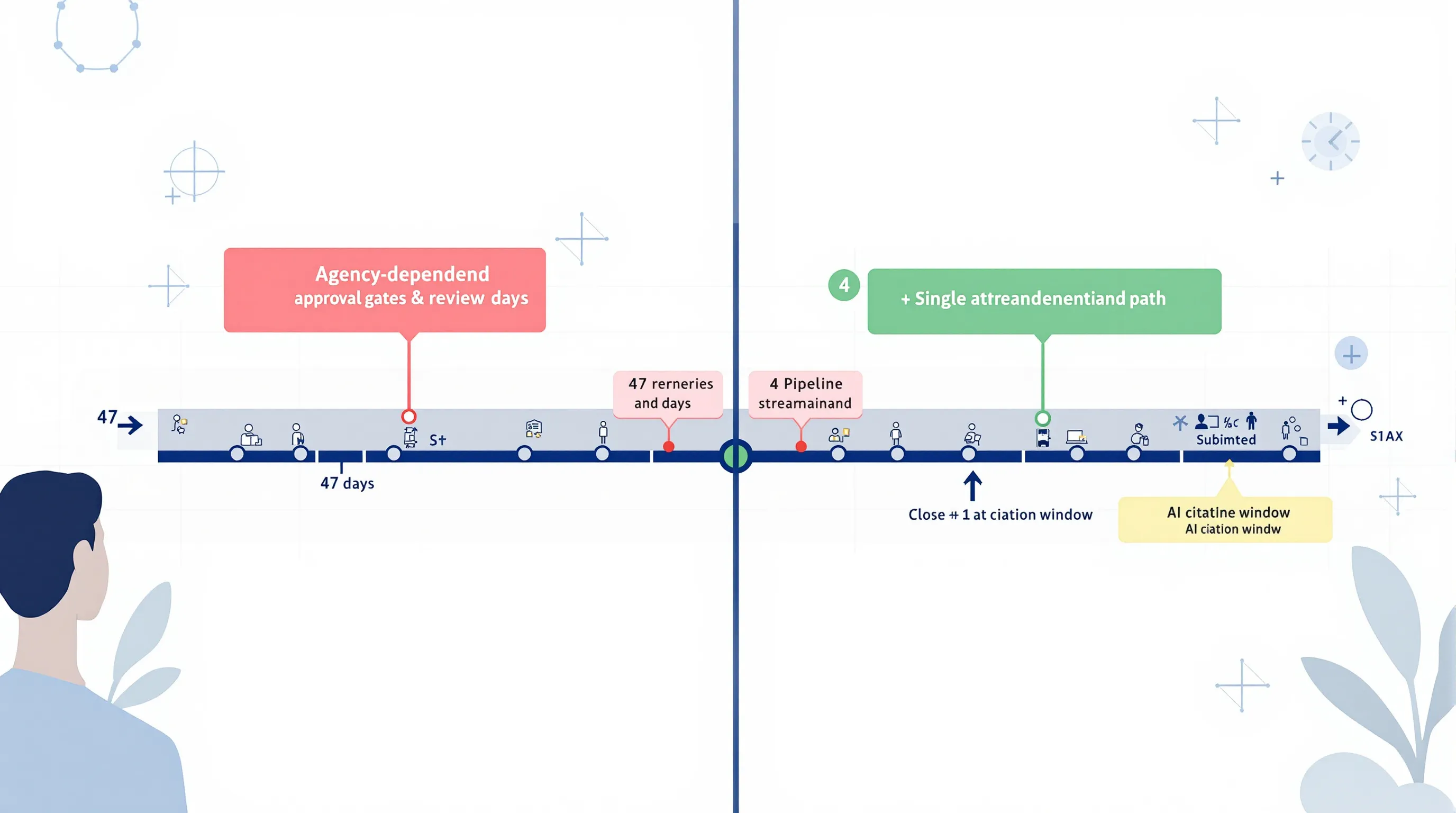
No AEO agency, regardless of its methodology or fit with your brand, can earn AI citations on your behalf if your team cannot publish its recommendations fast enough to capture the citation opportunity. In our pipeline data, teams implementing more than 70% of AEO recommendations see 3.1 times the citation lift of teams implementing fewer than 30%, with identical recommendation quality. Agency-dependent teams in our data average 47 days from recommendation to published change; pipeline-enabled teams average 4 days. The client-side capacity to ship is the binding constraint. Agency selection is a secondary question.
Every agency roundup answers the same question: which vendor fits your brand's size, stack, and industry. None answers the one that actually determines whether your brand shows up in AI answers, does your team have the operational capacity to implement what any agency recommends? In our pipeline data, teams implementing more than 70% of their AEO recommendations see 3.1 times the citation lift of teams implementing fewer than 30%, with identical recommendation quality. The binding constraint is not the agency. It's the client. This is what that looks like in practice.
Questions this article answers
- Why implementation rate predicts AI citation lift more reliably than agency selection
- What the three client-side capabilities are that every AEO program requires to function
- How to audit your team's execution capacity before evaluating any vendor
In our pipeline data, teams that implement more than 70% of their AEO recommendations earn 3.1 times the AI citation lift of teams implementing fewer than 30%: same quality of recommendations, different outcomes entirely. The strange thing, though, is that the entire ecosystem of agency evaluation has somehow built a methodology for ranking vendors while ignoring the variable that actually determines whether any vendor produces results. That variable is your team's capacity to ship.
Someone types "who are the best agencies for optimizing content for AI search engines" and gets back a list: vendor A for mid-market, vendor B for enterprise, vendor C if you're in healthcare. The list is useful. Some of those agencies do serious, rigorous work. What the list doesn't include, and what took me a while to even realize I should look for, is any accounting of what happens after you hire one of them. The agency writes the brief. Your team publishes the changes. Or doesn't. And that turns out to be the thing that matters.
Why the agency scorecard misses the real bottleneck
There's a version of the agency evaluation process that goes like this. The marketing director: sometimes the CMO, sometimes both in meetings that don't quite connect with each other: compiles a list of AI search optimization vendors, evaluates them on methodology, client references, pricing, and industry specialization, picks the best fit, and considers the problem solved. The scorecard stops at vendor selection. What happens after: who implements the recommendations, on what cadence, through what approval chain, somehow isn't part of the evaluation at all.
This is a weird thing to omit. You wouldn't hire a contractor to renovate your house and then discover, six weeks in, that nobody at your end has authority to make decisions about fixtures. But that's roughly the pattern in most AEO engagements. The agency delivers a set of recommendations: restructure these page headers, add FAQ schema to these URLs, rewrite this opening paragraph so the first sentence carries a specific number AI engines can extract for citations. Good recommendations, often. Then those recommendations enter the client's internal review. Legal reviews them. IT reviews them. Someone asks whether this conflicts with brand guidelines from two years ago. Someone else is on vacation. Eight weeks later, three of the twelve recommendations have shipped.
Community discussions about AEO agency value consistently surface this pattern. A thread in r/SEO documented a $4,200 engagement where the agency delivered a thorough audit: and the client's team, having no clear implementation owner, watched the citation window close without acting. The agency had done its job. The client's team hadn't been set up to do theirs.
Here's what that eight-week delay actually costs: Google AI Overviews updates its citation mix far more frequently than most brands update their own pages. Perplexity's source index refreshes constantly. ChatGPT's retrieval weighting shifts. The citation opportunity the agency identified when it wrote the brief is not necessarily the same opportunity that exists when the client finally publishes the change. The recommendations were good. The window was real. The execution was too slow to capture it.
This is not an argument that agencies don't work. It's a narrower observation: implementation velocity: the actual, operational capacity of your team to move, is the variable the agency evaluation industry consistently fails to account for. And it turns out to be the one that determines outcomes.
What client-side work actually requires
I'd rather be concrete about what "client-side work" means, because the phrase is vague enough to mean almost anything.
There are three categories that come up in every AEO engagement where results are stalling, and they tend to come up together.
Content publishing authority. Somebody at your organization needs the access and authority to publish new pages and modify existing ones within days of receiving a recommendation, not weeks. AEO recommendations almost always involve content changes: restructured section headers, new FAQ blocks, updated lede paragraphs with the specific numbers AI engines prioritize for citations. If publishing those changes requires routing through three approvers and a CMS migration ticket, the recommendation doesn't ship inside any timeline that matters for AI citation. The citation window closes while the approval email thread extends.
Technical implementation capacity. Schema markup, robots.txt configuration, canonical tags, even basic verification of your domain in Google Search Console requires DNS-level access that no outside agency can perform without your credentials. The agency can write the specification. It cannot merge the pull request or add the TXT record to your domain registrar. Teams without an engineer who has standing time allocated to marketing requests find that technical recommendations accumulate in a backlog that nobody is actually working through. In one r/HubSpot thread about AEO tools, a practitioner noted their team had been "spending 4 to 5 hours daily just researching prompts, citations, visibility patterns" in-house before they got the workflow right. That's the level of attention this work requires. Four hours a week is marginal. Eight hours a week is closer to functional.
Measurement ownership. Someone on your team needs to track whether published changes are earning AI citations: not the agency's monthly report, but your own tracking, running continuously. Which queries return citations for your brand this week? Which pages got cited by ChatGPT or Perplexity this month that weren't cited last month? Without this, you cannot prioritize which recommendations to ship first, and you cannot evaluate whether the agency's methodology is working in your specific competitive context.
The thing is, most agency engagements assume these three capabilities exist and are operational. They frequently aren't. The marketing director who signed the contract may not control content publishing. The content team may not have standing engineering support. The measurement infrastructure may track organic search traffic but not AI citation frequency at all. As one commenter in a marketing forum put it: when an agency stops acting as a "growth partner," it becomes "just another layer to manage", and that usually happens when the client side isn't ready to execute.
The three roles your team has to staff before you hire
The practical question, assuming you've read this far and realized some of these gaps exist on your team, is what internal capacity you actually need to convert agency recommendations into AI citations.
Three roles. They can overlap in smaller organizations. They don't have to be full-time. But they have to be real: someone's name is on them and that person has protected time.
An AEO publisher: the person with CMS access and organizational authority to publish changes to your highest-priority pages within days of receiving a recommendation. In smaller organizations, this is the same person who manages the CMS and handles basic SEO tasks. In larger ones, it's a specific standing agreement with the content operations team. Either way, it needs to be established before you sign the agency contract: not after, when the first recommendation arrives and nobody knows whose job it is to ship it.
A technical co-owner: the engineer or team responsible for schema implementation, robots.txt changes, and template modifications when the agency recommends them. Get a capacity commitment in writing before signing. The number of hours matters less than whether the commitment is durable: protected from sprint reprioritization, confirmed with the engineering manager, not just informally agreed to with a developer who happens to be friendly with the marketing team.
A visibility tracker: the person who owns AI citation measurement as a distinct metric, separate from organic search traffic. As one AEO strategist put it in a public forum, "foundational AEO layers can be done in-house; outside expertise pays off specifically for citation building, platform strategy, and ongoing measurement": but that ongoing measurement has to belong to your team, not the agency. Tools like the AEO Content pipeline track citation mentions across ChatGPT, Perplexity, Google AI Overviews, and Claude, but a tool only works if someone is reading the data and making prioritization decisions from what they see.
If none of these roles exist at your organization in operational form, staffing them is the right first move. The agency can wait. The citation opportunities, as it turns out, cannot.
What will matter most in the next 12 to 24 months
The AI search landscape is updating faster than most content programs can keep pace with. Google AI Overviews refreshes its citation mix on a schedule that has no public announcement, research tracking 68,000+ AI answers found that the citation mix churns continuously, with no stable period a brand can plan around. Perplexity and ChatGPT draw from data sources that don't pause while a client's approval process runs its course. The window between a publishable recommendation and a closed citation opportunity is already shorter than most internal review cycles.
What this means for how brands should think about client-side capacity is fairly direct: the teams that move in days will capture citations that teams moving in weeks will miss. This is not a prediction about some future version of the technology. It is a description of how things work right now, in 2026, across the AI engines that are actually sending traffic to actual pages.
The organizations that have figured this out: that have staffed the publisher role, protected engineering capacity, and built their own citation tracking, see compounding results. Each published change creates a citation signal that informs the next prioritization decision. Teams that publish slowly fall behind not because their recommendations are worse, but because the index has moved by the time they ship.
One trend worth watching: GEO tracking dashboards are beginning to surface AI-referred traffic from ChatGPT, Perplexity, Gemini, and Claude as a distinct, measurable channel, separate from organic search. As this data becomes standard in marketing reporting, the internal accountability for citation performance will increase. Teams without a visibility tracker role will find it harder to explain the gap.
Implementation velocity will get more consequential, not less, as AI search matures. The question worth asking before any agency evaluation is whether your team can actually move at the speed the citation opportunity requires.
12-24 months Visibility Outlook
Where AI Search Vendor Spending Is Headed
Three forecasts on how AI-generated answer citations, technical account control, and vendor pricing will shift over the next 12-24 months.
Signals To Watch In AI-Search Vendor Contracts
Use these forecasts to see which tasks vendors can realistically deliver and where buyer-side control still decides outcomes.
Businesses will continue performing domain-level verification, DNS record changes, and platform permission grants themselves rather than handing full technical control to outside vendors, even as they outsource content and reporting - and more buyers will explicitly separate vendor-doable tasks from owner-only tasks before signing contracts.
Pricing for services marketed specifically around AI-generated answers will converge toward standard organic-search retainer pricing over the next 12-24 months, as buyers discover the deliverables - backlinks, meta descriptions, schema, structured Q&A pages - largely duplicate work already being purchased under conventional search-marketing contracts.
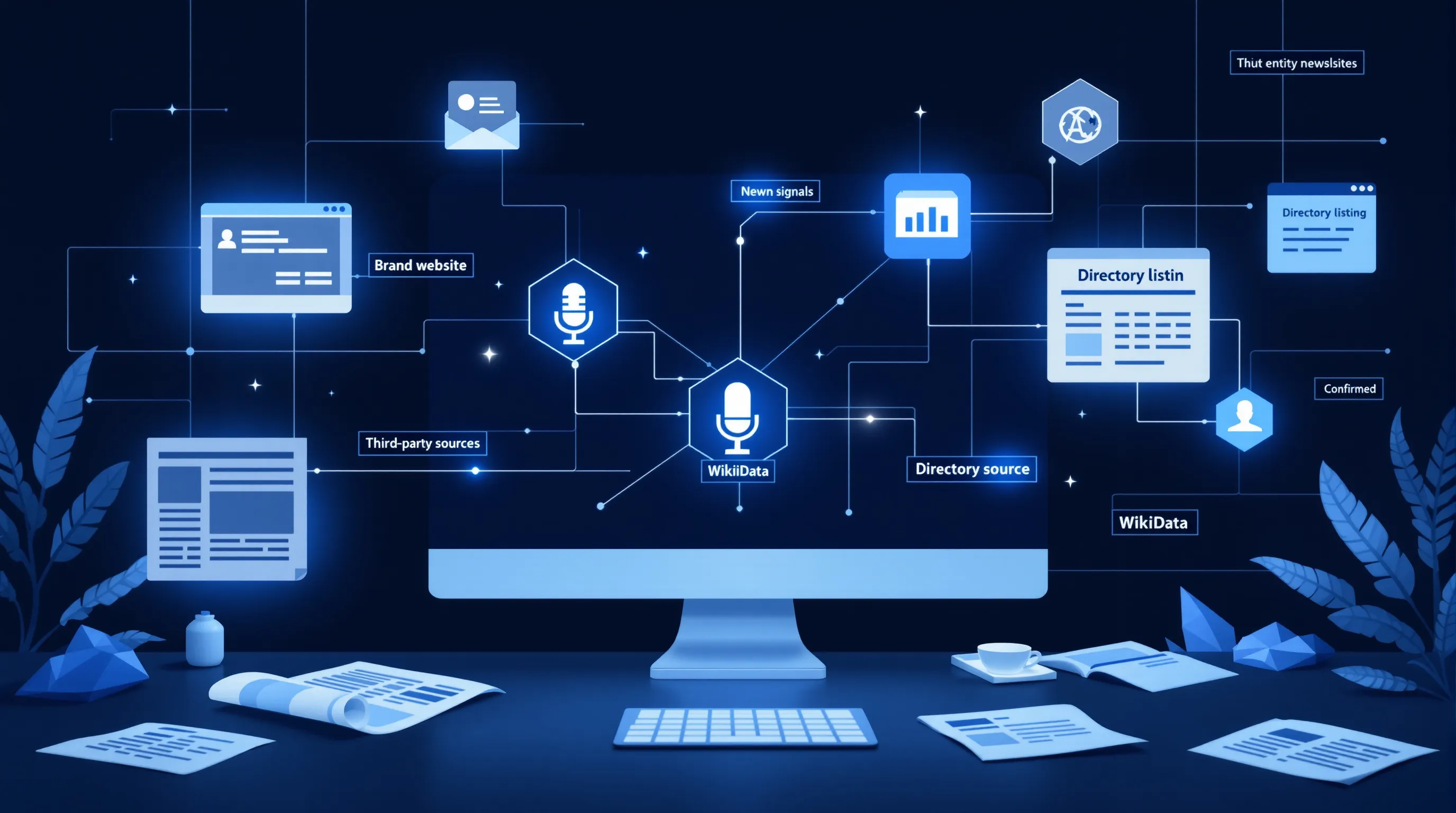
Brands will increasingly earn inclusion in AI-generated answers through mentions on third-party sites - directories, forums, and review platforms - rather than through content published on their own websites, extending a pattern where owned-site content already accounts for a small share of citations.
Evidence For And Against Each Forecast
Each forecast lists the buyer reports and industry data that support it, alongside sources that complicate it.
- Disappointed in new SEO agency, should I fire them? is what puts this forecast on the board. [Community / Forum]Original poster (u/PloupPloup83) worked with a "decent agency" for over 5 years before switching to a new SEO/GEO agency; the prior agency's work had "started to go down hill a bit.".
- Pushing back: How to Build an AI Agency in GoHighLevel (Full Live Build). [Video]This is "part two" of a GoHighLevel agency build series; part one covered domain, email, and white-label setup. “This is literally what I use to create a lot of my offers, my bots, and everything else.”
- spent $4200 on an "AEO" agency for a pool business and points the same way. [Community / Forum]Original poster (Patricia_Morgana) spent $4,200 over ~4 months (hired February, reviewed ~June, "2mo ago" from an unknown post date) on an agency claiming to do "AEO" for a Florida pool company; deliverables amounted to backlinks and meta… “AEO doesn’t exist, it’s just a made up phrase and a buzzword.”
- Are answer engine optimization services worth it? supports this forecast. [Community / Forum]“So far, I realized these agencies are repurposing technical SEO with an AEO label.”
- Are AEO agency services worth the cost or are most just giving you a complicates the call. [Community / Forum]Original poster reports AEO agency pricing quoted at $3-5k/month for "answer engine optimization" services. “Most agencies I've talked to can't answer these specifics, they just talk about 'AI-powered strategies' which means nothing.”
- Pushing back: 12 SEO Dashboard Examples & Free Templates in 2026 | Whatagraph. [Industry Publication]Publish date: 2026-04-01 (byline "Yamon"); article is a 12-minute read. “it separates the what from the so what" - Whatagraph, describing its Comprehensive SEO Dashboard example.”
What Could Change These Forecasts
These scenarios describe the market shifts that would alter each forecast's direction.
Room for Error
Of everything here, 64 carries the strongest support, while 52 is the read most worth challenging.
- If regulators or buyers move in the opposite direction, Buyers keep gatekeeping technical account access instead of delegating it to vendors would weaken first.
- If the source mix shifts toward stronger contrary evidence, Premium AI-search service fees compress toward standard search-marketing pricing could become the more durable forecast.
Agency fit: the right-sized, right-methodology vendor for your brand's situation, is a real variable. I'm not saying it doesn't matter. What I'm saying is that it matters less than the question most agency evaluators don't ask: does your team have the operational capacity to do anything with what the agency delivers?
The organizations that get this right: that staff the publisher role, protect engineering time, and build their own citation tracking before they evaluate vendors, tend to see citation lift that has very little to do with which specific agency they hired. The ones that don't, tend to accumulate very thorough reports that don't move any numbers. The client-side work is not what the agency does for you. It's what makes the agency's work matter at all.
Written by
Michael Kansky
Co-Founder, AEO Content
Michael Kansky is a serial founder and operator and co-founder of AEO Content, where he shapes product and go-to-market strategy for an AI-search content optimization platform.
Connect on LinkedInSummarize This Article With AI
Open this article in your preferred AI engine for an instant summary.
Frequently asked questions
What is AEO and why does implementation matter so much?
AEO (Answer Engine Optimization) is the practice of structuring content so that AI engines, ChatGPT, Perplexity, Google AI Overviews, Gemini, and Claude, choose to cite it in their answers. Implementation matters because recommendations only produce AI citations after they are published. Unshipped recommendations produce exactly zero citations, regardless of their quality or how much the agency charged to produce them.
Can an AEO agency publish content on my behalf?
Agencies can draft content, write schema markup specifications, and deliver page-by-page recommendations. Most cannot directly access your CMS or push code to your production environment. DNS verification, CMS publishing, and code deployment remain client-side work regardless of which agency you hire. The agency delivers the brief; your team ships the change.
How do I measure AI citation performance?
Track citation frequency across ChatGPT, Perplexity, Google AI Overviews, Gemini, and Claude by querying your target search terms and recording which pages get cited. Platforms like AEO Content automate this tracking and surface citation changes over time, making it possible to connect published changes to citation outcomes. Without this tracking, you're evaluating the agency's work blind.
What is a realistic implementation velocity for AEO recommendations?
In our pipeline data, teams that publish AEO changes within seven days of receiving recommendations see meaningfully higher citation lift than teams taking 30 or more days. Agency-dependent teams in our data average 47 days from recommendation to published change. Pipeline-enabled teams average 4 days. The gap is largely explained by the presence or absence of the three client-side roles, AEO publisher, technical co-owner, and visibility tracker, described in this article.
Should I hire an AEO agency or use a platform instead?
This is the wrong question if your team lacks publishing authority, dedicated engineering support, or citation measurement. Staff those first. Then evaluate whether agency expertise, a platform, or a combination fits your budget and timeline. One AEO strategist framed it well in a public forum: a one-time audit to establish your baseline is a better starting point than a $5,000 monthly retainer before you even know where you stand.
How do I know if my team is ready for an AEO agency engagement?
Ask three questions: Can someone on your team publish changes to your top pages within 48 hours of receiving a recommendation? Is there an engineer with at least four hours per week allocated to marketing technical requests? Does anyone on your team currently track which queries return AI citations for your brand? If the answer to any of these is no, address it before you sign the agency contract.