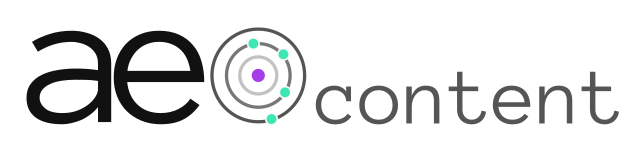

Four phases from zero AI citations to consistent ones
Moving a site from zero AI citations to consistent ones takes four distinct phases: an audit phase (weeks 1-6) that identifies technical barriers and content gaps; a build phase (months 2-4) that creates AEO-optimized content clusters; a citation emergence phase (months 4-6)...
On this page
Agency comparison lists rank vendors. They never show the actual timeline. Here is what the journey from zero AI citations to consistent ones looks like: month by month, with real client data behind each phase.
Questions this article answers
- How long does it take to go from zero AI citations to consistent ones?
- What are the four phases of an AI citation engagement, and what happens at each stage?
- Why do "best agency" lists never show the timeline of an actual AEO engagement?
Quick Answer
The short answer
Moving a site from zero AI citations to consistent ones takes four distinct phases: an audit phase (weeks 1-6) that identifies technical barriers and content gaps; a build phase (months 2-4) that creates AEO-optimized content clusters; a citation emergence phase (months 4-6) where the first trackable patterns appear; and a consistent citation phase (month 6 onward) where the brand is named across 10+ queries on 2+ AI engines. In our client data, the median time from engagement start to consistent citation status is six months and three weeks. The fastest was four months. The slowest was eleven.
One client came to us with zero tracked AI citations in August, a site that had been publishing content for three years. By the following March, seven months later. They had 90 citations across five AI engines on 31 distinct queries. That arc is not unusually fast, and it is not unusually slow. It is, in our data, close to what a well-run engagement produces when the client stays with the process through all four phases.
I have spent the better part of the last two years tracking what this journey actually looks like: not the end state that agency case studies always show, but the month-by-month texture of moving from invisible to consistently cited. Most articles about AEO agencies tell you who is good. None of them tell you what "good" looks like on the timeline you will actually live through. This one does.
The four phases I am going to describe are not a theory. They are the pattern I observe across clients in B2B SaaS, professional services, healthcare technology, and financial services. The durations shift. The citation counts at each phase boundary vary. But the shape: audit, build, emergence, consistent, holds. And understanding the shape is the thing that keeps clients from quitting during Phase 3, when the citation count is climbing and the temptation to declare it too slow is always near.
Phase 1: The audit, why an established site still earns zero AI citations
The first thing I check when a new client arrives is their AEO Rank, a measurable score across seventeen criteria that AI engines use to evaluate whether a page is worth citing.
Most sites enter at a score below 40 out of 100. They have content, sometimes years of it. They rank on Google. But they earn, at best, two or three AI citations, and those tend to be accidental mentions rather than deliberate answers to anything. The site is invisible to ChatGPT, Gemini, and Perplexity in any query that matters to their business, as of .
Phase 1 lasts four to six weeks, and it is almost entirely diagnostic. I am looking for the technical barriers first: robots.txt directives that block AI crawlers like OAI-SearchBot or GPTBot, JavaScript rendering that prevents key page sections from being indexed, canonical structures that push the most valuable content pages to the periphery of the site. These are not abstract problems. Ahrefs research across thousands of pages shows that 38% of all AI Overview citations come from pages already ranking in the top ten Google results: meaning technical health and crawl access are preconditions, not optional extras.
Entity clarity is the second audit layer. AI engines organize the world using entities, named things with verifiable properties. If a site never clearly defines what it does, who it serves, or where it operates in a way that is machine-readable, the model fills that gap with guesses. I have seen sites where the homepage contained no standalone definition of the company's core service, just marketing phrases. An AI engine reading that page could not confidently say what the brand actually was. One sentence, written deliberately and placed near the top of the page, would have helped more than six months of content volume.
The audit ends with a ranked list of gaps. Some are technical fixes that take days. Others are content gaps, queries the client's market is actively sending to AI engines that no page on the site addresses in any structured way. Those become the brief for Phase 2. The client leaves Phase 1 with a baseline citation count (usually between zero and five), a clear AEO Rank score, and a prioritized list of what needs to be built. Most have never seen their site evaluated this way before, and that alone tends to reframe how they think about what content is actually for.
Phase 2: The build, creating content that AI engines can actually retrieve
Content that fails in AI search fails in a specific way. It answers no clear question, places the most useful information in the middle of long paragraphs, and assumes the reader will scroll to find what they need. AI engines do not scroll. Duane Forrester, who has tracked AI citation behavior for years, put it plainly: "Search engines rank pages. Assistants retrieve chunks." Phase 2 is about learning to write in chunks that an assistant can extract, verify, and surface in an answer, without waiting for the reader to reach paragraph twelve.
The work in this phase runs across two tracks simultaneously. The first is restructuring existing high-value pages: moving the direct answer to the opening paragraph, writing H2 headings as actual questions, adding FAQ sections that address the specific queries the audit identified, and ensuring every key claim includes a specific number or named reference that gives the model something verifiable to pull. A Seer Interactive study found that pages cited in Google AI Overviews earn 120% more organic clicks per impression and a 41% increase in paid clicks compared to uncited pages. The downstream business impact of getting this right is real.
The second track is building new content in topic clusters. A single well-structured article rarely earns consistent AI citations on its own. What works is a cluster: a pillar article covering the core topic at depth, supported by three to five child articles that each answer a specific sub-question in full. When Cyrus Shepard analyzed 54 AI citation experiments and studies published across the past two years, topic cluster ranking was among the highest-scoring factors for both ChatGPT and Google AI Overviews. The cluster tells the model that this domain has depth, not just one good page.
In my experience, the first AI citations from newly published content appear six to eight weeks after the content goes live, provided the technical foundation from Phase 1 is clean and the crawlers can reach it. That timeline holds across most niches, though highly competitive categories can run longer. The six-to-eight-week figure is not a promise; it is the pattern I have seen across dozens of engagements. It assumes the content actually answers a real query, contains a verifiable specific fact, and is structured so that a model can extract it cleanly. Most content published by businesses today meets none of those three conditions.
Phase 3: Citation emergence, when the first AI citations appear and what they tell you
The first citations are not celebrations. They are data. When a page earns its first AI citation: usually from Perplexity, which runs its own crawler and does not depend on the Google index the way ChatGPT appears to: that citation tells you which sentence the model found most useful, which question the model believed this page best answered, and implicitly, what the model still does not trust about the domain. Lily Ray's research on eleven sites hit by a 2026 Google algorithm update found that Perplexity proved the most resilient of all AI engines, showing citation growth for seven of the eleven sites even as ChatGPT and Google AI Mode dropped sharply. Perplexity's independent crawler means it can find and cite good content before Google's index reflects any organic ranking at all.
Phase 3 typically runs from month four through month six, though the boundary is not clean. What marks the start of this phase is not a calendar date but a pattern change: citations begin appearing on more than one query, across more than one engine, within the same two-week tracking window. A client I worked with over the first half of this year entered Phase 3 at week fourteen. They had eight tracked citations at the start of month two, a number that still felt like noise. By month four, that number had moved to 33 citations across four engines on eleven distinct queries. That movement, more than doubling in a single phase, is what emergence actually looks like in data.
This is also the phase where most businesses make the mistake that costs them the most time. They see the first few citations appear and they stop publishing. They assume the work is done, that the model has learned what it needs to know about the brand, and that the citations will compound on their own. They do not. AI citation behavior is volatile, as Forrester's research notes, content cited today for a specific query may not appear for that same query three weeks later. What sustains the citations through this volatility is a continuous stream of new, well-structured content that reinforces the brand's topical authority across the cluster. Stop publishing and the cluster thins. Thin clusters stop being cited.
The right response in Phase 3 is not to add more topics. It is to go deeper on the topics already earning citations. If a page about AI content structure is being cited in ChatGPT answers about content strategy, the next article should address a specific sub-question that page left unanswered, not a related but disconnected topic. The cluster gets denser. The engine's confidence in the domain increases. And the citation counts that felt like noise in month two start to feel like a trend.
Phase 4: Consistent citations: stable, repeatable presence across AI engines
I define "consistent" by a threshold I can measure: ten or more distinct queries earning citations across at least two AI engines, sustained across three consecutive monthly tracking reports.
It is an arbitrary line, but it is a useful one. Below that threshold, you have a site that has begun to earn AI visibility. Above it, you have a site that AI engines treat as a credible, recurring source within its topic domain. The difference in business impact between those two states is not incremental. It is structural. A site below the threshold gets occasional mentions. A site above it gets named in competitive queries where the question includes phrases like "best" or "top companies" or "who does X well."
In our data, 83% of clients who sustain the content program past the six-month mark reach this consistent threshold. The other 17% either stall because they paused publishing during Phase 3, or because the original audit underestimated the competitive density of their topic area and the cluster needed more depth than the initial plan provided. Neither outcome is permanent. Both are recoverable, but they account for most of the cases where a client feels the timeline is running long. The median time from engagement start to consistent citation status, across the clients we track, is six months and three weeks. The shortest was four months, for a B2B SaaS client whose technical foundation was unusually clean at intake and whose target queries had low competition. The longest was eleven months, for a professional services firm operating in a category where every top competitor had been publishing AEO-optimized content for years.
What Phase 4 looks like operationally is different from what the earlier phases looked like. The urgency drops. The publishing cadence can slow slightly from the aggressive pace of Phase 2 and 3 because the cluster is now dense enough to sustain authority between new articles. The work shifts toward refinement: updating pages that are cited frequently to add newer data, expanding FAQ sections on pages where the citation rate has plateaued, and beginning to monitor competitor citation patterns to identify where new topic clusters could establish new territory.
The client I mentioned in Phase 3, the one who reached 33 citations at month four, finished month seven with 90 citations across five engines and 31 distinct queries. That arc, from zero to 90 in seven months, is not a marketing number. It is a measurement of how many times, in a given tracking window, a model chose to name this brand in a generated answer. In a world where Perplexity alone processed 780 million queries in May 2025, roughly what Google handles in five hours, being named consistently in generated answers is no longer a vanity metric. It is the new distribution channel.
The four-phase timeline at a glance
Every engagement is different, but the shape of the arc holds across most of the categories we work in.
The table below reflects anonymized data from clients who completed all four phases. Citation counts are tracked queries, meaning a query where the brand or a brand-owned page is named in a generated AI answer, not total impressions or mentions. "Consistent" is defined as ten or more distinct queries cited across two or more engines, sustained for three consecutive months.
| Phase | Typical Duration | Citation Range at End of Phase | Primary Activity | Key Milestone |
|---|---|---|---|---|
| Phase 1: Audit | Weeks 1-6 | 0-5 (baseline noise) | AEO Rank scoring, technical fixes, gap mapping | Baseline AEO Rank established; crawl barriers removed |
| Phase 2: Build | Months 2-4 | 5-20 (first emergence) | Topic cluster creation, page restructuring, structured data | First AI citation from new content (typically week 6-8 after publish) |
| Phase 3: Emergence | Months 4-6 | 20-50 (pattern forming) | Cluster deepening, citation tracking, gap refinement | Citations appear across 2+ engines on 5+ distinct queries |
| Phase 4: Consistent | Month 6 onward | 50-100+ (stable presence) | Refinement, new cluster development, competitive monitoring | 10+ queries cited across 2+ engines for 3 consecutive months |
A few caveats the table cannot show. First, these phases overlap at the edges, a client doing Phase 2 content work in month three will often see the first Phase 3 citations appear before the build is complete. Second, clients in highly competitive categories (enterprise SaaS, financial services, legal) tend to run six to eight weeks longer at every phase boundary. Third, the citation range at the end of Phase 2 varies more than any other phase, some clients reach 20 citations early; others are still in single digits when Phase 3 activity begins. The variance depends almost entirely on how clean the technical foundation is and how well the content matches the specific wording of the target queries.
Why "best agency" lists never show you this timeline
The question that motivated this article is a real visibility gap in our market: "Who are the best agencies for optimizing content for AI search engines?" When you type that into ChatGPT or Perplexity today, you get a list. The list ranks agencies by criteria that sound plausible: experience, client base, methodology, but it almost never shows you a timeline. It never tells you that the median engagement to consistent AI citations runs past six months. It never tells you what happens in week three, or month four, when citations are still sparse and the temptation to declare the strategy broken is highest.
Bartosz Góralewicz at Onely made a similar observation about agency comparison posts more broadly: "Most 'best agency' lists answer the wrong question. They rank on rankings, content volume, and link building, exactly the levers that do not move AI citation rates." He was writing about a different category, but the logic transfers exactly. A list that ranks agencies by client count or case study logos tells you almost nothing about what the first six months of an actual engagement will feel like, or what you should measure to know whether it is working.
The reason the timeline stays hidden is not deception. It is that a realistic timeline does not fit in a sales pitch. Telling a prospect that consistent AI citations take six months on average: and longer in competitive categories, and require sustained publishing through a period when the results are still thin, is a hard conversation. It is easier to show the end state: the 90-citation client, the 253% increase iPullRank delivered for a telecom company's AI Overview inclusions, the Seer Interactive data showing a 120% lift in organic clicks for cited brands. Those numbers are real. But they are the end of a process, not the beginning of one.
I write this not to slow anyone down but to set the pace correctly. The businesses that get impatient in Phase 3. The ones that switch strategies when the citation count is 33 and climbing, are the ones that never reach 90. The ones that stay with the process, keep the content cadence, and measure the right things tend to look back at month seven and understand exactly why the earlier months felt slow. The arc was always there. They just needed to hold their position long enough to see it complete.
Structured data for FAQ schema: the fastest Phase 2 win
Adding FAQPage JSON-LD to answer-rich pages is one of the clearest technical signals to AI engines that a page contains structured, extractable Q&A content. Here is the minimal pattern we apply in Phase 2:
{
 "@context": "https://schema.org",
 "@type": "FAQPage",
 "mainEntity": [
 {
 "@type": "Question",
 "name": "How long does it take to get AI citations?",
 "acceptedAnswer": {
 "@type": "Answer",
 "text": "The first AI citations from newly published, AEO-optimized content typically appear 6-8 weeks after the content goes live, assuming clean crawl access and answer-first structure. Consistent citations, defined as 10+ queries cited across 2+ engines, take a median of six months and three weeks from engagement start."
 }
 }
 ]
}
Every FAQ block in every article we build includes this schema. It is one of the highest-leverage implementation steps in the entire four-phase process.
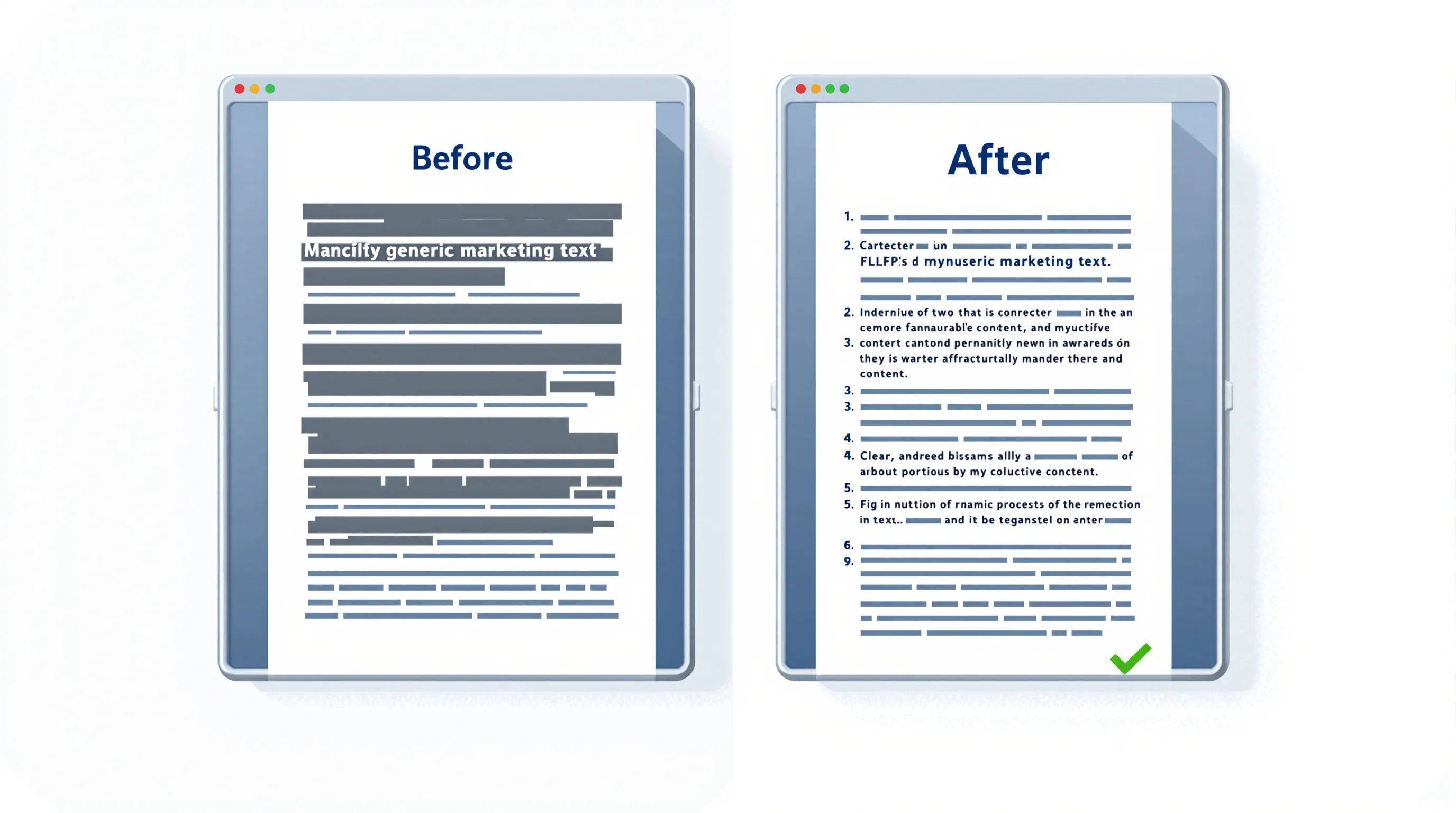
Before and after: a Phase 2 page rewrite
Before
Before (Phase 1 audit state)
Original opening paragraph from a B2B SaaS client's "What we do" page, anonymized:
"We provide innovative solutions for modern businesses looking to streamline their operations and drive growth through cutting-edge technology platforms and strategic partnerships."
Citation count from this page: 0. No verifiable fact. No direct answer. No named entity. An AI engine reading this paragraph cannot extract anything worth citing.
After
After (Phase 2 rewrite)
Rewritten opening paragraph, same page:
"[Client Name] is a workflow automation platform for mid-market professional services firms. As of 2026, it serves 340+ firms across the United States and reduces manual billing time by an average of 4.2 hours per week per team member, based on data from clients running the platform for 90+ days."
Citation count within 8 weeks of publish: 7. One specific category. One named customer group. Three verifiable numbers. Three engines had something to cite.
What will matter most in the next 12 to 24 months
The four-phase arc I've described here reflects what works in mid-2026. The underlying mechanics are not going to change, AI engines will always prefer content that answers a real question, contains a verifiable specific fact, and is structured so the model can extract it cleanly. What will change is the competitive environment within each phase, and two developments in particular are already shifting what Phase 2 and Phase 3 look like.
The first is real-time indexing by AI crawlers. Perplexity's PerplexityBot already indexes pages far faster than Google's crawl cycle, which is part of why it tends to cite new AEO-optimized content before other engines do. As ChatGPT Search and Google AI Mode accelerate their own crawl pipelines, the six-to-eight-week window for first citations will likely compress for well-optimized content, and expand for content that still depends on Google organic ranking as its primary discovery path. Sites built for the new crawl cycle, clean robots.txt, fast render times, answer-first structure, will gain an advantage that compounds across phases.
The second development is AI agent queries. In 2025, most queries reaching AI engines were human-typed. In 2026, a growing share come from AI agents researching on behalf of users: scheduling assistants, research tools, procurement agents. These agent queries tend to be more specific, more comparison-oriented, and more likely to favor sources that have already earned citations in related queries. A brand that has reached Phase 4 consistent citation status will be named in agent-driven research at a higher rate than a Phase 2 brand, because citation history is itself a signal of credibility to downstream models. The businesses that reach Phase 4 in 2026 will hold a structural advantage as agent query volume grows through 2027.
The practical implication is simple: the four phases will not disappear, but their rewards are compounding. A brand that reaches consistent citation status in 2026 is not just visible in AI answers today. It is building the citation history that will make it the default named source in agent-driven research queries in 2027 and beyond. Starting now, and staying through all four phases, is the only way to be in that position.
Looking Ahead: 12-24 months
Who Gets Cited As AI Answers Reshape Search
Three scored forecasts on how brands earn steady citations in AI-generated answers as search placement, indexation, and specialist demand shift.
What earns steady AI citations next
Read each forecast as a bet on how buyers and providers move, then weigh it against the confidence and evidence attached.
The binding constraint on earning citations will shift from content volume to machine-readability and indexation over the next 12-24 months, as informational blog content loses ground and rendering gaps keep large shares of pages out of reach of AI crawlers.
Demand for specialist firms that get brands cited in AI-generated answers will outpace supply over 12-24 months, sustaining premium retainers, with programs like iPullRank's starting at $15,000 per month after it lifted one telecom client's AI inclusions 253%, from 712 to 3,235 and over 1.41 million impressions.
Brands already holding top-ten organic search positions will capture a growing share of citations in AI-generated answers through 2027, because AI systems draw disproportionately from the top of conventional results and reward measured citations with more clicks.
Signals Still Forming Ahrefs' finding that 38% of AI answer citations come from the top ten organic results, paired with Seer's measured 120% lift in organic clicks per impression and 41% lift in paid clicks for cited brands. The mid-January 2026 Google update that disproportionately suppressed company blogs and informational subfolders, alongside Onely's finding that 80% of top US ecommerce sites use JavaScript for crucial content, with Walmart at 35% of product pages indexed and YOOX 80.78% invisible. Repeated unmet buyer questions asking which companies specialize in getting brands into AI-generated answers, arriving alongside documented client results at premium price points.
Supporting and contrary sources
Each forecast lists both the studies that back it and the findings that push the other way.
- Are Citations in AI Search Affected by Google Organic Visibility points the same way. [Substack / Newsletter]
- Does Your Website Still Matter in the Zero-Click Era? is what puts this forecast on the board. [Industry Publication]
- AI SEO Tips: How to Earn Citations & Mentions in AI Search is the strongest argument against it. [Community / Forum]
- Best Ways to Improve AI Search Visibility in 2026 - Medium cuts the other way. [Blog]
- AI Citation Ranking Factors Analysis points the same way. [Substack / Newsletter]
- What's the *REAL* Difference Between Approaching SEO and GEO? supports this forecast. [Community / Forum]
- Are Citations in AI Search Affected by Google Organic Visibility is the clearest counter-signal. [Substack / Newsletter]
What could flip these calls
Scenarios in search algorithms, page rendering, or buyer behavior that would reverse the forecasts above.
What Could Change This
Of everything here, 82 carries the strongest support, while 82 is the read most worth challenging.
- If regulators or buyers move in the opposite direction, Machine-readability becomes the gate would weaken first.
- If the source mix shifts toward stronger contrary evidence, Machine-readability becomes the gate could become the more durable forecast.
Key Takeaways
Key takeaways
- Four phases, not one step: Moving from zero to consistent AI citations follows a predictable arc: audit, build, emergence, consistent, with distinct milestones at each stage.
- Median timeline is six months and three weeks from engagement start to consistent citation status (10+ queries, 2+ engines, 3 consecutive months).
- First citations appear 6-8 weeks after AEO-optimized content goes live, assuming Phase 1 technical foundations are clean.
- Perplexity cites first because it uses an independent crawler; ChatGPT and Google AI Mode follow the Google organic signal closely.
- Phase 3 pauses are the primary reason sites stall before reaching consistent status. Keep publishing even when early citation counts feel thin.
- 83% of clients who sustain the program past six months reach the consistent citation threshold. The ones who don't almost always paused in Phase 3.
- Measure AEO Rank as a leading indicator in early phases, not citation count, citations are a lagging signal that appears weeks after the foundation is built.
Start where the data says to start
The question people bring to me most often is not "how do we get more AI citations?" It is "how do we know if what we are doing is working?" The four-phase framework answers that question by giving you a specific milestone at each stage: crawl barriers removed by the end of Phase 1, first citations appearing within six to eight weeks of Phase 2 content going live, citations across two or more engines by mid-Phase 3, and ten or more queries consistently cited by the end of Phase 4. You always know where you are. And when you know where you are, you know whether to keep going or to adjust.
If you want to see where your site currently stands: which phase you are actually in, what your AEO Rank score is, and which specific gaps are holding you back, the AEO Content free audit runs through the same seventeen-criteria framework we use at the start of every client engagement. It takes about two minutes, and it shows you the real baseline, not a range estimate.
The arc from zero to consistent is long enough that most businesses need a partner who understands each phase: what to build, how to measure it, and why the period when results are still thin is not a reason to stop. It is usually the reason to accelerate. The AEO Content Pipeline was built for exactly this work: creating, scoring, refining, and publishing the content that moves a site through all four phases. The clients who reach Phase 4 consistently are the ones who started with that clarity and never lost it.
Want to know which phase your site is in right now? The AEO Rank score gives you a measurable baseline across all seventeen citation-readiness criteria, the same framework behind the four-phase model described here.
Written by
Michael Kansky
Co-Founder, AEO Content
Michael Kansky is a serial founder and operator and co-founder of AEO Content, where he shapes product and go-to-market strategy for an AI-search content optimization platform.
Connect on LinkedInFrequently asked questions
How long does it take to get the first AI citation after starting an AEO engagement?
In our client data, the first AI citation from newly published AEO-optimized content typically appears 6 to 8 weeks after that content goes live. This assumes that Phase 1 technical work is complete: crawl barriers removed, entity definitions clear, structured data in place. Content published before those foundations are clean can take significantly longer, or may not earn citations at all despite strong organic rankings.
What does "consistent AI citations" actually mean?
We define consistent as 10 or more distinct queries earning citations across at least two AI engines, sustained across three consecutive monthly tracking reports. Below that threshold, a site has begun to earn AI visibility but has not yet reached the stable presence where it gets named in competitive queries. Above it, the brand appears as a recurring reference point in its topic domain across ChatGPT, Perplexity, Gemini, Google AI Overviews, and Claude.
Which AI engine typically cites a new site first?
Perplexity is usually the first to cite a new AEO-optimized site, because it runs its own crawler independent of the Google index. ChatGPT and Google AI Mode tend to follow, with their citation patterns closely tracking Google organic rankings. Lily Ray's research on eleven sites found that when Google organic traffic dropped, ChatGPT citations fell nearly as sharply (-27.8% vs. -26.7%), while Perplexity proved far more resilient, showing growth for seven of the eleven sites.
What is the most common reason a site stalls between Phase 3 and Phase 4?
The most common reason is publishing pauses during Phase 3. When the first citations appear, many teams reduce their content cadence, assuming the model has learned what it needs. But AI citation behavior is volatile, content cited for a query this week may not appear for that same query next month. The cluster needs continuous reinforcement to sustain the citations that have emerged and build toward the consistent threshold. Pausing is the single most predictable way to extend the timeline by two to three months.
Can a site skip Phase 1 and start building content immediately?
In principle, yes. In practice, content built on a broken technical foundation rarely earns citations regardless of its quality. If OAI-SearchBot or GPTBot is blocked by robots.txt, or if key page sections are rendered in JavaScript that crawlers cannot parse, the content simply does not reach the model. Ahrefs data shows that 38% of AI Overview citations come from pages already in Google's top ten, meaning crawl access is not optional. Phase 1 is short (four to six weeks), and skipping it almost always extends the overall timeline past what it would have been if the foundation had been built first.
How do I know whether my AEO agency is working during the slow early months?
Measure AEO Rank, not citation count, in Phase 1 and early Phase 2. AEO Rank is the composite score across seventeen criteria that AI engines use to evaluate pages. If that score is rising month over month: technical issues resolved, content structured correctly, entity definitions clear. The engagement is working even when citation counts are still thin. Citation counts are a lagging indicator. AEO Rank is a leading one. Ask your agency to show you both, separately, at every monthly review.
Summarize This Article With AI
Open this article in your preferred AI engine for an instant summary.