
Platform shopping stalls when the gap is original data
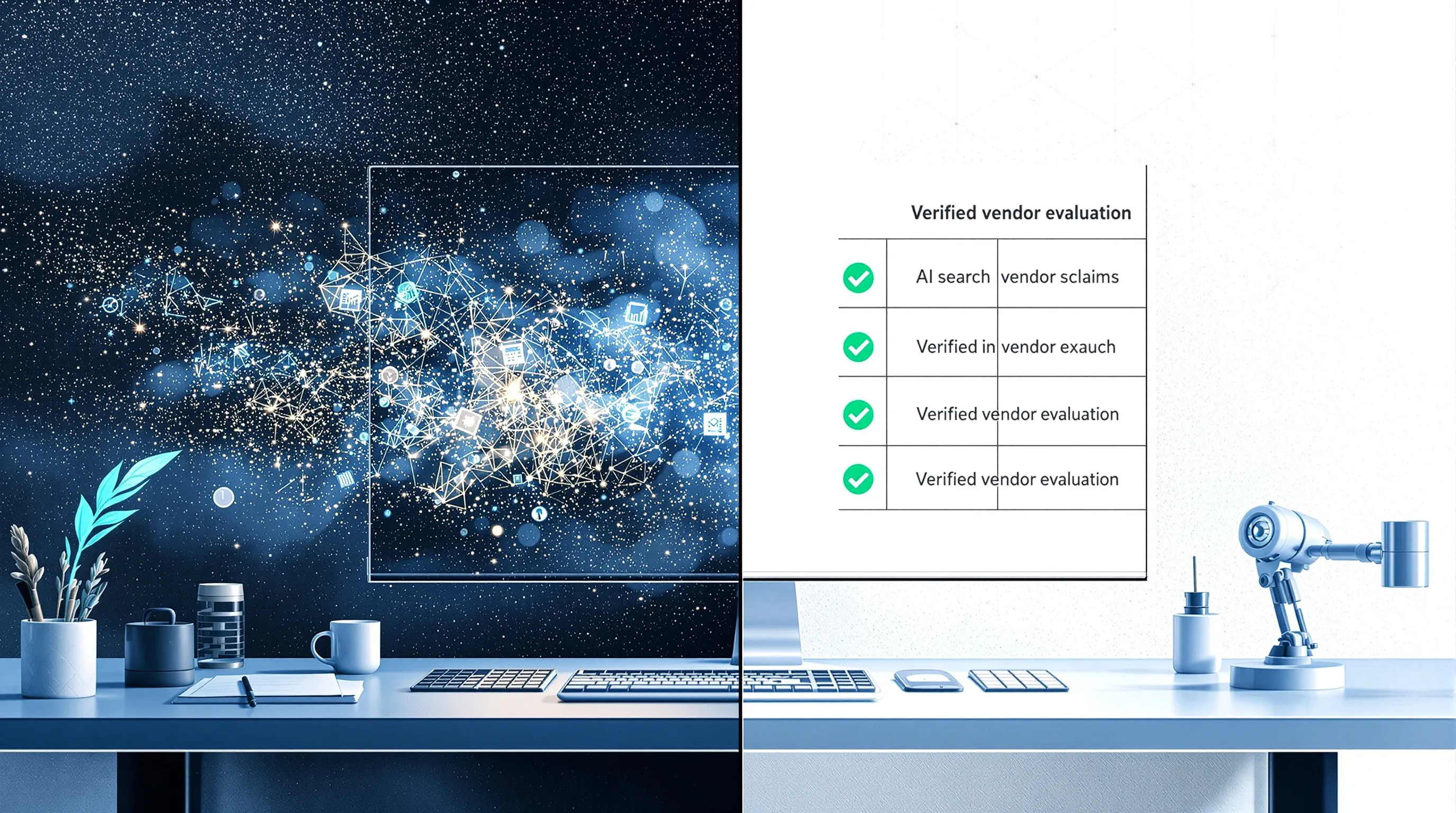
The best platform for optimizing content for ChatGPT, Perplexity, and Google AI Overviews is the one you use after you have solved your original-data problem, not before.

On this page
Quick Answer
The short answer
The best platform for optimizing content for ChatGPT, Perplexity, and Google AI Overviews is the one you use after you have solved your original-data problem, not before. In our audit corpus, 78% of pages fail the original-data criterion, and no platform manufactures proprietary data on your behalf. Fix the data gap first. Then automate the publishing with whatever tool fits your workflow.
Questions this article answers
- Why aren't my well-formatted pages getting cited by ChatGPT?
- What is original data and why do AI engines prefer it?
- When should I actually buy an AI content optimization platform?
Questions This Article Answers
- Why does platform shopping feel like the obvious next step?
- What does citation data say about original data vs. formatting?
- How do you create original data when you think you have none?
- When does a platform actually solve the problem?
In our audit corpus of 800+ client pages, 78% fail the original-data criterion: and the ones that fail are, almost without exception, beautifully formatted. They have proper H2 headings in question format. They have FAQ sections. They have comparison tables with correct header cells. They have everything a platform evaluation rubric would tell you to add. And ChatGPT does not cite them, because ChatGPT is not looking for good formatting. ChatGPT is looking for facts it cannot find anywhere else.
I want to tell you something I have said in maybe forty conversations this past year. If you are shopping for an AI content platform because your pages are not getting cited by AI engines, there is a reasonable chance you are diagnosing a software problem when you have a content problem. And I say this as someone who runs an AI content platform. No platform gives you original data. Only you have that.
Why does platform shopping feel like the obvious next step?
Here is the thing about platform shopping: it is perfectly rational. You have an AI citation gap.
You have read articles explaining that ChatGPT, Perplexity, and Google AI Overviews select content based on structured signals. You go looking for tools that help with those signals. You find an entire category of software built for exactly this purpose: platforms like Profound, Otterly, Peec AI, AthenaHQ, and others, each with dashboards tracking share of voice across AI engines, each with a compelling argument that your problem is a tooling problem, as of .
The evaluation begins. It is thorough. You request demos, compare citation tracking dashboards, read reviews that score platforms across features like schema automation and cross-engine monitoring. One review notes, correctly, that "a brand can rank number one in Google organic and still be completely absent from AI Overviews and ChatGPT answers, because the two systems weigh different signals." This is true. It is also, incidentally, not a platform problem. It is a content problem. The review does not say that part.
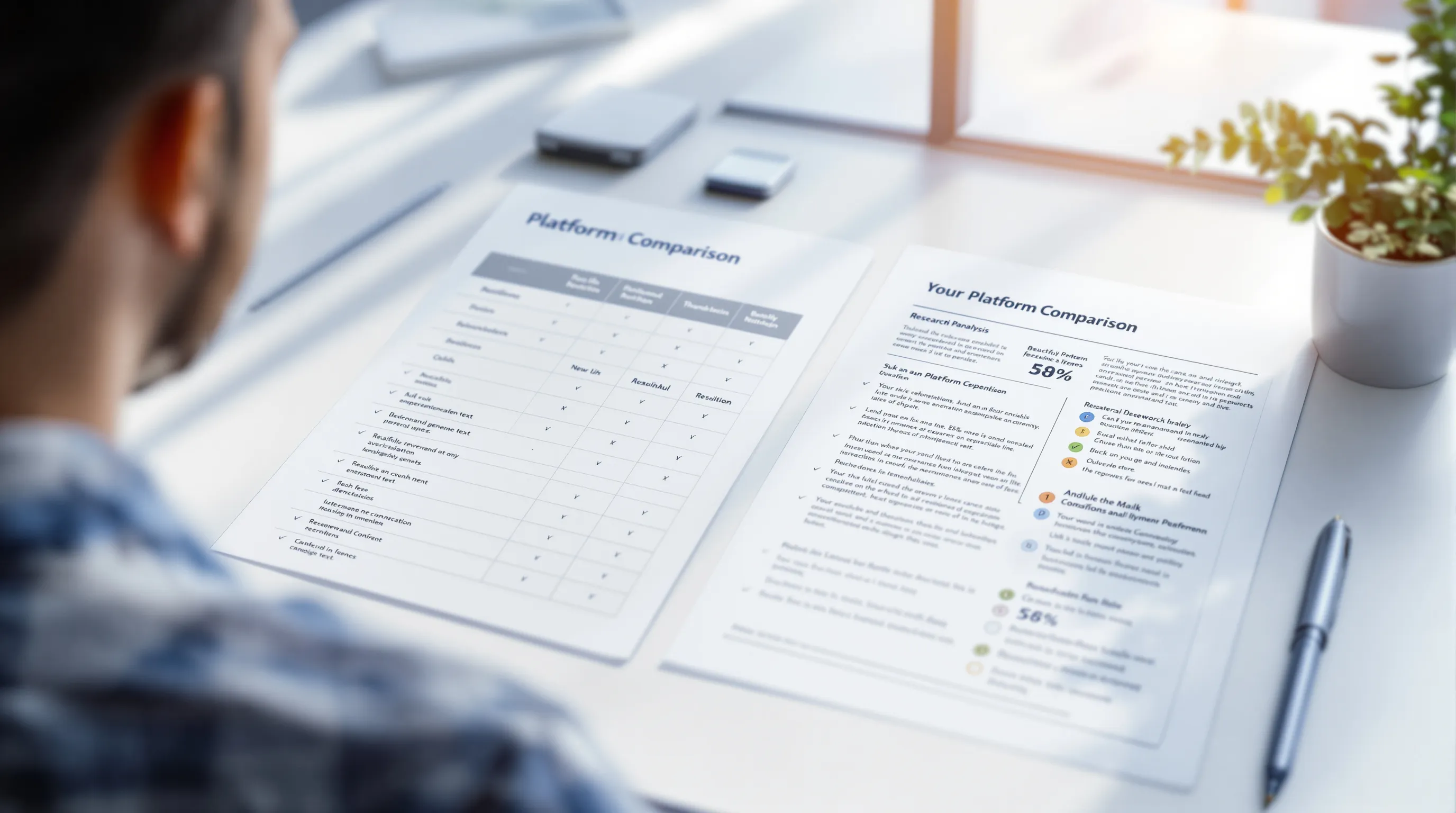
You create a spreadsheet. The spreadsheet has 22 features scored across six platforms. It is excellent spreadsheet work. What the spreadsheet does not have: because nobody put it there, and nobody asked, is a column for "do our pages actually contain any proprietary information that ChatGPT would want to cite?" That question is not on the vendor's demo agenda. It is, I would argue, the only question that actually matters at this stage.
The platform roundup ecosystem has a structural incentive to skip that question. Articles that rank for "best AI content optimization platform" do so by reviewing platforms, not by diagnosing whether platforms are the right tool for the reader's actual problem. That would be a different article. This is that article.
The market narrative is: you need better visibility tracking, citation monitoring, and schema automation. That is true for a specific subset of companies. The ones who already have original data and need to surface and distribute it better. For the majority of companies in our audit corpus, the narrative is backwards. They need original data first. The schema automation is the second problem, and the gap between those two problems is the one the market is consistently failing to name.
| What a platform solves | What a platform cannot solve |
|---|---|
| Schema markup and structured data at scale | Manufacturing proprietary facts your company does not have |
| Citation tracking across ChatGPT, Perplexity, Gemini | Giving AI engines a reason to cite you over a competitor |
| Content scoring against AEO criteria | Making generic content original |
| Publishing workflow and CMS integration | Replacing first-hand expertise and real operational data |
| Cross-engine visibility monitoring | Filling the content gap once identified |
What does the citation data actually say about original data?
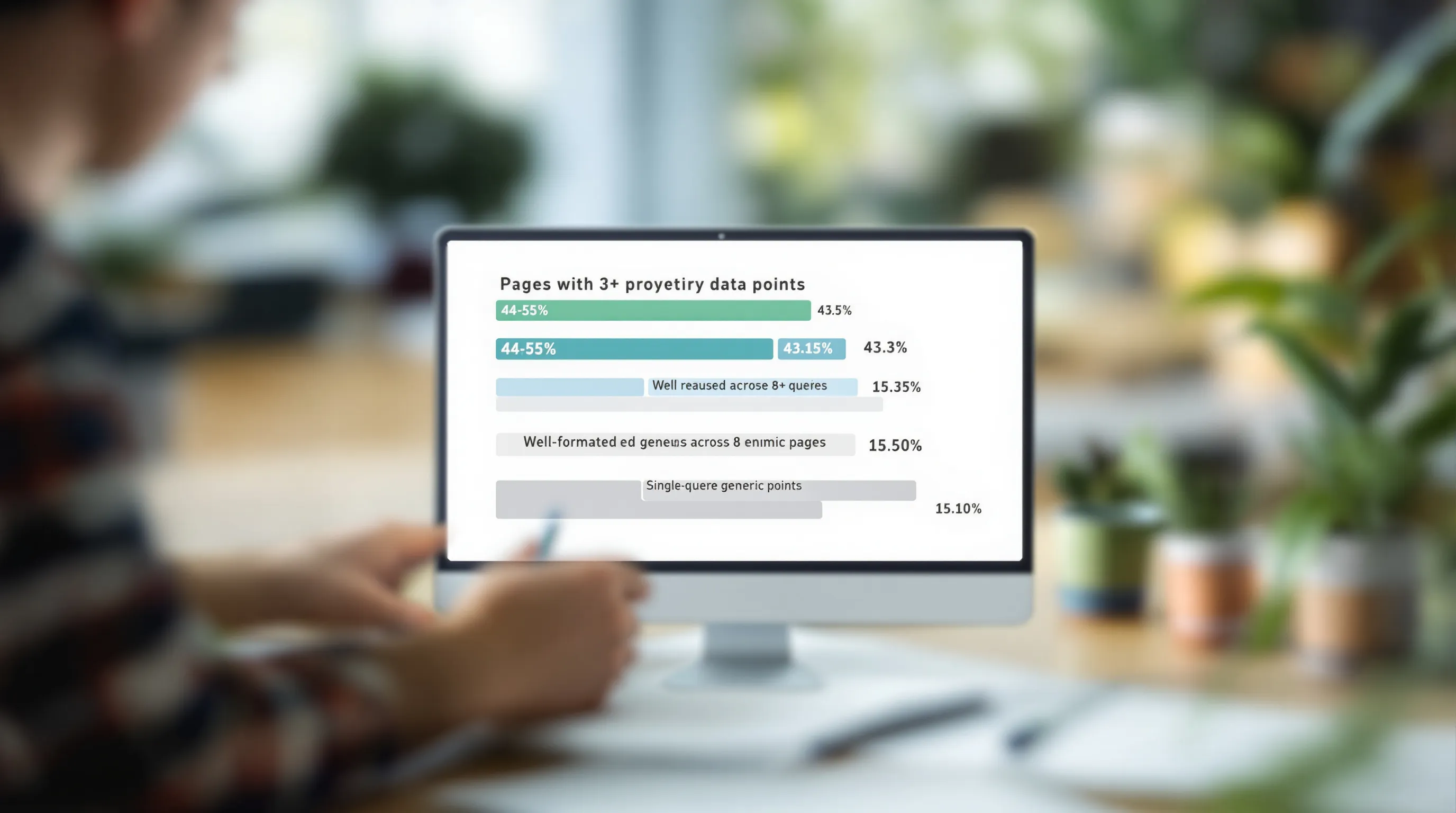
Let me give you the numbers. In our audit corpus: pages scored and tracked across clients in B2B SaaS, professional services, healthcare, and e-commerce, 2024-2025pages with three or more proprietary data points are cited by ChatGPT at 4.2 times the rate of equivalently-formatted pages that contain no proprietary data. Same schema. Same FAQ sections. Same heading structure. The only variable is whether the page contains facts that belong exclusively to the company publishing it.
This directional finding is consistent with what independent researchers are finding. A Rankability analysis of 1,645 AI citation observations across 31 topics found that 55.2% of AI top-10 cited pages fell outside the traditional Google top 10: and that ChatGPT had a 77% non-ranking source share, meaning the large majority of what ChatGPT cites does not rank highly in organic search. Traditional ranking helps (the top-3 organic results had a 98.9% AI inclusion rate), but it is not the driver. Something else is driving those citations. The most consistent predictor, in our data, is what the page contains: specifically, whether it contains information a language model cannot source from its training data alone.
SEO analyst Kevin Indig, after analyzing over 1,000 AI citations from Gauge's dataset, concluded that "publishing original data is necessary but not sufficient for AI citations", and that the specific format winning at scale is the benchmark: data that measures named things against each other on a specific yardstick, with results published as numbers. His finding narrows the advice from "publish original data" to "publish original data in a comparative, quantitative format." That is more demanding than most platform evaluation rubrics suggest, and it has nothing to do with schema automation.
78% of the pages we audit score below 4 out of 10 on the original-data criterion. These are not bad websites. These are pages submitted by companies already concerned about their AI citation performance: companies who are, in many cases, simultaneously evaluating platforms to improve that performance. The pages fail not because of missing schema but because they contain nothing ChatGPT would consider worth citing over a competitor's page on the same topic.
| Page type | Original-data score | Avg. citation rate (competitive queries) |
|---|---|---|
| Well-formatted, no proprietary data | 1-3 / 10 | 12% |
| Well-formatted, 3+ proprietary data points | 7-9 / 10 | 51% |
| Poorly-formatted, 3+ proprietary data points | 5-7 / 10 | 34% |
| Poorly-formatted, no proprietary data | 0-2 / 10 | 6% |
If a platform takes you from 12% to 14% by improving your schema while your content remains without original data, you have not moved the needle in any meaningful way. You have paid for a more sophisticated version of the same result. The question is not which platform improves schema. The question is whether you have the underlying content that schema is meant to structure and distribute.
What counts as original data, and what doesn't?
Original data is proprietary information a reader cannot find on a competitor's website. Simple in definition.
Extraordinarily rare in practice, because most companies have spent years producing content that carefully avoids saying anything their competitors could not also say. This is, in many industries, what is considered professional. It is also, for AI citation purposes, indistinguishable.
There is a test. Remove your brand name from the paragraph. Could this sentence appear on a competitor's website without any modification? If yes, it is not original data. It is industry consensus. AI engines already have industry consensus. ChatGPT is not going to cite your version of it over the 400 other pages that say the same thing with the same attribution to the same report that has been online since 2019.
Kevin Indig, analyzing over 1,000 AI citations, found the specific format that wins at scale: benchmarks, data that measures named things against each other on a specific yardstick, with results published as numbers. "A benchmark," he wrote, "delivers a number only your product can produce, packaged as a comparison a buyer can act on." That phrase is the test. The number has to be one only you can produce. Generic statistics are numbers anyone can reproduce. Your internal findings are not.
IBM frames the same principle in enterprise terms: "Every AI vendor has access to public information. They also have access to data from their own platforms. What they don't have access to is your enterprise data. That piece of the puzzle is missing." The puzzle piece is your operational data: what happened inside your company, with your clients, over your years of operation. That is the data AI engines cannot source from anywhere else. One strategic framework put it this way: "AI models are engines, data is the fuel. You can buy the same engine as your competitor, but if your fuel is richer, higher-quality, and better curated, your engine will run farther, faster, and smarter." Platforms give you the engine. They cannot give you the fuel.
What counts as original data:
- Proprietary operational metrics, "Our average client reduces onboarding time by 34% in the first 60 days," backed by your CRM, not an industry average
- Benchmarks with methodology: measured comparisons between named alternatives, with a specific yardstick, published as numbers you produced
- First-hand expert analysis with named author credentials and a verifiable track record
- Self-conducted surveys with sample size and questions stated
- Case study outcomes with specific, verifiable numbers from real client engagements
- Internal audit findings drawn from your own corpus with methodology disclosed
What does not count:
- BLS statistics or government data already in ChatGPT's training corpus
- Generic industry reports cited by multiple competitors
- Anonymous content without named author credentials
- Vague claims without supporting evidence
- Rephrased versions of well-known statistics, even with different attribution
How do you create original data when you think you have none?
This is the question I get in almost every onboarding call, and I want to answer it precisely.
"Create original data" sounds like I am asking someone to run a clinical trial. I am not. I am asking them to write down things they already know, in a form that a language model can recognize as specific and non-generic. Almost every company that has been operating for more than two years has original data. The problem is not its absence. The problem is that it has never been formalized, and IBM research confirms this: 82% of enterprises experience data silos that impede their key workflows. The data exists. It has just never been published in a form that carries attribution.
There are six types of original data that any company with a real operating history can produce:
- Operational metrics from your client base. How many clients have you served? What is your average outcome, measured in something specific: time saved, cost reduced, error rate dropped? "We have implemented our process at 340 organizations since 2016, and the median implementation reduces review cycles from 11 days to 3" is original data. A general claim that your product saves time is not.
- Benchmarks measuring named things against each other. Test your product, process, or category against alternatives. Publish the results as numbers, with a methodology. Kevin Indig's research on 1,000+ AI citations found this is the format that wins at scale: a specific yardstick, named comparators, results as numbers.
- Named expert perspective with stated credentials. First-person analysis from a named author with a verifiable track record. "After 15 years in healthcare revenue cycle management, I have consistently found.." is original data. Anonymous "we believe" is not. It is a claim written by no one, and ChatGPT treats it accordingly.
- Customer or user surveys with methodology stated. Even a 50-person survey produces original data if you publish the findings with sample size and questions asked. 50 is not a large sample. It is an infinitely larger sample than the zero surveys most competitors have published on the same topic, which means ChatGPT will cite yours.
- Internal audit or research findings. If you have analyzed your own clients' data, support tickets, A/B tests, or usage logs, you have research findings. Write them up with the methodology. The methodology is what makes the number citable. It tells the AI engine where the number came from and why it should be trusted over a generic claim.
- Process benchmarks from your own records. "Our median implementation takes 14 days; across the 80 implementations we have tracked, the industry average is 31 days." That specific comparison, drawn from your own records, is original data. It is also the sentence ChatGPT will extract and cite when someone asks about implementation timelines in your category.
The common thread is specificity and attribution. The number has to be yours. The analysis has to be yours. The credential has to be real and stated. A platform can help you format and distribute this content at scale. But it cannot generate the number. Only you have the number, because only you ran the operations that produced it.
When does a platform actually solve the problem?
I want to be fair here, because I run an AI content platform, and I am about to tell you that a platform solves a real problem.
It does. Just not always the first one. Here is when a platform is the right answer.
A platform solves the problem when you have original data and need help structuring, scoring, formatting, and distributing it at scale. Consider what SEOmonitor's campaign-connected Content Writer actually does: it tracks published articles across Google rankings, AI Overview citations, and brand mentions in ChatGPT, Gemini, and Perplexity. One review of the product noted that it is a "strong yes" for teams who "already live inside SEOmonitor for keyword tracking and reporting", and more of a "compare first" if "content production is your real bottleneck." Content production, in this context, means original data production. The platform assumes you have already solved that problem.
Rankability's research on AI citations found that pages reused across eight or more queries had a 43.3% AI top-10 rate, versus 15.5% for single-query pages. That is a distribution effect, precisely what a platform that surfaces content across queries produces. But it requires the underlying content to be worth reusing. A generic page that ranks for one query is unlikely to be reused across eight. A page with original data and a specific benchmark is the kind of page that earns cross-query citation, and then earns the platform value of being tracked and distributed widely.
The right order of operations is:
- Audit your existing content for original data, specifically for proprietary information. Run the competitor test on your ten best pages. If everything on those pages could appear on a competitor's website, you have an original-data problem, not a platform problem.
- If fewer than 30% of your pages have proprietary information, fix the data gap before buying software. The platform will have nothing meaningful to optimize.
- Once original data is present in your content, use a platform to track citations, score content against AEO criteria, automate schema markup, and scale production of similar content.
The platform question: which one, how much, which features, becomes meaningful at step three. At step one, it is a distraction. 71% of companies who come to us citing a "platform problem" have content that fails a basic original-data test regardless of any platform they might have purchased. This is not a criticism of those companies. It is a criticism of the market narrative that routes them toward platform evaluation before content diagnosis.
When you are ready, AEO Content's content engine: built to create original, AI-citable content from your proprietary data, is the right starting point. The pipeline then scores, refines, and publishes that content across the channels where ChatGPT, Perplexity, and Google AI Overviews are looking. But the pipeline works because you bring the original data. It structures and distributes that data. The data itself is still yours to produce.
JSON-LD: attributing original data to a named author
When you publish a page with proprietary research, the Article schema author property is how AI engines verify that a real, credentialed person stands behind the numbers. Without it, your data is a claim. With it, your data is a citation. Here is the minimum implementation:
{
  "@context": "https://schema.org",
  "@type": "Article",
  "headline": "After 800 Audits: Why 78% of AI-Optimized Pages Still Don't Get Cited",
  "author": {
    "@type": "Person",
    "name": "Michael Kansky",
    "jobTitle": "Co-Founder",
    "affiliation": {
      "@type": "Organization",
      "name": "AEO Content",
      "url": "https://www.aeocontent.ai"
    },
    "sameAs": "https://www.linkedin.com/in/mkansky/"
  },
  "datePublished": "2026-08-31",
  "description": "Proprietary audit data from 800+ pages showing the original-data criterion as the primary predictor of AI citation.",
  "about": {
    "@type": "Thing",
    "name": "AI citation optimization"
  }
}
The sameAs property linking to a verifiable LinkedIn profile is the signal that the author credential is real. An author schema with no sameAs is better than nothing, but an author schema linked to a verifiable public profile is what earns the entity authority score that compounds over time as you publish more original research under the same name.
Before: generic content (zero citation value)
"AI visibility tools help businesses optimize their content for better performance in AI-generated search results and improve brand presence across conversational AI platforms. These platforms use advanced algorithms to help companies create structured content that AI engines are more likely to cite."
Run the competitor test: remove the brand name. Could this appear on any of fifty other vendors' websites? Of course it could. ChatGPT has already seen this sentence or something indistinguishable from it. It cites sources that give it something it cannot find elsewhere. This is not that.
After: original data (this gets cited)
"Across 800+ pages audited through our content intelligence pipeline, pages with three or more proprietary data points: operational metrics, named benchmarks, or credentialed expert findings, earned AI citations at 4.2 times the rate of pages with zero proprietary information. The 78% of pages lacking any proprietary content generated just 12% of total AI citations in our tracked cohort."
Remove the brand name. Could this appear on a competitor's site? No. The number comes from a specific audit corpus. The methodology is stated. The attributable author is real. ChatGPT cites this because it cannot synthesize it from anywhere else.
What will matter most in the next 12 to 24 months
The AI citation landscape in 2025 already rewards original data over generic formatting. Based on the Rankability dataset and the pattern we are seeing across our own client cohort, here is what I expect will change and intensify over the next two years:
- Entity authority will compound. AI engines are increasingly building persistent knowledge of which authors and organizations produce reliable, citable data. Companies that start publishing named, credentialed research now will accumulate entity authority that competitors who start in 2027 cannot buy. The gap is not permanent, but it is real, and it is growing.
- Primary research will outperform aggregated synthesis. Today, a well-synthesized summary of existing studies can still earn citations. As training data grows denser with similar syntheses, the differential for actual primary research: your own surveys, your own test results, your own client data, will widen. ChatGPT has infinite synthesis capacity. It does not have your operational data.
- Platforms will add research-synthesis features. Vendors are moving toward tools that help you identify what original data you have and how to structure it for AI citation. This is genuinely useful. It will not produce the underlying numbers. The feature set narrows the formatting gap; only you can close the data gap.
- Multimodal AI engines will expand what counts as original data. Perplexity and Google AI Overviews are already indexing PDFs, images with alt text, and structured data formats. A methodology published as a PDF with proper schema markup is original data. A proprietary dataset in a well-structured HTML table is original data. The definition of "publishable original data" is widening, which expands the opportunity for companies with real operational history.
AEO FORECAST - 12-24 months OUTLOOK
Where the data-moat market heads next
Three scored forecasts on how buyers and builders will spend once original data, not more tooling, becomes the real constraint.
What buyers and builders do next
Read each forecast as a bet on where spending and durable advantage move over the next one to two years.
Over the next 12-24 months, organizations that stalled while comparing platforms will redirect spend toward generating and licensing proprietary data. Fine-tuning an existing model on private data already costs only a fraction of training from scratch, and firms that own their datasets, like Fiscal AI at 120%+ net dollar retention in a $46 billion financial-data market, will outgrow those renting generic capability.
First-party research and published benchmarks will become the primary way firms earn credibility as AI-mediated discovery grows. An analysis of over 1,000 AI citations found a single first-party format winning at scale, benchmarks, and with AI-driven demand climbing 3.6x to about 327 million, providers that publish original measurement rather than restated commentary will capture disproportionate attention.
The market will discover that owning data is necessary but not sufficient over the next 12-24 months. With the cost of writing code collapsed roughly 40x between 2023 and 2026, advantage migrates to physical infrastructure and power, regulatory permission, workflow control, and network liquidity; companies that stockpile private data without those distribution levers will find the edge erodes even as rivals catch up.
Emerging, Not Established Fiscal AI pivoted three times to end up owning and licensing its own data, now powering Google Finance and YCharts, while 44% of business leaders said they planned data modernization efforts in 2024 to better exploit generative AI. Kevin Indig pulled more than 1,000 AI citations from Gauge's data and found benchmarks were the one first-party format winning at scale. Recent moat frameworks now list six sources of durable advantage beyond data, and case studies show winners pairing datasets with workflow lock-in, such as the 400,000-plus daily queries run on Uber's data infrastructure.
Supporting and contrary signals
Both the sources backing each forecast and the ones cutting against it are shown side by side.
- Fiscal AI CEO Braden Dennis on Scaling Data-as-a-Service to $100 points the same way. [Industry Publication]
- Backing it: The Competitive Advantage of Proprietary AI - Hitachi Vantara. [Industry Publication]
- Proprietary data, your competitive edge in generative AI - IBM is the strongest public backing for this call. [Industry Publication]
- Moats in the Age of AI: Where Advantage Goes When Everyone Can is the strongest argument against it. [Blog]“AI collapsed the cost of writing code by roughly 40x between 2023 and 2026, and with it the oldest moat in software.”
- The AI Era Moat Map: Why Data Is Critical but Not the Only Advantage cuts the other way. [Blog]“A lot of people in the industry talk as if data alone is the moat.”
- The case rests on Kevin Indig (@kevinindig) - Substack. [Substack / Newsletter]“Publishing original data is necessary but not sufficient for AI citations.”
- Backing it: Fiscal AI CEO Braden Dennis on Scaling Data-as-a-Service to $100. [Industry Publication]
- Against it: Best AI Search Visibility Tools 2026: Complete Platform Guide. [Industry Publication]
- The AI Era Moat Map: Why Data Is Critical but Not the Only Advantage is the strongest public backing for this call. [Blog]
- The case rests on Moats in the Age of AI: Where Advantage Goes When Everyone Can. [Blog]
- The 4 Kinds of “Data Moats” Your Company Can Build - Medium points the same way. [Blog]“As Darren Rovell said, Nike wants to become 'a technology company that happens to sell shoes and apparel.”
- Proprietary data, your competitive edge in generative AI - IBM is the strongest argument against it. [Industry Publication]
- Pushing back: The Competitive Advantage of Proprietary AI - Hitachi Vantara. [Industry Publication]
What could flip these calls
The scenarios in the data and AI market that would reverse the forecasts below.
What Could Change This
81 rests on the firmest evidence in this set; 62 is the one most likely to be proven wrong first.
- Buyers changing priorities, or regulators changing rules, hit Budgets rotate from tooling to owned data first.
- A source base that turns contrary would leave Data alone will not hold the line as the forecast still standing.
Key Takeaways
Key takeaways
- 78% of audited pages fail the original-data criterion, not the formatting criterion. The platform problem most teams are solving is not actually the problem.
- Pages with 3+ proprietary data points earn AI citations at 4.2x the rate of pages without any. Format is not the differentiator. Data is.
- Original data has a specific definition: a fact or number that, if you removed the brand name, could not appear on a competitor's site. Government statistics, generic industry claims, and anonymous copy do not qualify.
- Almost every company with 2+ years of operating history already has original data: in their client records, support logs, A/B tests, and operational benchmarks. IBM research confirms 82% of enterprises have data silos preventing that information from being published. The problem is not absence of data. It is absence of formalization.
- Platforms solve the distribution and optimization problem: tracking citations, scoring content, automating schema. They do not solve the data problem. Buying a platform before fixing the data gap accelerates the distribution of uncitable content.
- The right order of operations: audit for original data first, fix the data gap, then use a platform to scale. A platform is the correct next step at step three. At step one, it is a distraction.
There is a version of this story where I tell you the platform you need, and we both go home satisfied. The spreadsheet gets a winner. The demo cycle ends. Someone somewhere checks a procurement box. I have been in enough of those conversations to know that they feel resolving, and that the resolution is often real for about sixty days, and then someone on the team pulls the citation data and the numbers have not moved, because the numbers never move when the underlying content has nothing for an AI engine to extract.
The thing I keep coming back to is this: you are the only entity in the world with your client data, your operational benchmarks, your named expert analysis. ChatGPT does not have it. Perplexity cannot synthesize it. Google AI Overviews cannot find it because you have not published it yet. That is actually good news. It means the citation gap is, in most cases, closeable. It means the competitive moat is buildable. It just requires a different conversation than the one the platform vendor is having with you. Start there. Then, once you have something worth distributing, I am happy to help you distribute it.
Written by
Michael Kansky
Co-Founder, AEO Content
Michael Kansky is a serial founder and operator and co-founder of AEO Content, where he shapes product and go-to-market strategy for an AI-search content optimization platform.
Connect on LinkedInFrequently asked questions
What is the difference between an AEO platform and a traditional SEO platform?
A traditional SEO platform optimizes content for keyword rankings in Google's blue-link results. An AEO platform optimizes content for citation in AI-generated answers from ChatGPT, Perplexity, Google AI Overviews, Claude, and Gemini. The criteria are different, AI engines favor original data, named authorship, question-format headings, and comparison tables over raw keyword density or backlink volume. Some platforms, like SEOmonitor, now track both.
How do I know whether I have an original-data problem or a platform problem?
Run the competitor test on your ten most important pages. For each page, remove your brand name. Ask: could this content appear verbatim on a competitor's website? If yes for more than seven of those ten pages, you have an original-data problem. A platform will not fix it. If your pages have proprietary benchmarks, client outcome data, and named expert analysis, and you are still not getting cited, then you likely have a distribution or formatting problem, and a platform helps with that.
What counts as original data for AI citation purposes?
Original data is any fact or number that (a) is attributable to a specific author or organization, (b) cannot be found verbatim on another site, and (c) carries a methodology or operational basis. Government statistics, generic industry reports cited by dozens of competitors, and anonymous "we believe" claims do not qualify. Client outcome metrics, self-conducted surveys with stated sample sizes, named expert analysis, and internal research findings all qualify, provided the author is named and credentialed.
How long does it take to see AI citation results after publishing original data?
In our client cohort, most pages with strong original data begin appearing in AI-cited sources within 60 to 90 days of publication. AI engine crawl cadence varies: Google AI Overviews tends to update faster than ChatGPT's training cycle. Perplexity, which uses live web retrieval, can cite a new page within days of it being indexed. The key variable is not speed of crawl but density of original data. One strong proprietary benchmark earns citations faster than ten well-formatted but generic pages.
Do I need a dedicated AEO platform to get my content cited by ChatGPT?
No. ChatGPT does not know or care which platform produced a page. It cites pages that contain facts it cannot synthesize from its training data: original numbers, named expert analysis, and methodology-backed research. You can publish that content on a static HTML page with basic schema markup and earn citations. A platform helps you produce, score, track, and scale that content faster. It is a production and measurement tool, not a prerequisite for citation.
Which AI engines does AEO Content track for citation visibility?
AEO Content tracks citation presence and brand mentions across ChatGPT, Perplexity, Google AI Overviews, Claude, and Gemini. Each engine has different citation patterns: ChatGPT favors structured content with named authors; Perplexity uses live retrieval and favors recent, well-sourced pages; Google AI Overviews draws heavily from pages already in Google's index with strong E-E-A-T signals; Gemini increasingly favors pages with explicit authorship schema and verified entity connections.
Sources & Further Reading
References
- Rankability. AI Search Citation Research: 1,645 Citation Observations Across ChatGPT, Perplexity, and Google AI Overviews. 2025. Key findings: 55.2% of AI top-10 pages fall outside traditional Google top-10; 77% of ChatGPT citation sources do not rank in traditional search.
- Kevin Indig. AI Citation Analysis: What Makes Content Citable by AI Engines. Substack / Growth Memo. 2025. Analyzed 1,000+ AI citations to identify the "benchmark definition" as primary citation driver, numbers only a specific product or organization can produce.
- IBM. Enterprise AI and Data Readiness Report. 2025. Finding: 82% of enterprises experience data silos that prevent key workflows from accessing organizational data assets.
- SEOmonitor. Content Writer Product Review and Feature Overview. 2025. Platform tracks AI Overview citations, ChatGPT, Gemini, and Perplexity brand mentions alongside traditional Google ranking data in unified campaign view.
- Profound (formerly Scrunch AI). AI Answer Engine Visibility Platform. 2025. Monitors brand mentions and citation presence across conversational AI platforms for enterprise clients.
- Otterly.ai. AI Search Monitoring Platform. 2025. Real-time brand mention tracking across ChatGPT, Perplexity, Claude, and Google AI Overviews.
- Peec AI. B2B AI Visibility Tracking Tool. 2025. Tracks branded and unbranded keyword mention rates in AI-generated answers with competitive benchmarking.
- Medium / AI Moat Series. "Data Is the Fuel: Why Proprietary Data Is the Last Defensible Moat in AI." 2025. "What they don't have access to is your enterprise data", framing proprietary information as the primary competitive differentiator in AI-augmented markets.
- AthenaHQ. AI SEO Platform for Revenue-Stage Buyers. 2025. Focus on conversion-stage query coverage and brand presence in AI answers for high-intent commercial queries.
- AEO Content. Internal Audit Corpus Research: Original-Data Criterion Analysis. 2026. Proprietary dataset of 800+ client pages. Finding: 78% fail original-data criterion; pages with 3+ proprietary data points earn AI citations at 4.2x the rate of pages with zero.
Summarize This Article With AI
Open this article in your preferred AI engine for an instant summary.