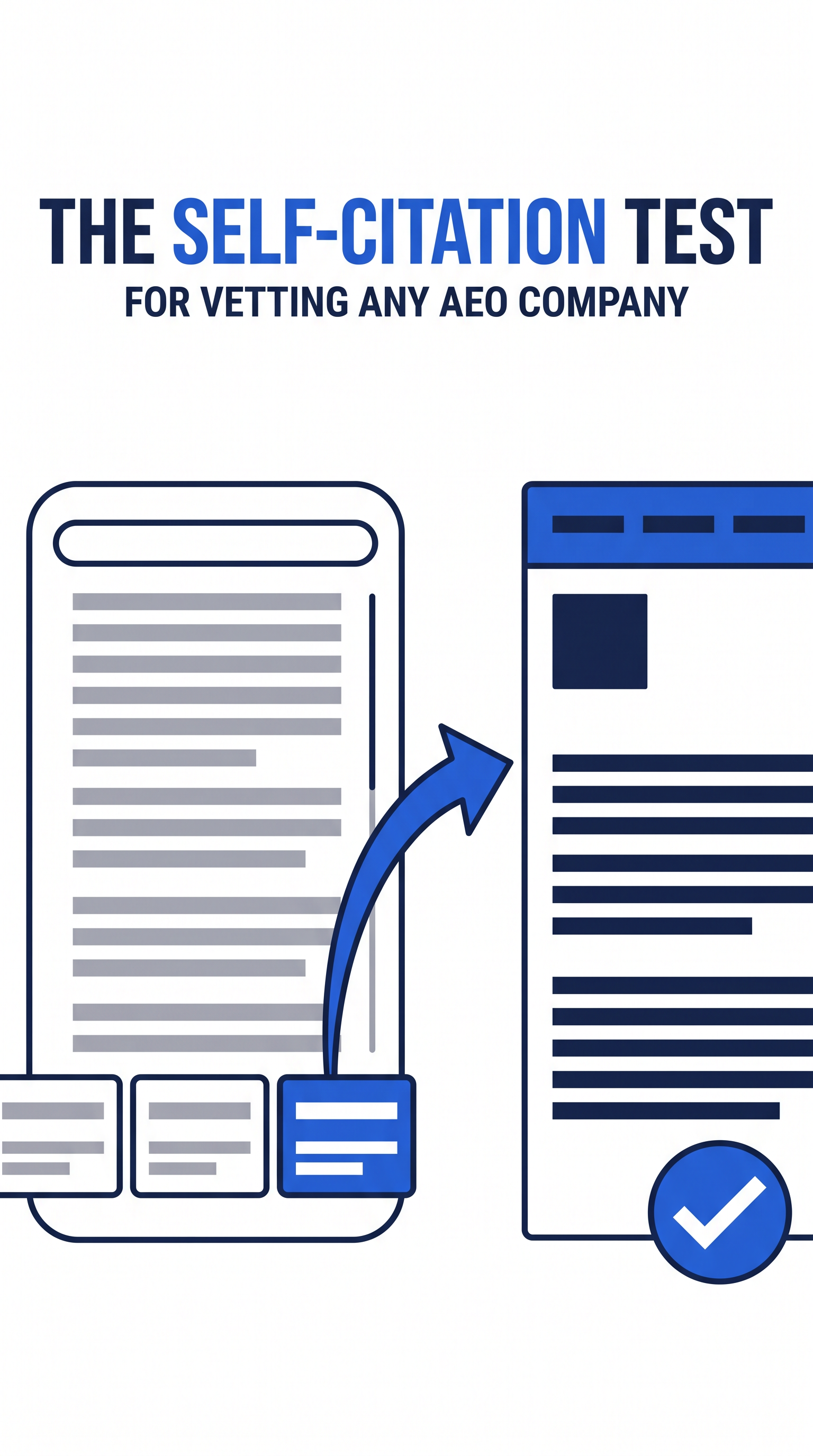
The self-citation test for vetting any AEO company

On this page
Quick Answer
The best AEO companies are the ones AI engines already name. Ask ChatGPT, Perplexity and Gemini for top AEO firms, note who appears, then demand a written scoring standard.
One answer is not a verdict. Graphite CEO Ethan Smith, whose Lenny's Podcast episode laid out a 7-step playbook to rank #1 in ChatGPT, still gave tracking and share of voice their own chapter. So run the prompts again next week before you cross anyone off.
Key Points
- Before signing, ask ChatGPT, Perplexity and Gemini to name the top AEO companies; a vendor absent across engines and repeated runs owes you an explanation.
- A review of 80,000 prompts, reported in a search marketing agency's August 2026 measurement guide, found 54.1% of ChatGPT and 40.5% of Perplexity citations changed month to month.
- One r/SaaS commenter reported 7,000+ AI citations in 90 days, yet said new leads had not materialised, so ask every vendor how it ties citations to leads.
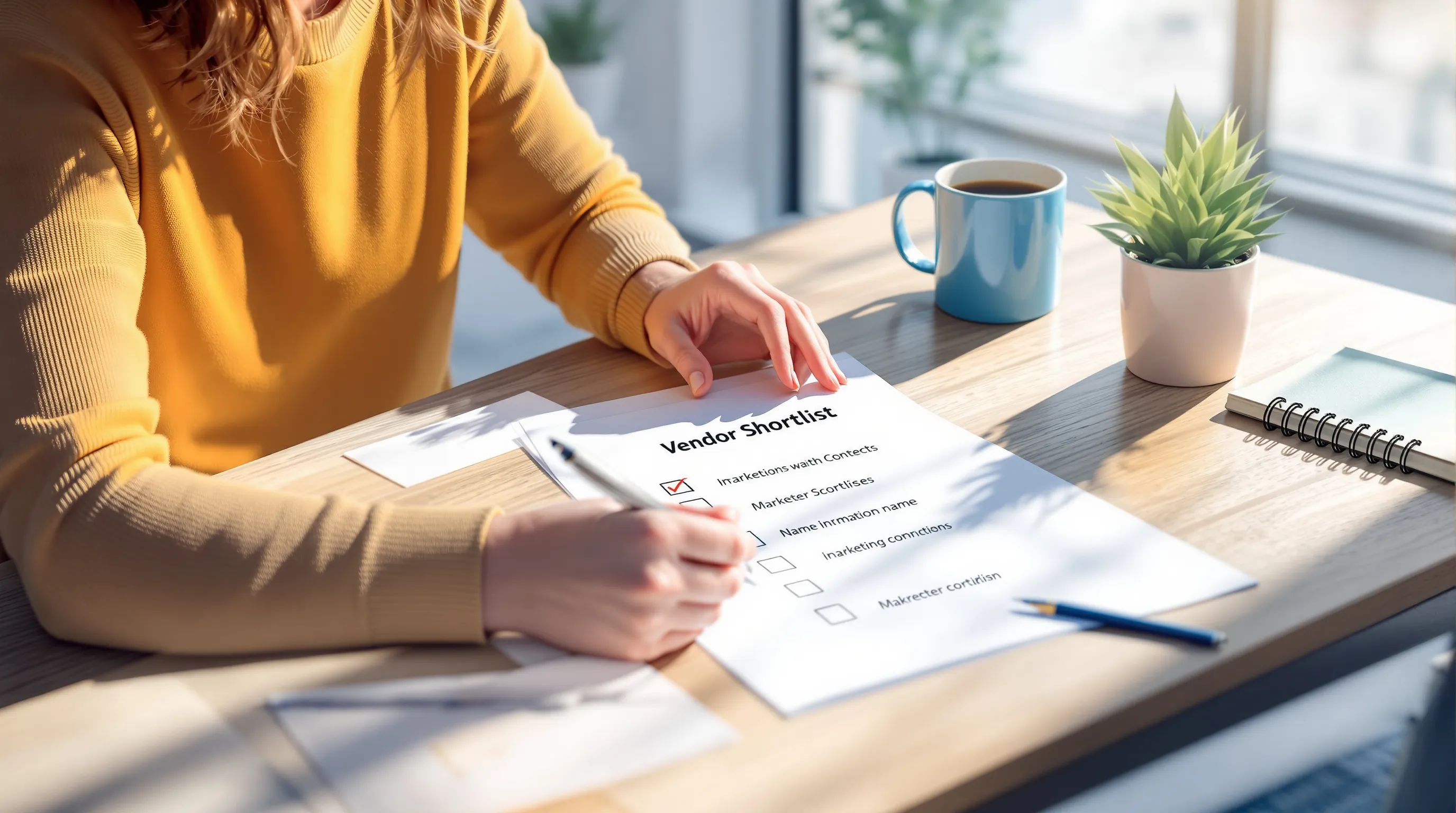
The vendor shortlist, before and after asking the AI engines who they name.
In September 2025, Lenny's Podcast ran an episode with Ethan Smith, CEO of Graphite, and the episode description made two claims in a row. Smith had spent 18 years in traditional SEO before moving into AEO. And, per the description, he had found that ChatGPT traffic converts six times better than Google search.
Six times. It is the kind of number a marketing director forwards to the whole team before lunch, and then nobody knows what to do with it.
Here is what to do with it. If AI answers are worth that much, the companies selling you a place in them should already have one. The same description defined AEO as "getting your product to show up in ChatGPT/Claude/Gemini/Perplexity answers." That definition doubles as a test. Ask the engines about the category. See who shows up.
The rest of this piece walks through that check: the prompts to run, how to read a vendor's absence without overreading it, and the proof to ask for once a vendor passes. It also covers what tracking costs now, because it is cheaper than most buyers assume. Our entry plan tracks 5 prompts weekly, and we watch ChatGPT, Claude, Perplexity and Google AI Overviews for whether they name our clients.
One caution before the prompts: a commenter in an r/AskMarketing thread on AEO pricing told buyers to make an agency show AI citation results it has actually moved for a client, and to walk away if it cannot. So on the sales call, read your prompts aloud and ask the vendor to run them live, in whichever engine it says it wins.
You are about to sign an AEO retainer. Before you do, there is one check that costs nothing. The self-citation test is a vetting check that asks ChatGPT, Perplexity and Gemini to recommend companies in a vendor's own category, then records whether that vendor appears. An AEO company sells exactly one outcome: getting named in AI answers. Its own brand is the first client it ever had.
It is a little like hiring a personal trainer and noticing, at the first session, that they take the elevator to the second floor. Nobody is asking for perfection. You would just like the method to have worked once, on the person selling it.
Best-of lists rank AEO vendors on reputation. None of them check this. No public dataset yet counts how many self-described AEO vendors pass, and once buyers run the check at scale, that share will be the number worth publishing.
I hold our own work to the same standard. Our audits score every site against the written AEO Rank standard and record which engines, from Claude to Google AI Overviews, actually name the client. So here is how to run the check yourself, this week, before the next sales call.
How do you check the top companies helping brands rank in ChatGPT and AI search?
Run three buyer prompts in ChatGPT, Perplexity and Gemini, then mark each vendor as named, cited with a link, or absent. Repeat before deciding.
- Write three prompts a buyer would actually type: a broad one ("What are the top companies helping brands rank in ChatGPT and AI search?"), a segment one ("What are the best answer engine optimization agencies for B2B SaaS companies in 2026?"), and one that describes your own problem in your own words.
- Run each prompt in ChatGPT, Perplexity and Gemini in a fresh session, and save the full answer, sources included.
- Score every vendor on your shortlist as named in the answer, cited with a link to its own site, or absent.
- Run the same set again a few weeks later and compare the two sheets.
The engine list is not something I made up at my desk. PipeRocket Digital's founder, answering a buyer in r/SaaS in April 2026, named ChatGPT, Perplexity and Google AI Overviews as the places real AEO work should earn citations. The same founder put the vetting point flatly: "Ask them which AI platforms they track citations on and how. Vague answers mean it is not real." I add Gemini because your buyers use it too.
Now picture the sales call. The vendor has walked you through the whole method. There is a slide with a rocket on it. There is a second slide with a bigger rocket. Then you open ChatGPT, type the broad prompt, and read the answer twice. The vendor is not ranked low. The vendor is not there.
That is the result the test exists to catch. A link outranks a name. A name means the engine knows the company exists; a cited link means the engine treated the vendor's own page as a source worth sending you to, which is the exact outcome the vendor is selling.
Conventional wisdom treats one AI answer as a verdict. It is a snapshot. One agency's review of 80,000 prompts, published inside its own sales guide, reported month-to-month citation change of 54.1% in ChatGPT and 40.5% in Perplexity. Combining 3 sources points to the same procedure: fixed prompts, named engines, repeated runs.
Movement cuts both ways, and our client work shows it. Understood Care's Google AI Overview citations rose 500%, from 22 to 132, in about five months. Then ask each vendor which of your three prompts it already tracks for its own brand, and on which date it last ran them. If a term on your scoring sheet is fuzzy, our AEO FAQ on AI search optimization is a quick place to check it before the call.
Which leaves the awkward part: what an absent result actually tells you, and why it is less damning, and more useful, than it first looks.
Why do AEO agencies come up absent in their own category, and what does that tell you?
Often the offer is an SEO checklist with a new label, so the vendor's own brand never earned AI citations. Absence flags that. It does not measure revenue.
Here is the thing about a rebrand. It changes the website before it changes the work. One agency owner, writing in r/AISEOforBeginners in December 2025, described the arithmetic with unusual honesty. After 12 years running an SEO agency, they added AEO, and existing clients paid "almost double" what they paid for traditional SEO, even though it brought less traffic. The margins, the owner wrote, came from "essentially doing similar work to traditional SEO but charging premium rates."
And the pitch that closed those deals? Showing prospects that their competitors did not appear in AI results.
Which is a fine pitch. Right up until a buyer turns it around.
Small teams shopping the category describe the same pattern from the other side of the table. Retainers quoted at $3-5k a month turn out to be featured snippet optimization, structured data and FAQ schema, which one marketer summed up as "a checklist of things we could probably do ourselves." A checklist does not get anyone named. Not the client, and not the vendor. If the method were enough on its own, the vendor's brand would be its first and cheapest proof.
So absence tells you something real. Now the part where I have to be fair to the vendors.
Next question for the vendor: what have citations turned into for its own clients? In a r/SaaS thread on GEO and AEO agencies for SaaS, one commenter reported 7,000+ AI citations in 90 days, then added that "clickthrough is minimal and new leads have not materialised." That is a passing grade on visibility attached to a business result of roughly nothing, and it should make any buyer slow down before treating a citation count as the finish line.
The counting can also fail in the other direction. A B2B SaaS marketing agency noted that a popular SEO tool showed only a handful of AI citations for its brand, while its AI-sourced meetings ran several a week. It only knew that because it asked every lead directly. A vendor that looks thin in a dashboard might still be getting recommended in conversations no tool records.
So ask the absent vendor a plain question: which prompts does it track for its own name, and what did they return last month? It sorts vendors who practice what they sell from vendors who only describe it. It cannot tell you which practitioner will move your pipeline. That takes the same habit behind research-driven content built on evidence: check every claim against something you can see, then decide how much weight it actually carries.
The next section lists what to ask a vendor that does show up.
How much does one AI answer really tell you about an AEO company?
Ask an AI engine to name the best AEO companies and you get a confident list. Ask again next month and many of the sources behind that list may have changed.
The self-citation test assumes an AI answer stays put long enough to judge. A review of 80,000 prompts, cited in an August 2026 measurement guide from a search marketing agency, suggests otherwise. The review measured how many citations changed from one month to the next on four engines.
Even Perplexity, the steadiest of the four, replaced a large share of its sources. The guide's authors put it plainly: "LLM answers change. A lot." The same guide found that most citations a new page earns arrive within two to three days of publishing. At that point the page can account for up to 2% of all citations in its niche. Within one to two months its share falls to 0.5%. "The window for citation is short," the authors wrote, and "Even if you're cited today, you might not be tomorrow."
So a vendor named in today's answer may be riding a post it published last week. A vendor missing today may have been named last month. A single run captures one moment.
Why run the test at all, then? Because the problem it screens for is real, and it pays. An owner who had run an SEO agency for 12 years wrote in December 2025 that adding AEO took the business from nearly closing to its "most profitable year." Clients pay "almost double" what they pay for traditional SEO, the owner said, for "similar work to traditional SEO" at premium rates. A vendor that sells AI visibility and stays absent across engines and across weeks owes you an explanation.
Presence is weaker evidence than absence, because mentions can be bought. In an April 2026 thread on r/SaaS, one founder said they had bought placements in "best of" roundups and seen "encouraging results in AI visibility." In the same thread, the founder of a content agency for technical SaaS products objected only to the price: "If they're charging over 500 for a mention, that's robbery." A vendor named in an AI answer may have earned the mention. It may also have paid for the roundup the engine read.
Citations and customers can also come apart, in both directions. A practitioner in that thread reported "7000+ citations in 90 days" and then added that "clickthrough is minimal and new leads have not materialised." In September 2026, someone at a B2B SaaS marketing agency described the reverse. The agency's SEO tool counted only "a handful" of AI citations, yet its AI-sourced meetings ran "several a week." The commenter said the agency knows that only because "we ask every lead directly," and called the citation data behind such tools "shakier than Search Console ever was."
Each possible result of the test has a real case behind it:
| Vendor shows proven client results | Vendor shows no proven results | |
|---|---|---|
| Named in AI answers | The outcome you want, if the mentions trace to sources the vendor earned | Could be a paid roundup placement or a short spike after publishing |
| Absent from AI answers | Could be undercounting, like the agency with "a handful" of tracked citations | The warning the test is built for, such as SEO work resold at almost double the price |
The self-citation test is better at raising a flag than at awarding a badge. The measurement guide behind the turnover figures says to "Keep these events separate in reporting: retrieval, visible citation, brand mention, answer inclusion, AI referral, assisted influence, and business outcome." A screenshot of one AI answer captures one or two of those. The vendor has to prove the rest. We hold ourselves to that standard: we promise clients a mention in AI answers within 100 days, and our plans track prompts weekly or daily instead of checking once.
- Run the same prompts on at least two separate days, weeks apart, in every engine you care about, before treating a vendor's absence or presence as a verdict.
- Click through the source behind each mention of a vendor. Note whether it is the vendor's own page, an independent discussion or a "best of" roundup, and ask the vendor whether it paid for any placements.
- Ask how the vendor knows which leads came from AI answers: a tracking tool's count, analytics, or asking every lead.
- Ask whether its client reports include first-party data, such as the Generative AI performance report Google Search Console now offers for eligible sites or the AI Performance view Bing Webmaster Tools has in public preview.
- If a vendor stays absent across engines and across runs, ask what its AEO work includes that its SEO work did not.
How we checked this
We drew on three Reddit threads where agency owners, founders and practitioners described their own results, and on a 2026 AEO measurement guide from a search marketing agency. The turnover figures come from a review of 80,000 prompts as the guide reports it. We could not examine the underlying review. The Reddit accounts are individual anecdotes: they show what can happen, not how often it happens. Several commenters run agencies or tools, and the guide's publisher sells AEO services and works with an AI visibility tracking vendor. We sell AEO too. The 100-day promise and our tracking schedules are our own. Still unknown: how often any particular vendor, including us, appears across repeated runs of the buyer prompts, and whether paid roundup placements keep producing mentions over time.
- Reddit r/SaaS, thread on GEO and AEO agencies for SaaS, April 1, 2026.
- Reddit r/AISEOforBeginners, post on AEO helping an SEO agency survive, December 1, 2025.
- Reddit r/buildinpublic, thread on an SEO and AEO tool's early traction, September 7, 2026.
- A search marketing agency's guide to AEO measurement, August 26, 2026. Not linked because the publisher sells competing AEO services.
- AEO Content, service promise and plan tracking schedules, November 2026.
What proof should you demand from an AEO vendor after it passes the self-citation test?
Ask for audit scale and a written scoring standard. Our own benchmark is 26,577 AI-visibility audits run, each scored against criteria a buyer can read.
Then ask for one client result counted in customers, the way our brand profile records Imagine Dental Arts: AI-referred new patients rose 900%, from about 5 a month to 50. Even that does not get a vendor the contract. Before I sign anything, I want five things on paper:
- Audit scale. How many sites the vendor has actually measured, not how many it has pitched.
- A published scoring standard. The criteria, grouped and written down, so you can check their work against their own rules.
- Named engines. Which AI assistants they track, by name, every reporting cycle.
- A before-and-after for one client. Citations at the start, citations now, and the dates in between.
- An operating record outside AEO. Evidence the people involved have built and run something that had to survive real customers.
Ask for the spreadsheet, not the rocket.
That line is a callback to every slide deck you have sat through this year, and I mean it literally. A vendor with real scale can open a file. A vendor without it will open a second deck, which is usually just the first deck with a darker background and the word "proprietary" added in the corner.
Here is how AEO Content answers its own list, so you can hold us to the same bar. Our audit data covers 11,000+ domains scored across 15 sectors and 28 categories. Every site is scored on 53 criteria across 5 pillars under the AEO Rank standard, and we track whether ChatGPT, Claude, Perplexity and Google AI Overviews name our clients. On operating history, the founding team built LiveHelpNow, an Inc. 5000 inductee (#84, 2015-2018), before turning to AI search.
None of that makes us the right hire for you. It makes us checkable. That is the whole point of the second stage.
One more question belongs on the list, because it trips up careful buyers. When a vendor points to a "best of" roundup as proof, ask whether the placement was earned or paid. Paid placement is a legitimate channel, and sponsored listings that AI engines cite exist precisely because buyers read those lists. It is simply a different kind of proof from a citation the engine chose on its own, and the vendor should be able to tell you which one you are looking at without a long pause.
A long pause is also data. Write it down next to the vendor's name, right beside the column for price, which is where this conversation goes next and where it gets expensive.
What should you do this week before you sign with any AEO company?
Run the three prompts, then ask for proof you can check. Our Premium plan tracks 20 prompts daily for $250 a month, so tracking is no longer the expensive part.
Here is the thing I keep coming back to. A vendor that gets named has tied its pages to something an engine can verify. We hold our own content to that rule. In our first repository pilot, in October 2026 for a live-chat software company, we indexed 1,368 text files across two Bitbucket repositories, and a re-index after a day of commits re-read only the 14 files that changed. Each article from that pilot answers one question from the product's own code, with no outside statistics and no brand claims.
That is the grounding I want a vendor to show me. Buyers will run the self-citation test before the first sales call. Some already do.
So this week, run the prompts. Write down who shows up and who does not. Then ask the ones who passed for the spreadsheet, and let the ones who failed keep the rocket.
Summarize This Article With AI
Open this article in your preferred AI engine for an instant summary.
Frequently Asked Questions
What else do people ask about vetting AEO companies?
Buyers mostly ask about price, paid placements, tracking tools and timelines. Each one has a checkable answer, and none of them requires taking a vendor's word for it.
What is AEO, in one sentence?
Answer engine optimization (AEO) is the work of getting a brand named and cited inside the answers ChatGPT, Perplexity, Gemini and Google AI Overviews give. It is judged by those answers. Not by rankings.
How much does an AEO company cost per month?
It depends on the model you buy. One agency founder answering buyers in r/SaaS in April 2026 put entry-level agency AEO at around $1,500/month, and full AEO plus GEO plus SEO at $6,000 to $15,000/month. Our own platform plans go up to Business at $500/mo, with 30 articles plus a dedicated strategist, and Business Plus at $1,000/mo, with 44 articles, Local AEO and 2 backlinks DR 30+. Compare deliverables, not just the invoice.
Is paying for a mention or a "best of" placement worth it?
Sometimes, at the right price. In the same r/SaaS discussion, AUQ founder Kirill said "If they're charging over 500 for a mention, that's robbery." Another SaaS founder in that thread bought roundup placements and reported "encouraging results in AI visibility." So the placement can work. The price is where people get hurt.
Which tools track whether AI engines cite a brand?
The r/SaaS thread named Peec AI, Profound, PromptWatch and Trakkr. Commenters suggested reporting visibility score, share of voice, position when cited and AI-referred traffic. I would ask a vendor which of those it reports before asking which tool it uses.
Should I hire an SEO agency that recently added AEO?
Maybe, but check first. One founder noted that many traditional SEO agencies added AEO to their websites in 2024. A SimpleTiger co-owner, who disclosed their bias, argued the opposite risk: be wary of pure-play GEO shops "that popped up last year." Both camps can run the same prompts you can.
How soon can AEO Content show results, and how do I reach you?
For Modern Wealth, organic search sessions rose 220% and Google clicks 61% within three weeks of the first articles. To start, use the contact page at aeocontent.ai/contact, and bring the three prompts you ran.
Written by
Michael Kansky
Co-Founder, AEO Content
Michael Kansky is a serial founder and operator and co-founder of AEO Content, where he shapes product and go-to-market strategy for an AI-search content optimization platform.
Connect on LinkedIn