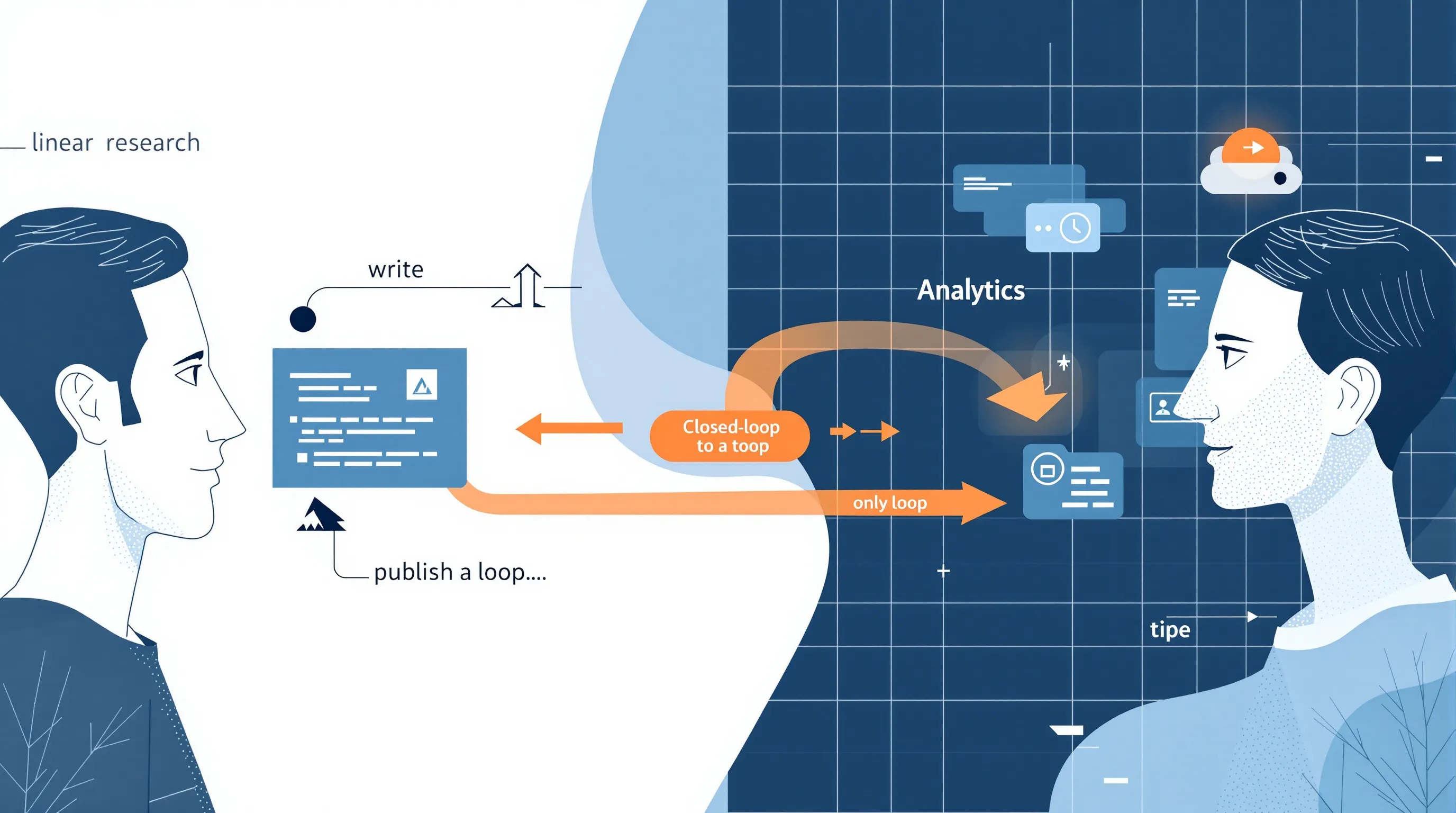

The domains AI engines cite instead of you are rarely your rivals
On this page
Key Points
- According to Everything-PR Research, Reddit holds roughly 40% of multi-engine aggregate citation share, and the top 15 domains capture 68% of consolidated citation share.
- Everything-PR found only 38% of AI Overview-cited pages also rank in the top 10, down from 76% in mid-2025, so rank and rival reports miss displacers.
- The question-and-URL log tracks each buyer question and the page cited for it across ChatGPT, Claude, Gemini, Perplexity and Google AI Overviews, rerun every month.
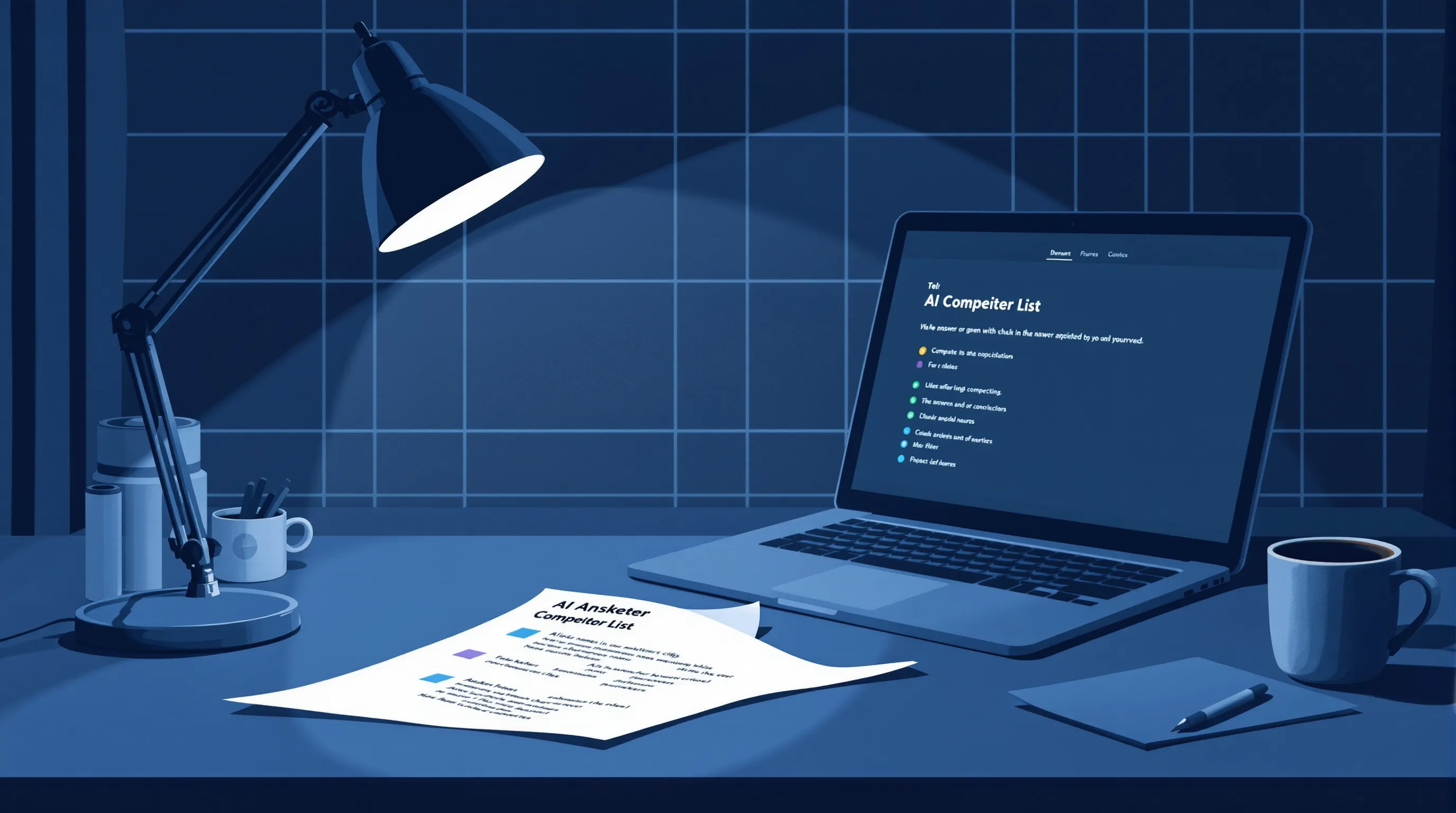
The rival list on the desk and the sources in the answer are rarely the same names.
Quick Answer
A displacing domain refers to the site an AI engine cites in the answer slot your brand wanted, and on ChatGPT, Perplexity and Google AI Overviews it is rarely a rival.
It is usually a platform, a publisher, a review site or a roundup. According to Everything-PR, LinkedIn alone appears in 13.5% of Google AI Mode responses. Review marketplaces such as Gartner Peer Insights answer vendor questions with rated lists. So I'd rank the domains that displace you on each missed buyer question first. Track rivals second.
When a buyer asks what companies specialize in AEO, whose page answers?
A review page like Gartner Peer Insights, which lists 16 enterprise search products with user ratings, answers the which-vendor question before any vendor's own site gets a word in.
That is the whole problem on one screen. The buyer asks a vendor question. The answer comes from a page about vendors, written by somebody who is not one.
According to Everything-PR, the top five sources in Google AI Overviews are YouTube, Wikipedia, Reddit, the Google Knowledge Graph and Google Maps. Behind them come LinkedIn, then news outlets such as Reuters, AP News and The New York Times, then Healthline and WebMD. Google even pulls Reddit threads into its answers as "Community Perspectives." Few of those names would ever turn up on a rival list.
The visibility gaps on record for aeocontent.ai look the same. They are questions like "What are the best AI search optimization (AEO) companies?" and "What are the top tools for AI SEO or answer engine optimization?" Questions like that get answered from lists. So whoever wrote the list holds the slot.
This article makes one argument and hands you two tools. The argument: rank the domains that displace you before you track the rivals who compete with you. The tools are the slot check, one question you ask of every cited domain, and the question-and-URL log, a monthly record of which page each engine cites for each buyer question. I don't have per-query displacer counts for this site on the record yet, so I won't put a number on the split. The method below is how you'd get one.
YouTube is the most-cited domain in Google AI Overviews, holding 20.9% citation share after climbing 34% in six months, and it is not your rival.
So I'll tell you the mistake, because it is an easy one to make and it looks like diligence. You build a watchlist from the sales floor. You put five rivals on it and you track them every week, and the dashboard tells you who is winning. And all the while the answer goes somewhere else.
According to Everything-PR's Google AI Overviews index, AI Overviews cite YouTube above Mayo Clinic on health queries, above CNET on tech-product queries and above TripAdvisor on travel. The specialist loses to the platform. Across the big engines, the five most-cited domains are Reddit, YouTube, LinkedIn, Wikipedia and Forbes. Not one of them sits on a typical competitor list.
That is what I mean by a displacing domain: a site an AI engine cites in the answer slot your brand wanted. One practitioner who audited their own niche came to the same place, writing that the work is "less about my own site and more about getting into the few sources the models trust for my category."
So my argument is short. Rank the displacing domains first. Track the rivals second.
Three questions this article answers
- Which websites does AI cite instead of my company? Mostly platforms and publishers, not rivals.
- Why does tracking my competitors miss the sites replacing me in AI answers? The watchlist sees who got named, never the page that named them.
- How should I monitor AI citations instead? By buyer question and cited URL, engine by engine, month after month.
Which websites does AI cite instead of my company?
An analysis of 30 million sources shows AI answers lean on a small set of platforms and publishers, and they are not the rivals on your watchlist.
The test I'd run first is plain, and I call it the slot check. Take every AI answer your brand misses and write down the domain that got the citation. Then ask one question: does that domain sell what you sell? Run the public numbers through it and the answer keeps coming back no. It is the first question I'd put to any AI-visibility audit, and AEO Content has run 26,577 real AI-visibility audits.
According to Everything-PR Research, Reddit holds roughly 40% of multi-engine aggregate citation share and ranks first on every major AI engine. The same index found that the top 15 domains capture 68% of consolidated citation share across ChatGPT, Claude, Gemini, Perplexity and Google AI Overviews. It pulls together six independent tracking studies and more than 680 million citations logged between August 2024 and April 2026. "The concentration is more extreme than Google PageRank ever produced," the report says. Read that line, and then look at your own competitor list. Reddit is not on it. Neither is Wikipedia.
Google's own answers run tighter still. Everything-PR's Google AI Overviews index found that the top 1% of domains, roughly 12 sites, take 47% of all citations. Three of its top five are Google-owned properties. And the index said it plain: the top-ranked sources are platforms, not rivals.
Each engine keeps its own company, too. ChatGPT leans on Wikipedia, Forbes and Business Insider. Claude leans on The New York Times, The Atlantic and The Economist. Gemini leans on YouTube and Google's own properties. Perplexity leans on Reddit, NIH/PubMed and LinkedIn, and for B2B buying questions it pulls in G2 as well. Editorial outlets such as Reuters, Forbes and The New York Times account for 27% of all citations, and 49% on time-sensitive queries, per the same Everything-PR index. So the pattern is not one engine's quirk. It is the way the whole system is built, and the AEO knowledge base has more guides on how each engine picks its sources.
A common misconception is that the brand beating you in AI answers is the brand beating you in deals. The reality is the answer slot mostly goes to a forum thread, a video, an encyclopedia entry or a news page. None of them will ever bid against you. So they never make the competitor list, and they never show up on a dashboard built from that list. That is the gap AI visibility tracking has to close: it has to show the cited domain, not just the rival.
One marketer who audited the pages AI assistants cite in their niche found the same thing on the ground. Review sites, a few Reddit threads and "random listicle blogs" kept coming up, and the brands named on those pages were the ones getting recommended. The page belonged to somebody else. The recommendation went to whoever was on it.
In practice, the fight for the answer is with a publisher, not a peer. The takeaway is short. Watch the domain that holds the slot first, and then watch the company. If the terms here are new, the AI search optimization FAQ covers the common questions.
Why does tracking rivals miss who AI names as the companies that specialize in AEO?
Questions like which companies specialize in AEO tend to be answered from roundups, review sites and threads. A rival watchlist shows who got named, not where the list came from.
Take this site as the case. The visibility gaps on record for aeocontent.ai are buyer questions, and they read like a shopping list:
- What companies specialize in answer engine optimization (AEO)?
- Who are the best agencies for optimizing content for AI search engines?
- What are the top tools for AI SEO or answer engine optimization?
Every one of those is a category question. Nobody asking it wants a definition. They want names, and so the engine hands them a list. And a list has to come from somewhere. Most often it comes from a page somebody else wrote: a roundup of agencies, a comparison of tools, a review marketplace, a forum thread where people argue about who is any good.
That is the mechanism, and it is why the watchlist goes blind. A watchlist asks one question: did Rival A get named? It never asks which page handed the engine the names. So you can watch a rival climb in the answer and never learn that the roundup that put them there was the domain you should have been chasing all along.
The people doing this work in the open say the same thing. In a thread on r/GenEngineOptimization, a B2B advertising technology practitioner said listicles and comparisons on third-party blogs and media outlets stand a higher chance of being cited by LLMs, because that is the content buyers look for when they are about to decide. Another commenter in the thread, citing a 2025 study by Chen, said only 15-25% of cited sources are shared across engines. The same commenter said Gemini and Perplexity draw from pools of 100-150 unique domains per category, while Claude and GPT stay nearer 40-65.
Think about what that does to a list of five or ten rivals. The pool an engine draws on for your category is far wider than the names you track. Most of it is not selling anything. Even the engine can hide the trail. The original poster in that thread found ChatGPT and Perplexity gave real article links, but Gemini mostly gave just the domain, so the exact page was harder to pin down.
Now the honest part. I do not have the per-query count of displacing domains for these gap questions on the record yet, so I will not put a number on how many of them are rivals. What I can say is what that count has to measure: every domain cited in the answer, tagged rival or not rival, question by question. And in my view the second tag is the one that will carry the weight.
What this means is plain. The watchlist measures the result, not the cause. In practice, the cause is a page on a domain you never thought to watch.
How should you monitor AI citations if your competitor list is the wrong watchlist?
Monitor the buyer question and the URL it cites, not the rival. Log every cited page per engine, tag who owns it, and rank the domains that keep showing up.
So the unit changes. It stops being a competitor and becomes a pair: the buyer question plus the cited URL. I call the record that holds those pairs the question-and-URL log, and here is how I'd build it.
- Start from a buyer question, not a rival. Pick the questions a buyer asks right before a shortlist, like "What are the best AI search optimization (AEO) companies?" Write each one down word for word.
- Run it on every engine you care about. ChatGPT, Claude, Gemini, Perplexity and Google AI Overviews each lean on a different mix. According to Search Engine Land's coverage of a Peec AI study, Google leaned toward platforms like Facebook and Yelp. So one engine's answer tells you little about the next.
- Log the URL, not just the name. Record every cited page. Where an engine hands you only a domain, log the domain and flag it for a manual search. Log only what shows in the final answer. Search Engine Land's linked coverage reported that only 15% of pages retrieved by ChatGPT appear in final answers, so what an engine read is not what it cited.
- Tag each domain. Rival, publisher, review site, community, roundup or tool list, or your own. That one column is the whole argument of this article.
- Rank the displacers. Sort the non-rival domains by how many buyer questions they show up on. The top of that list is your target list.
- Open the cited page and read the top of it. In one study of 100 Google AI Overview citations, 55% of cited passages came from the first 30% of the source page. So check whether your name sits near the top of the page that got cited, or down in the tail, or nowhere.
- Run it again next month. Same questions, same engines, same columns.
That last step is the one people skip, and it is the one that bites. Everything-PR Research reported that ChatGPT's Reddit share fell roughly 50 points between August and September 2025 on Semrush's measurement, and that Forbes' ChatGPT citation roughly doubled after September 2025. "The volatility is measured in weeks, not years," the report says. A log you ran once is a photograph of a room somebody has since rearranged.
And the room keeps getting bigger. One study of more than 600,000 keywords across 10 industries found the share of commercial-intent results showing AI Overviews grew 71% between November 2025 and April 2026. Buying questions are where the answer slot matters most. That is where it is spreading.
Then you act on both ends. You get onto the pages the engines already trust for your category, and you make your own pages easier to cite. One practitioner building a citation tracker said it plain in a public thread: it is probably both, not one or the other. Danny Goodwin of Search Engine Land put the first half this way: "To win in AI search, you need authority beyond your site."
In practice, the log turns a vague loss into a named page. The takeaway is hard and simple. You cannot pitch a domain you never wrote down.

12-24 months Visibility Outlook
Who will displace brands in AI answers next
Forecasts on which platforms, review sites and specialist publishers will keep pushing brand pages out of AI-generated answers over the next two years.
How the AI citation mix is likely to shift
Use each forecast to decide which non-rival sources belong on your monitoring list and where to earn mentions first.
Contrary to the view that Reddit and Wikipedia will crowd out everyone, the sources displacing a typical brand in its own category will increasingly be specialist publishers, niche vendors and agencies whose pages answer the exact question early and clearly. Mid-sized domains will keep winning citations that raw domain authority would not predict.
Over the next 12-24 months, a small group of platforms led by Reddit, YouTube, LinkedIn and Wikipedia will keep taking the largest share of AI citations. For most brands, the top displacing domains will be these platforms rather than any company on their competitor list.
As AI Overviews spread into commercial-intent searches, review platforms such as G2, Capterra and Yelp and third-party listicle publishers will increasingly decide which brands get recommended. Vendors will respond by spending on review volume and list inclusion rather than on out-publishing rivals.
Each AI engine favors a different mix of sources, and results change from search to search. Brands will therefore move from one-off competitor benchmarks to recurring, engine-by-engine audits of which domains are cited in their category.
Early and Unproven Across six tracking studies covering more than 680 million citations, Reddit holds roughly 40% aggregate citation share, and the top 1% of domains, roughly 12 sites, capture 47% of all citations. Yelp and G2 already appear often in recommendation queries. A practitioner auditing their niche reported that brands present on cited review pages and listicles were the ones recommended. The share of commercial-intent results showing AI Overviews grew 71% between November 2025 and April 2026. A study of 30 million sources found each engine favors different sources, with Google leaning toward platforms like Facebook and Yelp. The MLA notes that AI Overviews results are not stable but subject to change from search to search. The MLA Style Center's own post was the source linked for a style question. setproduct.com, a DR 42 domain, has 29 verified citations in AI Overviews. 55% of cited passages come from the first 30% of the source page, and Gartner says cheap AI-generated content is changing how domain authority is scored.
Citation studies behind these calls
Public studies and guidance on AI citation sources, with the exact line from each that a forecast relies on.
| Source | What it states | Forecasts it backs |
|---|---|---|
| How to get cited in Google AI Overviews (GEO guide with real data) [Web source] | The guide is based on 29 verified AIO citations across setproduct.com content, cross-referenced against the Ahrefs AIO tracker. “Google's AI Overview is the new #1 result.” | Specialist pages, not giants, displace most brands |
| Where Google AI Overviews Cite From: A 100-Page Study - CXL [Web source] | 55% of cited passages came from the first 30% of the source page. “Treat answer placement as a retrieval consideration, not a guaranteed ranking factor.” Semrush: Across 600,000+ keywords in 10 industries, the share of commercial-intent SERPs showing AI Overviews grew 71% between November 2025 and April 2026. |
Specialist pages, not giants, displace most brands Review sites and listicles gatekeep buying queries |
| Should I cite a summary generated by Google's AI Overviews feature [Web source] | In a Google search for "scare quotes MLA style," AI Overviews followed each example with a link icon pointing to the source, which was the MLA Style Center's own post. “[S]earch results are not a work.” The MLA notes that AI Overviews results "are also not stable, but subject to change from search to search.". |
Specialist pages, not giants, displace most brands Source mixes diverge by engine and by search |
| Gartner Predicts Search Engine Volume Will Drop 25% by 2026 [Web source] | Gartner says GenAI is driving down the cost of producing content, which affects keyword strategy and website domain authority scoring. “Organic and paid search are vital channels for tech marketers seeking to reach awareness and demand generation goals.” | Specialist pages, not giants, displace most brands |
| The 50 Websites AI Engines Cite Most in 2026 - Everything-PR [Web source] | Reddit holds roughly ~40% multi-engine aggregate citation share and is the #1 source across every major AI engine (Everything-PR Research, published Aug 16, 2026). “The concentration is more extreme than Google PageRank ever produced. The volatility is measured in weeks, not years.” | A dozen platforms keep absorbing most citations |
| Google AI Overviews Citation Source Index 2026 - Everything-PR [Web source] | Citations are highly concentrated. The top 1% of domains (roughly 12 sites) capture 47% of all citations. “For health queries, AIOs cite YouTube above Mayo Clinic. For tech-product queries, AIOs cite YouTube above CNET. For travel queries, AIOs cite YouTube above…” | A dozen platforms keep absorbing most citations |
| AI search engines cite Reddit, YouTube, and LinkedIn most: Study [Web source] | The top five cited domains are Reddit, YouTube, LinkedIn, Wikipedia, and Forbes. “Reddit ranks as the most-cited domain in AI-generated answers, followed by YouTube and LinkedIn, based on a new analysis of 30 million sources by Peec AI, an…” Review platforms Yelp and G2 appeared often in recommendation queries. Each engine favors different sources:. |
A dozen platforms keep absorbing most citations Review sites and listicles gatekeep buying queries Source mixes diverge by engine and by search |
| which sources actually get you cited in AI answers? sharing what i [Community / Forum] | OP's observation on cited sources: Review sites (G2, Capterra type), a few Reddit threads, and "random listicle blogs" appeared repeatedly. Brands present on those cited pages were the ones recommended. “So being on the cited pages seems to matter more than my own website SEO” | Review sites and listicles gatekeep buying queries |
What would shift the citation mix
Engine retrieval changes, platform share swings or a return of clicks to classic results could redraw which sources AI answers lean on.
Room for Error
Of everything here, 88 carries the strongest support, while 88 is the read most worth challenging.
- Specialist pages, not giants, displace most brands. Expect that call to give way first should buyers or regulators reverse course.
- Specialist pages, not giants, displace most brands. Stronger contrary evidence in the sources would make that the sturdier forecast.
What will decide who holds your AI answer slots over the next 12-24 months?
What will matter most is knowing which few domains hold your buyer questions each month, because the big platforms stay put while the pages below them keep changing.
Here is how I read the next 12 to 24 months. Three calls, each with the thin signal behind it.
| Prediction | Weak signal today | Why it matters to you | Public source |
|---|---|---|---|
| The giants stay fixed and the fight moves to the churning middle. | The top 15 cited domains in Google AI Overviews are stable, while positions 20-50 turn over on a 30-60 day rolling cycle. | You will not unseat Reddit or Wikipedia. The slots you can win sit in the band that changes every month or two. | Everything-PR, Google AI Overviews Citation Source Index 2026 |
| Review sites and listicles gatekeep buying questions. | Yelp and G2 already appear often in recommendation queries, across a study of millions of cited sources. | The shortlist an engine reads out may reflect who is listed on those pages more than who has the better product. | Search Engine Land, reporting a Peec AI study |
| Engines drift further apart, so one snapshot misleads. | Wikipedia accounts for 26-48% of ChatGPT's top-10 citations, and separate coverage found Google's AI Mode citing Google more than any other site. | A displacer you find on one engine may not be the one costing you on the next. | Everything-PR, AI Platform Citation Source Index 2026 |
According to Everything-PR Research, B2B queries route through LinkedIn and wire services carry disproportionate weight, and the report frames its findings as shaping AI visibility strategy through 2027. So I'd expect the displacer list for a B2B brand to lean on LinkedIn, trade press and roundups, and I'd check that against the log rather than trust it.
Now the uncertainty, stated plain. Search Engine Land's own October 2025 coverage ran under the headline that AI search relies on brand-controlled sources, not Reddit. That cuts against the platform story. If engines began weighting brand-owned pages over third-party platforms for recommendation queries, this whole forecast would flip, and rival tracking would matter more again.
What most buyers miss is that the headline shares describe the whole web, not your category. A commenter in a practitioner thread cited the Princeton GEO paper, which found on-page tactics such as real numbers and named sources lift low-authority pages most, by up to +115%. So the page holding your slot may be a small specialist page. And a small page can be beaten.
What should change before your next competitor report?
Put the displacing domains at the top of the report and the rivals underneath. The answer slot goes to pages, and most belong to someone you never compete with.
And the slots are not one per answer. According to Everything-PR, 88% of AI Overviews cite three or more sources, and Google's two AI surfaces, AI Overviews and AI Mode, share only 13.7% of cited URLs for the same queries. So there is room on the page for you. It just is not your rivals who are giving it away.
Here is the part I'd hold onto. Size is not the whole game. A DR 42 design site, setproduct.com, has earned 29 verified AI Overview citations, and in 2024 the MLA Style Center got cited on its own style question. But the MLA case cuts both ways, because the engine cited its post and flipped the meaning of one of its examples. Being cited is not the same as being quoted right.
So the next report I'd want on my desk opens with one table: each missed buyer question, the domain holding the slot, and the line on that page where my name should be.
Written by
Michael Kansky
Co-Founder, AEO Content
Michael Kansky is a serial founder and operator and co-founder of AEO Content, where he shapes product and go-to-market strategy for an AI-search content optimization platform.
Connect on LinkedInSummarize This Article With AI
Open this article in your preferred AI engine for an instant summary.
Frequently Asked Questions
What else do people ask about the sites AI cites instead of them?
Most questions come down to three things: what a displacing domain is, whether review sites count, and whether rival tracking still matters. Short answers follow.
Which sources actually get you cited in AI answers?
Review sites, a few community threads, listicles and category publishers show up again and again. Brands named on those pages tend to get recommended. So the work is two jobs: get onto the pages engines trust, and make your own pages easier to cite.
What is a displacing domain?
A displacing domain is a site an AI engine cites in the answer slot your brand wanted. It may be a rival. More often it is a platform, a publisher or a roundup.
Does this matter for B2B tech companies?
Yes, and more every quarter. According to Everything-PR, AI Overviews render for 82% of B2B tech queries, up from 36% a year earlier. In practice, most B2B buying questions now have an answer slot to lose.
Are review sites like G2 or Gartner Peer Insights displacing domains?
They can be. Review platforms spell out what a company does and who it serves, in customers' words, and one practitioner said reviews now do double duty for buyers and for AI. Gartner Peer Insights itself notes its reviews are the opinions of individual end users, not statements of fact. Some marketers also warn that paid placement on the big review sites gets expensive.
Can I trust the source link an AI Overview shows?
Not blindly. In 2024 the MLA Style Center reported that AI Overviews linked to its own post while presenting a "don't do this" example as correct usage. Click through and read what the cited page really says about you.
Should I stop tracking competitors?
No. Track them second. The rival list shows who got named. The displacer list shows where the name came from.