Does Google penalize AI content? Not if readers engage with it

On this page
Quick Answer
No. Google does not penalize AI content for being AI. It rewards pages that help readers, and engagement is how a page proves it: Google's ranking systems learn from how searchers respond to a result, whoever or whatever wrote it.
Our own data points the same way. Understood Care, the client whose readers engage most with our articles, is named in 91% of the AI answers we track for its topics, and its clicks from non-brand Google searches have more than tripled since we began publishing for it in April.
Key Points
- On Feb 8, 2023, Google Search Central wrote that "Appropriate use of AI or automation is not against our guidelines," so AI drafting alone draws no penalty.
- Engagement is the evidence Google can learn from: testimony in the 2023 US antitrust trial described NavBoost, a ranking system built on how searchers click on results, and none of it depends on who wrote the page.
- Understood Care, the client whose readers engage most, is named in 91% of the AI answers we track and has more than tripled its non-brand Google clicks since we began publishing in April. HelpSquad rose from 29% to 66% of tracked AI answers between July and October.
- In January 2025, Google updated its quality rater guidelines to target low-effort, low-value AI-generated content, which puts the risk on thin pages rather than on AI drafting.
- Across 16 sites from September 2 to October 16, 2026, AEO Content quiz data showed 38% of answers wrong and 11 times as many quiz finishers as feedback button clicks, and 9.5% of Understood Care readers finished the quiz.
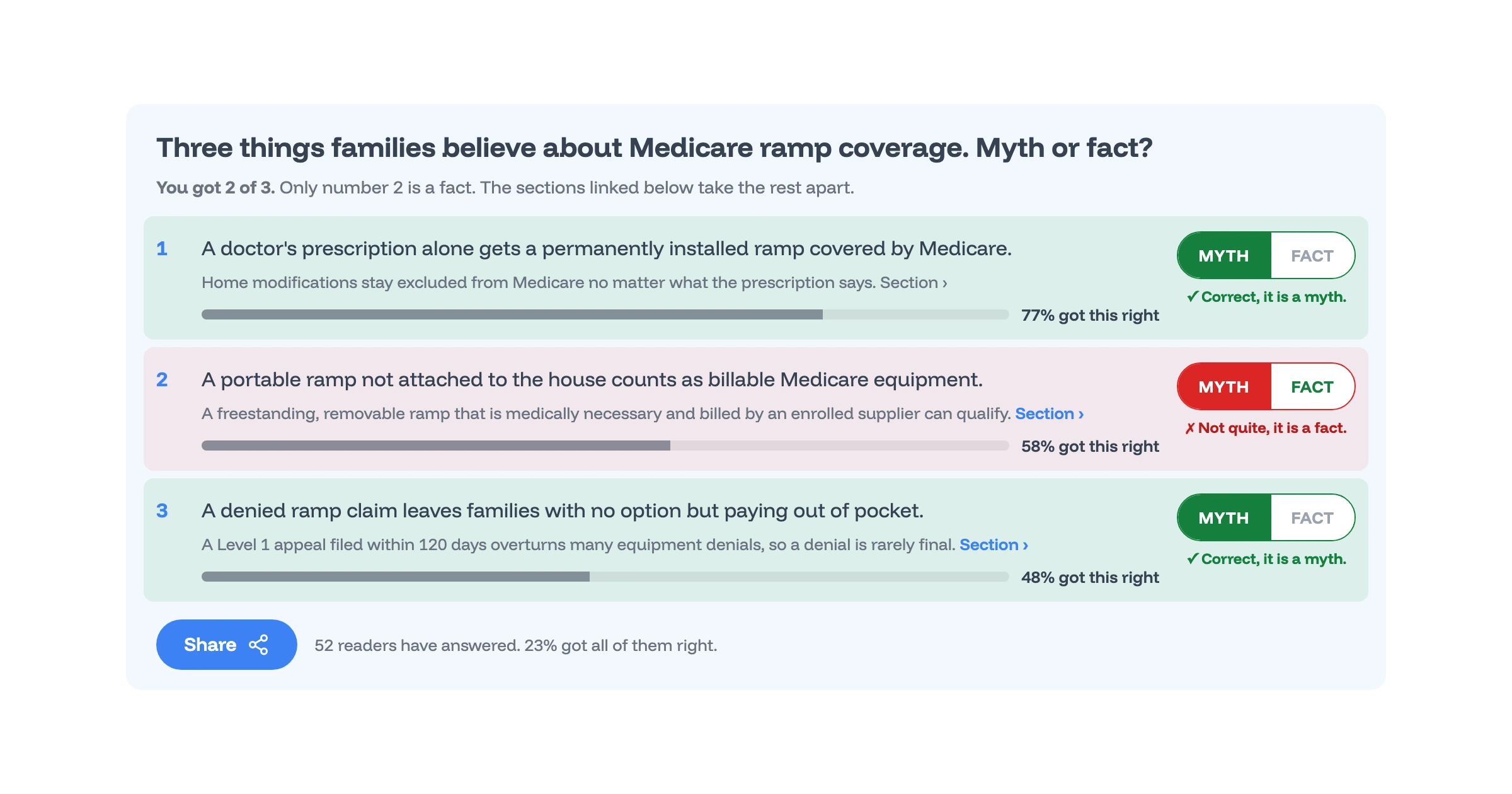
A real myth or fact quiz on an Understood Care article, after a reader revealed the answers. Reader results as of October 17, 2026
Google has faced this question before: its 2023 FAQ recalled that about 10 years earlier, a rise in mass-produced, human-written content led it to improve its systems to reward quality rather than ban human writing. Its question is whether the page did anything for the person who opened it. A 2024 r/SEO thread captured the official line through Google's SearchLiaison account on X: "If content is helpful, then it might succeed." Note the word might. Helpfulness earns a page a chance, not a guarantee.
Adoption is no longer the open question. A worldwide 2025 study of marketers put it bluntly: "Little more than one in 10 had no plans to use the technology." So the useful question for a marketing team is narrower: what does a reader get from this page that the other results on the same query did not give them?
The same 2024 thread offered a test I like for any AI written content. Would you read the page, or scroll past it and click back? I think a short myth or fact quiz puts that test in front of the reader. It asks them to commit to a belief, shows the source behind the answer, and sends them to the paragraph that settles it. That is what turns a static article into an interactive blog post.
The reader data later in this article holds the surprise. It is not how many people finished the quiz. It is how many got it wrong: 74% of readers who finished missed at least one statement, and on one Understood Care article, 66% believed the same myth.
Does Google penalize AI content? Not for being AI. Statista projected that global revenue from AI use in marketing would reach approximately 47 billion U.S. dollars in 2025 and exceed 107 billion by 2028. With spending on that scale, AI written content is no longer a fringe choice for marketing teams, and whether Google punishes it has become a budget question rather than a curiosity.
Google's answer has stayed consistent. It looks at what a page gives the reader, not at who or what typed the words, and the clearest evidence of what a page gives is engagement: whether people stay, read and act on it. The real risk is sameness. A page that repeats what search results already say gives a reader nothing to engage with and a search engine no reason to rank it, however carefully it was drafted.
I think the fix is practical: build engagement into every article by giving the reader something to do. Our own Myth or Fact quiz, which we built for every article we publish, turns a static page into an interactive blog post: three short statements, each answered with its source the moment the reader picks. Below, I walk through what Google has actually said, why some AI pages still sink and how to build a myth vs fact quiz for blog posts. Then comes the part most guides skip: what happens when you add a quiz to your website and count how readers respond.
Top 3 questions this article answers
- Does Google penalize AI content? Not for the way it was made. Google judges whether the page helps the reader.
- Why does some AI written content still lose rankings? Generic pages produced at scale add nothing new, and human reviewers can flag them.
- How do you build a myth vs fact quiz for blog posts? Three statements, an instant reveal, a source for each.
Does Google penalize AI content?
No. Google does not penalize AI written content for how it was made; it rewards pages that help readers and acts against low-value pages built to manipulate rankings.
Before worrying about authorship, put each draft through four questions:
- Does the page answer the reader's question better than the results that already rank?
- Has someone checked every fact, figure and product detail before it goes live?
- Was any passage written to hit a keyword rather than to help a reader?
- Are you judging the draft by its usefulness, not by who or what typed it?
Google Search Central put its position in writing on Feb 8, 2023, under the headline "Rewarding high-quality content, however it is produced." The same guidance is blunt: "Appropriate use of AI or automation is not against our guidelines." Google's FAQ on the subject explains why it never banned the practice, noting that "automation has long been used in publishing to create useful content." The line it does draw is narrower. Using AI to generate content primarily to manipulate search rankings is what breaks its spam policies.
Those spam policies define the offense precisely. Google's documentation describes spam as "techniques used to deceive users or manipulate our Search systems into featuring content prominently," and the definition now names "attempting to manipulate generative AI responses in Google Search" as part of it. Notice what is missing. No clause mentions who wrote the page.
The common assumption is that Google quietly enforces a human-written only rule. It does not. The test it applies is whether content is helpful, original, accurate and made for people rather than for search engines. Google's public statements, as quoted in practitioner threads in 2024, made the same point: AI content was never declared bad, and content written primarily for search engines instead of humans was the issue.
Across 4 sources, from Google's own documentation to independent practitioner guides, the deciding variable is the same: value to the reader, and value shows up as engagement. The tool is not on trial. The page is.
I think the authorship debate is mostly a distraction. The hours spent arguing over which model typed a paragraph would be better spent checking its numbers. My co-founder Alex and I bring a combined 40+ years of SEO and content infrastructure experience to AEO Content, and I read Google's 2023 guidance as one of the plainest positions it has published on content. Our guide to research-driven content built on evidence shows what that standard looks like on a working page.
So if authorship is not the trigger, something else is. Google names it in the same policy pages, and it has a great deal to do with volume.
Why does some AI written content still lose rankings?
AI pages sink when they are generic, mass-produced or broken in editing. The trigger is low value at scale, never the model that drafted the words.
Google's spam policy on scaled content abuse targets content that "provides little to no value to users, no matter how it's created." That last clause matters. A team churning out thin pages by hand sits in the same position as a team doing it with a model.
The bar rose in January 2025, when Google updated its quality rater guidelines to target low-effort, low-value AI-generated content. The update does not ban AI drafting. It tells the human reviewers who grade Google's results to rate generic, mass-produced pages that paraphrase existing search results without adding anything as lowest quality. Their ratings do not move any single page directly, but Google uses them to check whether its ranking systems reward the right pages. What survives review is the layer a machine cannot scrape from somewhere else: unique data, personal experience or a strong point of view.
Most of the confusion comes from four beliefs that do not hold up:
| Myth | Fact |
|---|---|
| Google penalizes pages because AI wrote them | Google's policy targets low value at scale, however the page was made |
| AI detectors show what Google sees | Detectors have labeled posts written entirely by people as AI-generated |
| A human rewrite makes an AI draft safe | Rewrites can drift from intent, break structure and dilute key terms |
| More pages build more authority | Mass-produced paraphrase is exactly what raters are told to flag |
The detector myth is the most expensive one. In a May 2026 r/content_marketing thread, one writer tested a personal blog post written from scratch in Ahrefs and an AI detector, and both labeled it AI-generated. Another commenter's team ran old articles written entirely by their content writer through several detection tools and got the same verdict. A 2023 r/SEO thread was harsher, with its original poster dismissing many detectors as "just guessing a random number."
Human rewrites carry their own risk. Editors who work through large volumes of AI drafts describe rewrites that wander away from what the query wants, break a scannable structure, swap consistent terms for synonyms and soften direct answers in an effort to sound less machine-made. Each of those changes can make a page worse. None of them adds information.
My advice is blunt: stop paying for detector passes and cosmetic rewrites, and spend that budget on facts the page does not have yet. What does predict trouble, according to one practitioner in a February 2026 r/aeo thread, is volume without review: the sites getting hit are "usually pumping out dozens of articles per day with no human oversight." Our AEO knowledge base of AI search guides covers what to add first when a page reads as generic.
All of which leaves a harder question. If value is the test, how does Google tell whether readers actually got any?
What do readers do when an article asks them to spot the myth?
Google learns whether readers got value through engagement. In the 2023 US antitrust trial, Google's vice president of search, Pandu Nayak, testified about NavBoost, a ranking system that learns from about 13 months of searcher clicks. Internal Google API documents that leaked in 2024 list click measures such as goodClicks, badClicks and lastLongestClicks, and Google confirmed the documents were real while cautioning that they lack context, so how much weight each measure carries is not public. None of those measures asks who wrote the page. They record how searchers respond to it.
That makes engagement the evidence that matters, AI written or not. We wanted to see how much engagement an article can create. We built the Myth or Fact quiz ourselves, it ships in every article we publish, and we track every answer.
Google's own wording sets the bar. When its spam policy describes scaled content abuse, one example it gives is "Using generative AI tools or other similar tools to generate many pages without adding value for users." AI tools are named in that sentence, but the offense sits in its last five words. Value for users is hard to see from the publishing side, so we went looking for something readers would actually do.
The usual shortcut, checking who wrote a page, holds up poorly. In a May 2026 discussion among content marketers on Reddit, one team put old articles "written 100% by our content writer a long time ago" through different AI detection tools. "And these tools said it was AI content," the poster wrote. Another writer said two tools flagged a personal post they had written from scratch as AI. Two forum anecdotes cannot establish a pattern. They do show how little a detector score may tell you about who wrote a page, and it tells you nothing about what a reader gained.
So we counted reader behavior instead. Between September 2 and October 16, 2026, we tracked our myth or fact quizzes across 16 sites, counting how many readers answered all three statements. Then we set that count beside the other ways the same pages ask for a response.
The 16 sites include Understood Care, a Medicare patient advocacy service; Imagine Advanced Dental Arts, a dental practice in Lawrenceville, New Jersey; Grass, an app that rewards people for sharing unused internet bandwidth; HelpSquad, a customer support outsourcing company; Blooms By The Box, a wholesale flower seller; Modern Wealth, a fee-only wealth manager for business owners; and Seamless Chex, a payment processor. Across all 16 sites, 5.5% of article views ended with a finished quiz.
11 times
as many readers finished a quiz as clicked the feedback buttons on the same pages that ask whether the page answered their question. Fewer than 1% of finished quizzes were shared. AEO Content quiz data, 16 sites, September 2 to October 16, 2026.
Shares barely registered. On our pages, a pointed question about the subject drew far more response than a request to rate the page or pass it on. We have not tested why, and where each element sits on the page may play a part.
More than a third of all answers were wrong, so many finishers held a belief, at the moment they answered, that the article's own facts contradict. Each reveal in our quizzes names its source and links to the section that explains the answer, so a wrong guess points straight back to the evidence. For a marketing team, the most-missed statement on a page shows where readers' assumptions run strongest. It is also the first place to check whether the explaining section is clear enough.
Perfect scores were rare. Of readers who finished a three statement quiz, 26% called all three correctly and 5% got none right. In all, 74% missed at least one.
Readers also leaned toward belief. Across every statement with at least 10 answers, readers called a myth a fact 40% of the time, but called a fact a myth only 34% of the time. A claim that sounds plausible gets the benefit of the doubt, and a quiz shows a team exactly where that happens.
The misses are the part a marketing team can use. On an Understood Care article about Medicare CPAP machines, 76% of readers believed a myth about when the 90 day compliance clock starts, and the article explains when it really does. On its GLP-1 appeals article, 66% of readers believed that resending the first appeal's paperwork strengthens a case at independent review, when the article explains that new evidence, such as a specialist's letter, is what moves reviewers at that stage. Each miss tells the team which explanation to make plainer and which myth to answer in its next article or social post.
Topic matters. Every site runs the same quiz format, and the best article on each site shows how far engagement goes when the subject matters to the reader: 25.6% at Understood Care, 15.6% at Imagine Advanced Dental Arts, 8.3% at HelpSquad, 6.6% at Grass and 5.9% at Seamless Chex.
I think the best performers share one trait: a reader with a decision to make and money or care at stake, such as whether Medicare covers a wheelchair ramp or whether dental implants are worth it after 70. One caution: Understood Care supplied 85% of all finished quizzes, so the overall totals lean heavily on one audience.
Engagement is half the story. The other half is what happened to the sites. Since we began publishing for Understood Care in April, its clicks from non-brand Google searches have more than tripled, up 218% when the last four weeks are compared with the four weeks before its first article. Its impressions rose 63% over the same weeks, and the number of non-brand searches where it ranks on page one grew 14%, including "will medicare pay for a lift chair", "cdpap" and "medicare grocery card".
AI answers moved too. In October, Understood Care was named in 91% of the AI answers we track for its topics. HelpSquad went from being named in 29% of tracked AI answers in July to 66% in October.
I attribute these gains to the content we publish: articles built on original data, made to be engaged with, each carrying our Myth or Fact quiz. The quiz has run in every article only since September 6, so we cannot yet separate its share from the rest of that work. What the numbers do show is that Understood Care, the site whose readers engage most, is also named in 91% of the AI answers we track.
Follow both threads and authorship drops out of each. Google's systems learn from how searchers engage with a page. Our counts show that readers engage when a page invites them to: asked a direct question, they answered in far greater numbers than they rated or shared, and many got something wrong that the page was built to set right. Neither measure depends on who drafted the words. One limit matters. Google does not see the clicks inside a quiz; it sees how searchers behave around the page, such as whether they return to the results. We have not yet measured a ranking change from adding a quiz.
A few checks follow for your next article:
- Before publishing, try to write three statements from the draft that a reasonable reader might get wrong. If you cannot, ask what the article teaches that readers do not already believe.
- Measure your own completion rate before judging a quiz: count how many quiz views end with all three statements answered, site by site, and watch it over several weeks.
- After a few weeks live, find the most-missed statement and reread the section its reveal links to. Ask whether that section corrects the belief plainly enough.
- If rating buttons or share counts are your main read on whether a page helps, add a direct question about the content and compare the response.
- Treat an AI detector score as a guess about authorship, never as a verdict on quality.
How we checked this
We read Google's spam policy documentation, reporting on the 2023 US antitrust trial and on Google's 2024 API document leak, and a May 2026 Reddit discussion among content marketers. We also analyzed our own quiz data from 16 sites, most of them client sites, between September 2 and October 16, 2026. For outcomes, we used Google Search Console data for Understood Care and our own AI visibility tracking for Understood Care and HelpSquad. Every quiz figure here is ours: finished quizzes, scores, wrong answers by statement, finish rates by site and article, feedback clicks and shares. Our quiz data counts article views and actions on the page. It cannot show time on page or what readers did after a reveal, and Google cannot see clicks inside the quiz. The quiz and the feedback buttons may sit in different places on a page, which could affect the comparison. The detector reports come from anonymous forum posters. We sell articles that ship with a myth or fact quiz, so we have a stake in readers using them. Still unknown: whether readers who miss a statement go on to read the section that explains it, whether quiz engagement changes rankings, and whether these rates hold beyond our 16 sites.
- Google Search Central, spam policies for Google web search, retrieved October 16, 2026.
- The Verge, Google confirms the leaked Search documents are real, May 29, 2024.
- r/content_marketing, discussion on whether Google prefers human-written content, May 4, 2026.
- Google Search Console, understoodcare.com search performance, March 22 to October 16, 2026.
- AEO Content, AI visibility tracking for Understood Care and HelpSquad, July 16 to October 16, 2026.
- AEO Content, myth or fact quiz data across 16 sites, including Understood Care, Imagine Advanced Dental Arts, Grass, HelpSquad, Blooms By The Box, Modern Wealth and Seamless Chex, September 2 to October 16, 2026.
How do you build a myth vs fact quiz for blog posts?
Pick three statements your article proves, make each one a belief readers really hold, reveal the answer instantly with its source, and place it right after the main answer.
A myth or fact quiz is a short interactive element that shows readers a statement, asks them to call it myth or fact, and then reveals the answer with its evidence. It turns an article into an interactive blog post without adding a single new claim. Here is the build I recommend:
- Take three statements from the article itself, each one a claim the article already proves with a named source.
- Choose beliefs readers actually hold. Forum threads, sales calls and the questions people type into search are the best places to find them.
- Write each statement as one plain claim that is either true or false, with no trick wording and no double negatives.
- Reveal the verdict the moment the reader answers, with the correct fact, the source behind it and a link to the section that explains it.
- Place the quiz right after the main answer, where a reader has just enough context to hold an opinion.
Question-shaped search gives the format its opening. In a 2025 podcast interview, SEO practitioner Bruce Clay said question-style queries "used to be... six percent of all queries, now it's eighteen percent." A reader who arrives with a question usually arrives with a guess. The quiz asks for that guess before it corrects it.
Precision matters in the reveal. Schema.org, which publishes term usage statistics compiled with Google from its public web crawl, reports adoption in ranges of domain counts instead of exact numbers, because crawl figures can jump up and down from day to day. The lesson carries over. A reveal should repeat a figure with exactly the precision its source uses, and no more.
The statements themselves should come from evidence, which is how we already work. AEO Content has run 26,577 real AI-visibility audits, and the articles we build are sourced claim by claim; one engagement went from a quiet site to 10 booked calls in 3 weeks. I would not credit any quiz with that result. The quiz reuses facts the article has already earned, nothing more.
If you need a starting list of misconceptions to test, the questions in our AEO FAQ on AI search optimization show the kind of beliefs worth turning into statements. Most of them are things smart people get wrong for understandable reasons.
Built this way, the quiz is cheap to add. Whether readers bother to play it is a separate question, and one with numbers attached.
What should you check before your next AI written article goes live?
Judge the draft by whether readers will engage with it, then add a three-statement myth or fact quiz built from facts the article already proves with named sources.
I would check one thing no drafting tool supplies: a review by someone who knows the subject, after the original data and examples go in, as one February 2026 r/aeo commenter advised. I expect enforcement against mass-produced, paraphrased pages to keep tightening, while the drafting tool stays beside the point. Detector checks will not protect a thin page. Neither will a cosmetic rewrite.
Reader trust is the harder problem. Statista reported that consumer comfort with brands using AI fell to 46 percent in 2024, down from 57 percent in 2023. A quiz reveal that names its source answers that doubt in the open, one checked claim at a time. Readers see the evidence instead of taking the prose on faith.
My view after watching these numbers: engagement is the strongest proof of usefulness a page can offer, and it settles the AI question better than any detector. Readers who stop to answer, check a source and read the section that explains it are showing that the page is worth their time, whoever wrote it.
Start with the next draft in your queue. Pick the three claims a skeptical buyer would doubt most, write each one as a plain true or false statement, and watch which answer your readers get wrong first.
Summarize This Article With AI
Open this article in your preferred AI engine for an instant summary.
Frequently Asked Questions
What else do people ask about AI content and blog quizzes?
The questions below cover two worries: whether AI drafting itself triggers a Google penalty, and whether a quiz earns its place inside the article.
Does Google penalize AI content?
No. Google acts against low value and manipulation, whatever produced the page. Pages that break its spam policies can rank lower or drop out of results, and a human reviewer can apply a manual action, a penalty set by a person at Google rather than by an automated system.
Can I publish AI written content without editing it?
I would not. In a 2024 Income Stream Surfers video, the host watched Claude invent a price column, complete with made-up prices, inside a product article. The host's advice was to check every image link and internal link, because the model sometimes makes things up. One fabricated number is enough to cost a reader's trust.
Does a myth or fact quiz help SEO?
Indirectly, through engagement. Google cannot see clicks inside the quiz. What its ranking systems do learn from is how searchers respond to a page, including whether they go back to the results. A myth or fact quiz is a set of short statements a reader labels myth or fact, each revealed with its source, and it gives every reader a reason to engage with the article instead of leaving. I would not promise rankings from any single element, but engagement is the signal worth building for.
How many questions should a blog quiz have?
Three. That is enough to catch one wrong belief and short enough to finish before the reader moves on. In a myth vs fact quiz for blog posts, mix the verdicts so readers cannot guess a pattern.
Where should the quiz sit in an article?
Right after the main answer, before the deep sections. When you add a quiz to your website, readers meet the statements with the core claims fresh in mind, and each reveal links to the section that explains it. A reader who misses one has a clear place to go next.
Why does reader value matter more as AI answers spread?
Fewer searches end on a website. One 2025 estimate put no-click searches at 60% of mobile queries and about 35% on desktop. When a reader does arrive, the page has to offer something a summary cannot. An interactive blog post, an article that asks the reader to act rather than only read, is one way to do that.
How do I get a myth or fact quiz in my own articles?
Every AEO Content article ships with a myth or fact quiz built from its own facts. See how it works on our myth or fact quiz page, or reach the team through the contact page at aeocontent.ai/contact.
Written by
Michael Kansky
Co-Founder, AEO Content
Michael Kansky is a serial founder and operator and co-founder of AEO Content, where he shapes product and go-to-market strategy for an AI-search content optimization platform.
Connect on LinkedIn