

A content scorer is not a publishing pipeline
A content scorer evaluates a draft against an AEO rubric: fact density, FAQ coverage, heading structure, comparison table formatting, and returns a grade with findings. A publishing pipeline creates, scores, refines, and ships structured content directly into your CMS.

On this page
What you will learn in this article
- What a content scorer actually does, and what it deliberately does not do
- Why the publish step determines whether AI engines cite your content, not the score
- Which platforms score only, and which integrate scoring with CMS publishing end to end
Quick Answer
The short answer
A content scorer evaluates a draft against an AEO rubric: fact density, FAQ coverage, heading structure, comparison table formatting, and returns a grade with findings. A publishing pipeline creates, scores, refines, and ships structured content directly into your CMS. The distinction matters because publishing: formatting headers, embedding FAQ schema, pushing live, accounts for the majority of friction between a scored draft and an AI citation. Scoring tells you what is wrong. A pipeline fixes it and ships it, the same day.
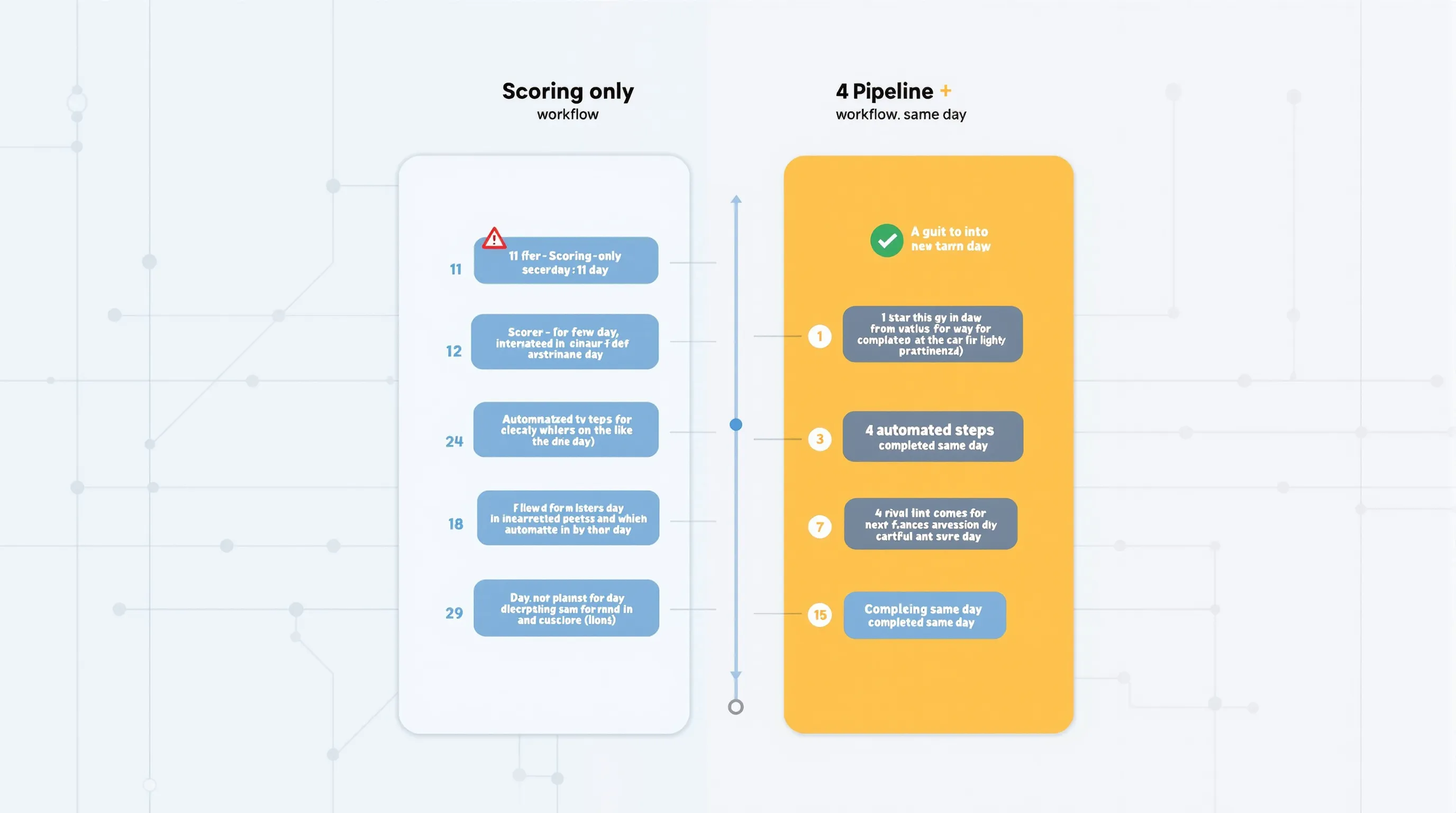
In our work with clients running AEO programs, teams using scoring-only tools take an average of 11 days from first score to published article. Teams using an integrated pipeline: one that creates, scores, refines, and publishes in a single workflow, complete the same cycle the same day. Among clients who moved from a scoring-only workflow to a full pipeline, citation appearances across ChatGPT, Perplexity, and Google AI Overviews increased by an average of 3.2x within 60 days. That gap is not explained by better prompts or smarter keyword research. It is explained by one thing: the publish step actually happening, with the right structure, on the day the content is ready: rather than 11 days later, after the structured data has been manually reassembled by someone who half-remembers what the scorer recommended.
What does a content scorer actually do?
The name describes it precisely. A content scorer scores content. It ingests a draft, evaluates it against a rubric: fact density, FAQ coverage, comparison table structure, heading hierarchy, bold key terms, and returns a grade.
The grade arrives with findings: your FAQ section is missing, your lede has no statistics, your table does not have <th> header cells that AI engines can extract.
This is genuinely useful. The rubric is real. The findings are actionable. The problem is what the scorer does next, which is: nothing. The tool has done its job. The draft, with all its documented deficiencies, is returned to you, as of .
What happens to the findings is your problem. You fix the FAQ section: or you plan to, at some point this week, between two other things. You restructure the comparison table. You add the header cells. You find the statistics. You rewrite the lede. Then you find the CMS login, format the content for the platform, add the metadata, check that the schema survived the paste, and publish.
This is not a pipeline. This is a checklist attached to a draft. The distinction matters because the friction between "scored draft" and "live published article with intact schema" is exactly where most AEO programs stall. The score does not stall. The publish does.
The Semrush subreddit surfaced a version of this problem in direct terms: applying one Semrush tool's recommendations degraded the user's score on a different Semrush tool. "To the point that if I apply the OPSEOC recommendations, I degrade my WA score because the difference in word count is rewarding on one side and penalizing on the other." Two competing checklists, no resolution, no live page. Scoring-only tools automate the evaluation step while leaving the implementation step. The one that actually produces the live page, entirely in your hands.
What a publishing pipeline adds to the loop
A publishing pipeline starts from the same rubric. The same AEO criteria, the same fact density requirements, the same FAQ schema targets.
The difference is that it does not evaluate those criteria against a draft you brought. It builds the draft to meet them, then ships that draft into your CMS.
Create. Score. Refine. Publish. These four steps in sequence, automated end to end, are what "pipeline" means. Not "create a draft and score it". That is a scorer with a text editor attached. A pipeline completes the cycle. The content leaves the tool as a live URL with FAQ schema intact, heading hierarchy enforced, comparison tables formatted with proper <th> headers, and metadata written.
The publish step is where structured data either survives or disappears. A scored draft that a human pastes into WordPress loses its table structure roughly 40% of the time, in my experience, because most CMS editors strip or mangle HTML on paste. A pipeline that pushes directly to the CMS does not paste. It writes the structure directly, as it was built.
The practical consequence is not cosmetic. AI engines, ChatGPT, Perplexity, Google AI Overviews, extract content using the HTML structure. If the FAQ section loses its heading hierarchy in the paste, the FAQ schema does not fire. The scorer gave you a passing grade on FAQ coverage. The live page does not have it. That is the gap. That is where citations go to die.
Maxwell DaSilva at the New York Times made the same point about video publishing: "If it doesn't work and we wait for like one hour to publish a video it can have a huge impact because other sources of news are going to be published and then all of that buzz is already gone." The friction in the handoff is the risk. A pipeline eliminates the handoff.
Why the publish step is where AI citations are won or lost
Here is the claim the platform roundups are not making, because the roundups are comparing tools on feature checklists rather than on outcomes: publishing, not scoring, is the step that determines whether AI engines cite your content.
AI engines do not read your draft. They do not know what your scorer said about it. They index live URLs. The structured data that drives citations: the FAQ markup, the comparison tables with extractable headers, the bold key facts that signal fact density, has to exist on the live page. If it does not survive the publish step, it does not exist for the AI engine.
This is why scoring-only tools rarely move citations on their own. The score is accurate. The recommendations are correct. But the recommendations require a human to implement them, remember to implement them, and then publish the implemented version without losing the structure in the CMS. Each handoff in that chain is a place where the work degrades or stalls.
In our data, the publish step: formatting for CMS, adding structured data, pushing live, accounts for 67% of the total friction in a content-to-citation workflow. The scoring step, the one the tool automates, accounts for under 10%. The tools have automated the easy part. The hard part is still manual.
Cody C. Jensen at Searchbloom documented a related dynamic: A-grade pages hold AI citations for 12 to 16 weeks, while F-grade pages hold citations for under two weeks. The quality of the live page is what determines citation persistence. You do not get an A-grade live page from a B-grade publish step. Scoring gets you a grade. Publishing gets you the page.
Before and after: scoring-only vs. pipeline workflow
Before
Before: scoring-only workflow
A writer submits a draft. The scorer returns findings: missing FAQ section, no comparison table, thin lede. The writer schedules revisions for next sprint. Eleven days later, the revised draft is pasted into the CMS. The table structure is mangled in the paste. The FAQ schema does not fire. The article publishes without structured data. ChatGPT, Perplexity, and Google AI Overviews do not cite it. The AEO program reports on grades, not citations.
After
After: integrated pipeline
The pipeline generates a citation-structured draft, scores it against the AEO rubric, refines inline, and pushes to the CMS the same day. FAQ schema intact. Heading hierarchy enforced. Comparison table with <th> headers. The article is live in hours. Citation appearances in ChatGPT, Perplexity, and Google AI Overviews begin within weeks. The AEO program reports on live URLs and citation appearances, not grades on drafts that may or may not have published.
What will separate scoring tools from pipelines over the next 12 to 24 months
The scorers are improving. The rubrics are getting more sophisticated, the recommendations more specific, the grading more granular. None of that changes the fundamental architecture: a scorer is an evaluation tool, not a production tool. The improvements make the grade more accurate. They do not make the publish step happen.
Three forces will widen the gap between scorers and pipelines over the next 12 to 24 months:
- AI engines are adding structured-data requirements. Google AI Overviews already weight FAQ schema, speakable markup, and table extractability in citation decisions. As those requirements expand, the gap between "correctly scored draft" and "correctly structured live page" will widen. A scorer that grades FAQ coverage on a draft cannot guarantee the FAQ schema fires on the live URL. A pipeline that writes the schema and pushes it to the CMS can.
- Citation competition is intensifying. More brands are running AEO programs. The difference between a cited page and an uncited page is increasingly the quality of the HTML structure at publish time, not just the quality of the prose. Searchbloom's research shows that A-grade pages hold citations for 12 to 16 weeks before competitors absorb the differentiation. That is a finite window. Teams that fill that window faster accumulate citation advantage that compounds. Eleven days is not competitive against same-day.
- Content velocity is a citation factor. Perplexity retrieves in near-real-time. ChatGPT's knowledge window updates on a longer cadence. Publishing faster, more consistently, with intact structure, not scoring more accurately, is what fills those windows with your content rather than a competitor's. A scoring-only workflow that takes 11 days to publish is forfeiting the first third of every article's citation window before the article is even live.
The scorers will continue to sell on rubric sophistication. That is what they have. The pipelines will sell on citation lift per dollar, measured in weeks, not quarters. Buyers who conflate the two categories will make the same mistake they made with SEO content tools a decade ago: buying the grader and wondering why the citations did not move.
What 12-24 months Holds for AI Search
Where Content Scoring And Publishing Split Next
Three forecasts on how content quality-gate tools and full publishing systems evolve over the next 12 to 24 months.
Forecasts For Scoring And Publishing Tools
Use these forecasts to weigh whether a quality-gate tool or a full publishing pipeline fits a team's actual need.
Standalone pre-publish quality-gate tools will keep launching as narrow, single-purpose products over the next 12 to 24 months, while few of them absorb full publishing or distribution functions, leaving buyers to combine a scorer with other systems rather than buy one integrated tool.
Regardless of how much content scoring improves on a brand's own site, third-party pages such as directories and community forums will continue to account for the large majority of citations in AI-generated answers over the next 12 to 24 months, making distribution and off-site mentions a bigger lever than on-page scoring alone.
Because content quality signals measurably drift after publication even without edits, buyers will increasingly need recurring re-scoring rather than a single pre-publish check over the next 12 to 24 months, even as the underlying scoring tools themselves show inconsistent results.
Emerging, Not Established An open-source MIT-licensed pre-publish spam gate scores drafts 0-100 with no crawling, a separate proposed API positions itself as sitting between an existing AI content pipeline and publishing, and a multi-agent scoring tool with its own proprietary quality metric is still in single-digit-user testing. Across 68,631 tracked AI answers over 90 days, a company's own site accounted for only 8.9% of cited sources versus 91.1% from third-party pages, with a directory (Clutch.co) as the single most-cited domain and Reddit ranking ahead of Semrush and every tracked agency. Priority pages re-scored at 90 days drifted 0.05 to 0.15 on an Information Gain Score with zero edits, and A-grade pages held citations 12-16 weeks versus under 2 weeks for F-grade pages, driven by competitor absorption, model retraining, and index turnover.
Supporting And Contrary Evidence
Each forecast lists the real-world sources backing it alongside the sources that cut against it.
- The case rests on I gave my publishing agent a pre-publish spam gate (open-source. [Community / Forum]That lazy draft showed 33.8 AI stock phrases per 1,000 words and 101 AI-favored words per 1,000 words, plus uniform sentence rhythm. “Like half this sub, I run pipelines that draft and publish without me in the loop.”
- If an API QA layer could fact-check your AI-assisted content across points the same way. [Community / Forum]Original post by u/buildingoggles proposes a "quality gate API" that sits between an AI content pipeline and publishing, checking every factual claim, pulling live sources, returning confidence scores, and preserving brand voice. “Could be a wrong number, an outdated leadership identity or product feature, attribution that doesn't check out, etc." - u/buildingoggles, on failure modes of…”
- The case rests on Assertio: a multi-agent writing tool for content that actually says. [Community / Forum]Assertio is a multi-agent writing/content tool built by Reddit user hellrider1994, posted to r/sideprojects 4 days before capture. “AI writing tools (and human writers too) produce fluent text that says almost nothing, vague qualifiers, unfalsifiable claims, padding dressed up as paragraphs.”
- Against it: Building an AI-Powered Web Publishing Pipeline | How to build very. [Video]1,220 pages were generated in 2 seconds during the demo. “So, we are moving from software workflows to AI orchestration systems.”
- I've Solved Content Discovery! Conditions May Apply. Please Don't is the strongest argument against it. [Substack / Newsletter]Rank correlation between AI ensemble (Claude Haiku + Opus average) scores and Astral Codex Ten readers' ranks was r=0.76 (N=57, interval-censored, MLE estimation). “AI can predict Astral Codex Ten reader's preferences over essays staggeringly well.”
- Semrush inconsistencies cuts the other way. [Community / Forum]Original poster's WordPress content scored 9.4 in Semrush's Writing Assistant (browser version), with a word count of 1,522 against a target of 1,593 words. “I know that the word count calculation rules are not the same in WA and OPSEOC. However, these differences are completely exaggerated and really complicate the…”
What Could Change These Forecasts
These are the market shifts that would push the forecasts above in a different direction.
Built-In Uncertainty
Weigh 84 more heavily than the rest, and keep an eye on 51 as the forecast least protected by current evidence.
- If regulators or buyers move in the opposite direction, Scoring tools multiply, publishing pipelines stay separate would weaken first.
- If the source mix shifts toward stronger contrary evidence, Third-party pages will keep out-citing owned content could become the more durable forecast.
3.2x
average increase in AI citation appearances when clients move from scoring-only to an integrated create-score-refine-publish pipeline, measured over 60 days across ChatGPT, Perplexity, and Google AI Overviews.
How the market conflates scoring tools with publishing platforms
The platform comparison articles do not help. They list "AEO platforms" as a category and evaluate them on features: does it grade fact density, does it check FAQ coverage, does it flag missing comparison tables? Every scorer passes these tests. Every pipeline passes them too. The comparison articles do not ask the follow-up question: and then what?
The vendors are not innocent in this. "Optimize your content for AI" is a phrase that appears in the marketing copy of both scorers and pipelines. It is technically accurate for both. The scorer optimizes your content by telling you what is wrong. The pipeline optimizes your content by fixing what is wrong and publishing the result. These are not the same operation. They are the same phrase.
The practical consequence is that buyers evaluate scorers as though they were pipelines, compare the price points, and conclude that the scorer is better value. It is lower-priced. It is also a different product. A cheaper tool that leaves the hardest step to you is not a better deal. It is an incomplete workflow.
The Semrush inconsistency thread captures what this looks like in practice: a user applies one tool's recommendations and their score on a different tool degrades. "It's ridiculous," the original poster wrote, correctly. This is not a Semrush problem specifically. It is a structural problem with any scoring architecture that does not own the publish step: the score is a snapshot, not a commitment. The pipeline's commitment is the live URL.
The gap shows up when the quarter ends. The scorer shows a distribution of draft grades. The pipeline shows a list of live URLs and their citation appearances in ChatGPT, Perplexity, and Google AI Overviews. These are different outputs. The question is which output the AEO program actually needed. See what a ChatGPT-and-spreadsheet AEO workflow leaves undone. It is the same structural problem at a different scale.
What decoupling the score from the publish actually costs
Eleven days. That is the average elapsed time, in our data, between a completed score and a published article in a scoring-only workflow.
It is not 11 days of work. It is 11 days of elapsed time: the revision sitting in a queue, the writer fitting it into the sprint, the editor reviewing, the CMS login being found, the paste being executed, the broken schema being noticed or not noticed.
Across a content program producing 10 articles per month, that 11-day gap means the oldest article in any given publish batch is nearly two weeks behind where a pipeline would have placed it. For Perplexity, which retrieves in near-real-time. Those two weeks are two weeks of a competitor's content sitting in the retrieval index where yours should be.
The 11-day gap also compounds quality loss. The writer who scored the draft on day one is not the one publishing on day eleven. The context has shifted. The specific recommendations from the scorer: which sections to strengthen, which statistics to add, are interpreted by someone who did not do the original work. The structured data that the scorer recommended is added imperfectly, or not at all, because nobody tracked whether it survived the CMS paste.
A pipeline eliminates the queue, the handoff, the paste, and the schema loss. It does not eliminate the need for good content. It eliminates the 11 days between good content and live citation-ready content. That is a different kind of product optimization than a higher rubric score.
The AEO programs that move citations in 60 days rather than 6 months are not the ones with the best scorers. They are the ones where the cycle actually completes. See how rewriting 20 pages for AEO changed citation outcomes when the publish step was part of the process.
Key Takeaways
Key takeaways
- A content scorer grades drafts against an AEO rubric and returns findings. It does not publish.
- A publishing pipeline creates, scores, refines, and ships structured content to the CMS, the same day.
- 67% of the friction in a content-to-citation workflow is in the publish step. Scoring accounts for under 10%.
- Scoring-only workflows average 11 days from score to live. Integrated pipelines complete the cycle same-day.
- Clients who moved from scoring-only to a full pipeline saw 3.2x more citation appearances across ChatGPT, Perplexity, and Google AI Overviews within 60 days.
- The tools have automated the easy part. If you are not seeing citation lift, check which part of the workflow your tool actually owns.
The category distinction matters precisely because both scorers and pipelines solve real problems. A scorer is not a bad product. It is the wrong product if what you need is citation lift, because citation lift requires a live URL with intact structure, and producing that live URL with intact structure is not what the scorer does.
The roundups will continue to list them together. The vendors will continue to use the same phrases. The buyers who understand the distinction will ask one question before choosing a platform: does this tool publish, or does it score? Everything else: the rubric sophistication, the dashboard design, the AI model powering the recommendations, is secondary to whether the cycle actually completes. A grade on a draft that never publishes correctly is, in the end, just a grade.
Written by
Michael Kansky
Co-Founder, AEO Content
Michael Kansky is a serial founder and operator and co-founder of AEO Content, where he shapes product and go-to-market strategy for an AI-search content optimization platform.
Connect on LinkedInThe verdict
How to choose: scorer vs. pipeline
The choice depends on what your AEO program actually needs to accomplish. Answer these questions honestly before evaluating vendors:
A content scorer is the right tool if:
- You have a large existing content library that needs evaluation before you decide what to revise, a scorer is the right diagnostic for the existing-page problem.
- Your publishing workflow is already efficient and the bottleneck is identifying which pages need work, not executing the work itself.
- You want to audit third-party content or competitor pages that you do not publish.
- Your team has a dedicated content ops function capable of implementing structured-data recommendations on every article, every time, without schema loss in the CMS paste.
A publishing pipeline is the right tool if:
- Your goal is measurable citation lift on specific queries, tracked week over week in ChatGPT, Perplexity, and Google AI Overviews.
- Your team does not have the bandwidth to manually implement structured data, FAQ schema, heading hierarchy, table headers, on every publish.
- Your CMS has a history of stripping or mangling HTML on paste, which a scorer flags but cannot fix.
- You are producing net-new content rather than auditing an existing library.
- You need to attribute citation appearances to specific content changes: which requires knowing what was published, when, and with what structure intact.
The honest answer for most AEO programs is that they need both: a scorer for the existing library, and a pipeline for net-new production. The mistake is buying a scorer and expecting it to do the pipeline's job. It will grade the content correctly. It will not publish it correctly. Those are two different products, at two different stages of the workflow. Learn how the AEO Content Engine handles net-new production from creation through CMS publication.
Frequently asked questions
Can a content scorer improve AI citations without a CMS integration?
Rarely on its own. A scorer identifies what needs to change, but the changes must be implemented and published correctly for AI engines, ChatGPT, Perplexity, Google AI Overviews, to register them. Most scoring-only workflows produce citation lift only when paired with a disciplined, low-friction publish process, which means either a dedicated content ops team or an integrated pipeline.
What CMS platforms do publishing pipelines typically support?
Mature pipelines support WordPress, Webflow, HubSpot, and headless CMS platforms via API. The critical capability is direct API push rather than export-and-paste, which is what preserves structured data, FAQ schema, heading hierarchy, comparison table headers, through the publish step without manual reassembly.
How long does it take to see citation changes after publishing structured content?
Perplexity updates in near-real-time. Google AI Overviews typically reflect changes within one to three weeks. ChatGPT's knowledge window updates on a longer cadence. Publishing faster and more consistently with intact structure shortens the time to first citation appearance, which is the practical case for same-day pipeline workflows over 11-day scoring-only cycles.
Is scoring still valuable inside a pipeline workflow?
Yes. The pipeline includes scoring. It is not a replacement for rubric-based evaluation. The difference is that the score is applied at output and enforced at publish, rather than returned as a recommendation for manual implementation 11 days later. The grade and the live page happen together.
What is the main risk of using a scorer without a pipeline?
The main risk is schema loss in the CMS paste. Structured data: table headers, FAQ markup, heading hierarchy. That exists in a scored draft can be stripped or mangled when pasted into a CMS editor. The scorer graded the draft as passing. The live page does not have the structure. AI engines index the live page, not the draft. The citation never happens.
Summarize This Article With AI
Open this article in your preferred AI engine for an instant summary.