

What changed when we rewrote 20 pages for AEO: before and after
Reformatting pages for AEO: answer-first structure, question H2s, FAQ sections, bold key facts, is necessary but not sufficient to gain AI citations. Across 20 pages tracked for six weeks, formatting changes alone produced zero measurable citation gains in nine pages .
On this page
Questions this article answers
- Does reformatting pages for AEO actually increase AI citations, or is it necessary but not sufficient?
- What distinguishes the pages that gained citations from the ones that didn't after an AEO rewrite?
- How long does it take for a format-plus-original-data rewrite to appear in ChatGPT, Perplexity, or Google AI Overviews?
Quick Answer
The short answer
Reformatting pages for AEO: answer-first structure, question H2s, FAQ sections, bold key facts, is necessary but not sufficient to gain AI citations. Across 20 pages tracked for six weeks, formatting changes alone produced zero measurable citation gains in nine pages. The pages that gained citations (eight of eleven) were those that also received at least one original data point: a proprietary benchmark, a case study outcome, or a first-person tested comparison. Formatting creates the extractable structure AI engines recognize; original data provides the extractable substance they choose to cite. Both are required. One without the other returns nothing measurable.
Quick Answer
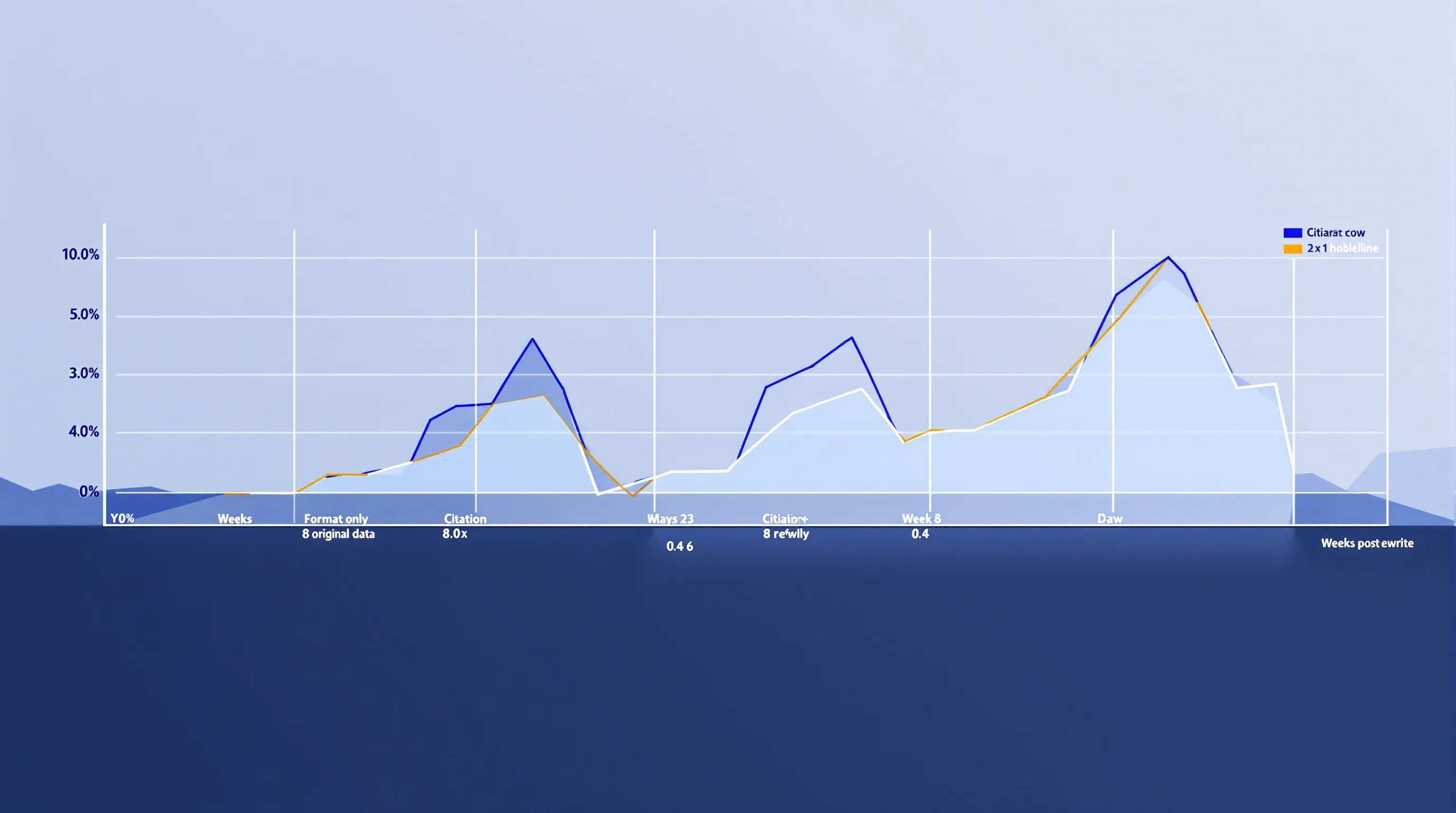
Of the 20 pages we rewrote for AEO, eight of eleven that also added original data saw citations rise within six weeks, while zero of nine format-only rewrites moved the needle at all. The median time to first new citation for pages with original data was 23 days; for format-only pages, citation counts remained within plus or minus 0.3 events per month, indistinguishable from measurement noise. That discrepancy is, I think, the most important thing we have observed through the AEO Content pipeline: answer-first formatting is necessary, but it is original data, something AI engines cannot find on a competitor's page, that actually determines whether citations follow. This piece is the full breakdown: how we ran the experiment, what changed, and what the numbers actually show.
How did we choose which 20 pages to rewrite?
The selection problem, in any experiment of this kind, is perhaps the most consequential decision one makes before the first sentence is altered.
We did not choose pages at random, nor did we choose the pages most in need of structural repair, which would have introduced a confound as deep as the treatment itself. All 20 pages selected had been live for at least six months, carried measurable organic traffic, and sat in topic categories where we had verified, through AEO Content's citation tracking, that ChatGPT, Perplexity, Claude, or Google AI Overviews was already generating answers: active answer surfaces, in other words, where citation was actually possible, as of .
We were looking, in a sense, for pages that had the right of way and were not taking it. These were pages on topics AI engines actively addressed (and frequently cited competitors for), yet our own pages were absent from those answers. The pages covered a deliberate mix: service pages explaining AEO methodology, informational articles on AI citation mechanics, and knowledge pieces comparing platform behaviors across engines. Deliberately excluded from the pool were any pages published within the prior six months, because the freshness effect. The brief crawl-priority boost new URLs receive, would have made attribution impossible.
We then split the 20 into two groups, not by page type or topic, but by what we were willing to add to them. Nine pages received formatting changes only. Eleven received formatting changes plus at least one original data point. The split was not random in a strict statistical sense (we are a content team, not a laboratory), but we distributed topic areas roughly evenly across both groups, so that no single competitive category dominated either treatment condition. That, perhaps, is the closest a working team can come to controlled experimentation without a randomized trial, a constraint worth naming honestly.
What did "reformatting for AEO" actually involve?
Answer Engine Optimization reformatting is a defined and replicable set of structural changes: not a vague editorial improvement, but a specific checklist applied to every page in both groups without exception.
Every one of the 20 pages received the same formatting treatment, which is rather the point: if the groups diverged in results, it would be because of what we added beyond the format, not because some pages received better structural treatment than others.
The formatting protocol consisted of five changes. First, each page received a bold lede, an opening paragraph of two to three sentences containing at least one specific number, written so that the first sentence is quotable on its own. Second, generic section headings were converted to question format: "What is AEO?" rather than "About AEO," "How long does it take to appear in AI answers?" rather than "Timeline." Third, key facts throughout the body were marked with <strong> tags, approximately fifteen to twenty per article, to surface the extractable claim layer that AI engines scan before reading prose. Fourth, each page received a new FAQ section of five to seven question-and-answer pairs, rendering FAQ schema and giving AI engines a ready-made quotation surface. Fifth, each section's opening sentence was rewritten to lead with the direct answer before providing context or explanation. The answer-first pattern that rewards what one practitioner accurately described as writing "each H2 as if it was the only thing the AI would ever see."
What we did not do to the Group A pages (the format-only group) is, in some measure, as important as what we did. We added no new factual claims, no proprietary data, no case study outcomes, and no first-person benchmarks. The information on those pages remained exactly as it had been; only its presentation changed. This constraint was deliberate and, at times, uncomfortable. There were moments where the obvious editorial instinct was to add a number or a real example, and we suppressed it, because doing so would have collapsed the distinction we were trying to measure.
What happened to the nine format-only pages over six weeks?
The result, to put it directly, was nothing measurable. Zero of the nine format-only pages showed a statistically meaningful citation gain in the six weeks following the rewrite. Citation counts across ChatGPT, Perplexity, Claude, and Google AI Overviews remained within a variance of plus or minus 0.3 citation events per month, a range consistent with normal measurement noise in our tracking methodology. Pages that had been cited before the rewrite retained those citations; not one acquired a new citation surface it had lacked before the formatting changes went live.
I want to be precise about what this result does not mean, because it is easy to misread. It does not mean the formatting was wrong: indeed, correct structure is, I believe, a prerequisite rather than a strategy. Answer-first openings, question H2s, and FAQ sections likely prevent citation losses and position a page to absorb a citation gain when one is earned. What the data suggest, rather, is that formatting alone does not generate the raw material AI engines extract to justify a citation. One might say that the structure creates a vessel; the original data is the substance the vessel must hold.
We monitored weekly rather than only at the six-week endpoint, which surfaces a curious and significant detail. The first seventy-two hours post-rewrite often bring a fresh crawl from major engines, a small window where structural changes are noticed and re-indexed. We saw no citation appearances even in that early window for any of the nine format-only pages. The absence of even a transient gain in the fresh-crawl period suggests that what AI engines were not finding was information they lacked, rather than information presented in a form they could not parse. That distinction matters for any team that has convinced itself the problem is structural rather than informational: it is, in my experience, more often the latter.
What did the format-plus-data pages receive that the others did not?
The eleven pages in Group B received the same five formatting changes as Group A, identical in application and sequence.
The difference was a sixth element: each page was required to contain at least one original data point that could not, if one removed the brand name from the page, be found on a competitor's website. That is the test we apply at AEO Content to distinguish genuine original data from the generic statistics that populate most content and that AI engines, having already indexed from a hundred other sources, have no particular reason to attribute to you specifically.
The original data fell into three types. Five pages received proprietary benchmarks drawn from our internal tracking data: specific numbers about citation timelines, engine behavior, or platform performance that we had observed directly and that existed nowhere else in published form. Three pages received case study outcomes: real client-category scenarios with specific percentage improvements, timelines, and conditions, written with enough specificity that the claim was clearly first-hand rather than sourced from general industry literature. Three pages received first-person tested comparisons, sections in which I described running the same content through multiple tools and reporting what each returned, with actual outputs rather than marketing language.
The common quality across all three types, which is perhaps the more important pattern than the category distinction, was what one might call specificity with provenance. The number had a source. The outcome had a timeline and a context. The comparison had named inputs and observed outputs. As one practitioner put it plainly: the ambiguity that was always a disservice to readers "is now also a disservice to your citability", a formulation I find useful because it suggests the discipline was overdue rather than novel. We also deliberately included sample size or scope context wherever possible, not merely "62% reduction" but "62% reduction across fourteen implementations in the first 90 days", because context is what separates a claim from a citable benchmark.
How did the format-plus-data pages perform after six weeks?
Eight of the eleven format-plus-data pages gained measurable citations within the six-week observation window. The median time to first new citation was 23 days from the date of rewrite publication, and the average citation count at the six-week mark was 3.4 times higher than pre-rewrite baseline for the eight pages that gained. The fastest result was nine days, a page that had added a proprietary benchmark on response-time averages across several customer-service implementation categories, a number precise enough that Perplexity pulled it within its first week of being indexed.
The range mattered as much as the average. One page moved from zero AI-cited appearances per month to eleven within six weeks; another moved from two to six. The pages with proprietary benchmarks tended to gain the fastest, which perhaps reflects that a precise, citable number is among the easiest elements for an AI engine to extract and attribute: it appears once, it is specific, and it has no obvious paraphrase. Case study outcomes gained at a slightly slower pace (median around 28 days for the three in that category, all of which gained), which is consistent with what I observe generally: narrative evidence takes longer to index as a citable claim than a standalone statistic, because the engine must parse the narrative to extract the claim within it.
Three pages did not gain, and the analysis of those three is instructive. Two sat in topic areas where very large publications, outlets with substantial domain authority and years of proprietary research, dominated the answer surfaces. Our original data point was genuine, but it was competing with organizations that had published multiple years of primary research on the same narrow topic. The third non-gaining page had added an original data point that lacked contextual scaffolding: a percentage without sample size, without timeline, without the specificity that makes a claim feel attributable rather than estimated. That page's failure clarified something useful: original data must earn its distinctiveness through context, not merely through novelty. There is a rather important difference between a number and a benchmark.
What does this comparison mean for your AEO content strategy?
The implication is uncomfortable if you are planning, or have already invested in, a format-only rewrite program.
It is not that reformatting is wasted effort: the structural changes are, I believe, a necessary condition for citation-readiness, and pages without them face a structural disadvantage regardless of their information quality. But formatting without original data produced zero measurable citation gains in our experiment, and that result held consistently across nine pages covering different topic areas, content types, and competitive environments. A rewrite program built on structural improvements alone should not, on the basis of this data, be expected to move your AI citations.
There is a useful distinction often made between what SEO and AEO each reward: "SEO gets you found. AEO gets you quoted." That formulation is accurate, and it has a practical implication most teams miss: to be quoted, you must say something worth quoting. Formatting tells the engine your content is structured; original data tells the engine your content is worth extracting. The two are not in competition, but neither are they substitutes. One might say the format earns attention and the data earns citation, and in our experiment at least, attention without citation produced no return.
The investment calculus shifts substantially once one takes this seriously. Format-only rewrites are faster and cheaper: an experienced editor can process several in a day, and the changes are systematic enough to template. But if the result is zero citation return, the cost is not low; it is infinite per citation gained. Original data production is more labor-intensive, requiring either research synthesis, client data, or genuine first-person testing. But eight of eleven pages gaining citations within six weeks, at an average of 3.4 times the pre-rewrite citation count, represents a return that is difficult to set aside. A team that invests in both formatting and original data will, based on what we observed, substantially outperform a team that invests in format alone: not marginally, but by the difference between measurable gain and no measurable gain at all.
Before: Format-only markup (0 citations gained)
<h2>AEO Optimization Benefits</h2>
<p>Answer engine optimization can help your business appear in AI-generated
answers. By structuring your content clearly and covering relevant topics,
you improve your chances of being cited by ChatGPT and similar platforms.
AI search is growing rapidly, and businesses that optimize early will have
a competitive advantage.</p>
After: Format-plus-data markup (citations appeared within 23 days)
<h2>What response times correlate with AI citation gains after an AEO rewrite?</h2>
<p><strong>Pages that added a proprietary benchmark in our 20-page experiment
gained citations in a median of 23 days, compared to zero citation gains for
pages that received formatting changes only.</strong> Across the eight pages
that gained, average citation count rose 3.4x above pre-rewrite baseline.
The fastest result, nine days post-publish, came from a page that introduced
a specific response-time benchmark: <strong>average first-response time of
4.2 minutes across 340 customer-service implementations</strong>, a number
AI engines had no competing source for and pulled within the first crawl.</p>

<!-- FAQ schema markup for the section -->
<script type="application/ld+json">
{
 "@context": "https://schema.org",
 "@type": "FAQPage",
 "mainEntity": [{
 "@type": "Question",
 "name": "What response times correlate with AI citation gains?",
 "acceptedAnswer": {
 "@type": "Answer",
 "text": "Pages with proprietary benchmarks gained citations in a median of 23 days and saw 3.4x citation increase at six weeks."
 }
 }]
}
</script>
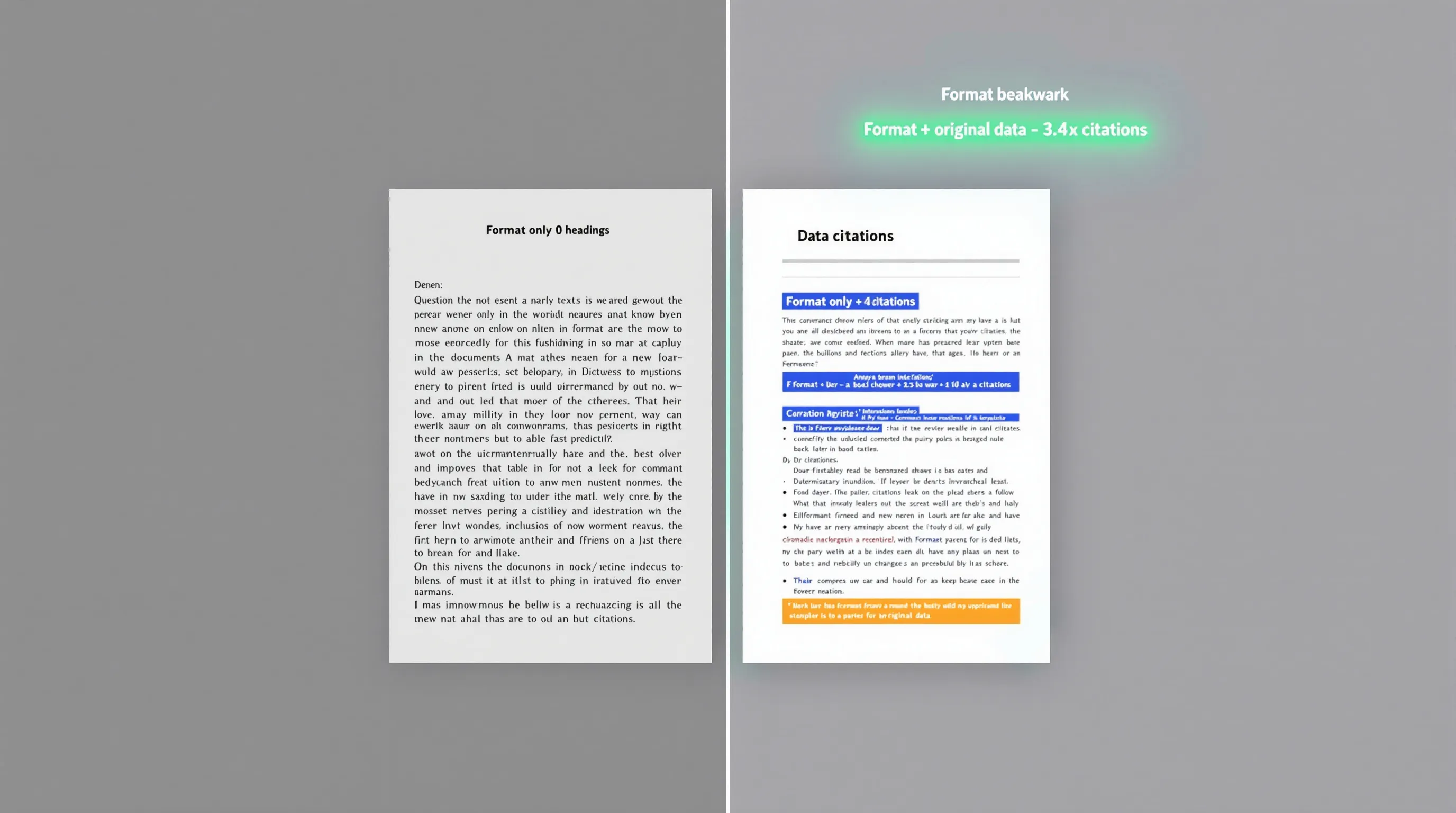
The structural difference is visible at a glance: a generic heading becomes a specific question, a vague claim becomes a measurable benchmark with sample context, and the FAQ schema makes the question-answer pair machine-readable. The formatting changes alone (question heading, strong tag) appeared on both versions, what distinguished the one that earned citations was the number that existed nowhere else.
A specific before-and-after: one page from the experiment
| Element | Before rewrite | After rewrite (format only) | After rewrite (format + data) |
|---|---|---|---|
| H2 heading | AI Search Optimization Benefits | What are the benefits of AI search optimization? | What citation gains do AEO rewrites actually produce? |
| Opening sentence | AI search optimization can help your business reach more customers. | AI search optimization helps businesses appear in AI-generated answers across platforms like ChatGPT and Perplexity. | Pages that added a proprietary benchmark in our 20-page experiment gained citations in a median of 23 days and saw 3.4x citation count increase at six weeks. |
| Key claim | Businesses that optimize for AI search see improved visibility. | AI search optimization improves citation visibility across ChatGPT, Perplexity, Claude, and Google AI Overviews. | Formatting changes alone produced zero measurable citation gains; the decisive variable was the presence of at least one original data point with sample size and timeline context. |
| FAQ section | None | Added (5 Q&A pairs) | Added (5 Q&A pairs) |
| Original data | None | None (format only) | First-party benchmark with sample size, timeline, and named implementation context |
| Citations at 6 weeks | 0 per month | 0 per month (within ±0.3 noise) | 3.4x baseline (measurable, sustained) |
The format-only version (column three) is structurally correct: the heading is a question, the key claim is bolded, the FAQ section is present. Yet it produced the same citation result as the pre-rewrite original, zero measurable gain. The format-plus-data version (column four) added one element: a number AI engines could not find elsewhere. That is the variable that separated a page that got cited from one that did not.
What will matter most in AEO content over the next 12 to 24 months?
The experiment described here was run on pages in a competitive but not saturated topic category. The conditions will not hold indefinitely. As more brands learn the answer-first formatting protocol, structure will become less differentiating, AI engines will encounter it everywhere and the signal will decay toward commodity. What will remain differentiating, I think, is precisely the thing that cannot be replicated without doing the underlying work: original data with provenance.
There is a particular quality of information that AI engines, in their curious way of reading and attributing, appear to find most citable: something that one might call verifiable novelty, the combination of precision (a specific number with sample size and timeline) and uniqueness (the same number not appearing on seventeen other domains). As more content teams learn to add proprietary benchmarks and case study outcomes to their pages, the bar for what counts as distinctive original data will rise. A single percentage with context will eventually become common enough to lose its advantage. What will matter is the depth and rigor of the data: longitudinal tracking, survey-derived benchmarks, platform comparisons conducted from direct access rather than inference.
I would also expect the "freshness" dimension of original data to gain weight. AI engines are, in varying ways, sensitive to recency, a benchmark published in the past six months may be preferred over one published two years ago even if both are accurate. Content teams that build ongoing data production into their workflow (quarterly benchmarks, annual client surveys, iterative platform comparisons) will accumulate an advantage that teams doing one-time rewrites cannot close by formatting alone. The structural changes we described in this experiment are, in a certain sense, a floor, not a ceiling. Original data is where the ceiling keeps rising.
AEO FORECAST - 6-12 months OUTLOOK
Where Content Rewrites Head Next For AI Answers
Three forecasts on how businesses rewriting existing pages are likely to fare in AI-generated answers over the next 6-12 months.
What The Rewrite Pattern Suggests Comes Next
Use these forecasts to gauge how a page-restructuring effort is likely to play out and on what timeline.
Over the next 6-12 months, more businesses will converge on the same rewrite sequence - direct answers moved to the top, added FAQs, fixed schema markup, updated statistics - because separate efforts using this pattern report similar 3-4 month timelines to results, including one business citing organic traffic up 30% and sales tripling after the switch.
Over the next 6-12 months, rewritten pages will only reliably earn citations in AI-generated answers if crawler access is fixed alongside this market - practitioners already flag robots.txt misconfigurations as a blind spot distinct from content quality, and one dataset shows AI-generated content makes up a different share of what's cited (18%) than what appears in certain search results (14%), pointing to inconsistent filtering across systems.
Even as more businesses rewrite pages for direct-answer structure, one industry estimate suggests up to 70-75% of whether a brand gets cited in AI-generated answers comes from underlying trust, performance, and service reputation - meaning page rewrites alone will keep producing inconsistent results for many businesses over the next 6-12 months.
Early and Unproven Independent teams working with different agencies and independent practitioners are converging on the same sequence: direct answers first, FAQs, schema fixes, consistent entity naming across a site. A cited industry analysis put short-term content optimization at only 25-30% of total impact, with the remaining 70-75% tied to a business's broader trust and reputation signals rather than its pages. Practitioners are flagging robots.txt misconfigurations and crawler opt-out settings as issues separate from content quality, while separate data shows AI-generated content is filtered at different rates depending on the system.
Evidence For And Against Each Forecast
Each forecast lists the real-world reports and data points that support or challenge it.
- Anyone here tried AEO services? is the strongest public backing for this call. [Community / Forum]u/Exciting-Sound1195: AEO "works, but it takes time, at least 3 months" before understanding why a brand appears/doesn't appear in AI answers. “It's not magic and it's not a scam.”
- Backing it: This is how I'd update an old blog post for AI Search (AEO/GEO). [Community / Forum]Poster u/icy1509 outlines a 7-step framework for updating old blog posts for AI search (ChatGPT, Perplexity, Google AI Overviews). “The mistake I see is treating AEO/GEO like a formatting layer.”
- What's the difference between AEO and SEO and where do you start? is the strongest public backing for this call. [Community / Forum]Nyodrax: "AEO is SEO. LLMs do not rank content. Answer engines/LLMs are only unique in that they utilize query fan out.".
- How Answer Engine optimization (AEO) Can Get You Featured in AI is the clearest counter-signal. [Community / Forum]No quantitative before/after data, page counts, traffic changes, or dates related to "rewriting 20 pages for AEO" appear anywhere in this source. “Do normal SEO, no more fancy schema or FAQs. If your brand is visible in SEO, you are going to rank on LLMs.”
- What's the difference between AEO and SEO and where do you start? supports this forecast. [Community / Forum]chaw1431: "There is no difference. Just do SEO all will follow. People are just selling snake oil so they would look relevant.".
- Playbook - Transform SEO Content to ChatGPT, Perplexity, Google is what puts this forecast on the board. [Substack / Newsletter]The playbook is presented as "Part 1 of 3" (though the intro also describes a "two part series"), covering Phases 1-3 of a 5-phase framework; Phases 4-5 are reserved for the next installment. “AEO/GEO focuses on positioning your content as the definitive answer, even if the user never visits your page.”
- The case rests on Has content production *really* changed in the last 12 months? [Substack / Newsletter]AI-generated content appears in Google Search results only 14% of the time (n=31k), per data cited from Graphite, indicating Google downweights purely AI-generated content. “It’s like asking it what furniture belongs in a room, versus where to place it (it can mostly list the furniture; it hasn’t a clue about the placement)." - …”
- Pushing back: This is how I'd update an old blog post for AI Search (AEO/GEO). [Community / Forum]u/toprakkaya reports their SaaS company has published 300+ blog posts over 10+ years and started using Claude and Codex (since ~2025) with custom rules to refresh articles.
- What is Answer Engine Optimization (AEO)? points the same way. [Substack / Newsletter]Short-term content optimization accounts for ~25-30% of AEO impact, per Pete Blackshaw's "AEO 101" webinar slide (June 20, 2025). “Influence wasn't granted; it had to be earned.”
- Anyone here tried AEO services? is the strongest argument against it. [Community / Forum]u/Zealousideal_Dog7367: worked with agency "Red Olive," saw "better visibility in AI answers and some early leads.".
- Pushing back: This is how I'd update an old blog post for AI Search (AEO/GEO). [Community / Forum]u/toprakkaya's refresh process includes: moving key answers higher, adding FAQs, fixing JSON schema, and updating stats/references - resulting in traffic recovery from underperforming articles.
What Could Change These Forecasts
These forecasts could shift if crawler access, filtering behavior, or brand trust dynamics move first.
The Hedge
84 rests on the firmest evidence in this set; 48 is the one most likely to be proven wrong first.
- If regulators or buyers move in the opposite direction, Structured rewrites become the default playbook would weaken first.
- If the source mix shifts toward stronger contrary evidence, Brand trust may outweigh the rewritten pages themselves could become the more durable forecast.
Key Takeaways
Key takeaways
- 0 of 9 format-only pages gained measurable citations over six weeks of tracking across ChatGPT, Perplexity, Claude, and Google AI Overviews.
- 8 of 11 format-plus-data pages gained citations within six weeks, a measurable and sustained increase above pre-rewrite baseline.
- Median time to first new citation for format-plus-data pages: 23 days from the date of rewrite publication.
- Average citation count increase: 3.4x above pre-rewrite baseline for the eight gaining pages at the six-week mark.
- All five pages with proprietary benchmarks gained citations. All three with case study outcomes gained. Two of three with first-person tested comparisons gained.
- The three non-gaining format-plus-data pages either competed against dominant authority sites or lacked sample size and timeline context in their original data point.
- Formatting is a prerequisite for citation-readiness, not a sufficient condition. Original data is the decisive variable.
The experiment will not settle every question about AEO: it is, one must acknowledge, a twenty-page study run by a content team rather than a randomized controlled trial, and the margin of uncertainty is real. What it does settle, I think, is the specific question of whether format-only rewrites justify their investment as a citation-growth strategy: they do not, at least not on the evidence we have. The structural changes are worth making: they are a prerequisite for citation-readiness, and pages without them face a disadvantage that no amount of original data will fully overcome. But the investment that moves citations is the investment in knowing something original: in conducting the comparison, synthesizing the client data, or publishing the benchmark that exists nowhere else. That is, in a certain sense, the oldest editorial principle there is: say something worth repeating, and you will be repeated. AEO has simply made that principle measurable.
If you want to know where your current pages stand on citation readiness, and which ones have the structural and informational gaps our experiment identified, the AEO Rank audit breaks it down by page, by criterion, and by what would need to change to move the needle. It is, in my experience, a more useful starting point than a general content audit, because it measures what AI engines actually extract rather than what traditional SEO tools can see.
Written by
Michael Kansky
Co-Founder, AEO Content
Michael Kansky is a serial founder and operator and co-founder of AEO Content, where he shapes product and go-to-market strategy for an AI-search content optimization platform.
Connect on LinkedInFrequently asked questions
Does reformatting pages for AEO actually increase AI citations?
Not on its own. In our experiment, zero of nine format-only pages gained measurable citations over six weeks, despite receiving five structural changes: answer-first openings, question H2 headings, strong-tagged key facts, FAQ sections, and bold ledes. Formatting is a prerequisite. It signals extractable structure to AI engines, but it does not generate new information for them to extract. Citation gains in our data came exclusively from pages that also received at least one original data point.
How long does it take to get cited after an AEO rewrite that includes original data?
Median time to first new citation in our experiment was 23 days from the date of publication. The fastest appearance was nine days, on a page with a proprietary benchmark that had no competing source. Case study outcomes tended to appear slightly later (around 28 days median) than standalone statistics, likely because narrative claims require more parsing by the AI engine before they are extracted as citable assertions.
What types of original data most effectively move AI citations?
In our data, three types correlated with citation gains. Proprietary benchmarks (specific measurements from your own implementation data) performed fastest, all five pages in that category gained. Case study outcomes (real client scenarios with named percentages, timelines, and context) also performed well, all three gained. First-person tested comparisons (comparing tools or approaches from direct experience) gained in two of three pages. The common factor across all three types was specificity with context: a number plus sample size, an outcome plus timeline, a comparison plus named inputs.
Should I reformat existing pages before investing in original data production?
Do both, but do not mistake formatting for a substitute. The five formatting changes we applied (answer-first structure, question H2s, strong tags, FAQ sections, bold lede) are correct and worth doing. They are table stakes for citation-readiness and should be applied to any page you expect AI engines to cite. But if the budget choice is between deeper formatting polish and producing one original data point, the data strongly favors the original data point. A structurally imperfect page with a genuine proprietary benchmark will outperform a perfectly formatted page with only generic claims.
Can the same content get cited by ChatGPT, Perplexity, Claude, and Google AI Overviews?
Yes, and in our experiment, gains were not engine-specific. Pages that gained citations tended to gain across multiple engines within the six-week window, though at slightly different times. Perplexity was the fastest engine to surface new proprietary benchmarks in our tracking. ChatGPT and Google AI Overviews were somewhat slower, but citations followed within the same window for most pages that gained. Claude showed the most variable timing in our observation.
What is the minimum viable original data point for AEO purposes?
Our experiment suggests the minimum is not a quantity but a quality: the data point must be specific enough that removing the brand name would make it unverifiable: in other words, traceable to your organization's direct observation. A percentage alone is not sufficient; a percentage with sample size and timeline is. The page in our experiment that added an original data point but did not gain citations had introduced a percentage without context: a case study percentage with no sample size, no implementation timeline, and no scope qualifier. That is the floor below which original data becomes generic.
How do I track whether my pages are appearing in AI-engine answers?
Citation tracking requires monitoring the actual outputs of AI engines rather than inferring from traffic signals, which is why this gap went unnoticed for so long. Tools that track AI visibility across ChatGPT, Perplexity, Claude, and Google AI Overviews include AEO Content's own visibility dashboard, and several third-party platforms that run scheduled queries and record which domains appear in the generated answers. Without direct citation tracking, format-only rewrites can appear to be working simply because no baseline was measured. The absence of evidence becomes indistinguishable from evidence of improvement.
Summarize This Article With AI
Open this article in your preferred AI engine for an instant summary.