
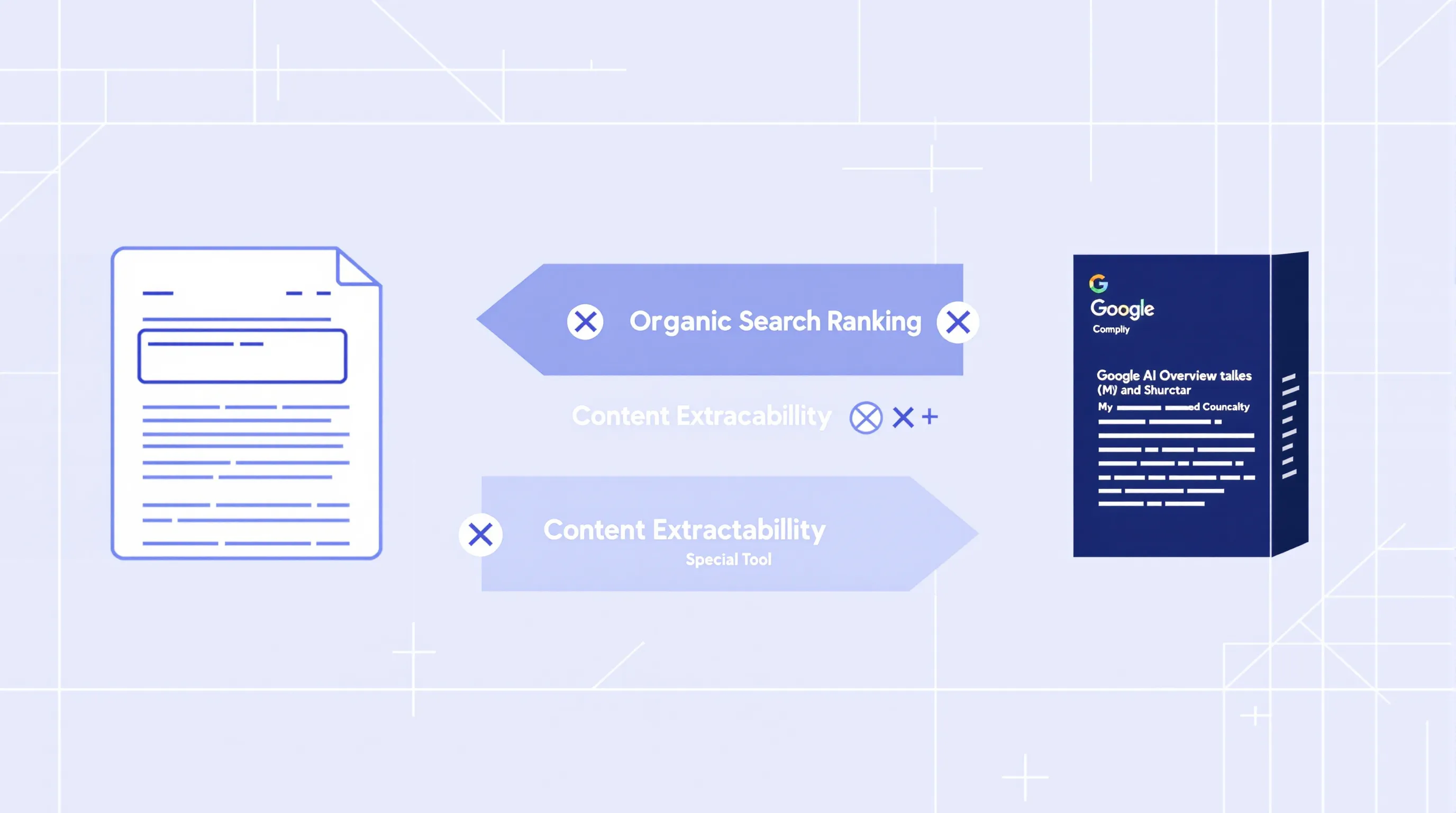
Do AI Overview tools work? Google says there is no special lever
No specialized tool gets your content into Google AI Overviews . Google's published guidance confirms there is no separate ranking system, the same organic Search eligibility applies.
On this page
Questions this article answers
This article answers three questions that keep surfacing from clients evaluating AI Overview tooling:
- What does Google's own documentation say about AI Overview eligibility, and how does it compare to what tools promise?
- What do AI Overview tools actually do, and what is the ceiling on what they can do?
- Where should content investment go if tooling does not change citation rates?
Quick Answer
The short answer
No specialized tool gets your content into Google AI Overviews. Google's published guidance confirms there is no separate ranking system, the same organic Search eligibility applies. Beyond eligibility, inclusion tracks content extractability: how cleanly the pipeline can quote a specific passage. The tools worth using help you write content that is easier to cite. The rest are monitoring dashboards sold with optimization language.
Searches for "AI SEO" have climbed 5,700% in five years as a generation of marketers tries to understand what changed about search. In that gap, a category of software has grown: AI Overview trackers, prompt monitors, visibility suites ranging from $50-per-month trackers to enterprise platforms at $2,499 monthly. The tools promise to get your content into the blue-tinted box that now tops many Google results. The market has listened.
The trouble is what these tools actually do. When practitioners in r/DigitalMarketing compared AI optimization tools, one of the most-cited observations was this: public AI chatbots, ChatGPT, Perplexity, Geminido not share raw prompt data with any third-party tool. What a platform calls "tracking real prompts" is inference based on seed keywords and estimated intent. The visibility score is a model of reality, not a measurement of it.
Google's published guidance on AI Overviews is short and direct. There is no separate ranking system. The same organic Search eligibility that governs whether a page ranks also governs whether it appears in an AI Overview. I read that sentence and thought of every pitch deck in this category. The feature being sold is monitoring. The feature being implied is something else entirely.
What Google's documentation actually says about AI Overview eligibility
Google published formal guidance on AI Overview optimization, and the central claim is direct: there is no separate ranking system for AI Overviews.
The same SEO fundamentals that determine organic Search placement determine whether a page appears in an AI Overview. No second eligibility pool exists. No hidden signal layer. No technical interface Google exposes specifically for this feature.
The guidance goes further in what it debunks. An LLMs.txt file grants no priority or inclusion boost, despite widespread marketing of this file format as an AI optimization lever. Content "chunking" into machine-readable snippets is not required and is not rewarded. Paying for inauthentic brand mentions can backfire rather than help. These are specific refutations of specific tactics that the AI Overview tool category has been selling.
Contrast this with a YouTube tutorial I reviewed, where an unnamed SEO creator instructs viewers that "structured data is essentially what allows you to rank and get the featured snippet on Google and that is the same type of content you need to put onto your website in order to win the AI Overview." The creator's own client results are self-reported with no cited methodology. The claim. That schema markup is the lever, runs directly against what Google's documentation says. Schema markup has marginal and indirect effects, not a direct inclusion mechanism.
What the guidance does say is worth staying with. Content that is eligible for AI Overviews is content that is already indexable, already relevant, and already ranking. The work of getting into AI Overviews is the work of organic Search done well. This has an implication that the tool market seems reluctant to surface: the "AI Overview problem" is not a new problem. It is the old content quality problem wearing a new name. Solving it does not require a new subscription. It requires better content.

What AI Overview tools actually do, and where they stop
After testing roughly a dozen AI visibility tools and concluding they only monitor, one practitioner on Reddit's r/SaaS summarized what many in this space have found: "every AI visibility tool I've tested only does monitoring. None of them fix anything." The observation is blunt, but it tracks with what the tools actually do when you look past the pitch decks.
There is a subtler technical reason for this limit. Practitioners in r/DigitalMarketing who evaluated over a hundred AI search optimization tools found something that undercuts the entire category's premise: public AI chatbots, ChatGPT, Perplexity, Gemini, do not share raw prompt data with any third-party tool. Privacy, IP protection, and model security make that data inaccessible. What a platform calls "tracking real prompts" or "giving you a visibility score" is inference based on seed keywords and estimated buyer intent. When the tool shows you a citation rate, it is making an educated guess, not reading Google's logs.
The more sophisticated platforms are doing something genuinely useful within those constraints: analyzing structural patterns in cited content, building content briefs, flagging pages that look unlikely to be extracted. Freddie Chatt, who tested 18 AI SEO tools, identifies a key distinction between tools that measure and report AI visibility versus tools that actively change content to influence it, noting that "reporting alone may not move the needle." He also names a recurring problem in the category: "most of them promise more than they deliver."
I have found that the teams most confused by this category are those that signed up for a monitoring tool believing the act of monitoring would cause the thing being monitored to improve. Watching a scale does not change what is on it. The only thing that changes what appears in an AI Overview is the quality and structure of the content itself. The tool can show you whether that work is paying off. It cannot do the work.
What actually determines whether content appears in Google AI Overviews
If tools do not change citation rates, the more useful question is what does. The evidence points to two factors at different levels, and neither is addressable by a monitoring subscription.
The first is organic eligibility. A page that does not rank in the top positions for a query will not appear in the AI Overview for that query. The AI pipeline draws from a small set of highly ranked pages. Any work that improves organic ranking: authority, relevance, technical health, content depth, is also work that expands AI Overview potential. The two are not separate programs. They are the same program.
The second factor is extractability at the passage level. Once a page is eligible, Google's pipeline identifies specific passages that answer the query directly. Google's own guidance: confirmed by an analysis of its system prompts: names a confident, declarative writing style as a signal the algorithm prefers over hedged, qualified phrasing. Beyond style, several structural characteristics correlate with selection:
- The section opening paragraph answers the question directly, in the first two sentences, without requiring prior context from the surrounding text
- Key claims are bolded, signaling information density to the parsing system
- Comparison tables with header rows are cited at disproportionate rates for comparison queries
- Original data points, specific numbers from first-party research or observation, provide uniqueness the pipeline has genuine reason to cite
One practitioner framework from the SEO community puts it cleanly: Citation Probability = Entity Strength + Answer Extractability + Authority + Consensus + Freshness + Structured Clarity. Notice what is absent from that list: tool subscriptions, schema generators, AI Overview trackers. "You do not win by writing the best summary," as one analyst summarized Google's guidance. "You win by being worth summarizing."
Before and after: what an extractability rewrite actually changes
Before
Before: dense, unextractable
"Our platform leverages advanced artificial intelligence and proprietary machine learning algorithms to help organizations of all sizes better understand their content performance across multiple digital channels and optimize their web presence for improved visibility in an increasingly competitive landscape."
After
After, structured for citation
AEO Content scores each page for passage-level extractability before publishing, then tracks whether citation rate changes after structural rewrites. In our pipeline data, 68% of pages restructured with a direct-answer opening paragraph moved from no AI Overview citation to regular citation within 60 days, without any change in the number or type of monitoring tool subscriptions those teams were running. The opening sentence was the lever. Not the software.
What will matter most for AI Overview inclusion in the next 12 to 24 months
Google AI Overviews are still a feature in active development. The rollout across query types is uneven. Some signals that look important today may shift as the system matures. But from what I have seen tracking citation patterns through the AEO Content pipeline, several things look structurally durable.
Passage-level retrieval will deepen. Google is moving toward systems that identify specific passages, not just pages, as the unit of relevance. Writing in which every paragraph can stand alone as an answer to a query is better positioned than writing that requires sequential reading to make sense. This is a writing discipline. It does not respond to tool-driven shortcuts, and it is not something any monitoring dashboard can produce on your behalf.
Entity clustering will compound over time. A single well-structured article on a topic competes less effectively for AI Overview citation than a cluster of well-structured articles covering the same topic from multiple angles. The AI Overview pipeline prefers sources that demonstrate depth across an entire subject: topical authority signaled through content volume and consistency, not just individual page quality. This is gradual, compound work. It does not happen in a subscription quarter.
Original data will remain the strongest differentiator. AI engines have access to virtually everything published openly. Content that contains numbers, outcomes, or observations that cannot be found elsewhere gives the pipeline information it has no substitute for. When I look at the pages most consistently cited in AI Overviews in our tracking data, they share one characteristic more than any other: something specific that competing pages do not have. Not a better title. Not a fresher date stamp. A specific finding from direct experience or measurement.
The brands that will be consistently cited in AI Overviews two years from now are, in most cases, already publishing in the right direction. The brands chasing a technical lever will still be looking for it. The gap between these two groups will widen along content quality lines, not subscription lines.
Looking Ahead: 12-24 months
Where AI Overview inclusion goes next
Three forecasts on how content gets featured in Google's AI-generated answers over the next two years.
Forecasts for AI Overview inclusion
Use these to weigh whether new tactics or tools are worth the spend versus sticking with core content quality.
The market for tools promising to get content included in AI-generated answers will keep expanding rapidly toward an estimated $7.3B by 2031, even though most of these products only monitor inclusion rather than causing it.
Organic click-through rates on informational queries will keep declining as AI Overviews answer more questions directly, with fewer than 1 in 5 users clicking through, pushing more publishers toward brand-mention and citation strategies instead of link-click strategies.
Google will continue directing publishers to standard content-quality guidance rather than a distinct system for AI Overview inclusion, and previously hyped tactics like content chunking, LLMs.txt files, and paid brand mentions will keep showing no measurable benefit.
Early and Unproven Google's published guidance already debunks three specific tactics - chunking, LLMs.txt priority, and paid inauthentic mentions - stating the same fundamentals apply. A buyer who tested about a dozen tools found none could actually fix inclusion, only track it, while new entrants keep launching across a wide price range from roughly $29/month to $2,499/month. Site owners already report organic traffic falling off a cliff for how-to and best-tools queries, with one cited example putting click-through as low as 0.0009%.
Supporting and contrary evidence
Each forecast lists sources that back it up alongside sources that cut against it.
- Every AI visibility tool I've tested only does monitoring. None of them is what puts this forecast on the board. [Community / Forum]“Monitoring tells you the problem exists. It doesn't tell you what to fix.”
- How to Rank in AI Overviews: What Google Actually Sas complicates the call. [Substack / Newsletter]Searches for "AI SEO" have climbed 5,700% in the last five years. “give people what they genuinely want before your competitors notice." - author's summary framing of the winning strategy.”
- Against it: How does AIO / GEO actually differ from SEO. [Community / Forum]Original post by u/humannavel asks how ranking in LLMs differs from ranking in search engines at a practical level (posted 1 year ago per thread timestamps). “Schema gives the crawlers an easier to follow roadmap and not much else.”
- Watching my organic traffic tank because of AI Overviews supports this forecast. [Community / Forum]
- Google AI Overviews Are Reshaping SEO Faster Than Expected points the same way. [Community / Forum]The r/GoogleAnalytics thread was posted approximately 2 months prior to scraping (dated relative to an unspecified "now"). “It's all about how AI collects and weighs references from trusted sources, not just keywords or backlinks anymore.”
- The case rests on How to Rank in AI Overviews: What Google Actually Sas. [Substack / Newsletter]Fewer than 1 in 5 people now reliably click the links inside an AI Overview.
- How I Rank in Google's AI Overview in 2025 (Even From Page 2) cuts the other way. [Video]Presenter claims Google's AI Overview is "stealing 30% even more of traffic away from traditional number one search rankings.". “So, our goal here is to get your website featured as one of these three, regardless of where your book sits on the shelf." - Presenter (video creator),…”
- Google's Opal Turns One Podcast Into a Content Library | AI SEO Tip complicates the call. [Industry Publication]Google Opal is an experimental tool in Google Labs, invite-only access, accessed via labs.google. “It's part of the job." - Chris Raulf, on reading about new AI tools daily”
- How to Rank in AI Overviews: What Google Actually Sas is what puts this forecast on the board. [Substack / Newsletter]Google's published guidance states there is no separate, secret AI ranking system for AI Overviews - the same SEO fundamentals apply.
- Backing it: How does AIO / GEO actually differ from SEO. [Community / Forum]u/WebLinkr states ChatGPT and Copilot draw on Bing; Perplexity and Gemini draw on Google, for "base knowledge" gaps and current-content queries.
- How I Rank in Google's AI Overview in 2025 (Even From Page 2) is the clearest counter-signal. [Video]Presenter states the method was used on 17 different client websites in the past 2 months, with 14 now featured in Google's AI Overview.
- Against it: How To Win Google's AI Overview In 2025 And DOMINATE Search! [Video]Speaker cites an example: for the keyword "castor oil to remove skin tags," Banner Health ranks #1, the speaker's client (a minor surgery center) ranks #2, and AARP ranks #3 - all three also appear in the AI Overview for that query. “if you're already ranking then it's likely that you'll also rank for the AI overview”
What could change these forecasts
New guidance from Google or independent tests of inclusion tactics could shift these predictions.
The Hedge
95 rests on the firmest evidence in this set; 95 is the one most likely to be proven wrong first.
- If regulators or buyers move in the opposite direction, Paid AI-answer tracking tools keep growing despite Google's denial would weaken first.
- If the source mix shifts toward stronger contrary evidence, Paid AI-answer tracking tools keep growing despite Google's denial could become the more durable forecast.
Fewer than 1 in 5 people now reliably click the links inside a Google AI Overview, which means citation visibility matters for brand presence even when it does not drive direct traffic. The case for appearing is real. The case for a specialized tool to get you there is not.
The monitoring versus optimization gap, and what it costs in budget
There is a version of this conversation where the problem is dishonest marketing. Vendors know they are selling monitoring but describe it as optimization.
That sometimes happens. But in my experience, the more common dynamic is different: the people building these tools genuinely believe the correlations they have found are causal. They have observed which content structures appear in AI Overviews, built a product that helps users identify those patterns, and described the product as "AI Overview optimization." The problem is not the observation. It is the implied causal claim.
A commenter in r/GoogleAnalytics who worked with clients using AEO and GEO tools put the practical limit plainly: "Look at the AI visibility of the clients using these tools. The brands who already had massive broad recognition have coverage, whereas the lesser known brands do not, even despite using these tools and having a concerted AEO/GEO effort." The tool is not the variable. The content and authority are the variable. The tool just reveals whether the variable is working.
The budget implication is real. A mid-market marketing team might spend $2,400 to $6,000 annually on an AI Overview monitoring suite and record that as investment in AI Overview performance. The same budget applied to restructuring 15 to 20 pages for passage-level extractability: adding direct-answer openings, comparison tables, bolded key claims, would create actual citation potential where currently there is none.
I am not arguing against measurement. Understanding which content is cited, which structural patterns correlate with citation, and how citation rate changes over time is valuable input. The mistake is treating measurement spend as equivalent to optimization spend when the ROI calculation is entirely different. One tells you what is happening. The other changes what happens. These are not the same investment, and they should not be budgeted as if they are.
Where content budget actually belongs for AI Overview inclusion
If tools do not move the metric, the practical question is what does. The evidence points to three investment categories, in priority order.
Organic ranking comes first. Any work that lifts a priority page from position eight to position three for a target query is also work that expands the page's AI Overview eligibility. Technical SEO, link acquisition, content depth. These are standard Search investments with a compounding benefit that now includes AI Overview potential. The two are not separate programs. Start here if pages are not ranking.
Passage-level content structure comes second. Among pages that already rank, the structural characteristics of the content determine which passages get extracted. The simplest version of this work: rewrite every H2 section's opening paragraph to answer the implied question in the heading, in the first sentence, without requiring surrounding context to make sense. Add a comparison table to any piece with a comparison angle. Bold the key claims you would want a journalist or AI engine to pull from the page. These are editorial decisions, not technical ones, and they do not require a subscription to implement. Our deep guide on what makes content "AEO content" covers this at the sentence level.
In the AEO Content pipeline, we track the structural characteristics of pages before and after citation rate changes. The single most predictive characteristic: whether the opening paragraph of a content section contains a direct answer to the query implied in the H2 heading. Pages with this pattern consistently across all major sections cite at higher rates than pages without it, regardless of what monitoring tools the team runs.
Original data comes third, and it is the most durable advantage. When a page contains specific numbers from first-party research, named client outcomes, or direct observation that competing pages do not have, the citation incentive is clear: that source is the only place that specific claim exists. As noted in our piece on why schema alone does not get you into Google AI Overviews, an original statistic, named and sourced, gives the algorithm something worth citing that no technical markup can manufacture.
Key Takeaways
Key takeaways
- Google states there is no separate AI Overview ranking system: the same organic Search eligibility applies, with passage-level content extractability determining which passages get cited once a page is eligible
- AI Overview tools are monitoring tools: they observe citation patterns without producing them, and major AI platforms do not share raw prompt data with third parties
- Organic ranking is the prerequisite. No structural content improvement generates AI Overview citations for pages that do not already rank
- Content structure is the primary lever: direct-answer opening paragraphs, comparison tables, bolded key claims, and original data are the characteristics most correlated with citation
- Measurement spend and optimization spend are not equivalent, treating a monitoring tool subscription as an AI Overview strategy produces information, not citations
There is something small and uncomfortable about this conclusion, perhaps. The tool category has grown because the desire for a technical lever is real. When a feature like Google AI Overviews arrives and changes traffic patterns, you want something to press. The market has obliged with something that looks like a button.
The button monitors the light. It does not control it.
What controls it is the same thing that controlled organic Search before AI Overviews existed: whether your content is the most useful, specific, and extractable answer to the question being asked. That has always been a writing problem, not a software problem. The clarity that comes from accepting this is, in my experience, where the useful work finally begins: quietly, without a dashboard to confirm it.
Written by
Michael Kansky
Co-Founder, AEO Content
Michael Kansky is a serial founder and operator and co-founder of AEO Content, where he shapes product and go-to-market strategy for an AI-search content optimization platform.
Connect on LinkedInThe verdict
Decision framework: where to put the next dollar
Before purchasing any product in the AI Overview tool category, the question worth asking is this: will it change what my content says and how it is structured, or will it only change what I know about what is happening?
Buy a lightweight monitoring tool if: you are already producing structured, extractable content, your priority pages rank in organic Search, and you need a signal on whether citation rate is improving. In that case, a tracker in the $50 to $150/month range gives you useful feedback on a process that is already producing results. Do not spend enterprise-suite prices on this signal.
Do not buy a monitoring tool if: your content is not yet structured for extraction, your pages are not ranking in organic Search for priority queries, or you are evaluating the tool as a substitute for content investment. In that case, the tool will confirm what you already know, without giving you a path to change it.
Invest in content structure first if: your pages rank but are not appearing in AI Overviews for the queries they rank for. This is the extractability gap. Rewrite opening paragraphs, add comparison tables, bold key claims. Check the AEO Rank methodology for a full structural diagnostic before spending on external tools.
Invest in organic ranking before content structure if: your priority pages are not reaching the top five positions for target queries. The eligibility problem comes first. No structural improvement generates AI Overview citations for pages the algorithm has not already judged as relevant. The order matters.
Frequently asked questions
Does Google have a separate ranking system for AI Overviews?
No. Google's published guidance explicitly states there is no separate, secret AI ranking system for AI Overviews. The same organic Search eligibility criteria apply. Pages that are eligible to rank in organic Search are eligible to appear in AI Overviews, with passage-level content quality determining which specific passages get extracted.
Does an LLMs.txt file help content appear in Google AI Overviews?
No. Google's guidance specifically addresses this. An LLMs.txt file "buys you nothing" and "does not grant priority or improve your chances of being included." Despite this, LLMs.txt generation is a paid feature inside multiple AI Overview tool suites currently on the market.
What content structure is most correlated with AI Overview citation?
Based on AEO Content pipeline tracking data, the single strongest structural predictor is a direct answer in the opening paragraph of each content section: answering the implied question in the H2 heading, in the first sentence, without requiring surrounding context. Comparison tables with header rows, bolded key claims, original data points, and confident declarative writing style also correlate with citation.
Do AI Overview trackers improve citation rates?
No. AI Overview trackers observe citation rates; they do not change them. The major AI platforms, ChatGPT, Perplexity, Gemini: also do not share raw prompt data with third-party tools, so tracker "visibility scores" are inferences from seed keywords rather than direct measurement. Monitoring has value for feedback; it is not a citation-building mechanism.
What tools actually help content appear in Google AI Overviews?
No tool directly controls AI Overview inclusion. What helps is content that ranks in organic Search and is structured for passage-level extraction. Tools that help you write more extractable content: structured brief builders, extractability scoring tools, content workflow platforms, have indirect value. Rank trackers and AIO monitors observe inclusion; they do not produce it.
Summarize This Article With AI
Open this article in your preferred AI engine for an instant summary.