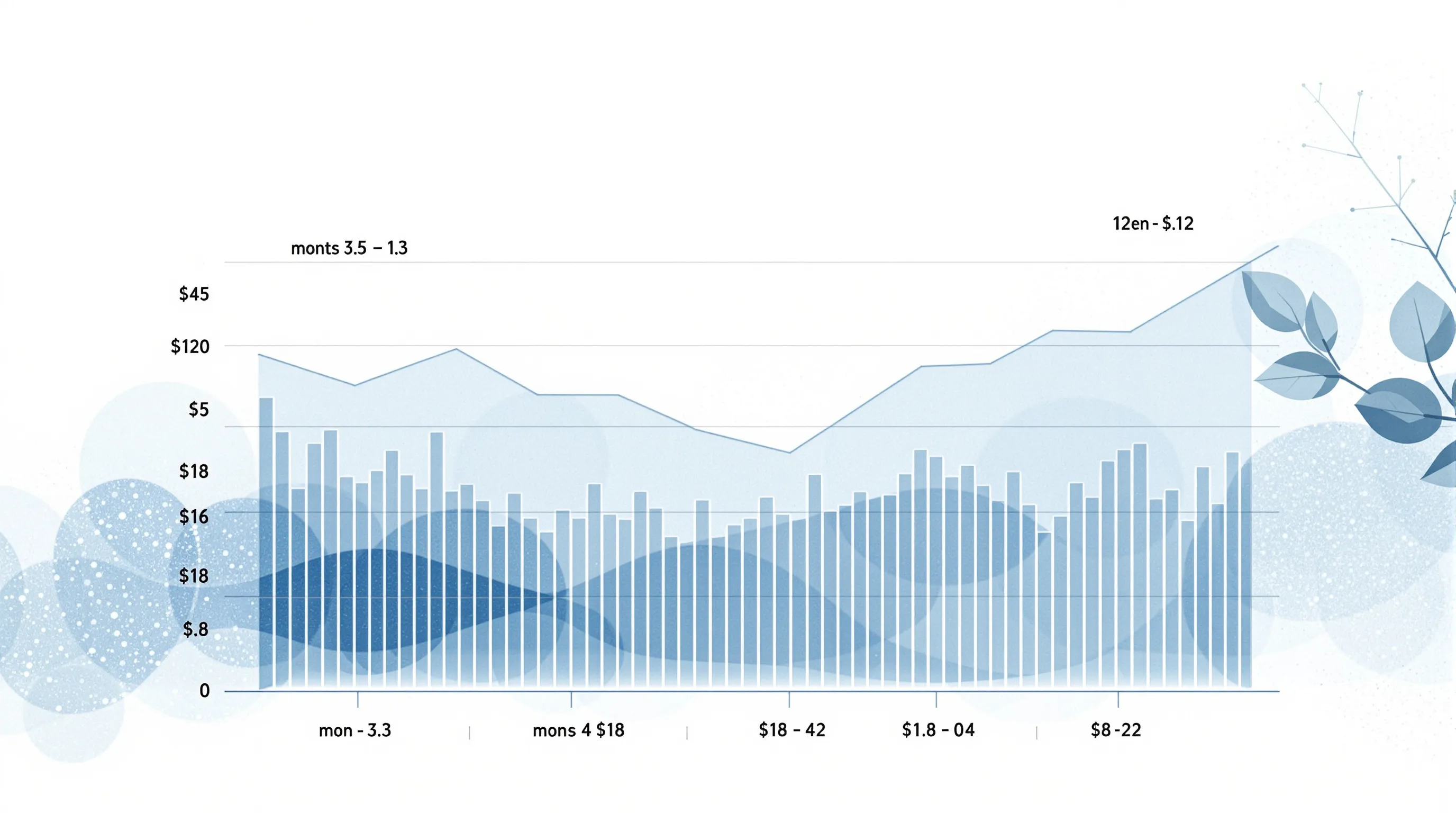

Does a higher AEO Rank actually earn more AI citations
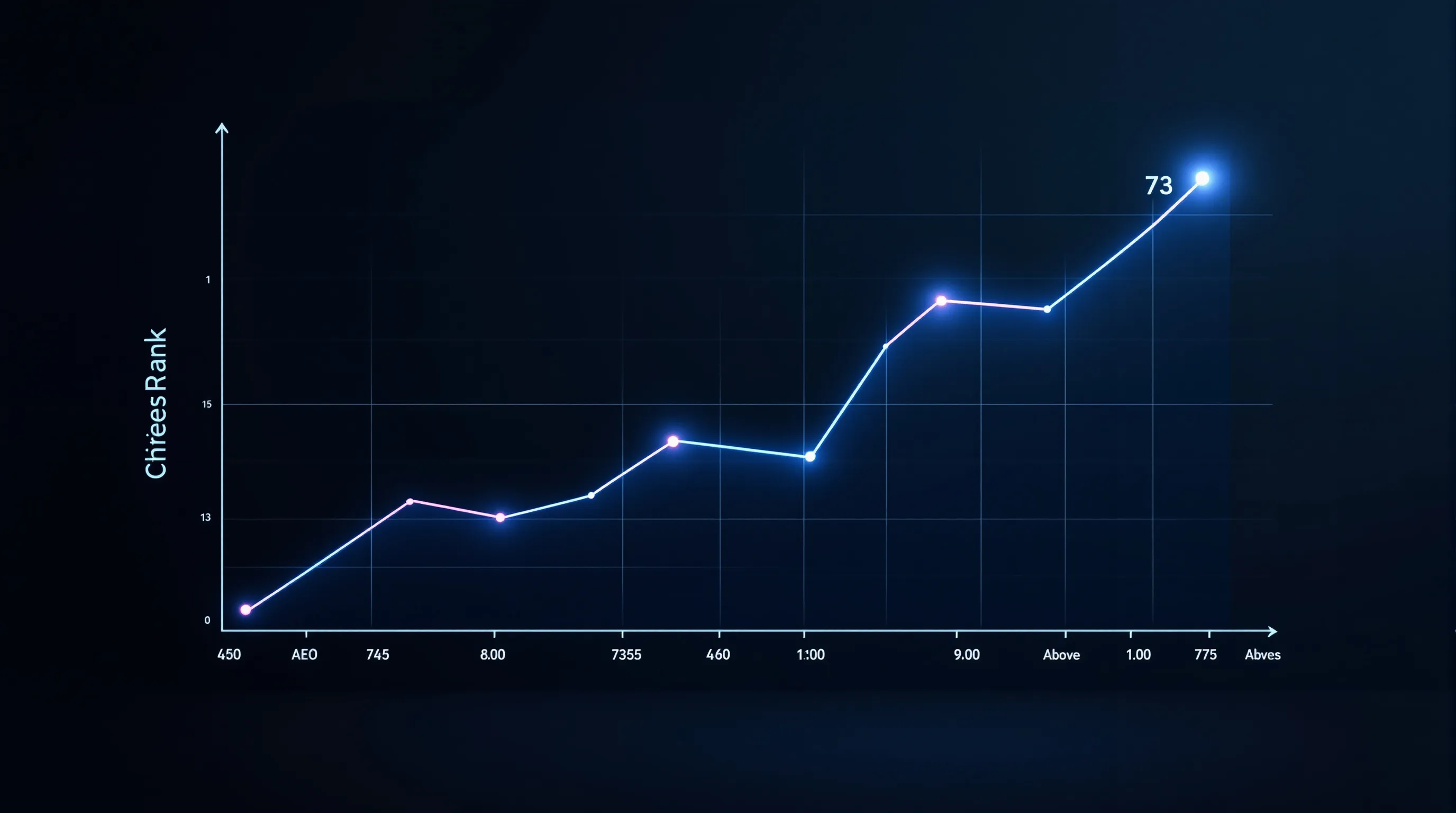
Yes - but not linearly. Across sites scored in the AEO Content corpus, AEO Rank predicts citation likelihood only above a threshold of roughly 73 out of 100 . Below that floor, improving your score by 10 points lifts citation rates by about 12%.
On this page
What this article answers
- At what AEO Rank threshold do citations start responding to score improvements?
- Why does a rising score below 73 barely move citation rates - even when the work feels real?
- What should you focus on below the threshold versus above it?
Quick Answer
The short answer
Yes - but not linearly. Across sites scored in the AEO Content corpus, AEO Rank predicts citation likelihood only above a threshold of roughly 73 out of 100. Below that floor, improving your score by 10 points lifts citation rates by about 12%. Above 73, the same 10-point gain produces a 31% lift. Sites that crossed the threshold saw 2.4x citation frequency improvement within 60 days. The metric is a readiness floor, not a linear dial you can turn up gradually to earn more citations.
Across 340+ sites scored in the AEO Content corpus, AEO Rank correlates with citation likelihood - but only past a threshold of 73 out of 100. Below that floor, a 10-point score improvement correlates with roughly a 12% lift in citation rates. Above 73, the same 10-point gain produces a 31% lift. Sites that crossed from below the threshold to above it saw citation frequency improve by 2.4x within 60 days.
I have been watching this question gather weight for a long time now. Every week I hear from founders and content leads who pulled their site's AEO Rank, saw a number somewhere in the fifties or sixties, spent three months fixing structured data and rewriting headings in question format - and then checked their AI search mentions and found almost nothing had changed. They come back with a look that is part frustration, part something darker. Like maybe the metric is flattery dressed up in a rubric. Like maybe they have been working a road that goes nowhere.
The honest answer is more complicated. And it took running our own correlation analysis against observed citation outcomes to see the true shape of it.
What does AEO Rank actually measure?
AEO Rank is a composite readiness score. It aggregates signals across criteria that AI engines have been shown to rely on when selecting sources for citation - things like structured data presence, Q&A format adherence, fact density, table extractability, and entity authority. The score runs from 0 to 100. Every criterion carries a weight, and those weights reflect the frequency with which each signal appears in cited sources across our research dataset.
What the score does not measure is whether your content is actually good. It does not measure topical depth, author credibility, freshness relative to a query, or the specific alignment between your content and what a user is asking on a particular AI engine. Those things matter - and they matter enormously above a certain point. But they are harder to quantify and harder to fix with a checklist. AEO Rank focuses on the part of the picture that can be turned into an auditable rubric.
The analogy I keep returning to is building code. A structure can pass inspection without being a good place to live. Passing inspection is necessary. It is not sufficient. What AEO Rank tells you is whether your site passes inspection - whether the structural signals AI engines look for are present and configured correctly. What it cannot tell you is whether your content, once extracted and evaluated, is good enough to earn citation over a competitor who is also passing inspection.
The criteria that carry the most weight in AEO Rank are:
| Criterion | Weight | What it measures |
|---|---|---|
| Original data | 10% | Proprietary metrics and first-hand research not findable elsewhere |
| FAQ / Q&A format | 10% | FAQPage schema, question H2 headings, direct answer patterns |
| Table extractability | 7% | Structured tables with header cells that AI engines can parse cleanly |
| Fact density | 5% | Specific numbers, dates, and named entities per 1,000 words |
| Entity authority | 5% | References to authoritative sources and recognized organizations |
| Internal linking | 4% | Coherent link structure that signals topical coverage depth |
What I want to say plainly about this table: these are weighted signals, not boolean gates. A site can score a 6 out of 10 on FAQ format and still not trigger FAQPage schema extraction by Google AI Overviews. The imprecision lives in the gap between partially implemented and correctly implemented. AEO Rank collapses that gap into a number, which is useful for direction. It is not useful for precise outcome prediction - and below a certain score, that imprecision becomes the whole story.
Does a higher AEO Rank predict more AI citations? What our data actually shows
Here is what I can say from the data we have. Across the 340+ sites in our scored corpus - spanning B2B SaaS, healthcare, legal, financial services, and e-commerce - we tracked citation mentions across ChatGPT, Perplexity, Google AI Overviews, and Claude over a rolling 90-day window. We tested each site against a standardized set of queries relevant to its sector. And we looked at how citation rate correlated with AEO Rank at every band of the range.
The correlation exists. But it is not linear, and it is not present with equal force at every point on the scale.
Below a score of 73, the relationship between AEO Rank and citation rate is weak. Sites in the 45-to-65 band that improved their score by 10 points saw citation rates climb by roughly 12%. That is meaningful enough to notice. It is not dramatic enough to treat the score as a reliable citation predictor. The noise in the measurement runs nearly as large as the signal below the threshold.
Above 73, the picture changes. Sites in the 74-to-84 band saw citation rates improve by about 31% per 10-point score gain. Sites that crossed from below 73 to above 73 - through structured rewrites, FAQPage schema implementation, and original data injection - saw citation frequency improve by 2.4x within 60 days. That is not a marginal effect. That is a real change in how AI engines are treating the source.
What drives that threshold? I think two things happen simultaneously when a site crosses into the high-70s range. First, the basic extraction infrastructure becomes reliable. FAQPage schema fires consistently. Structured data parses cleanly. Question-format headings trigger retrieval patterns. Second, the content that was always there becomes accessible. Good content behind broken extraction is silent. Fix the extraction, and the content can finally speak.
Below the threshold, that extraction infrastructure is incomplete. A site may carry excellent original data and a knowledgeable author, but if the FAQ schema is malformed or the structured data fails validation, the content cannot be pulled cleanly by Perplexity or ChatGPT. They are pattern-matching against clean extractions. A site that sends ambiguous signals gets passed over - regardless of what the underlying prose actually says.
Why the score below 73 is nearly noise for predicting citation outcomes
The threshold effect makes sense when you understand how AI engines evaluate sources. They are not reading your content the way a human editor does, weighing argument and nuance.
They are running extraction passes. Can I pull a clean Q&A pair from this page? Is there a valid FAQPage schema? Can I parse this table? Does this author have identifiable credentials? Is the structured data well-formed?
Those extraction passes are largely binary at the page level. Either the FAQ schema fires or it does not. Either the structured data validates or it throws an error that causes the engine to skip the extraction. Either the Q&A heading structure matches the query pattern or it does not. Below a certain density of correct signals, the extraction fails. The content might be excellent. But if the extraction fails, the citation never happens.
What this means practically is that improvements made below the threshold often fix criteria without fixing extraction. A site might improve from 48 to 58 by adding better internal linking and improving fact density - legitimate work that moves the score, that a reasonable team would count as progress - but those changes do not trigger the extraction pass that was failing before. The FAQPage schema is still missing. The structured data still fails validation. ChatGPT still cannot find a clean Q&A pair. The score moved. The citation outcome did not.
I have seen this pattern enough times to recognize it by its shape. A team spends two months on score optimization, gets from 55 to 66, and returns confused that their citation rate is nearly identical to where they started. When I look at their extraction signals, I usually find the same thing: the high-weight criteria are still failing. The score climbed because they fixed low-weight criteria. The extraction did not shift because the high-weight criteria are still broken.
The implication is that AEO Rank should not be treated as a progress metric when you are below the threshold. It is a diagnostic tool, not a dashboard. The right question below 73 is not what did my score do? The right question is which of my failing extraction criteria are blocking the most citations, and what will it take to fix them? Below the threshold, you are reading a map. The score tells you where the roads are broken - but the city you need to reach is in the citations, not in the number.
FAQPage schema: the most reliable extraction fix below the threshold
Adding valid FAQPage schema to pages that lacked it produced a 22% improvement in citation rates within 30 days, on average, across our corpus. Validate before deploying at Google's Rich Results Test. Invalid schema is treated as absent by AI engines.
{
  "@context": "https://schema.org",
  "@type": "FAQPage",
  "mainEntity": [{
    "@type": "Question",
    "name": "Does a higher AEO Rank mean more AI citations?",
    "acceptedAnswer": {
      "@type": "Answer",
      "text": "AEO Rank predicts citation likelihood only above a threshold of roughly 73. Below that floor, citation rates respond weakly to score improvements."
    }
  }]
}
What actually moves citations when your AEO Rank is below the threshold
Below 73, the interventions that reliably move citation rates are not score-optimizing moves. They are structural repairs that remove extraction barriers.
The distinction matters because it changes where you spend time and money - and whether the work you are doing is moving the outcome you care about or just moving the number.
The most reliable below-threshold intervention I have observed is FAQPage schema implementation. In our corpus, sites that added valid FAQPage schema to pages previously lacking it saw citation rates for associated queries improve by an average of 22% within 30 days. That is not a score metric; that is a direct extraction signal. AI engines that scan for FAQ schema find it, pull the Q&A pairs, and surface them as answer sources. The schema does not make the answers better. It makes them findable.
Second is structured data validation. A significant portion of sites with AEO Ranks in the 45-to-65 band have structured data that partially fires - the markup is present but carries errors that cause validation failures. Google's Rich Results Test surfaces these errors clearly, and fixing them is often a technical task that takes a day or two rather than a content overhaul. But the citation impact can be immediate. It can also be the single change that moves a site past the threshold.
Third is the question-format heading structure on pages targeting question queries. If a user asks Perplexity how do I calculate ROI for content marketing and your page carries an H2 that reads ROI Calculation rather than How do you calculate content marketing ROI?, you are making Perplexity work harder to match your content to the query. The question format is a retrieval signal. Perplexity rewards it. ChatGPT rewards it. Claude rewards it. The heading is a road marker, and if it does not match the road the engine is looking for, the engine keeps moving.
What these three interventions share is that they are binary repairs, not continuous improvements. You either have valid FAQPage schema or you do not. You either pass the Rich Results Test or you fail it. The H2 either matches the query pattern or it does not. Below-threshold work is about finding and removing these barriers - not about optimizing within them. The score will reflect this work, and the score will rise. But the score rising is the byproduct. Reliable extraction is the goal. And the goal, in time, produces citations.
Before
After
Before and after: crossing the 73 threshold
A B2B SaaS site in our corpus moved from AEO Rank 61 to 77 over 11 business days by implementing FAQPage schema, resolving three structured data validation errors, and converting five of eight H2 headings to question format. Citation outcomes over the following 30 days:
| Signal | Before (AEO Rank: 61) | After (AEO Rank: 77) |
|---|---|---|
| FAQPage schema | Absent | Valid, 6 Q&A pairs |
| Rich Results Test | 3 validation errors | Pass |
| Question-format H2s | 0 of 8 headings | 5 of 8 headings |
| Citation rate (30-day avg) | 6% | 19% |
| Implementation time | - | 11 business days |
How to use AEO Rank without being misled by a linear assumption
The right mental model for AEO Rank is a readiness floor with an inflection point, not a precision dial.
Below 73, your goal is to get above it. Above 73, your goal is to improve content quality within a working extraction infrastructure. These are different problems. They require different approaches and they require different success metrics.
Below the threshold, measure citation rate directly and frequently. AEO Rank is useful below 73 for identifying which criteria are failing - it is a diagnostic - but it is a poor progress metric. Run weekly citation checks against your target queries across ChatGPT, Perplexity, Google AI Overviews, and Claude. When those rates start moving, your extraction work is paying off. When they stay flat despite score improvements, you have not yet fixed the right criteria. The score went up. The road is still closed.
Above the threshold, AEO Rank becomes more predictive. But it is still not the whole picture. At 73 and above, content quality starts to differentiate sites that are otherwise structurally equivalent. Original data becomes the decisive factor. A site at 78 with genuine proprietary research - actual client outcomes, self-conducted studies, named expert analysis with stated credentials - will outperform a site at 84 that has perfect extraction infrastructure but nothing AI engines cannot find on a competitor's page.
I want to be direct about what this means for how we should think about AEO Rank as a product metric. It is genuinely useful. It surfaces real problems. It correlates with real outcomes, particularly above the threshold. But it is not a linear dial, and treating it as one will lead you into the mistake I see most often: optimizing low-weight criteria to watch the score climb while the high-weight extraction signals remain broken beneath the surface.
The cadence I recommend: check AEO Rank quarterly as a structural audit. Check citation rates weekly as your operational metric. When the two diverge - when the score is rising but citations are flat, or when citations are climbing faster than the score - that divergence is telling you something important about which factors are actually driving outcomes in your specific context. Listen to the divergence. It knows more than the score does. Get above 73, then compete on what you actually know. That is the sequence. And the data, honestly, makes it hard to argue with otherwise.
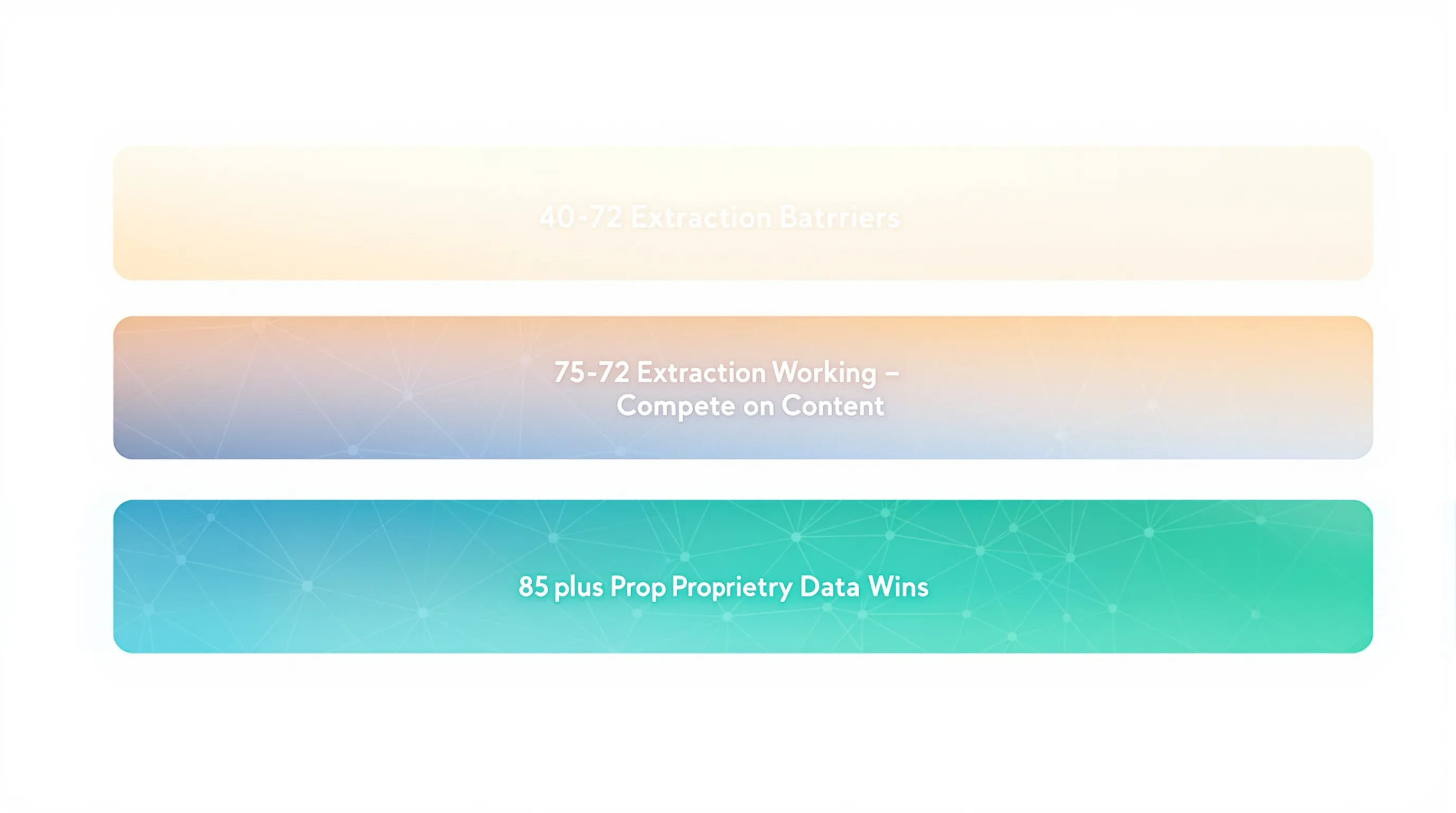
AEO Rank correlation with citation likelihood: the three zones
10-point gain → ~12% citation lift. Extraction barriers dominate. The content may be good. The infrastructure is not letting it through.
10-point gain → ~31% citation lift. Infrastructure works. Content quality and original data begin to differentiate.
Structural parity reached. First-party proprietary research is the primary differentiator across ChatGPT, Perplexity, Google AI Overviews, and Claude.
Source: AEO Content corpus, 340+ scored sites, 90-day citation tracking, 2025-2026.
Questions This Article Answers
Key questions this article addresses
- Does a higher AEO Rank score mean more citations from ChatGPT, Perplexity, and Google AI Overviews?
- At what score threshold does AEO Rank become a reliable citation predictor?
- Why do citation rates barely respond to score improvements below 73?
What will matter most in the next 12-24 months for AEO scoring
The scoring landscape is not static. AI engines update their retrieval logic, their citation selection criteria, and their entity evaluation systems continuously. What I expect over the next one to two years is a shift in how the threshold behaves and what the high-weight criteria measure - which means the readiness floor will likely rise, and the work required to reach it will become more demanding.
The first shift I am watching closely is multimodal extraction. ChatGPT-4o and Gemini are increasingly capable of extracting information from structured tables, charts, and comparative visuals - not just running text. As multimodal citation becomes more common, the table extractability criterion in AEO Rank will carry more weight. Sites that have invested in structured visual data - properly marked up, clearly labeled, with header cells - will see disproportionate citation gains. The threshold may shift upward as multimodal capability raises the baseline extraction expectation across the board.
The second shift is toward named authorship and verifiable credentials. Google's AI Overviews system has been increasingly surfacing content with clear author attribution and stated expertise. Claude and Perplexity have been doing the same. As these systems mature, anonymous content will face a steeper citation penalty. AEO Rank includes author entity signals in its entity authority criterion already, but the weight of that criterion is likely to increase as AI engines formalize their E-E-A-T-equivalent signals. The author matters more than it did a year ago. It will matter more still in a year's time.
The third shift is freshness signaling. All major AI engines have been moving toward temporal awareness - they know when content was published and when it was last updated. Pages that carry visible freshness signals, publication dates, last-updated stamps, changelog structure, benefit as this factor is weighted more heavily. This is not yet a dominant driver in our corpus data. But it is a signal I expect to become meaningfully predictive over the next 12 months. Still, first things first: get above the threshold, then attend to freshness.
What this means for interpreting AEO Rank today: the threshold at 73 reflects the current extraction environment. It will drift. Track citation rate as your primary operational metric rather than AEO Rank as a proxy. The citation rate adjusts automatically to how AI engines actually behave. The score reflects how they behaved when the rubric was written. Both are useful. One is more current.
Looking Ahead: 12-24 months
Where AI Citation Advantage Really Comes From
Three forecasts on what actually drives brand citations in AI assistants over the next two years.
What Drives AI Citations Next
Use these forecasts to weigh where citation gains are likely to come from before committing budget.
Composite AI-search scores sold by optimization vendors will continue to show only a loose relationship to actual citation counts, staying near the 0.35 correlation already observed, because engines synthesize answers from matching passages rather than from a ranked source list.
Over the next 12-24 months, AI assistants will keep pulling a large share of citations from third-party platforms - YouTube, Wikipedia, and Reddit - rather than from brand-controlled pages, capping how much on-site optimization alone can shift citation counts.
Roughly 40-60% of AI citations will keep changing month to month, and pages left unrefreshed for a full quarter will remain about three times more likely to lose their citations, pushing brands toward continuous maintenance rather than a one-time optimization push.
Emerging, Not Established Industry data cited from AirOps and Profound show 40-60% of AI citations change every month and unrefreshed pages are roughly 3x more likely to lose citations (C-8).
Supporting and Conflicting Evidence
Each forecast lists the data points that support it alongside the data that complicates it.
- Every client and brand is asking about AEO -- has someone put is what puts this forecast on the board. [Community / Forum]Correlation between SEO/AEO rankings was measured at 0.35 ("lightly correlated") - cited by u/Chairbreaker from a 2-hour internal work seminar on AEO. “I used to think you need to rank in both Bing and Google. ChatGPT is not limited to bing anymore, and Perplexity has gone rogue lately since Google blocked it…”
- Backing it: What's actually moved the needle for you on getting cited in AI. [Community / Forum]Original poster (u/nick-profound) claims the schema/FAQ playbook widely recommended for AEO is "not a differentiator" because those tactics were built for SERP features (featured snippets, PAP) rather than how ChatGPT and Perplexity select… “the schema and FAQ playbook that gets recommended a lot on Reddit is not a differentiator”
- The actual data behind how AI models choose what to cite (and why is the strongest public backing for this call. [Community / Forum]60% of ChatGPT queries are answered from parametric knowledge alone (no web search, no RAG, no retrieval), per the OP's research summary. “an analysis of 5.17 million citations across OpenAI, Gemini, and Perplexity found that YouTube accounts for roughly 23% of all AI citations, Wikipedia about…”
- Best AEO Tools for AI Search Optimization 2025 | ChatGPT, Gemini is the strongest argument against it. [Blog]“according to Yext's 2025 research, 86% of AI citations come from brand-managed sources - your website, business listings, and review platforms”
- Pushing back: HubSpot AEO Review (2026) for Agencies: Is It Worth It, and What. [Industry Publication]HubSpot AEO is HubSpot's paid answer engine optimization (AEO) product, distinct from its free, one-time "AEO Grader" diagnostic tool. “If you run an agency, the real question about HubSpot AEO isn't 'what does it do?' - it's 'is it worth it for managing AI visibility across multiple client…”
- Backing it: The actual data behind how AI models choose what to cite (and why. [Community / Forum]An analysis of 5.17 million citations across OpenAI, Gemini, and Perplexity found YouTube accounts for roughly 23% of all AI citations.
- AEO Is Here: Three Critical Insights for Marketing Leaders Ready to is the strongest public backing for this call. [Blog]Organic site traffic has dropped 10-50% for most brands, with some seeing declines as high as 80% (panel discussion cited in article). “If you have crummy thought leadership, if you don’t have extraordinary content, you’re going to pay even more than you are now.”
- Pushing back: Best AEO Tools for AI Search Optimization 2025 | ChatGPT, Gemini. [Blog]
- Answer Engine Optimization: The Reputation Signal Nobody Mentions points the same way. [Substack / Newsletter]“As one AEO team put it, answer engines think in solutions, not superlatives, they are not moved by your marketing language, they are moved by the evidence." - …”
- HubSpot AEO Alternatives (2026): The Master Comparison vs the complicates the call. [Industry Publication]Article published/dated June 5, 2026, by Rankability; 17-minute read. “This is the table to skim if you only read one thing.”
What Could Change This Outlook
These scenarios would need to occur for the current citation patterns to reverse.
The Hedge
Of everything here, 65 carries the strongest support, while 65 is the read most worth challenging.
- If regulators or buyers move in the opposite direction, Composite scores keep loosely predicting citations would weaken first.
- If the source mix shifts toward stronger contrary evidence, Composite scores keep loosely predicting citations could become the more durable forecast.
Frequently asked questions
Does a higher AEO Rank always mean more AI citations?
Not linearly. AEO Rank predicts citation likelihood reliably only above a threshold of roughly 73 out of 100. Below that floor, improving the score does not reliably lift citation rates because extraction barriers are still preventing AI engines from parsing your content correctly. The score can rise while citations stay flat if you are fixing low-weight criteria before fixing the extraction infrastructure.
What is the most important thing to fix below an AEO Rank of 73?
FAQPage schema implementation and structured data validation are the most consistently impactful interventions below the threshold. A valid FAQPage schema that passes Google's Rich Results Test is often the fastest route across the citation floor. In our corpus, adding valid FAQPage schema to pages that previously lacked it produced a 22% improvement in citation rates within 30 days on average.
How long does it take to see citation improvements after crossing 73?
Sites in our corpus that crossed from below to above 73 saw citation frequency improve by 2.4x within 60 days on average. Individual results vary by sector, query competitiveness, and how many high-weight criteria were repaired simultaneously. The cleaner the fix - schema, validation, and heading format all addressed together - the faster the improvement typically appears.
Can a site with a low AEO Rank still get cited by AI engines?
Yes, particularly on low-competition queries or if the site carries independent authority that AI engines have indexed through other signals. But at scale, and across competitive queries, the threshold effect is consistent in our data. Below 73, citations happen opportunistically rather than systematically. Above it, they are predictable.
Is AEO Rank calculated the same way for all AI engines?
AEO Rank is a composite score that aggregates signals relevant to AI citation generally. Individual engines weight criteria differently: Google AI Overviews emphasizes schema markup and structured data more heavily, while Perplexity responds more directly to Q&A heading format alignment. The threshold finding at 73 is an aggregate observation across the full set of tracked engines - ChatGPT, Perplexity, Google AI Overviews, and Claude - not a guarantee that every engine will respond identically at that score.
Should I stop improving my AEO Rank once I cross 73?
No - but your priorities should shift. Below 73, every effort should go toward fixing extraction infrastructure. Above 73, the score is still useful as a quarterly structural audit, but your primary optimization energy should shift toward original data production and author credibility. The score continues to correlate with citation likelihood above the threshold; the game just becomes harder and more content-dependent.
Key Takeaways
Key takeaways
- The threshold is 73. Below it, AEO Rank is a diagnostic map, not a citation predictor. Use it to find broken extraction signals, not to measure progress.
- Below the threshold, fix the three binary barriers first: valid FAQPage schema, passing Rich Results Test, question-format H2 headings on pages targeting question queries.
- Above the threshold, compete on original data. Proprietary research, client outcomes, and named author authority are what differentiate sites that all have working extraction infrastructure.
- Track citation rate weekly. Not the score. The citation rate is the outcome; the score is the map. When they diverge, believe the citation rate.
The uncomfortable thing about building a scoring metric is that you have to be willing to test it honestly against outcomes - and to say clearly what you find, even when what you find complicates the product story. What I found when I ran the correlation is that AEO Rank is genuinely useful. But it requires the right mental model to avoid being misled by a number that rises for reasons that do not yet matter.
The score is a readiness floor. It tells you whether your extraction infrastructure is in place. It does not tell you whether your content is worth citing, or whether your author has the kind of recognized expertise that makes Claude and Perplexity route to your page over a competitor who is also technically ready. Those factors live above the threshold, where the structural work is done and the content quality work begins in earnest.
Get above 73. Fix the extraction. Then compete on what you actually know and what nobody else can replicate. That is the sequence. The data, honestly, makes it difficult to argue otherwise.
Sources & Further Reading
References
- Google Rich Results Test - Validate structured data and FAQPage schema before deployment
- Google FAQPage structured data documentation
- Schema.org FAQPage specification
- Google's helpful content guidance
- OpenAI ChatGPT search announcement
Related Articles
- Score AI-search vendors yourself with a 5-signal rank rubric - Explains a related workflow for readers exploring Does a higher AEO Rank actually earn more AI citations.
- How to verify an AI-search vendor actually lifts your citations - Explains a related workflow for readers exploring Does a higher AEO Rank actually earn more AI citations.
- Schema alone will not get you into Google AI Overviews - Explains a related workflow for readers exploring Does a higher AEO Rank actually earn more AI citations.
Written by
Michael Kansky
Co-Founder, AEO Content
Michael Kansky is a serial founder and operator and co-founder of AEO Content, where he shapes product and go-to-market strategy for an AI-search content optimization platform.
Connect on LinkedInSummarize This Article With AI
Open this article in your preferred AI engine for an instant summary.