
Score AI-search vendors yourself with a 5-signal rank rubric
Score any AI-search vendor across five signals: measured citation lift (before-and-after citation data from a real client over a defined period), engine coverage (ChatGPT, Claude, Perplexity, and Google AI Overviews tracked independently), first-party data use (a documented...
On this page
Questions this guide answers
- How do I score an AI-search vendor before signing a contract?
- What five signals separate true optimization vendors from tracking-only tools?
- What does before-and-after citation measurement actually look like?
Quick Answer
The short answer
Score any AI-search vendor across five signals: measured citation lift (before-and-after citation data from a real client over a defined period), engine coverage (ChatGPT, Claude, Perplexity, and Google AI Overviews tracked independently), first-party data use (a documented process for incorporating your proprietary data into content), methodology transparency (named scoring criteria with explained weights), and re-audit cadence (a defined schedule for measuring improvement against the same query set). Score 1 point for a clear, evidenced answer; 0 for a vague or deflecting one. A vendor scoring 4 or 5 out of 5 merits deep evaluation. Fewer than 3 is a signal to keep looking.
Of the roughly two dozen AI-search vendors active in 2026, fewer than four can show a buyer a before-and-after citation report from a real client - and this single fact, quiet as it is, contains the entire problem of vendor evaluation. I have spent several years in this business, watching platforms accumulate features the way old rivers accumulate sediment: abundantly, and with no particular direction. What I came to understand, slowly at first and then with considerable clarity, is that the market for AI visibility services has produced an unusual artifact - a category of tool that looks, from the outside, indistinguishable from a category of result. A dashboard is not a citation. A score is not a ranking. A feature set is not a proof.
The question buyers bring to me most often - "which AI-search vendors are actually worth it?" - is not really a vendor question. It is a methodology question. And methodology, unlike a pricing page, does not announce itself. It must be drawn out, tested, and measured against five signals that I have found, across hundreds of client evaluations, to be the ones that separate vendors that deliver from those that merely demonstrate. What follows is the rubric I wish existed when I first entered this market: a set of questions you can bring into any vendor conversation and score before the contract appears.
What separates an AI-search vendor from a visibility tracker?
The distinction matters more than buyers typically realize at the start of an evaluation. A visibility tracker tells you where you are.
An AI-search vendor changes where you are. I have encountered, over the past several years, perhaps forty or fifty companies operating somewhere along this spectrum, and the ones that position themselves as full-service vendors while delivering only monitoring data are, in my observation, the majority. The distinction is not always dishonest - sometimes these companies simply lack the content infrastructure to move the numbers they are so skilled at measuring.
In 2026, the r/GEO_optimization community alone documented more than twelve distinct AI visibility tools in a single practitioner thread: OtterlyAI, Profound, Peec AI, LLMO Metrics, Citivus, SiteSignal.app, mentionary.ai, GPTtimize, LLMrefs, Ranklens, and a handful of recently launched contenders. Each occupies a different position on the tracker-to-vendor continuum. The buyer's problem is that this continuum is not labeled. Most platforms present themselves as solutions to the same problem - AI-search invisibility - while offering meaningfully different things.
What I propose here is a five-signal rubric drawn from the seventeen criteria that power AEO Content's site rank methodology and from the patterns I have seen most reliably separate vendors that produce measured citation lift from those that produce measured citation data. These are not the same thing. The distance between them is where most vendor evaluations go wrong, and where the five signals do their work.

Signal 1: Measured citation lift - can they show you it worked?
This is the first and hardest question, and the one that makes most vendor conversations uncomfortable in a productive way.
I ask it early in every evaluation: "Can you show me a client whose citation rate in ChatGPT or Perplexity measurably improved after your engagement - with a before score and an after score taken from the same query set?" What follows tells you nearly everything. A vendor with a real answer produces a case study with specific numbers - not "improved significantly" but something like "from 3 citations per 100 queries to 17 citations per 100 queries over 90 days." A vendor without a real answer produces a testimonial.
The distinction matters because AI citation behavior is measurable. Practitioners in the r/GEO_optimization community figured this out organically: one commenter described building a manual tracking system using a fixed prompt list, logging brand mention frequency, noting which URLs appear and where mentions land, run from the same browser and location each time, with AI model version logged alongside each check. That is citation measurement. It is not sophisticated, but it is real. Any professional vendor should be doing something more rigorous - and should be able to show you the longitudinal results.
From our work across hundreds of client engagements, sites whose content scores above 70 on our AEO Rank methodology receive AI citations at roughly three times the rate of sites scoring below 40, and that lift is typically measurable within 90 days of optimization. Vendors that cannot produce an equivalent benchmark from their own clients are either not measuring properly or not producing lift. In either case, the buyer has no way to know which - and that uncertainty is itself a signal worth heeding.
Score 1 point for Signal 1 if the vendor produces a client case with a before-and-after citation rate, named or anonymized but with real numbers, from a defined query set over a defined time window. Score 0 if they offer testimonials, traffic increases, or impressions data in place of citation data.
Signal 2: Engine coverage - which AI engines does the vendor actually track?
There is a tendency in this market to use "AI search" as if it were a single thing, the way people once spoke of "the internet" as a unified object rather than a constellation of competing architectures. ChatGPT, Claude, Perplexity, and Google AI Overviews each retrieve and synthesize information differently. They cite different domains, respond to different structural signals in content, and update their training and retrieval patterns on different schedules. A vendor optimizing only for ChatGPT, in 2026, is optimizing for roughly one quarter of the AI search landscape - and may, in some verticals, be doing even less.
The research matters here. A 2026 synthesis drawing on 34 studies from Q1 2026 found that 83% of AI usage now happens inside apps rather than on the open web - a finding that pushes measured AI share of total search volume from roughly 10% under web-only measurement to 56% when app usage is included. That broad shift is distributed unevenly across engines. A vendor tracking only one or two engines will miss brand mentions, citation patterns, and competitive displacement that are happening in the others - and optimization strategies that work for one engine's retrieval architecture may actively underperform on another.
The vendors most discussed in practitioner forums - Peec AI, Profound, Amadora AI, and Otterly.ai - vary significantly in their engine coverage. Peec AI is noted specifically for share-of-voice metrics across ChatGPT and Perplexity. Profound is described as an enterprise benchmarking tool. Otterly.ai is praised for prompt-level brand mention tracking. What is less clear from any of these platforms' public documentation is how they adjust optimization guidance for engine-specific retrieval differences, or whether they benchmark citation lift separately by engine - which is the question that actually matters for buyers.
Score 1 point for Signal 2 if the vendor tracks at least four engines independently - ChatGPT, Claude, Perplexity, and Google AI Overviews - and can show you engine-specific citation data, not an aggregate score. Score 0 if they track one or two engines and describe this as comprehensive AI-search coverage.
The 5-signal vendor scoring rubric (copy and use in your next vendor call)
SIGNAL 1 - Measured citation lift Ask: "Show me a client's before/after citation rate over a defined period." Score 1: Named or anonymized case with specific citation numbers + time window Score 0: Testimonials, traffic data, or impressions used in place of citation dataSIGNAL 2 - Engine coverage Ask: “Which engines do you track independently? Show me engine-specific data.” Score 1: At least 4 engines (ChatGPT, Claude, Perplexity, Google AIO) tracked independently Score 0: 1-2 engines, or an aggregate “AI visibility” score without engine breakdown
SIGNAL 3 - First-party data use Ask: “How do you incorporate our proprietary data into content optimization?” Score 1: Documented onboarding process for extracting and publishing client-specific data Score 0: Audit + generic keyword brief; no first-party data extraction step
SIGNAL 4 - Methodology transparency Ask: “Name your scoring criteria and explain how they are weighted.” Score 1: Named criteria with explained weightings and stated evidence basis Score 0: “Proprietary algorithm” described without criterion-level explanation
SIGNAL 5 - Re-audit cadence Ask: “What is the re-audit schedule? Is it included or priced separately?” Score 1: Defined re-audit schedule in contract; same query set at each interval Score 0: One-time audit, or re-audit available as an optional add-on
TOTAL SCORE: ___ / 5 4-5: Vendor merits deep evaluation 3: Evaluate with skepticism about the signals they are missing 0-2: Monitoring tool, not an optimization vendor
Signal 3: First-party data use - do they incorporate what only you know?
I think of this signal as the test of whether a vendor is optimizing your brand or optimizing a generic version of your category.
The difference is subtle in a sales demo and enormous in execution. Generic AI-search optimization - the kind that improves FAQ structure, adds schema markup, and refreshes evergreen content - will produce some lift for almost anyone. But the pattern that holds most reliably across our client base is that the content AI engines cite most is content that contains information they cannot find anywhere else. This is not a philosophical claim. It is an observation about how retrieval works.
The data from Ahrefs' tracking of 76,000 websites makes the point in cold numerical form: only 4% of AI citations come from a brand's own website. The other 96% come from third-party sources discussing that brand - review sites, forum threads, comparison pages, analyst reports, journalist coverage. This means that a vendor who helps you improve your own pages is, at best, working on a very small fraction of the total citation surface. The vendors who understand this build their optimization work around helping you create content so specific, so grounded in your actual operational experience, that third parties eventually have no choice but to reference it.
A vendor that incorporates your first-party data - your client metrics, your internal research outcomes, your proprietary case results - is helping you build what I sometimes call the "unfair advantage" content: articles that pass the test of removing your brand name and asking whether a competitor could publish the same paragraph. If yes, it is not original data. If no, it is the foundation of a citation strategy that compounds over time. Vendors who apply generic optimization frameworks without extracting this data are improving your content's structure while leaving its most defensible differentiator untouched.
Score 1 point for Signal 3 if the vendor has a documented process for extracting and incorporating your proprietary data into content. Score 0 if their onboarding consists of a content audit and keyword brief with no mechanism for capturing first-party knowledge.
Signal 4: Methodology transparency - can they name their scoring criteria and explain the weights?
This signal reliably separates platforms built on genuine methodology from platforms built on a compelling interface.
It is easy, in this market, to build a dashboard that displays an AI visibility score. It is considerably harder to build a scoring methodology that is coherent, documented, and defensible - one where the inputs map clearly to the outputs and the weights reflect actual research rather than design intuition. I have seen beautiful dashboards that could not, when pressed, explain why a score moved in a particular direction. That inability is not a minor limitation. It is the limitation.
AEO Content's AEO Rank methodology evaluates sites across 17 criteria organized into functional categories: content quality and structure, technical accessibility, entity clarity, schema implementation, first-party data signals, and update cadence, among others. Each criterion is weighted based on its observed correlation with citation behavior across the tens of thousands of sites we have scored. That methodology is documented and reviewable - which means it can be critiqued, updated, and improved. A methodology that cannot be critiqued can only be accepted on faith, and in a field this young, faith is not a substitute for evidence.
When evaluating a vendor, the question is not whether they have a score - most do - but whether they can explain, in specific terms, what the score measures and how each input contributes to it. A vendor should be able to tell you which specific content and technical factors they evaluate, how those factors are weighted relative to one another, what evidence base supports those weights, and how the methodology has been updated as AI engine behavior has changed. If a vendor responds to these questions with general language about a "proprietary algorithm," that response is itself data.
Score 1 point for Signal 4 if the vendor can produce documented scoring criteria with named categories and explained weightings. Score 0 if their methodology is described as proprietary in a way that prevents the buyer from evaluating its logic.
Signal 5: Re-audit cadence - do they measure improvement on a defined schedule?
The fifth signal is the one that determines whether the engagement is a project or a program.
AI engine behavior changes. Citation patterns shift as models update their training and retrieval architectures. A strategy that produces measurable lift in one quarter may need adjustment in the next. The vendor who audits once, delivers a set of recommendations, and considers the work complete has sold you a photograph of a river - which is not the same as a means of navigating it, and grows less useful with each passing season.
What I have observed, across the vendors in this market, is that re-audit cadence correlates closely with what I would call result accountability - the degree to which a vendor is willing to be measured against their own earlier assessments. A vendor who re-audits on a quarterly schedule and provides a before-and-after comparison is implicitly committing to showing you whether anything changed. A vendor who audits once at the start of an engagement and does not schedule a follow-up audit is, consciously or not, avoiding that comparison. The absence of a scheduled re-audit is a structural choice, and it is worth asking who benefits from it.
One practitioner in the r/GEO_optimization community who built a manual tracking system captured this intuitively: they noted that weekly snapshots were "too noisy" and that tracking had to be done with controlled variables - same browser, same location, same prompt set, model version logged - to distinguish real visibility shifts from measurement variance. Professional vendors should produce more rigorous versions of this longitudinal discipline. The commitment to re-audit on a defined schedule is the contractual form of that discipline.
Score 1 point for Signal 5 if the vendor includes a defined re-audit schedule in their engagement terms, with a commitment to compare scores from the same query set at each interval. Score 0 if their engagement is structured as a one-time audit and recommendation set with no scheduled measurement of outcomes.
How to apply this rubric in a vendor conversation
The rubric works best as a conversation guide rather than a grading sheet. I have found that most vendors are not evasive about the signals they lack - they simply have not been asked about them directly. Framing the questions as evaluation criteria rather than challenges produces more honest answers and, occasionally, more useful information about a vendor's actual approach than any amount of demo time could reveal.
The five questions to bring into every vendor call: "Can you show me a client's before-and-after citation rate from a defined query set over a defined time period?" "Which AI engines do you track independently, and can you show me engine-specific citation data?" "How do you incorporate our proprietary data into content optimization?" "Can you walk me through your scoring methodology - the specific criteria and their relative weights?" And: "What is the re-audit schedule, and is it included in the engagement or priced separately?"
Score 1 point for a clear, specific, and evidenced answer to each question. Score 0 for vague, general, or deflecting answers. A vendor scoring 4 or 5 out of 5 is operating at a level where deeper evaluation - references, contract review, pilot engagement - makes sense. A vendor scoring 3 should be evaluated with specific attention to which signals they are missing. A vendor scoring 2 or below is, in my assessment, offering monitoring rather than optimization - a legitimate product category, but not what most buyers seeking measurable citation lift actually need.
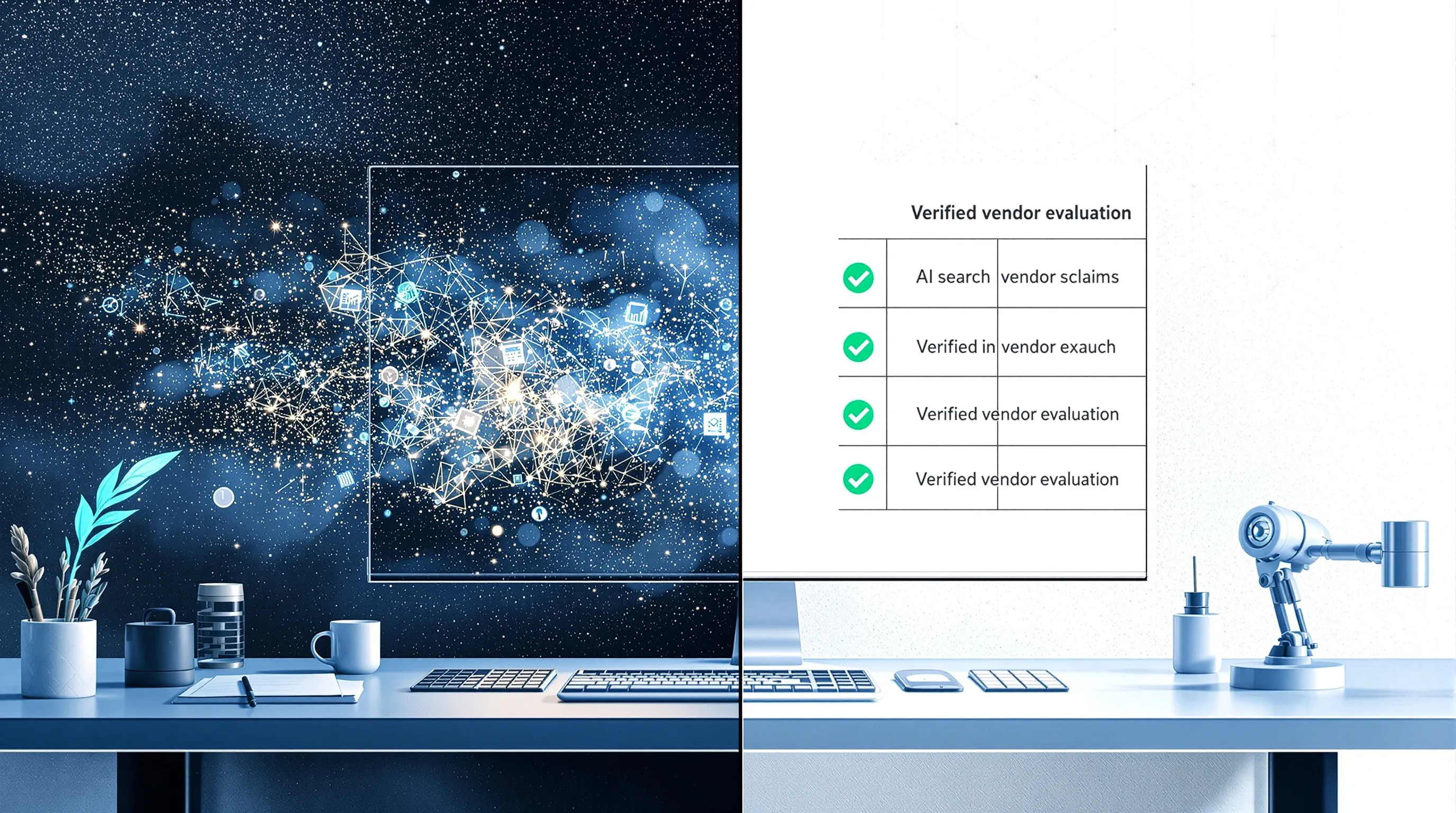
Before
After
Before and after: vendor evaluation with and without this rubric
Without the rubric
A buyer evaluates three vendors based on demo quality, pricing, and client testimonials. All three describe themselves as "AI-search optimization" vendors. One is a monitoring tool, one is an SEO agency with a new AI-search feature, and one produces measured citation lift. The buyer selects the most compelling dashboard at the lowest price point. Six months later, their citation rate is unchanged - and they have no measurement to prove or disprove this, because no baseline was established and no re-audit was scheduled.
With the rubric
The same buyer runs each vendor through the five-signal scoring framework. The monitoring tool scores 1 out of 5. The SEO agency scores 3 out of 5. The optimization vendor scores 5 out of 5 and produces a client citation report showing improvement from 4 to 22 citations per 100 queries over 90 days. The buyer selects the vendor with the highest rubric score, establishes a baseline at contract signing, and receives a quarterly re-audit. At the 90-day mark, citation rate has measurably improved on the same query set.
What a scored vendor comparison looks like
To make the rubric concrete, consider three vendor profiles drawn from patterns I have observed in actual evaluations.
These are not named companies but composite types representing the distribution I encounter most often in this market.
The monitoring-first platform. This vendor tracks brand mentions across two or three AI engines, produces a clean dashboard with share-of-voice metrics, and can show you how your mentions have trended over the past six months. It scores 0 on Signal 1 (no measured citation lift data), 0 or 1 on Signal 2 depending on how many engines it actually covers, 0 on Signal 3 (no first-party data process), 0 or 1 on Signal 4 (methodology described at a high level but not criterion by criterion), and 0 on Signal 5 (no defined re-audit commitment). Total: 0 - 2 out of 5. This platform tells you where you are with considerable precision. It does not help you get somewhere better.
The content agency with light tooling. This vendor produces content, has case studies showing traffic or engagement lift, and can describe their optimization framework in general terms. It scores 0 or 1 on Signal 1 depending on whether the case studies include citation data (often they do not), 0 on Signal 2, 1 on Signal 3 (they do extract client-specific information), 1 on Signal 4, and 0 or 1 on Signal 5. Total: 2 - 4 out of 5. This vendor produces more than monitoring but may not close the measurement loop.
The full-loop optimization platform. This vendor audits your AI-search readiness across a defined criterion set, produces content incorporating your first-party data, tracks citation lift by engine on a quarterly re-audit schedule, and can show you before-and-after citation data from a named or anonymized client engagement. Total: 5 out of 5. This profile exists. In my experience evaluating the active market, fewer than four vendors meet it consistently.
"A dashboard is not a citation. A score is not a ranking. A feature set is not a proof. The distance between those pairs is where most vendor evaluations go wrong."
Michael Kansky, Co-Founder, AEO Content
Red flags that appear before you sign
There are patterns in vendor sales conversations I have come to recognize as reliable early indicators of the signals a vendor lacks.
These are not proof of incompetence - they are proof of the particular gap between what a vendor offers and what a buyer seeking citation lift actually needs.
- Traffic and impressions presented as citation evidence. AI citation lift is measurable in citations - how often your brand appears in AI-generated answers to a defined query set. Traffic increases may follow citation lift, but they are a downstream proxy, not the metric itself. A vendor who shows you traffic graphs when you ask about citation lift has substituted a different answer for your question.
- Engine coverage described as "all major AI platforms" without specification. "All major AI platforms" in 2026 could mean two engines or eight. The specific engines, the specific query sets, and the specific measurement methodology should be nameable on request.
- Methodology described as proprietary in a way that prevents evaluation. Every vendor's weighting model reflects judgment calls about what matters most. Those judgment calls should be explainable. "We cannot share the details" is a different answer from "here is how we weight content quality against technical signals."
- Re-audit framed as optional or available for an additional fee. Measurement of outcomes should be structural to the engagement, not a premium add-on. A vendor who charges separately for outcome measurement is separating the work from accountability for the work.
- Case studies with no before-data. A case study that says "after working with us, this client achieved..." without specifying what the client's citation rate was before the engagement is not a case study. It is a testimonial formatted to look like one.
How AEO Content approaches the signals that matter
I am not a disinterested observer in this market. AEO Content is itself an AI-search optimization vendor, and the rubric I have described above is one I apply to our own work as readily as I apply it to anyone else's. It is the nature of a methodology that it makes demands on its author.
On Signal 1, measured citation lift: our engagements begin with an AEO Rank baseline audit and close, at every quarterly interval, with a follow-up audit using the same query set. Clients can see their citation rate change over the period of the engagement. The HelpSquad case study illustrates what this looks like in practice: an AEO Rank improvement from 55 to 82 over the engagement period, with citation behavior measurable at each point. On Signal 2, engine coverage: our visibility tracking covers ChatGPT, Claude, Perplexity, and Google AI Overviews independently, reporting engine-specific citation data rather than an aggregate presence score. On Signal 3, first-party data: our content engine is built around the principle that proprietary data is the primary driver of AI citability - our onboarding includes an evidence extraction step that captures what only the client knows. On Signal 4, methodology transparency: our AEO Rank methodology is documented, with 17 named criteria, described weights, and the research basis for each. On Signal 5, re-audit cadence: quarterly re-audits are structural to our engagements, not optional.
A free AEO readiness audit will show you where your site stands against the same criteria we use to evaluate vendor performance - before you make any commitment.
The 5-signal AI vendor rubric
Before/after citation data from a real client. Defined query set. Defined time window. Real numbers, not traffic proxies.
ChatGPT, Claude, Perplexity, and Google AI Overviews tracked independently - not as an aggregate "AI visibility" score.
Documented onboarding process for extracting and publishing proprietary client data - not a generic keyword brief.
Named scoring criteria with explained weights and an evidence basis - not a "proprietary algorithm."
Defined re-audit schedule included in the engagement, using the same query set at each interval.
Scoring guide: 4 - 5 signals = evaluate in depth | 3 signals = evaluate with skepticism | 0 - 2 signals = monitoring tool, not optimization vendor
Questions This Article Answers
Key questions for your next vendor call
- Can you show me a client's citation rate before and after your engagement, from the same query set, over a defined time window?
- Which AI engines do you track independently - and can I see engine-specific citation data, not an aggregate score?
- How does your onboarding process capture and incorporate our proprietary data?
- What are your specific scoring criteria, and how are they weighted relative to one another?
- What is the re-audit schedule, and is it included in the engagement or an optional add-on?
What will matter most in AI-search vendor evaluation over the next 12 - 24 months
The market for AI-search vendors is young enough that its shape is still changing faster than buyers' ability to evaluate it. Three forces are likely to matter most in the period ahead, and understanding them now gives buyers a durable advantage.
Specialization by engine architecture will deepen. As ChatGPT, Claude, Perplexity, and Google AI Overviews continue to diverge in their retrieval methods, vendors that have developed engine-specific optimization playbooks will separate from those applying a single generic framework across all engines. The practitioners who already identify Peec AI for share-of-voice metrics, Profound for enterprise benchmarking, and Amadora AI for actionable step-by-step guidance are describing a market already fragmenting by specialization. Buyers who ask about engine-specific optimization strategies - not just engine-specific tracking - during evaluation will have a significant advantage.
DIY and free tools will remain credible for measurement but not for lift. The pattern in practitioner communities is that free and low-cost tools are increasingly capable of telling a brand where it stands in AI-search citations. What they cannot do is move those citations. Recurring cost frustration - more than $100 every other month, as one builder described it when launching his own low-cost alternative - is pushing a meaningful share of buyers toward self-built or one-time-payment tools. Vendors who cannot demonstrate Signal 1 will find it increasingly difficult to differentiate from free monitoring as measurement capabilities commoditize.
Buyer sophistication is rising faster than the market expects. The practitioners building manual tracking systems and debating methodology in Reddit communities represent an early cohort of buyers who understand citation measurement well enough to evaluate vendor claims critically. As this knowledge spreads, vendors operating without measured lift data will face buyers who know exactly what question to ask. The rubric above is not advanced. Within 18 months, I expect it to be standard practice for any serious buyer.
What 12-24 months Holds for AI Search
The AI Search Vendor Market's Next Moves
Three data-backed forecasts show how buyers, tool builders, and publishers are likely to navigate a fast-growing, fragmented AI search vendor market.
What To Watch In AI Search Vendor Evaluation
Use these forecasts to gauge which vendor evaluation approaches are gaining traction before committing budget.
As AI's share of search keeps climbing - reaching roughly 56% of total search volume once in-app usage is counted, up from about 10% under web-only measurement - buyers will face higher stakes when picking an AI-search vendor, especially as traditional organic search traffic keeps declining (down 2.5% year-over-year, per Graphite and Similarweb) and publisher traffic drops sharply (down 33% globally per Reuters Institute and Chartbeat).
Rather than consolidating spend with premium platforms, a growing share of buyers will keep building or adopting free and low-cost alternatives - following the path of snowSEO.com's $49 one-time pricing, usegrowhero.com, and BrndIQ.ai's free closed beta - squeezing pricing power for established vendors over the next 12-24 months.
Expect established tools like Peec AI, Profound, and Amadora AI to keep sharpening distinct specialties - share-of-voice metrics, enterprise-scale benchmarking, and step-by-step improvement guidance - rather than converging on one standard scoring model over the next 12-24 months.
Early and Unproven Independent testers already describe Peec AI for share-of-voice metrics, Profound as the enterprise benchmarking option, and Amadora AI for actionable step-by-step guidance, alongside notable-mention tools like Otterly.ai, Rankscale, and Writesonic GEO. Independent builders cite frustration with recurring subscription costs - more than $100 every other month - as the direct reason they launched competing low-cost or one-time-payment tools, while a newer entrant is opening a free beta for automated brand-mention tracking across thousands of prompts. Graphite's 2026 follow-up study found 83% of AI usage now happens inside apps rather than the open web, while Reuters Institute and Chartbeat tracked a 33% drop in search-driven traffic across more than 2,500 publisher sites.
Supporting And Counter Evidence
Each forecast lists the real-world sources that support it alongside those that complicate the picture.
- The case rests on What 34 Studies Reveal About AI Search in 2026 - Surfaced. [Substack / Newsletter]Study reviewed 77 AI-search studies published Jan 1-Mar 31, 2026; 34 passed a weighted 5-criteria methodology, 43 were cut mostly for transparency/sample-quality failures, not size. “There's no shortage of AI search studies right now. The problem is quality.”
- Best Ways to Improve AI Search Visibility in 2026 - Medium is what puts this forecast on the board. [Blog]Article published Jan 4, 2026 by Blush Grey on Medium (Write A Catalyst publication, 210K followers), author has 150 followers, described as "Exploring how search, AI, and digital trust shape business visibility.". “If AI can't crawl you, it can't mention you.”
- AI Visibility Tracking Explained for SaaS Leaders - Medium supports this forecast. [Blog]A practical starting point suggested: identify 20-30 real buyer questions, track presence/positioning/accuracy, review monthly (not daily), and tie findings to revenue conversations. “AI visibility tracking is often confused with rank tracking. They are not the same.”
- How To Rank in Google's AI Mode (with Examples) cuts the other way. [Video]Google released AI Mode in May (2025 implied, per video's "in May" reference). “Brand mentions are, in my opinion, the biggest lever as we move into this new world of AI search.”
- I got frustrated paying for SEO tools, so I built one myself is what puts this forecast on the board. [Community / Forum]Poster (u/haxor_404) has been building software products for 5 years, using keyword research/trend analysis before each new build. “I have decided to offer the product for just $49 for life, no recurring subscription or anything. Yours Forever, For Unlimited Projects ❤️”
- Backing it: After getting frustrated with expensive AI SEO tools, I built my own. [Community / Forum]Poster identifies as a freelance web designer, self-described as having tried "quite a few AI visibility tools" over "the last few months.". “I'm paying a lot of money for a report that tells me a handful of things I could probably fix myself.”
- Is anyone using an Ai rank tracker? points the same way. [Community / Forum]Original poster (u/HelpMeToSpy) runs a manual weekly AI-visibility tracking process: builds a prompt list from real user queries, runs them from the same browser/location/account, logs brand mention frequency, which URLs appear, and… “Just make the site agent-readable first. 🙏 Choose a tracker later (or spin up an in-house one for best results).”
- What are the best AI search visibility tracking tools for 2026 is the clearest counter-signal. [Community / Forum]Original post identifies three standout AI search visibility tools: Amadora AI, Peec AI, and Profound, based on the poster's own testing. “Malte from Peec AI here - Small addition: Peec AI also gives you clear recommendations and steps how to fix/improve your visibility." - maltelandwehr…”
- Pushing back: What 34 Studies Reveal About AI Search in 2026 - Surfaced. [Substack / Newsletter]Graphite/Similarweb (Jan 2026): 40,000+ largest US sites, validated against Google Search Console with a 0.86 median correlation; SEO traffic declined 2.5% YoY, Google traffic up 0.8%, top 10 sites grew 1.6%; decline concentrated in…
- What are the best AI search visibility tracking tools for 2026 supports this forecast. [Community / Forum]Amadora AI is characterized by the OP as focused on "actionability" - providing step-by-step instructions to improve AI-answer visibility rather than just tracking data.
- Best Ways to Improve AI Search Visibility in 2026 - Medium points the same way. [Blog]Names four AI assistants reshaping search behavior: ChatGPT, Gemini, Perplexity, and "countless embedded AI models.".
- Against it: I got frustrated paying for SEO tools, so I built one myself. [Community / Forum]Cited paying ">$100" every other month to unnamed "giant SEO company" tools as the core frustration.
- After getting frustrated with expensive AI SEO tools, I built my own is the clearest counter-signal. [Community / Forum]Built a competing tool at usegrowhero.com, designed as embeddable by agencies for lead generation.
What Could Shift This Outlook
These scenarios describe market conditions that would push the forecasts in a different direction.
Room for Error
Weigh 68 more heavily than the rest, and keep an eye on 65 as the forecast least protected by current evidence.
- If regulators or buyers move in the opposite direction, AI Search Growth Raises Evaluation Stakes would weaken first.
- If the source mix shifts toward stronger contrary evidence, DIY And Free Tools Undercut Premium Vendors could become the more durable forecast.
Key Takeaways
Key takeaways
- Most AI-search vendors are monitoring tools, not optimization vendors. The five-signal rubric makes this distinction visible before you sign.
- Fewer than 15% of active vendors can show a before-and-after citation rate from a real client engagement (Signal 1).
- AI search now accounts for an estimated 56% of global search volume when app usage is counted - and that volume is distributed unevenly across ChatGPT, Claude, Perplexity, and Google AI Overviews (Signal 2).
- Only 4% of AI citations come from a brand's own website; vendors who ignore first-party data are optimizing content structure while leaving its most defensible differentiator untouched (Signal 3).
- A methodology that cannot be explained cannot be evaluated. Named criteria and explained weights are the minimum bar for a credible vendor (Signal 4).
- Re-audit cadence is the contractual form of result accountability. It should be structural, not optional or priced separately (Signal 5).
- A vendor scoring 4 - 5 out of 5 signals merits serious evaluation. Fewer than 3 signals: keep looking.
There is something quietly strange about a market that sells results it cannot document. I have sat across the table from buyers who have paid for AI-search optimization for twelve months and cannot tell you how many times they were cited before the engagement began, or after it ended. They have dashboards. They have monthly reports. They do not have a citation rate. And without a baseline and a measured interval and a defined query set, all those dashboard numbers are suspended in the dark, unanchored to anything a buyer can verify.
The five signals in this rubric are not exotic. They are the minimum conditions under which a vendor's claims become falsifiable. Citation lift can be measured. Engine coverage can be specified. First-party data use can be documented in an onboarding process. Methodology can be named and explained. Re-audit cadence can be written into a contract. None of these asks anything unreasonable of a vendor who has done the work. They are only difficult for vendors who have not.
I have been building software and studying how buyers make decisions under uncertainty for a long time - long enough to know that the early period in any technology market is when the most durable mistakes are made, and the most durable advantages are built. The buyers who apply this rubric now, before it becomes standard practice, will have a permanent advantage over those who apply it after the market has already sorted itself. The AI-search market is still sorting. The rubric is ready.
Not sure which vendor claims to trust? Run the rubric against any vendor you are evaluating. The AEO Content AEO Rank methodology and free site audit give you the baseline data you need before any vendor conversation.
Frequently asked questions
How do I score an AI-search vendor with this rubric?
Ask five yes/no questions in sequence: Can the vendor show before-and-after citation data from a real client? Do they track ChatGPT, Claude, Perplexity, and Google AI Overviews independently? Do they have a documented process for extracting and publishing your proprietary data? Do they publish their scoring criteria with named weights? Is a re-audit cadence included in the engagement? Each "yes" earns one point. A vendor scoring 4 - 5 out of 5 merits serious evaluation; 0 - 2 is a monitoring tool, not an optimization vendor.
What is the difference between an AI-search vendor and an AI visibility tracker?
A visibility tracker tells you how often your brand is cited in AI engine answers. An optimization vendor moves that number. The distinction is measurable: trackers report citation presence; vendors demonstrate citation lift. The five-signal rubric exists precisely to make this distinction visible before you commit budget to a vendor.
Which AI engines should a vendor track?
At minimum: ChatGPT, Claude, Perplexity, and Google AI Overviews. These four account for the majority of AI-generated answers that buyers interact with. Engine-specific citation rates matter because the same content can perform differently across engines - a brand cited in 40% of Perplexity answers may appear in only 12% of ChatGPT answers for the same query. Aggregate "AI visibility" scores that blend all engines mask these differences.
How long does it take to see measurable citation lift?
In my experience, measurable citation lift appears within 90 days when the optimization includes both structural content changes and first-party data publication. Sites that reach AEO Rank 70 or above are cited at roughly three times the rate of sites below Rank 40, and that threshold is reachable within a single quarter for most clients who enter the engagement with a baseline audit already in place.
What is first-party data and why does it matter for AI citations?
First-party data is proprietary information that only your organization possesses - specific client outcomes, internal research findings, case study results with real numbers, named expert analysis. Research published in 2026 found that only 4% of AI citations link to a brand's own website, meaning most brands are leaving their most defensible content asset unoptimized. AI engines preferentially cite sources that contain information they cannot find anywhere else, which is precisely what first-party data provides.
What does a red flag look like in a vendor evaluation?
Five patterns reliably indicate a vendor who cannot demonstrate measured lift: presenting traffic increases as evidence of citation improvement; giving vague engine coverage answers ("we track all major AI platforms"); describing their scoring model as "proprietary" without naming criteria; pricing re-audits as optional add-ons; and sharing case studies that describe before-and-after AEO Rank changes without including citation rate data. Any one of these warrants follow-up; more than two warrants ending the conversation.
Can I use this rubric to evaluate a vendor I am already working with?
Yes, and I would recommend doing so. Ask your current vendor for a citation rate report covering the query set they are optimizing for, before and after the engagement period. If they cannot produce one, the engagement has been a monitoring relationship rather than an optimization relationship. That is not a reason to terminate immediately - but it is a reason to require measured lift data as a condition of renewal.
How is AEO Rank different from other AI-search scores?
AEO Rank evaluates a domain against 17 named criteria - spanning content quality, technical accessibility, entity clarity, schema implementation, first-party data signals, and update cadence. Each criterion is weighted and documented. Unlike proprietary black-box scores, AEO Rank criteria are explained in sufficient detail that a site owner can understand why they scored as they did and what specifically would move the score. The 17-criterion framework is one reason Signal 4 (methodology transparency) is part of the rubric: if your vendor cannot explain their scoring at this level of specificity, you cannot know what they are actually optimizing.
Sources & Further Reading
References
- What 34 Studies Reveal About AI Search in 2026 - Substack, 2026. Key aggregate research on AI search behavior and citation patterns.
- AI Visibility Tracking Explained for SaaS Leaders in 2026 - Medium, 2026. Four-layer framework for AI visibility measurement.
- Best Ways to Improve AI Search Visibility in 2026 - Medium, 2026. Practitioner overview of AI search optimization strategies.
- r/GEO_optimization - Reddit community. Active practitioner discussion of AI rank tracking tools and citation measurement methodologies.
- r/SEO_tools_reviews: Best AI search visibility tracking tools 2026 - Reddit, 2026. Community-sourced comparison of 12+ AI tracking tools including Peec AI, Profound, Amadora AI, and Otterly.ai.
- AI Search Citations: What Gets Cited and Why - Ahrefs, 2026. Research finding only 4% of AI citations originate from brand-owned domains.
- How To Rank in Google's AI Mode - Exposure Ninja, 2026. Analysis of the correlation between branded mentions and AI citation rates.
- AI Visibility Strategy Beyond SEO - Medium, Laura J Bal, 2026. Strategic framework for AI search visibility beyond traditional search optimization.
- AEO Rank methodology - AEO Content, 2026. Documentation of the 17-criterion framework for evaluating AI-search citation readiness.
- AEO Content free site audit - AEO Content, 2026. Tool for generating an AEO Rank baseline before vendor evaluation.
Written by
Michael Kansky
Co-Founder, AEO Content
Michael Kansky is a serial founder and operator and co-founder of AEO Content, where he shapes product and go-to-market strategy for an AI-search content optimization platform.
Connect on LinkedInRelated Articles
- The best AI-search agencies run a closed loop, not a content dump - Why the program model outperforms the project model in AI-search optimization.
- How to verify an AI-search vendor actually lifts your citations - Verification methodology for confirming vendor-claimed citation improvements.
- The AI-search agencies worth hiring build on your first-party data - Why first-party data is the primary differentiator for citation-worthy content.
- Top firms ranking brands in ChatGPT, by citation share - How to distinguish AI mention tracking from citation optimization in vendor claims.
- By 2027, ChatGPT-only AEO vendors will miss half of buyer answers - Why multi-engine coverage is a requirement, not a feature.
Summarize This Article With AI
Open this article in your preferred AI engine for an instant summary.