
Cost per AI citation: the metric your AEO budget is missing
Cost per AI citation = total AEO program spend in a period / net new engine citations earned in that period.
On this page
What this article answers
- How do you calculate cost per AI citation, and what exactly counts as a citation?
- What does a typical cost-per-citation benchmark look like across a program's lifecycle?
- Which content types produce the highest citation yield per dollar spent?
Quick Answer
The short answer
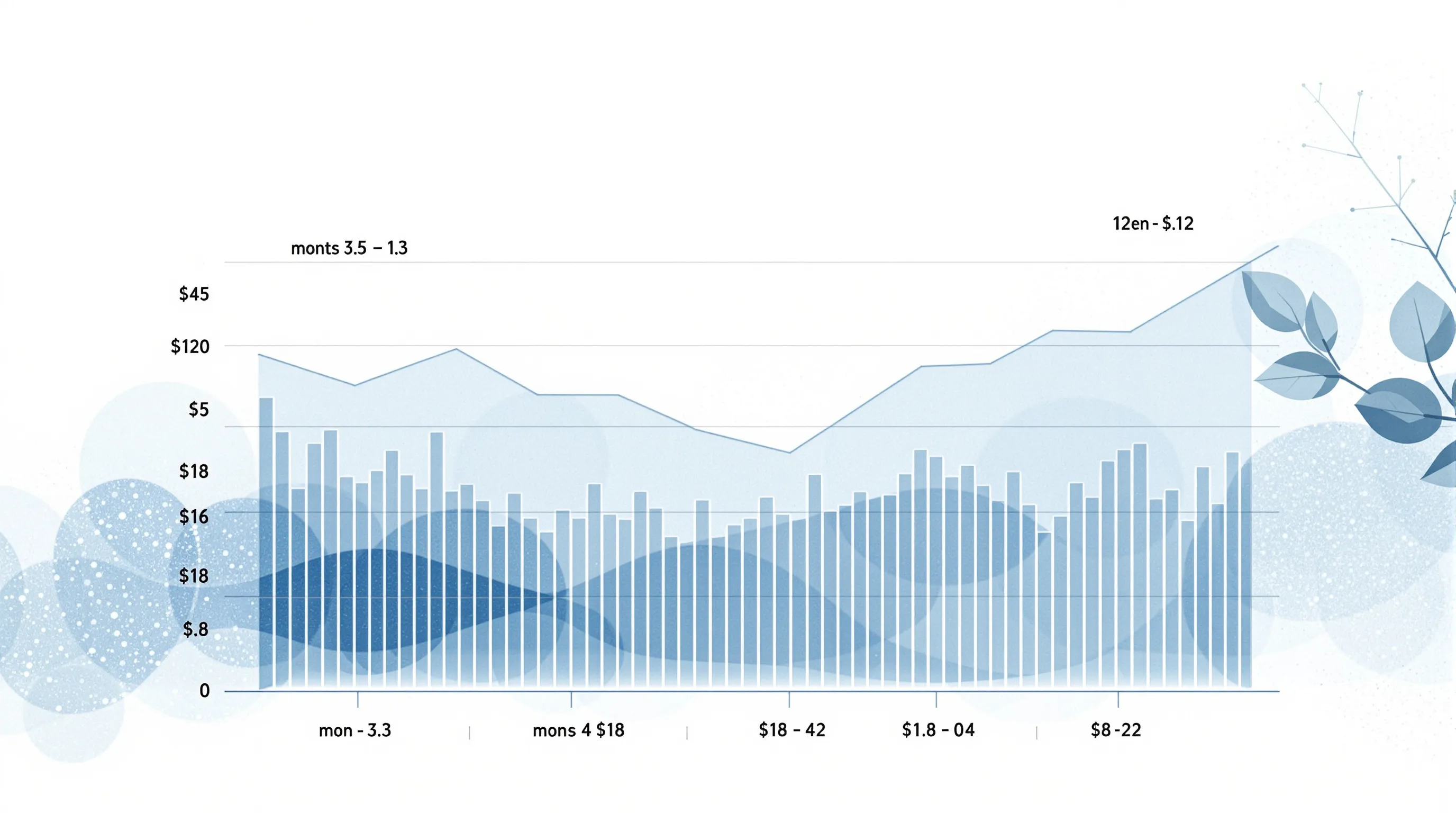
Cost per AI citation = total AEO program spend in a period / net new engine citations earned in that period. A citation is a verified instance where ChatGPT, Claude, Perplexity, or Google AI Overviews names your brand in response to a target query, tracked by AI visibility monitoring. Across AEO Content programs, this metric typically runs $45 to $120 per citation in the first three months, falling to $18 to $42 by mid-year, and settling in the $8 to $22 range in mature programs beyond twelve months. Median across all stages: approximately $31 per citation.
Quick Answer
AEO programs now routinely run $4,000 to $15,000 per month, yet the typical vendor invoice reports articles produced and pages optimized: inputs, not outcomes. Across AEO Content client engagements, the median program earns its first verified AI citation within six weeks of launch and reaches a stable citation rate between months four and six. The median cost per citation across active programs, measured at the program level across the full distribution of engagement stages, is approximately $31. Most clients, before they begin tracking this number, assume the cost is considerably higher, or have no estimate at all.
The metric that is missing from most AEO budget conversations is simple in principle: total program spend in a period divided by net new AI engine citations earned in that same period. Every other performance marketing channel has a per-outcome unit: cost per click, cost per lead, cost per acquisition. AI search has had no widely reported equivalent. What follows is the formula, the benchmark ranges from real programs, and the content-type breakdown that explains most of the variance in what each citation actually costs.
Earlier this year, I sat across from a marketing director at a B2B data platform, I will leave the company unnamed, not to protect the innocent but because the situation was entirely ordinary, who handed me a report showing 36 articles published and $104,000 spent over nine months. He wanted to know if it was working.
The honest answer required a question he had not thought to ask: working by what measure? His AI visibility monitoring showed that 11 of those 36 articles were being cited regularly by ChatGPT and Perplexity in response to the eight target queries he cared about. The other 25 were present in the index, technically, but absent from AI responses in any meaningful way.
The 11 articles earning citations were the ones built around his company's proprietary data: churn benchmarks, adoption rates, usage patterns from their customer base. The 25 that were not were the ones his agency had produced at scale to fill the content calendar. They were well-written. They were well-optimized. They were, to the extent that AI engines are concerned with such things, invisible. They were earning zero citations.
His cost per article was $2,889. His cost per AI citation, once we ran the numbers, was $208. The 11 articles earning citations were doing all the work. The other 25 were doing what generic content does in a well-measured program: occupying the line items where citations should be, and making the per-article cost look reasonable while the per-citation cost remained hidden.
The metric that mattered was the one he had not been tracking. It is worth noting that this is not an unusual situation. It is, based on my experience running AEO programs, the usual one.
Why does cost-per-article fail as an AEO budget metric?
The standard metrics that AEO vendors report: cost per article, monthly retainer, pages optimized, measure inputs.
They tell you what you spent. They do not tell you what you received. This distinction matters considerably when the output you are purchasing is AI engine citation, a currency that is simultaneously hard to earn, slow to compound, and impossible to buy directly, as of .
Consider what happens when a marketing team reviews its AEO program at the six-month mark. The vendor has produced 24 articles. The retainer has totaled $60,000. The math yields a tidy $2,500 per article. Whether any of those articles are being cited by ChatGPT, Claude, or Perplexity in response to the queries that actually matter to the business: that question, in my experience, goes unasked more often than not. The vendor reports what it can count. The client evaluates what it is shown.
This is not a failure of intent. It is a failure of instrumentation. Cost-per-article treats every piece of content as equivalent, which it decidedly is not. An article built around proprietary data that earns 12 AI citations over its lifetime has a fundamentally different value profile than a generic listicle that earns zero. Averaging them together produces a number that obscures the most important difference in the program.
The same problem afflicts retainer-rate comparisons. A program costing $5,000 per month might produce 40 verified citations over six months, yielding a cost of $750 per citation. A program at $12,000 per month might produce 200 citations in the same window, yielding $360 per citation. The more expensive program is, by any rational accounting, the better value. Yet most buyers compare vendors by monthly fee, not by citation outcome. The vendor who charges more and delivers more citations per dollar never gets credit for the efficiency.
There is a structural reason the industry has not converged on a per-citation unit metric: measuring citations requires AI visibility monitoring infrastructure that many agencies do not maintain and most clients have not demanded. Without that layer, the conversation stays at inputs: articles published, topics covered, schema implemented, because those are the only numbers available to report. As one digital marketing practitioner noted in a widely shared thread, "position 3 for [keyword] isn't a sentence a CMO can repeat in a meeting. 'We show up in ChatGPT for X, our competitor doesn't' is." The metrics that get reported shape the conversations that happen. Citation counts are not yet the default metric, but the argument for making them so is straightforward.
B2B marketers who evaluate cost-per-click across paid search platforms, or cost-per-lead across demand channels, are navigating a familiar framework. They have no equivalent unit for AI search spend. They are being asked to allocate budget to a channel they cannot measure at the outcome level. Cost per AI citation closes that gap, not as a novel concept but as a direct application of performance marketing logic to a channel that, until recently, lacked the measurement infrastructure to support it.
How do you calculate cost per AI citation?
Cost per AI citation is total program spend in a defined period divided by net new engine citations earned in that same period. If your AEO program cost $18,000 in Q1 and you earned 120 net new verified citations across ChatGPT, Claude, Perplexity, and Google AI Overviews, your cost per citation for that quarter was $150. Simple arithmetic, once you have the measurement infrastructure to supply the denominator.
The key word is "net new." You are not counting citations that existed at the start of the measurement window. Those were earned by prior spend. You are counting only the citations that appeared for the first time during the period. This distinction matters because a mature AEO program carries a large stock of existing citations; conflating those with newly earned citations would artificially deflate the cost and mask a program that has stopped generating returns. Net new citations are the signal. Cumulative citations are the asset.
The definition of an engine citation also requires precision. An engine citation is a verified instance where ChatGPT, Claude, Perplexity, Google AI Overviews, or another measured AI engine names your brand, product, or specific page in response to a target query, as tracked by an AI visibility monitoring tool running consistent test prompts at regular intervals. Research into AI visibility measurement has found that citation results vary considerably between runs; Sebastian Mueller, writing for The Citation Lab, established a working noise band of plus or minus five to eight percentage points on a stable query set as normal variation, meaning any change beyond that threshold represents a genuine shift in citation status worth tracking.
Program spend should include all costs attributable to the AEO effort: agency or vendor fees, internal content production time at a realistic hourly rate, monitoring tool subscriptions, and any technical implementation costs incurred during the period. Omitting internal time is a common error. It makes programs look cheaper than they are and produces a per-citation number that will not survive scrutiny when a finance team asks to see the full cost basis.
The measurement period matters as well. A single month is too noisy; AI citation data has inherent variance. A rolling 90-day window, compared to the prior 90 days, gives a stable enough denominator to make the metric meaningful. Quarter-over-quarter comparison aligns naturally with budget planning cycles and gives both vendor and client a consistent basis for reporting on program efficiency.
Setting this up requires an AI visibility monitoring tool capable of running structured test prompts across the engines relevant to your market and tracking citation presence at the query level over time. Without that measurement layer, cost per AI citation remains a concept rather than a reportable number. Getting to the number is the first prerequisite, and the first question worth directing at any AEO vendor who cannot produce an answer to it.
What does a typical cost-per-citation benchmark look like?
Across active AEO Content client engagements, cost per AI citation follows a predictable curve. Early-stage programs, months one through three, typically see costs between $45 and $120 per citation. The range is wide because some programs begin from zero citations while others start with modest existing presence that new investment can build upon. Most programs in this phase are still establishing the content authority that AI engines require before they begin citing a source consistently.
By the midpoint of the first year, the curve bends. Content published in months two and three begins earning citations more consistently as engines move from evaluating a source to trusting it. Programs we track closely see cost per citation fall to the $18 to $42 range between months four and twelve, as the citation stock compounds and the per-unit cost follows it down. Each new authoritative piece finds an existing corpus that AI engines already recognize, which accelerates its citation rate relative to early-program content that had to establish trust from nothing.
In mature programs, engagements running beyond twelve months. The cost stabilizes in the $8 to $22 per citation range. At that level, the program has accumulated enough authoritative content that each new piece it publishes finds an audience of engines already primed to trust the source. The marginal cost of an additional citation falls because the fixed cost of establishing authority has already been paid. This is the compounding dynamic that makes AEO structurally different from paid search, where every click costs the same on day one as on day three hundred.
The median cost per citation across all AEO Content active programs, measured at any given time across the full distribution of program stages, is approximately $31. That number spans programs in their first quarter and programs running for two years, which is why the phase-by-phase breakdown is more useful for budget planning than the aggregate. A new program should plan for $80 to $100 per citation in the first quarter, with a realistic expectation of reaching the $25 to $35 range by month nine if the content strategy is built around original data.
For context: a citation from ChatGPT or Perplexity is not a passive impression. It is a recommendation delivered to a user who asked a specific question and received your brand as part of the answer. Research from Seer Interactive found that brands cited in Google AI Overviews receive 120% more organic clicks per impression than those not cited, with a 41% increase in paid click performance as well. The analogy to paid search cost-per-click, where $15 to $80 per click is standard in competitive B2B categories, is more apt than any display comparison.
The structural difference is duration. A citation earned today, if the underlying content remains authoritative, will continue appearing in AI responses for months or years without additional spend. A paid click stops the moment the budget stops. That compounding property is what the cost-per-citation metric, properly tracked over time, will reflect, and what makes the metric grow more favorable the longer a well-run program continues.
Which content types earn the most citations per dollar spent?
The difference in citation yield between content types is not marginal. It is, in our measurement across AEO Content client programs, approximately eight to one.
Original research articles: pieces built around first-party data, client aggregates, or self-conducted surveys, earn an average of 2.4 citations per 1,000 words across the AI engines we monitor. Generic industry blog posts, the kind that restate publicly available statistics with no proprietary angle, average 0.3 citations per 1,000 words.
That gap has a straightforward explanation. AI engines prefer sources that contain information not available elsewhere. Kevin Indig, writing in his Growth Memo on Substack, put the principle precisely: "A benchmark only earns AI citations where the question has a measurable comparison behind it." A post reporting that "AI adoption is growing rapidly" adds nothing to what ChatGPT already knows from training data. A post reporting that "among the 340 B2B software companies we audited, 67% had no AI-readable schema on their key conversion pages" gives the engine something specific it cannot synthesize from generic corpora. The engine cites because it must; there is no other source for that fact.
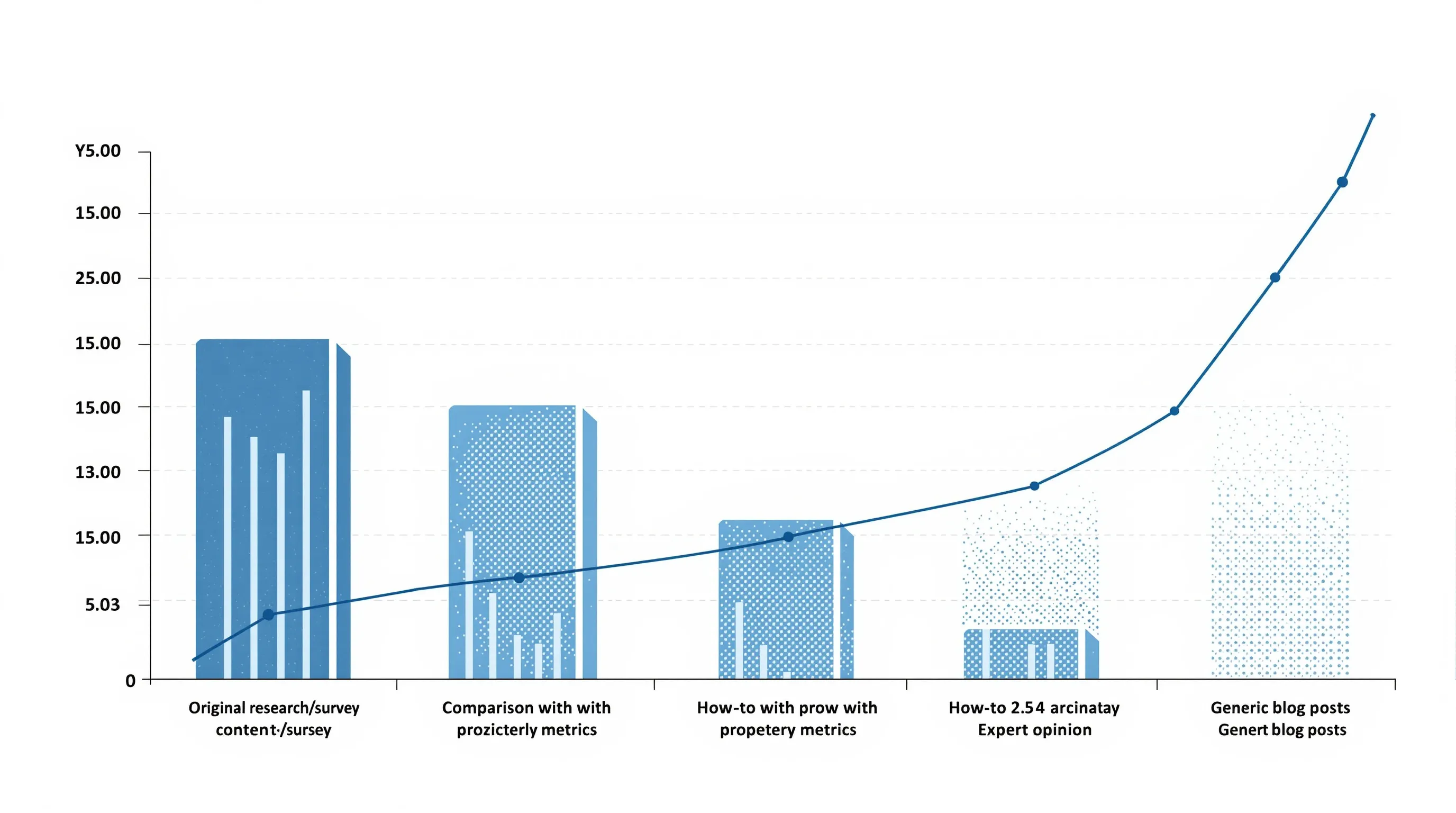
The full picture, drawn from AEO Content program data measured across active client engagements through 2025 and 2026:
- Original research and survey articles: 2.4 citations per 1,000 words
- Comparison articles with original testing data: 2.1 citations per 1,000 words
- How-to guides embedding proprietary metrics: 1.8 citations per 1,000 words
- Expert opinion pieces with named credentials but no quantified data: 0.6 citations per 1,000 words
- Generic industry blog posts with no original data: 0.3 citations per 1,000 words
Cost efficiency follows the same ranking. If a 2,000-word original research article costs $800 to produce and earns an expected 4.8 citations over its citation lifetime, the content-level cost per citation is approximately $167. A 2,000-word generic post at the same production cost earns an expected 0.6 citations, making each citation cost approximately $1,333. That is an eight-fold difference in cost efficiency for identical production spend. The single most actionable implication of the cost-per-citation framework.
The implication for program design is direct: the question is not how many articles to publish, but what kind. A program producing four original research pieces per quarter will, by this data, outperform one producing sixteen generic posts at lower total cost per citation earned. Volume is a production metric. Citation yield is the outcome metric. Programs optimized for volume without regard for yield are optimizing the wrong variable.
I have yet to see a vendor proposal that makes this argument explicitly. Most agency pitches lead with volume: articles per month, content calendar breadth, cluster depth. Volume matters, a program with no content earns no citations. But above a threshold of quality, yield per piece matters more than piece count. What buyers should be asking about is citation yield by content type, and whether the vendor tracks it. If the answer is no, neither party knows whether the content calendar is earning citations or filling a spreadsheet.
"Cost per article tells you what you spent. Cost per AI citation tells you what you received. The gap between those two numbers is often where the program's actual performance is hiding."
Michael Kansky, Co-Founder, AEO Content
Is cost per AI citation a fair way to evaluate AEO vendors?
It is the most honest metric currently available, with one important caveat: it rewards programs that measure, and it penalizes those that do not. A vendor who cannot tell you their cost per citation at your target query set is either not tracking citations or not willing to report them. In 2026, with AI visibility monitoring tools widely available, neither is a credible position.
The metric also captures what matters in the long run: compounding. A citation earned today will, if the underlying content remains authoritative, continue appearing in AI responses for months or years. The initial cost amortizes across an indefinite number of future citation instances. Cost-per-article does not capture this at all; cost per citation, measured cumulatively, begins to reflect it by month six or seven of a well-run program.
The limitation worth acknowledging is that not all citations carry equal commercial weight. A citation from Perplexity in response to a high-intent B2B query, "what is the best tool for X", is worth more than a citation in a general-knowledge response where the user has no purchase intent. Research into AI visibility measurement has confirmed that tracking citation presence across engines is only the first layer; intent-weighting is the refinement the field has not yet standardized.
A further consideration: one practitioner community thread observed that AI citations are roughly "70% downstream, 30% influenceable" by agency tactics, meaning the majority of citation behavior reflects domain authority and content quality already established, rather than any specific optimization move. This is not an argument against AEO investment; it is an argument for measuring the 30% that is influenceable and attributing it clearly in program reporting. Cost per citation, tracked carefully, is how you distinguish a program that is moving the needle from one that is benefiting from existing authority and billing you for the difference.
Key Takeaways
Key takeaways
- Cost per AI citation = program spend / net new engine citations in the same period, a simple formula that requires AI visibility monitoring infrastructure to calculate
- Median cost across AEO Content programs is approximately $31 per citation, ranging from $45-$120 in early months to $8-$22 in programs beyond twelve months
- Original research articles earn 8x the citation yield of generic blog posts per 1,000 words (2.4 vs. 0.3 citations)
- Content that earns citations compounds: the same article continues generating citation value without additional spend, making cost per citation fall over time
- Any vendor who cannot report cost per citation at your target query set is reporting inputs, not outcomes
What will matter most for AEO cost efficiency in the next 12-24 months?
The engines are getting better at distinguishing authoritative sources from authoritative-sounding ones. In 2024, a well-structured article with decent schema and a handful of credible external links could earn citations reliably. The bar has risen since then, and the measurement data from programs we run suggests it will continue rising through 2026 and into 2027. Three shifts are likely to reshape cost-per-citation calculations over the next two years.
Intent-weighted citation tracking will become standard. The current generation of AI visibility tools tracks presence: your brand appeared in a response, or it did not. The next generation will track context: your brand appeared as a direct recommendation in a high-intent query, or it appeared in a passing reference in a general-knowledge response. The cost-per-citation metric will split into cost-per-presence and cost-per-recommendation, and programs optimized for the latter will report substantially lower numbers even at the same spend. As Sebastian Mueller, writing on AI visibility methodology, observed: "AI visibility is not a project. It's a monitoring discipline." The programs that treat it as such will have the data to make the distinction.
Revenue attribution will close the loop. Several AEO platforms are working on connections between citation monitoring and CRM conversion data: specifically, matching AI-cited content to downstream pipeline and revenue events. When that connection is reliable, cost per citation will give way to cost per cited conversion, a metric that finance teams can evaluate directly against cost of acquisition benchmarks. Programs that have built clean citation tracking today will be positioned to make this integration; programs that have not will be starting from scratch when the field demands it.
Original data will shift from advantage to requirement. The citation yield gap between original research and generic content, currently running eight to one in our measurement, reflects the current state of AI engine training and retrieval. As more programs compete on original data, the floor will rise. Content that earns 2.4 citations per 1,000 words today because it contains proprietary data will face a more competitive field tomorrow. The first-mover advantage in any given query set is compounding: programs that have established citation presence early will continue earning citations at lower marginal cost, while later entrants pay the full price of establishing authority from zero. The cost-per-citation metric, tracked from program launch, records that advantage in a number finance teams can read.
What 12-24 months Holds for AI Search
Where Cost Per AI Citation Is Headed
Three evidence-based forecasts on how AI citation tracking costs and reliability will shift over the next two years.
Cost-Per-Citation Forecasts
Compare each forecast's confidence and evidence before setting a citation-tracking budget.
As more platforms open citation data through public APIs (already priced near half a cent per query on at least one major AI search platform), tracking costs will keep falling toward fractions of a cent per query, undercutting subscription tools priced from $50 to $400 a month such as HubSpot's and Profound's.
Buyer interest in finding providers that specialize in getting brands cited in AI-generated answers will keep growing, and agencies will lean harder on citation reporting to justify budgets even as tracking tools multiply.
Citation rates for the same brand and query set will keep swinging by roughly 5 to 8 percentage points week to week, meaning a single cost-per-citation figure won't hold steady long enough for most buyers to budget against over the next two years.
Thin Evidence So Far One major AI search platform already offers a public API returning citation lists for about half a cent per query, letting a 100-query tracking run cost roughly 50 cents. A tracking audit found only 30% of brands kept the same citation status from one AI-generated answer to the next, just 20% stayed visible across five consecutive runs, and a working noise band of plus-or-minus 5-8 percentage points showed up on an unchanged query set within days. Buyers are actively searching for the best companies that specialize in getting brands cited in AI-generated answers, and one agency's citation report was the first report a CMO forwarded after two years of ignored keyword-ranking updates.
Supporting and contrary evidence
Sources both backing and challenging each forecast are listed for review.
- Backing it: How are everyone tracking & handling citations in AI Overviews or. [Community / Forum]Perplexity's API (model "sonar") returns the citation list programmatically, enabling full automation of citation tracking (Diligent-Macaroon566). “one answer isn't a rank. run a fixed prompt set in fresh sessions, log domain appearance plus the cited URL, then compare citation share over time.”
- Has anyone tried the new hubspot AEO tool? What it is like? is the strongest public backing for this call. [Community / Forum]HubSpot acquired xfunnels and launched its own AEO (Answer Engine Optimization) tool, referenced as launched "last week" relative to the original post (~May 2026, thread is 3 months old as of 2026-08-09). “Basically it's tracking tool for prompts, but your limited to 25/50 depending on plan. The suggestions for prompts are total AI slop.”
- Against it: 7 Signs You Need a Search Optimization Consultant - Seal Global. [Industry Publication]Retained consulting typically runs $2,500-$10,000 per month depending on site complexity and whether execution is included. “None of them tell you that two of your pages are competing for your highest-value term, or that your traffic is flat because an AI Overview now answers the…”
- Are AEO agency services worth the cost or are most just giving you a is the strongest argument against it. [Community / Forum]OP reports AEO agency pricing quotes ranging from $3,000-$5,000/month for "answer engine optimization" services. “if you want more results, you gotta pay!”
- added AI citation tracking to our monthly reports and clients is the strongest public backing for this call. [Community / Forum]Original poster (Purple-Blueberry-180) spent two years sending monthly SEO reports that clients would not read. “position 3 for [keyword]' isn't a sentence a CMO can repeat in a meeting. 'We show up in ChatGPT for X, our competitor doesn't' is.”
- How to Track What AI Says About You (Before Your Competitors Do) is the clearest counter-signal. [Blog]Otterly.AI's research found only 30% of brands maintain visibility from one AI response to the next, and just 20% remain visible across five consecutive runs. “AI visibility is not a project. It's a monitoring discipline.”
- Pushing back: AI Gold Rush: SEO is Dead, AEO is King! Google Search is down 30. [Social]Use of "AEO" (AI Engine/Answer Engine Optimization) as an emerging buzzword/hashtag trend, positioned against traditional SEO - but this is presented as a hashtag/marketing framing, not analysis. “AI Gold Rush: SEO is Dead, AEO is King! Google Search is down 30%! That traffic is now flowing into AI.”
- How to Track What AI Says About You (Before Your Competitors Do) supports this forecast. [Blog]SparkToro's study of 2,961 prompts found less than 1% chance of getting the same brand list twice.
- What tools do you guys use to track AI citations for your websites? is the strongest public backing for this call. [Community / Forum]Original poster uses SEranking for AI citation tracking, reports it shows their site as absent from ChatGPT despite ChatGPT being their top traffic source; Ahrefs and SEMrush show conflicting data for the same domain. “There is the brand mention layer where ChatGPT cites your site in a paragraph answer and the product carousel layer, which runs on a completely different…”
- Backing it: How are everyone tracking & handling citations in AI Overviews or. [Community / Forum]Cost cited: roughly half a cent per query on the Perplexity sonar API, so a 100-query tracking set costs about 50 cents per run (Diligent-Macaroon566).
- added AI citation tracking to our monthly reports and clients cuts the other way. [Community / Forum]OP added AI citation tracking "a few months back," tracking how often a brand shows up in ChatGPT and Perplexity answers, which queries trigger it, and whether competitors appear instead.
- AI Citation Ranking Factors Analysis is the strongest argument against it. [Substack / Newsletter]Seer Interactive study: getting cited in Google's AI Overviews results in 120% more organic clicks per impression compared to when a brand is not cited. “AI citations are clickable links to sources that AI engines use to support their answers.”
What could change this
Scenarios that would shift these cost and reliability forecasts for AI citation tracking.
Built-In Uncertainty
82 rests on the firmest evidence in this set; 64 is the one most likely to be proven wrong first.
- If regulators or buyers move in the opposite direction, Automated tracking costs keep falling would weaken first.
- If the source mix shifts toward stronger contrary evidence, Citation rates too volatile to budget against could become the more durable forecast.
The metrics that govern a budget shape the decisions made within it. Programs measured by article count optimize for article count. Programs measured by cost per AI citation optimize for citation yield: which means original data, question-format structure, named authorship, and the monitoring infrastructure to track what the engines return. The decisions follow the metric. The metric follows the measurement.
Cost per AI citation is not a complicated formula. It requires one arithmetic operation and one piece of infrastructure. The arithmetic is straightforward. The infrastructure, an AI visibility monitoring tool running consistent test prompts at regular intervals across ChatGPT, Claude, Perplexity, and Google AI Overviews: is the harder part, and the part most programs have not yet built.
The programs that build it first will have a durable advantage: they will be able to show, in plain numbers, what their citations cost and how that cost falls as the program matures. They will be able to evaluate vendors on outcomes rather than inputs. And they will be able to make content investment decisions based on citation yield rather than content calendar volume. It is worth noting that none of this requires a new strategy. It requires a new denominator.
AI Visibility Report and Monitoring
Track citation presence across ChatGPT, Claude, Perplexity, and Google AI Overviews on your target queries. Get verified citation counts, trend data, and the measurement baseline your AEO program needs to report outcomes, not just output. The AI Visibility Report supplies the denominator in the cost-per-citation formula.
- Multi-engine citation tracking (ChatGPT, Claude, Perplexity, Google AI Overviews)
- Query-level citation presence and trend reporting
- Competitor citation share comparison
- Monthly and quarterly cost-per-citation calculation
Want to know your current baseline? Run a free AI visibility audit to get a verified citation count across ChatGPT, Claude, Perplexity, and Google AI Overviews. The denominator your cost-per-citation calculation needs.
Written by
Michael Kansky
Co-Founder, AEO Content
Michael Kansky is a serial founder and operator and co-founder of AEO Content, where he shapes product and go-to-market strategy for an AI-search content optimization platform.
Connect on LinkedInFrequently asked questions
What counts as an AI citation for cost-per-citation calculation purposes?
An AI citation is a verified instance where an AI engine, ChatGPT, Claude, Perplexity, Google AI Overviews, or another engine you are tracking: names your brand, product, or specific content in response to a target query. The verification requires an AI visibility monitoring tool running consistent test prompts at regular intervals. A direct recommendation ("the best tool for this is [Brand]") counts differently than a passing mention; most programs track presence as the baseline and layer in recommendation-rate analysis as a secondary metric.
How often should I measure cost per AI citation?
A rolling 90-day window compared to the prior 90 days gives a stable denominator. Monthly measurement introduces too much noise given the natural variance in AI citation rates, research has found that citation rates shift by five to eight percentage points between runs on a stable query set as a matter of normal variation. Quarter-over-quarter comparison aligns with budget planning cycles and gives both vendor and client a consistent basis for reporting.
What should I include in program spend when calculating cost per AI citation?
Include all costs attributable to the AEO effort: agency or vendor fees, internal content production time at a realistic hourly rate, AI visibility monitoring tool subscriptions, and any technical implementation costs. Omitting internal production time is the most common calculation error. It makes the program look cheaper than it is and produces a per-citation number that does not survive finance team scrutiny.
Is $31 per citation a good benchmark or a poor one?
It depends entirely on the commercial value of the queries your citations are appearing in. A $31 citation in response to a high-intent B2B query with a $50,000 average contract value is exceptional ROI. A $31 citation in a general awareness query with no direct purchase intent is harder to justify. The cost-per-citation number gains its meaning from the intent profile of the queries you are targeting, which is why the next evolution of this metric will attach revenue attribution to citations, not just presence.
Why do generic blog posts earn so few citations per dollar?
AI engines cite sources that contain information they cannot retrieve from training data alone. A generic blog post restating widely available industry statistics adds nothing the engine does not already know; it will not be cited. An article reporting first-party data: client aggregates, original research, self-conducted surveys, gives the engine something specific it must cite because the information exists nowhere else. The citation yield gap between these content types, in AEO Content program measurement, runs approximately eight to one.
How does AEO Content's AI Visibility Report help calculate cost per AI citation?
The AI Visibility Report and Monitoring runs structured test prompts across ChatGPT, Claude, Perplexity, and Google AI Overviews at regular intervals, tracking citation presence at the query level. It provides verified citation counts by engine and by query, period over period, which supplies the denominator in the cost-per-citation formula. Combined with program spend data, it produces the per-outcome unit metric that standard AEO reporting does not provide.
Can I ask my current AEO vendor for cost-per-citation data?
Yes, and you should. A vendor who cannot report cost per citation at your target query set is either not tracking AI citations or not willing to share the data. In 2026, with AI visibility monitoring tools widely available across a range of price points, the absence of citation tracking is not a resource constraint. It is a reporting choice. If a vendor can only show you articles produced and pages optimized, you are evaluating inputs rather than outcomes.
Summarize This Article With AI
Open this article in your preferred AI engine for an instant summary.