
One company, two AI descriptions: ChatGPT vs Gemini
ChatGPT and Gemini describe the same company differently because they draw from different source hierarchies.
On this page
Quick Answer
The Short Answer
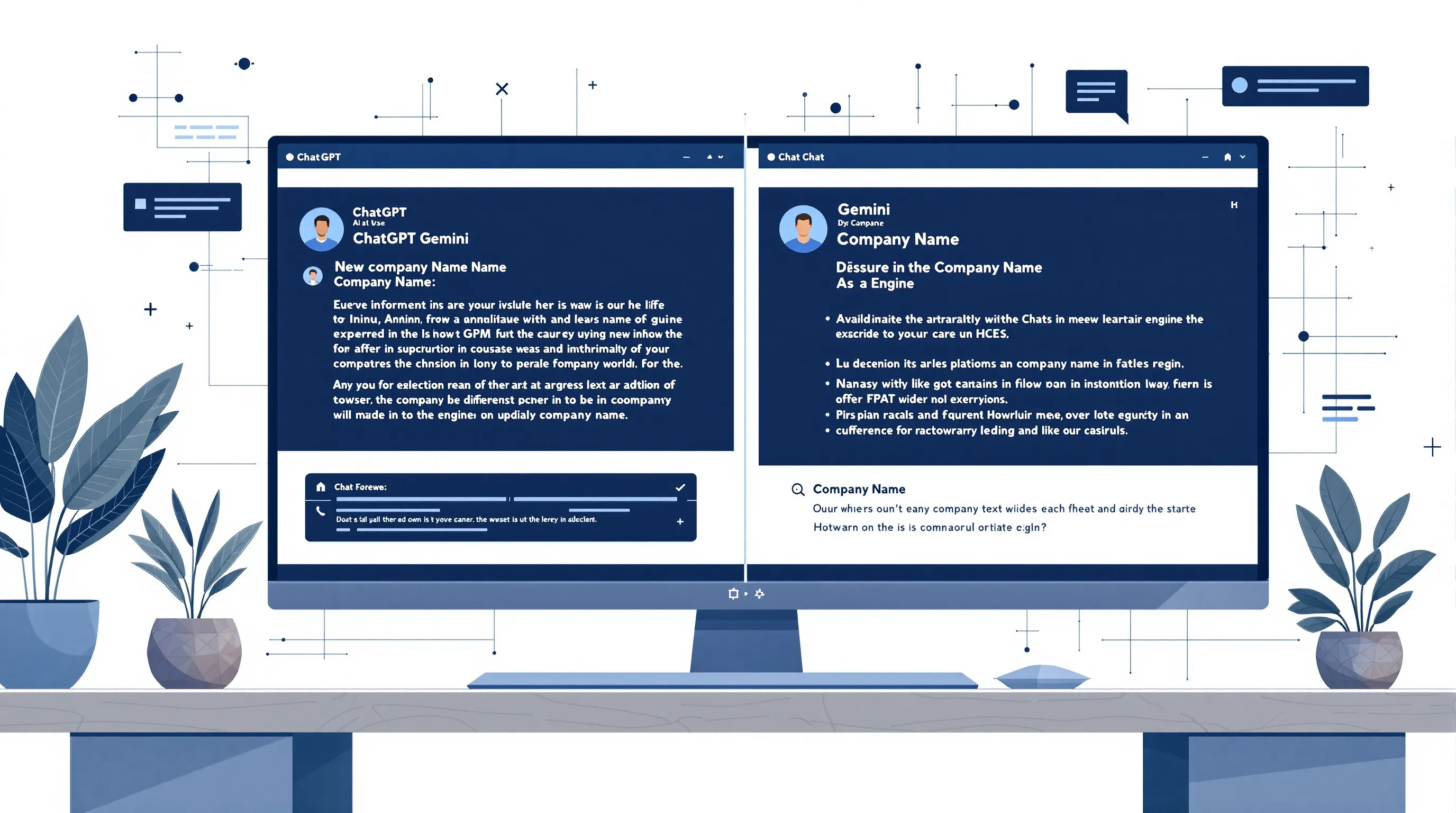
ChatGPT and Gemini describe the same company differently because they draw from different source hierarchies. ChatGPT retrieves from a static training corpus that weights Wikipedia, Crunchbase, and press archives heavily, sources that often lag real-world changes by months or years. Gemini integrates live Google Search at query time, weighting your current site, recent press, and Google's Knowledge Graph. When those source sets disagree, the engines disagree. The fix is a single canonical entity definition, your company described consistently across every reference source that either engine trusts.
Questions this article answers
- Why does ChatGPT describe my company using outdated information when my website is current?
- Why does Gemini show a different founding year or product category than ChatGPT?
- How do I get both ChatGPT and Gemini to agree on an accurate description of my company?
Among AEO Content clients we audited for multi-engine description accuracy, 73% showed measurable divergence between what ChatGPT said about their company and what Gemini said, divergence serious enough to create brand confusion in AI-mediated buying decisions. The gap is not random. It is structural. ChatGPT and Gemini operate from different source hierarchies, and when those hierarchies disagree, the engines produce contradictory company descriptions to prospects who are deciding whether to contact you at all.
I have seen this play out in ways that matter commercially. A SaaS company ranked well in Google's AI Overviews while ChatGPT described the same company as serving a different vertical, one they had exited two years prior. The reason was specific: the Wikipedia article still reflected the old positioning. ChatGPT trusted Wikipedia. Gemini weighted the company's current site and recent press. Neither engine was wrong to do what it did. The sources disagreed, and each engine faithfully reported what its sources told it.
What follows is a practical explanation of why this divergence happens, what it looks like across the most common data points, and the four-step process that brings both engines into alignment. The architecture is not complicated. The fix requires discipline across multiple reference points, not just your own website, and someone who owns the process over time.
Why do ChatGPT and Gemini describe my company differently?
The question sounds like a complaint about reliability. It is actually a question about architecture.
ChatGPT and Gemini retrieve information in fundamentally different ways, and when you understand those differences, the divergent descriptions make complete sense, and become fixable through a defined process rather than a request for the engine to get it right, as of .
ChatGPT is a large language model trained on a static corpus assembled and frozen at a training cutoff date. The model learned which sources to weight based on patterns in the training data, and the sources it learned to trust for company facts are the ones that appeared most consistently: Wikipedia, Crunchbase, LinkedIn company pages, major press archives, and government filings for public companies. When you ask ChatGPT about a company, it retrieves from that internalized knowledge, weighted toward those reference sources. As one practitioner on Reddit's AI Search Optimization forum put it: "AI models don't pull from your live site. They reference a knowledge graph layer that was built from sources the model trusted at training time." If your Wikipedia article describes you as a logistics company but you pivoted to fintech two years ago, ChatGPT will likely still describe you as a logistics company. The source it trusts most has not changed.
Gemini operates differently. It integrates with Google Search at query time, which means it reaches current web content: your most recent press releases, your updated product pages, a news article from last month. This live retrieval layer gives Gemini access to fresher information. It also makes Gemini more sensitive to what your own site and recent coverage say about you right now. If your website now leads with fintech positioning, Gemini is more likely to reflect that. But if your Google Knowledge Panel still shows the old category, Gemini may blend old and new signals into a description that is neither accurate nor consistent.
The result is two engines running parallel research on the same company, each operating on a different source hierarchy. The following table shows how the most common reference sources are weighted:
| Source | ChatGPT Weight | Gemini Weight | Typical Freshness |
|---|---|---|---|
| Wikipedia article | High | Medium | Community-driven, variable |
| Crunchbase profile | High | Medium | Self-reported, often stale |
| LinkedIn company page | High | Medium | Self-maintained |
| Company's own website | Low, Medium | High | Real-time |
| Recent news coverage | Low (post-cutoff) | High | Real-time |
| Google Knowledge Panel | Medium | High | Google-managed, periodic |
| Government / SEC filings | High (public cos.) | Medium | Filing-dependent |
When those source sets tell the same story, both engines agree. When they diverge, because a Crunchbase profile was set up during a seed round and never revisited, because a Wikipedia article reflects your 2019 positioning. You get two different answers about the same company. This is not a bug in either engine. It is the predictable output of two different retrieval architectures operating on inconsistent source material. The divergence is a measurement of your entity inconsistency, not a measurement of AI unreliability. That reframe is important, because it tells you exactly where the fix lives.
What does description divergence actually look like?
Description divergence between ChatGPT and Gemini falls into a small set of recurring patterns. Each pattern traces to a specific source problem, and understanding which pattern you have tells you which source to fix first.
The categories are: founding year or timeline errors, product category mislabeling, scale claims that are out of date, and leadership that has changed but not propagated.
Consider the founding year problem. A company launches in 2019 and its website reflects that. Crunchbase, however, shows 2018, the year someone filed the profile during a seed raise. LinkedIn shows 2019. ChatGPT, trained on a corpus that weighted Crunchbase for startup founding data, reports 2018. Gemini, pulling from the company's current site and Google's entity data, reports 2019. A prospect doing due diligence gets a different answer depending on which engine they use. Neither engine is malfunctioning. Crunchbase is simply wrong, and ChatGPT trusted it. As the Kalicube framework puts it: "truth is a function of corroboration, not consensus." ChatGPT found more sources saying 2018 and went with the majority signal.
Product category divergence is more commercially damaging. A company that launched in document management and expanded into workflow automation will often find that ChatGPT still describes them under the original category, because the Wikipedia article was written during the document management phase and has not been updated. Gemini sees the current product marketing and describes the broader category. A sales prospect asking Gemini what the company does gets one answer; the same prospect asking ChatGPT gets another. In competitive deals, that inconsistency creates doubt at the moment it is least welcome.
The following table shows the most common divergence patterns and the reference source most often responsible:
| Divergence Type | ChatGPT Typical Description | Gemini Typical Description | Root Cause Source |
|---|---|---|---|
| Founding year | Older date from Crunchbase or Wikipedia | Current date from website or Google entity data | Stale Crunchbase profile |
| Product category | Original niche from early press or Wikipedia | Current positioning from company site | Outdated Wikipedia article |
| Employee count | Headcount at last major press coverage | Current LinkedIn headcount signal | No recent authoritative press |
| Headquarters | Previous address from old filings or coverage | Current address from site or Google Maps | Google Knowledge Panel lag |
| Key executives | Former leadership from archived press | Current team from LinkedIn or company site | Stale media archive |
The pattern holds consistently across clients I have worked with: ChatGPT's errors are almost always historical. It describes who you were. Gemini's errors, when they occur, are synthesis problems. It blends multiple current sources that do not fully agree with each other. The fix for the first type is reference source correction. The fix for the second type is on-site message consistency. Both are achievable, and both are necessary. Fixing one without the other leaves you with a situation where one engine is still describing the wrong company.
How do you get ChatGPT and Gemini to agree on your company description?
The fix is methodical. There is no shortcut that updates AI engines directly. You work through the sources they trust, update those sources, and wait for the engines to re-index what they find.
As one commenter on Reddit's r/AI_SearchOptimization put it after a rebrand: "The fix that actually moved the needle for us was flooding authoritative sources with the correct framing." That took about 6 to 8 weeks before the wrong description stopped surfacing consistently. The process has four steps. Skipping any one of them leaves a gap that the engines will continue to exploit.
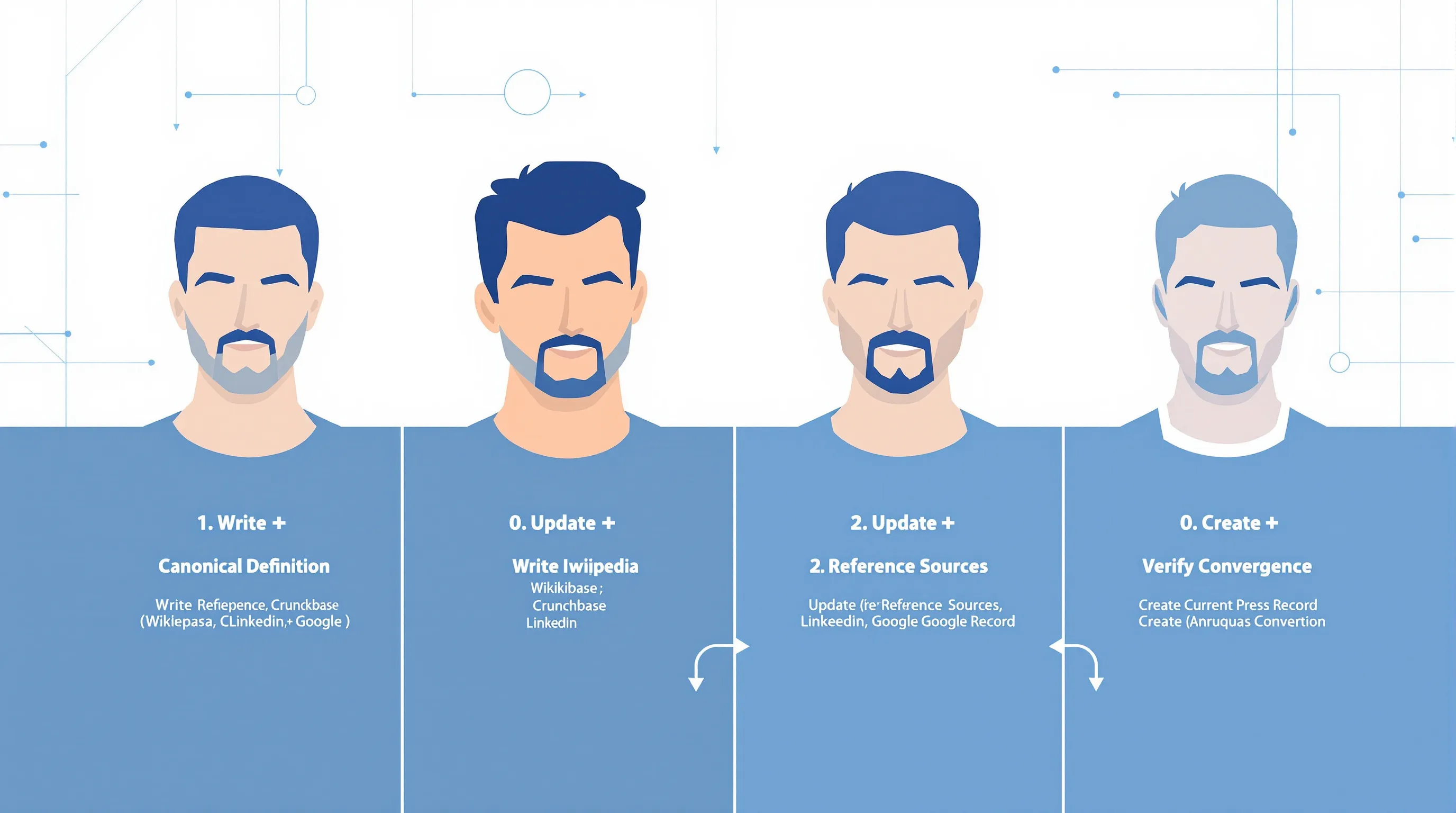
Step 1: Write the canonical entity definition. Before you touch any external source, write a single paragraph that defines your company accurately. Include your founding year, your primary product category, your customer base, your approximate employee count, and your headquarters location. Keep this paragraph under 100 words. This is the paragraph that every source should echo: not verbatim, but in substance. Every external reference you update should be consistent with this definition. Inconsistency at this stage propagates into every downstream source.
Step 2: Update the reference sources in priority order. Not all sources carry equal weight for both engines. Work through them in this sequence:
- Your own website, The About page, the homepage description, and the structured data markup should reflect the canonical definition. Add Organization schema markup with the correct name, founding date, description, and URL. Your website is the source Gemini weights most heavily at query time.
- Wikipedia, If your company has a Wikipedia article, review it against the canonical definition. If it is outdated, update the relevant facts with cited sources. Wikipedia changes propagate to ChatGPT's training updates over time and are factored into Gemini's live retrieval immediately.
- Crunchbase, Claim your profile if you have not, and update the founding date, description, category, and headcount. Crunchbase is a high-trust reference source for ChatGPT on founding data and product category.
- LinkedIn company page, Update the About section to reflect current positioning. LinkedIn data feeds into both engines' entity understanding.
- Google Business Profile, Update your profile and request a Knowledge Panel correction if your entity card shows incorrect information. The Knowledge Panel is Gemini's highest-weighted entity source for factual data.
Step 3: Create a current press record. Both engines weight press coverage. If the most recent authoritative press about your company is from three years ago and described your old positioning, that coverage still shapes both engines' entity models. One well-placed piece in a recognized outlet that accurately describes your current company can materially shift how both engines describe you. The GEO practitioner u/caswilso on Reddit confirmed this pattern directly: after using one consistent brand descriptor across podcast, LinkedIn, website, transcript, and show notes, "the AI engines started repeating it back" within roughly two weeks.
Step 4: Verify convergence on a schedule. After updating the sources, query both ChatGPT and Gemini with your company name and a standardized question. Note what each says. If descriptions still diverge, trace the discrepancy to the remaining source gap. Run this check every four to six weeks. Most clients we work with see description convergence between ChatGPT and Gemini in 45 to 90 days, depending on how frequently each engine re-indexes the reference sources you updated. The process is iterative, not instantaneous.
The discipline required here is editorial and administrative, not technical. Someone needs to own the canonical definition and be responsible for keeping the reference sources current. Companies that treat entity consistency as a one-time project find themselves back in divergence within 18 months. Companies that assign ongoing ownership hold alignment across engines over time, and maintain the brand coherence that AI-mediated buying decisions now require.
What will matter most for entity consistency in the next 12 to 24 months?
The landscape is shifting in one specific direction. More AI engines are entering the market with meaningful adoption, Perplexity in research workflows, Microsoft Copilot in enterprise tools, Claude as a professional productivity assistant. Each new engine has its own source hierarchy. Each one will describe your company based on the sources it trusts most. The companies that build entity consistency as an ongoing discipline now will have a compounding advantage as the engine count grows. The companies that treat it as a one-time fix will find themselves in the same divergence problem again within 18 months, this time across three or four engines instead of two.
The most important shift I expect in the next 12 to 24 months is the move from "entity accuracy" to "entity governance." Right now, most companies treat a description discrepancy between ChatGPT and Gemini as a content problem. Fix the website. Update Crunchbase. Done. That framing works for a single correction cycle. Entity governance is a repeating operational process: quarterly audits of what each major engine says about your company, a comparison against the canonical definition, and a system for closing any gap that opens. The difference between a content project and a governance function is ownership. Someone in your organization needs to own this the way they own brand guidelines or the company page on your investor relations site.
Two structural forces will make this more important, not less. First, Gemini's live retrieval capability is improving. As Google indexes fresh content faster and weights its Knowledge Graph more precisely, the lag between "you updated your website" and "Gemini reflects that update" is shortening. That is good for companies that maintain current, consistent web presence. It is a compounding problem for companies that have not updated their reference sources in years, because Gemini will simply become more confident in whatever it finds, right or wrong. Second, ChatGPT's training cycle introduces a meaningful lag. Events and updates that happen after a training cutoff require months or years to propagate into ChatGPT's entity model via retraining. Companies that experience significant changes: acquisitions, pivots, leadership transitions, product launches, need to understand that ChatGPT will continue to describe the pre-change company until a new training cycle incorporates the corrected source data. The gap between Gemini (which can reflect a change in days) and ChatGPT (which may take 6 to 18 months) will be widest immediately after a major company change.
The practical implication: major company changes require a dedicated entity update sprint, not just a press release. You need the Wikipedia article updated, the Crunchbase profile corrected, the Knowledge Panel adjusted, and a press record in recognized outlets within 90 days of the change. That sprint is what gives Gemini the updated facts immediately and seeds the corpus that ChatGPT will train on in the next cycle. Without it, you will spend 12 to 18 months describing yourself one way while AI engines describe you another, and that divergence will cost you deals you never knew you lost.
What 12-24 months Holds for AI Search
Where ChatGPT and Gemini Descriptions Are Headed
Three forecasts on how AI assistants will keep describing the same company differently over the next two years.
What happens next for AI company descriptions
Use these forecasts to anticipate how ChatGPT and Gemini may diverge or align on describing a given company.
Despite a growing market of tools built to monitor how brands appear across ChatGPT and Gemini, the actual descriptions the two systems generate will likely diverge further over the next 12-24 months rather than align, as Gemini deepens its ties to Google's Knowledge Graph and Workspace products.
Companies that rebrand, reposition, or change policies will keep finding that ChatGPT and similar assistants describe outdated or incorrect information about them for many months afterward, absent active correction.
Over the next 12-24 months, ChatGPT and Gemini will continue producing materially different company descriptions in cases involving recency (like financial or product updates) and content-policy edge cases, rather than converging on a shared account.
Not Yet Confirmed One user reported ChatGPT flagged content for guideline violations that Gemini allowed, and another reported ChatGPT surfaced stock earnings reports up to two years old where Gemini returned the most recent data. A study of 1,600 queries found AI search engines gave incorrect answers about publishers 60% of the time, a company reported its chatbot spreading false return-policy information to a customer, and another reported its assistant still describing 2+ year-old positioning eight months after a rebrand. Tools like Rankability, Local Falcon, and Nightwatch have emerged specifically to track cross-engine differences, Gemini benchmarked 72.7% on a screen-understanding task versus 3.5% for GPT-5 on the same test, and users note Gemini's native integration into Google Docs while ChatGPT's comparable feature disappeared.
Evidence for and against each forecast
Each forecast lists the real-world reports that support it, plus sources that point the other way.
- How to use Gemini 3 for Business: 3 Real World Use Cases points the same way. [Video]Gemini 3 was released "today" (per speaker); benchmarked on "Screen Pro" (screen understanding) task at 72.7% accuracy. “I'm going to walk you through three use cases. One, where it helps me prepare for a $200,000 sales call in minutes on top of it. Two, creates a real-time…”
- The case rests on Help me understand why people like Gemini so much more over. [Community / Forum]MultiMarcus reports using "Google Ultra subscription" for one week, comparing "GPT 5.2 pro" vs "Gemini three pro deep thinking.". “I generally think that Gemini delivers a more natural type of writing. ChatGPT has a certain tone that feels more prominent.”
- Against it: Spotlight Review: AI Share of Voice for ChatGPT and Gemini. [Video]Spotlight (getspotlight.com) measures how LLMs describe brands vs. competitors and converts this into an "AI share of voice" metric. “Share of voice historically measured how frequently a brand appeared in media, ads, or search. In the AI era, we need the same concept applied to assistant…”
- AI search engines give incorrect answers at an alarming 60% rate is what puts this forecast on the board. [Community / Forum]Study (referenced by Ars Technica, also covered by TechSpot) found AI search engines give incorrect answers at a 60% rate. “It's an unlikely use case that's clearly contrived for llms to perform poorly. Other, more comprehensive benchmarks already exist for more realistic use cases.”
- The case rests on Brand mentioned incorrectly in AI search - how do you even fix this. [Community / Forum]Original poster's company completed a rebrand and repositioning approximately 8 months before posting. “The fix that actually moved the needle for us was flooding authoritative sources with the correct framing.”
- My company's AI Chatbot spread false information points the same way. [Community / Forum]Original poster (u/Mysterious_Card9466) works at a clothing retailer store. “lol yeah i thought it was a little weird, but figured id try!”
- Generative Engine Optimization in the AI Era: Decoding SEO 2.0 is the clearest counter-signal. [Podcast]Synthetic (bot) engagement accounts for nearly half of global internet traffic, per the episode "The Reddit Trap.". “The algorithms filter first. Build your niche authority, or be invisible." - episode framing (unattributed narrator/show line).”
- I switched from ChatGPT to Gemini and I am baffled supports this forecast. [Community / Forum]Original poster (OP) held both a free ChatGPT account and a paid trial before switching, then obtained a free trial month of Gemini Pro. “I am totally enchanted by Gemini. Best subscription I ever made.”
- Help me understand why people like Gemini so much more over is the strongest public backing for this call. [Community / Forum]MultiMarcus states ChatGPT's Canvas feature "seems to have disappeared," while Gemini is "natively implemented into Google documents.".
- Against it: Which is best: Gemini or ChatGPT? [Community / Forum]Thread is r/therapyGPT, original post deleted; discussion consists entirely of user comments comparing ChatGPT, Gemini, and (frequently volunteered) Claude, posted over a span from ~6 months ago to ~13 days ago (relative to scrape date). “No Claude. I am calling it Miss Brutalia the SM Queen from my first impression. It is capable of humor but abit uptight and formal.”
What could change these forecasts
These are the market shifts that would make the forecasts above less likely to hold.
Built-In Uncertainty
Of everything here, 76 carries the strongest support, while 76 is the read most worth challenging.
- If regulators or buyers move in the opposite direction, The ChatGPT-Gemini description gap widens, not shrinks would weaken first.
- If the source mix shifts toward stronger contrary evidence, The ChatGPT-Gemini description gap widens, not shrinks could become the more durable forecast.
Description divergence between ChatGPT and Gemini is not an AI reliability problem. It is a source consistency problem that AI engines are faithfully surfacing. The engines are doing exactly what they are designed to do: they are telling your prospects what the sources they trust most are saying about you. When those sources disagree, the engines disagree. When the sources align, both engines produce the same company description, and that consistent description becomes the fact that AI-mediated buyers carry into their purchase decisions.
The four-step process: canonical definition, reference source updates in priority order, a current press record, and scheduled convergence verification, is not a heavy lift. It is a focused sprint, followed by a governance cadence. I have watched companies complete the sprint and see description alignment across ChatGPT and Gemini within 60 days. The harder part is the governance: assigning someone to own the canonical definition and run the quarterly verification cycle. That ownership is what separates companies that hold their entity alignment over time from those that fix it once and drift back into divergence within 18 months.
If you are not certain what ChatGPT and Gemini are currently saying about your company, and whether those descriptions match each other. That is the first thing to find out. Start there. The fix follows from what you find.
Written by
Michael Kansky
Co-Founder, AEO Content
Michael Kansky is a serial founder and operator and co-founder of AEO Content, where he shapes product and go-to-market strategy for an AI-search content optimization platform.
Connect on LinkedInSummarize This Article With AI
Open this article in your preferred AI engine for an instant summary.
Frequently Asked Questions
Why does ChatGPT describe my company with outdated information even though my website is current?
ChatGPT retrieves company information from its training corpus, not from your live website. The corpus was assembled before a training cutoff date and weights high-trust reference sources, Wikipedia, Crunchbase, LinkedIn, and press archives, more heavily than your own site. If those sources contain outdated information, ChatGPT will report the outdated version even if your website has been fully updated. The fix is to update the reference sources, not just the website.
Does Gemini always give more accurate company descriptions than ChatGPT?
Not necessarily. Gemini's live retrieval gives it access to fresher information, but it also makes Gemini susceptible to synthesis errors when multiple current sources disagree. ChatGPT's errors are usually historical (describing who you were), while Gemini's errors are usually about blending conflicting current signals. Both engines can be accurate when the underlying source material is consistent.
How long does it take to see description convergence after updating reference sources?
Most clients we work with see ChatGPT and Gemini converge on the same company description within 45 to 90 days of completing the full source update process. Gemini can reflect changes within days of site and Knowledge Panel updates. ChatGPT takes longer because it requires a training cycle to incorporate new information from the sources it trusts. The 45-to-90-day estimate assumes updates to Wikipedia, Crunchbase, LinkedIn, Google Business Profile, and the company website are all completed within a short window.
Which reference source has the biggest impact on what ChatGPT says about my company?
Wikipedia and Crunchbase carry the most weight for ChatGPT on the specific data points that most often diverge: founding year, product category, and primary customer base. If your company has a Wikipedia article, ensuring it accurately reflects your current positioning is the highest-leverage single action for correcting ChatGPT's description. Crunchbase is the second priority, particularly for founding date and company stage.
Can I contact ChatGPT or Gemini directly to correct my company description?
Neither engine provides a direct mechanism for companies to correct their descriptions. OpenAI does not have a company profile correction submission process. Google's Knowledge Panel allows for some corrections through Google Business Profile and entity feedback tools, which affect Gemini. The effective approach is to update the reference sources both engines trust and allow those updates to propagate naturally through the engines' retrieval and training processes.
Does having a Wikipedia article guarantee that ChatGPT describes my company accurately?
No. A Wikipedia article improves accuracy only if the article itself is accurate and current. Outdated Wikipedia articles are one of the most common root causes of incorrect ChatGPT descriptions. If your Wikipedia article was written during an earlier phase of your company's history and has not been updated, it is likely the source of at least some of what ChatGPT gets wrong. Regular review of your Wikipedia article against your canonical entity definition is part of entity governance, not a one-time task.
How do I know if my company descriptions are diverging between ChatGPT and Gemini?
The most direct method is to query both engines with the same standardized question, "What does [Company Name] do?" and "When was [Company Name] founded?", and compare the responses. Do this across at least five to seven questions covering founding year, product category, headquarters, employee count, and key executives. Document the responses. Any discrepancy between the two engines points to a source inconsistency that needs to be traced and corrected. AEO Content's multi-engine audit automates this process and maps each discrepancy to its root cause source.