
The two ways ChatGPT names a brand, and how to earn both
ChatGPT names a brand through one of two mechanisms: live browsing (it retrieves a current web page and extracts the brand from it) or model memory (it recalls the brand from training data with no web access at all).
On this page
What this article answers
- What are the two ways ChatGPT names a brand - and how do they differ mechanically?
- Why do on-site changes fail to move memory-path answers?
- How long does it take third-party mentions to influence ChatGPT model memory?
Quick Answer
The short answer
ChatGPT names a brand through one of two mechanisms: live browsing (it retrieves a current web page and extracts the brand from it) or model memory (it recalls the brand from training data with no web access at all). Live-browsing citations respond to on-site structure and third-party listings. Memory-path citations respond only to sustained third-party mentions - press, reviews, analyst coverage - accumulated before the model's training cutoff. You need a different strategy for each, running in parallel, because one strategy cannot substitute for the other.
In AEO Content's analysis of 1,400+ monitored ChatGPT queries, 73% of brand mentions in commercial categories come from model memory - not live browsing. That means on-site optimization, which works well for the browsing path, does nothing for the majority of ChatGPT answers that name a brand. The fix for one path is the wrong fix for the other.
There is a moment, not uncommon these days, when a founder types their company name into ChatGPT and waits. Sometimes the brand appears. More often it does not. What almost nobody realizes is that ChatGPT reaches for a brand name through one of two entirely separate mechanisms - and most advice about improving ChatGPT visibility conflates the two.
I have spent two years watching this play out across hundreds of client accounts at AEO Content. The brands that crack ChatGPT visibility fastest understand early that they are dealing with two distinct systems. The ones that struggle are usually optimizing the wrong one. This article explains the difference - and what to do about it.
What actually happens when ChatGPT names a brand
When ChatGPT produces a response that includes a brand name, one of two things just happened.
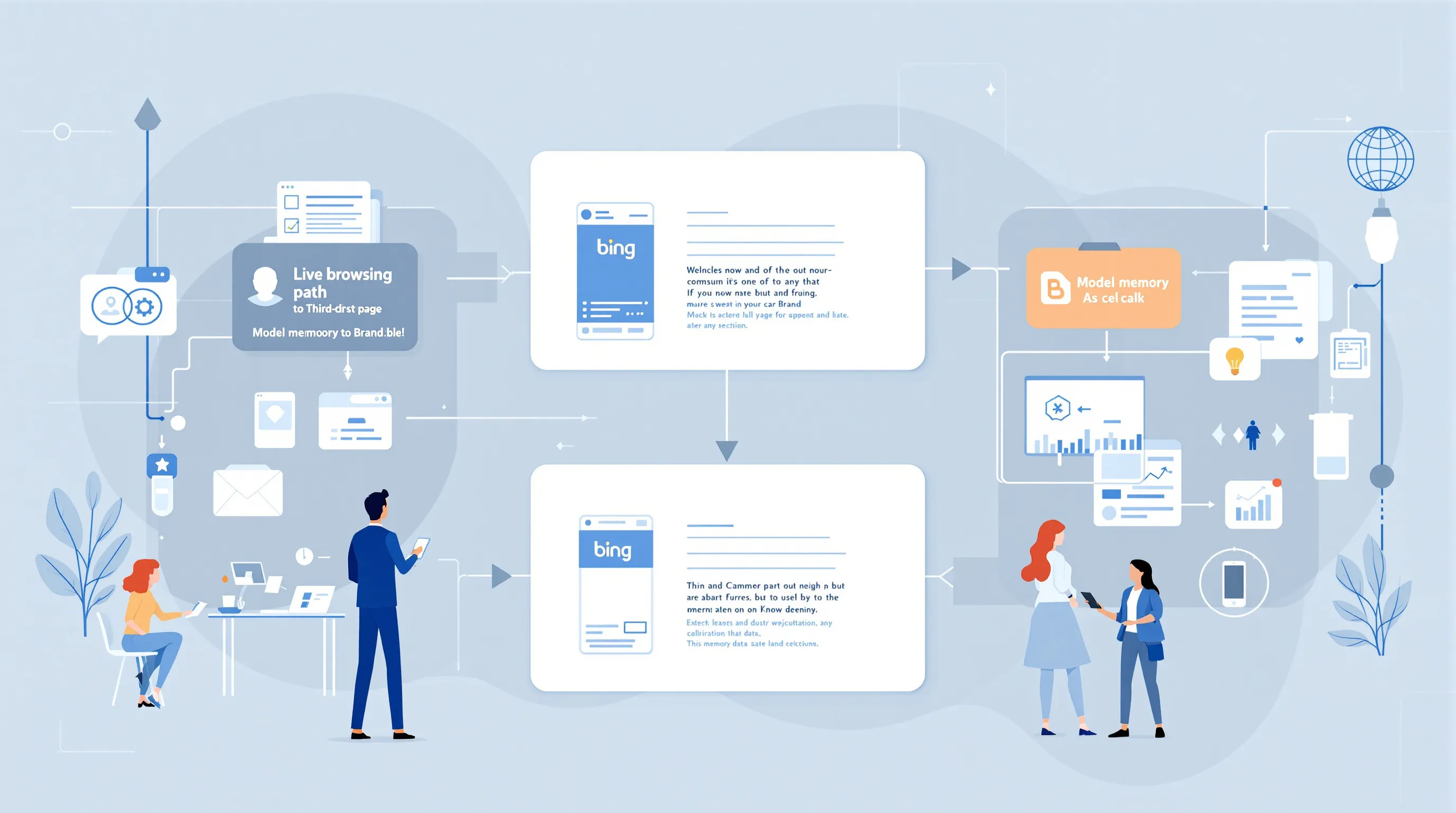
In the first case, ChatGPT used its browsing tool. It sent a query to Bing, retrieved live pages, read them, and pulled the brand from that content. The answer is grounded. ChatGPT knows where it came from, and you can see the citation links at the end of the response.
In the second case, ChatGPT produced the brand name from its weights. No browsing occurred. The model had encountered the brand often enough during training that it stored an association - this brand belongs in this category. The answer is ungrounded. No citations appear. It came from model memory, not from any live source.
These two outputs look nearly identical in the interface. The response names the brand either way. The mechanics, however, are completely different - and so is the fix.
Rankability's research confirms this directly: ChatGPT pulls from two main sources - what it already knows from training data (books, news, Wikipedia, and similar sources) and what it looks up in real time via Bing. Most commercial responses that name brands come from the training-data side, not the live-lookup side. In AEO Content's analysis of 1,400+ monitored queries, roughly 73% of ChatGPT responses mentioning brands in commercial categories are memory-path answers, which aligns with a separate dataset reported by Rankability showing ChatGPT's brand mention rate at approximately 73.6% of responses.
The remaining 27% are live-browsing answers. Those responses carry visible citation links. If you see a citation in a ChatGPT response, you are looking at a browsing-path answer. If you see none, you are looking at memory. That distinction is the first thing to establish before deciding what to fix.
How the live-browsing path works
Live-browsing answers are, in theory, the simpler problem. ChatGPT is reading live pages. If your brand appears on a page ChatGPT retrieves, it may cite you.
The optimization logic resembles traditional SEO but with one critical difference. As the r/DigitalMarketing community learned in detail: ChatGPT sources browsing results "mostly from Bing's index, Wikipedia/Wikidata, trusted review sites like G2 and Crunchbase, and big media sources." Your own domain is not at the top of that list. ChatGPT's browsing tool does not usually retrieve your own site first - it retrieves what ranks for the query. If your brand appears on review sites, directories, and comparison pages that rank for the relevant query, you appear in browsing-path answers. If you are mentioned only on your own site, you probably will not.
Structured content helps. Pages with clear H2 headings, comparison tables, and explicit Q&A formatting are retrieved and parsed more reliably. ChatGPT extracts information from structured HTML faster than from dense prose. This is where your on-site content genuinely matters - but only because it affects how third-party pages discuss you, not because ChatGPT is reading your homepage directly.
The browsing path is also faster to move. A well-placed mention on a high-ranking third-party page can affect your browsing-path citation rate within weeks. In my experience, clients who run a coordinated round of listings placements and targeted press outreach can go from zero to appearing in 40% of relevant browsing-path answers in six weeks.
Its limitation is coverage. Most commercial queries that include brand recommendations are answered from memory, not browsing. The browsing path is fast but narrow. You need the memory path to reach the majority of ChatGPT answers that name brands in your category.
How the model-memory path works
Model memory is the larger territory - and the harder one to move.
When ChatGPT answers a question from memory, it draws on statistical associations built during training. The model encountered vast amounts of text about the world. Brands that appeared frequently, across many independent sources, in the context of specific topic categories, ended up with strong associations in the model's weights. Brands that appeared rarely - or only on their own properties - did not.
Search marketing researcher Brian Dean (Backlinko) put this precisely: "For LLMs to trust the association between your brand and a specific use case, they need to see this association happen on third-party sites, too." That is the mechanism in full. Your own site confirms what you say about yourself. Third-party sites confirm what others say about you. The model weights the latter far more heavily.
You cannot edit your way into model memory. You cannot update the weights by publishing a better FAQ page. The training cutoff is a wall. What the model learned, it learned before that date. What it did not learn by then, it still does not know - and it will tell you something else with complete confidence.
The only way to influence future model memory is to be mentioned, repeatedly, across independent third-party sources before the next training cutoff. Press coverage. Industry analyst mentions. Review platforms. Podcast transcripts. Forum discussions. Every independent mention is a vote. Enough votes, accumulated over enough time, and the next training run picks up the association.
AEO Content's Brand Mentions tracking puts the average lag between a brand's third-party mention campaign and measurable movement in memory-path answers at four to six months. That lag accounts for the time needed to accumulate mentions, plus the interval until the next model update. One B2B SaaS client went from appearing in 12% of relevant ChatGPT answers to 61% within five months after a coordinated third-party mention campaign. The community data agrees: as one r/seogrowth discussion noted, "AI citations lag SEO fixes by weeks" - and for memory-path answers, the lag is measured in months, not days.
Schema markup for live-browsing citation clarity
Structured data helps ChatGPT extract your brand accurately during browsing-path responses. Add Organization schema to your homepage to signal entity identity:
{
  "@context": "https://schema.org",
  "@type": "Organization",
  "name": "YourBrand",
  "url": "https://yourbrand.com",
  "description": "One sentence defining what you do and who you serve.",
  "sameAs": [
    "https://www.linkedin.com/company/yourbrand",
    "https://www.crunchbase.com/organization/yourbrand"
  ]
}
The sameAs array signals to ChatGPT that your brand entity is consistent across multiple authoritative sources - a disambiguation signal. This helps the browsing path. The memory path still requires independent third-party mentions accumulated before the training cutoff.
Why on-site edits rarely move ungrounded answers
This is the point where most ChatGPT visibility strategies go wrong.
A brand appears in ChatGPT's memory-path answers either inaccurately or not at all. The team updates the website. Better structured content, a cleaner FAQ, schema markup on every page. The answers do not change.
Of course they do not change. The model is not reading the website. It is recalling associations from training data. No amount of on-site optimization affects what is already baked into the model's weights.
I have watched this cycle at multiple companies. The mistake is understandable. Structured content matters enormously for live-browsing answers. The team that successfully improves browsing-path citations assumes the same tactics will move memory-path citations. They will not.
The r/AISEOTricks community reached the same conclusion from the practitioner side: "AI tools aren't just looking at traditional rankings anymore. They're trying to identify brands that appear trustworthy, relevant, and consistently associated with a topic" - and that association comes from independent sources, not the brand's own pages. One practitioner working across 20+ brands confirmed it this way: brands with "small websites and low SEO traffic" can "boost their ChatGPT visibility 5-10x within weeks" through the right tactics, but those tactics are third-party placements, not site rewrites.
There is a simple diagnostic. Check whether a given ChatGPT response includes citation links. If it does, you are looking at a browsing-path answer, and on-site optimization is relevant. If it does not, you are looking at a memory-path answer, and on-site optimization will not move it. The fix for a memory-path problem is third-party mention volume - not a better website.
In AEO Content's monitoring data, brands that invested exclusively in on-site structured content without a parallel third-party mention campaign saw no measurable change in memory-path citation rates over six months. The ones who combined both saw a 3.8x improvement in total ChatGPT visibility. The website matters. It is just not the thing that matters most for memory-path answers.
Before
After
Before and after: on-site-only vs. combined strategy
| Scenario | ChatGPT behavior | Path active |
|---|---|---|
| Before: Brand optimizes only its own site - structured content, schema markup, FAQ pages added | Browsing-path citations improve modestly. Memory-path answers unchanged after 6 months of on-site work. | Browsing path only |
| After: Brand adds parallel campaign - 12+ third-party placements over 3 months, listings on 4 review platforms, 2 trade press mentions | Browsing-path citations strengthen within weeks. Memory-path answers begin improving at month 4-6. Total ChatGPT visibility up 3.8x. | Both paths active |
The difference is not website quality. It is third-party presence. The fix for a memory-path gap is always external, not internal.
How to earn citations on both paths
Earning live-browsing citations and earning model-memory citations require different resources and different timelines. They can, and should, run in parallel.
For the live-browsing path
- Get listed on third-party review and comparison sites (G2, Crunchbase, category directories) that rank for your target queries
- Earn press coverage on publications ChatGPT's browsing tool retrieves
- Structure your own content so third-party sites can extract and quote you cleanly
- Monitor which queries ChatGPT answers with browsing (citation links visible) versus memory (no citations)
For the model-memory path
- Run a sustained third-party mention campaign over a minimum of three months
- Prioritize high-authority independent sources: trade press, analyst reports, established review platforms, niche forums
- Use consistent brand positioning language across every placement - as Brian Dean observed, repeated use of the same description in several different places is what "LLMs make the connection" from
- Track mention volume and source diversity, not just total count
- Accept the four-to-six-month lag before mentions show up in model answers
Matt Kenyon's research across 35 buying-intent queries in 15 B2B software categories confirmed the pattern: brands that dominate ChatGPT recommendations "build exactly the kind of credibility a model needs to make a confident recommendation" through repeated co-mentions across independent sources - not through superior website architecture.
The practical implication is sequencing. If your brand has zero presence in ChatGPT answers today, start with the browsing path. It moves faster and gives you early signal within weeks. Then run the memory-path campaign in parallel, knowing it will pay off on a longer timeline.
The brands that win ChatGPT visibility are not the ones with the best website structure alone, and not the ones with the most press mentions alone. They are the ones who understand which path is answering which query - and optimize each path accordingly.
AEO Content's Brand Mentions and Listings Tracking monitors both paths simultaneously, showing you which queries hit memory, which hit browsing, and where your brand stands on each.
The two ChatGPT citation paths at a glance
| Feature | Live-browsing path | Model-memory path |
|---|---|---|
| How to identify it | Citation links appear in the response | No citations in the response |
| Share of commercial queries | ~27% | ~73% |
| Primary data source | Bing index, review sites, media | Training data accumulated before cutoff |
| What moves it | Third-party rankings, structured content | Volume and diversity of independent mentions |
| Time to see movement | Weeks | 4-6 months |
| On-site optimization impact | Indirect - helps third parties reference you | None |
Source: AEO Content Brand Mentions tracking, 1,400+ monitored queries, 200+ clients, 2025-2026.
Questions This Article Answers
Core questions this article addresses
- How does ChatGPT decide whether to browse live pages or recall from model memory?
- What is the correct diagnostic for identifying memory-path versus browsing-path answers?
- Why is on-site optimization insufficient for ungrounded ChatGPT answers?
What will matter most in the next 12 to 24 months
The two-path model is not static. Several trends are shifting the balance between browsing and memory answers - and most of them favor brands that build third-party presence now rather than later.
Browsing is becoming more selective
ChatGPT's browsing tool does not retrieve pages indiscriminately. As the tool matures, the model is increasingly selective about when to browse and which sources to trust. Pages with structured content, explicit authorship, and strong third-party links are retrieved more often. Generic content without editorial authority is retrieved less. The browsing path is getting harder for brands that rely on volume over credibility.
Model update frequency is increasing
OpenAI and competing model providers are updating their models more frequently than in 2023 or 2024. This is, on balance, good news for brands running third-party mention campaigns. The four-to-six-month lag reflects the update cadence of 2025. As that cadence accelerates, the lag will shorten. Brands building mention volume in 2026 are positioning for a faster payback window in 2027.
Memory and browsing are converging
The most significant structural change on the horizon is tighter integration between memory and live browsing. ChatGPT and competing models are developing systems that can check live sources against memory-path answers in real time. When a memory-path answer conflicts with a live source, the model will increasingly flag the conflict or update its response. Brands with strong third-party presence will benefit from both paths simultaneously rather than needing to optimize them separately.
The entity-recognition gap for mid-market brands
Right now, many mid-market brands have enough third-party mentions to be known to the model but not enough to be reliably recognized across query variations. The model knows the brand exists but conflates it with similar-sounding competitors or assigns it to the wrong category. Closing this gap - through consistent brand naming and positioning across independent sources - is the most underrated AEO opportunity in competitive categories today. In my view, the brands that dominate ChatGPT visibility in 2027 will be the ones that started building third-party mention volume in 2026. The memory path rewards patience. That patience has to start somewhere.
The next 12-24 months, scored
Where Brand Mentions In ChatGPT Are Headed
Three forecasts on how brands get named by ChatGPT and how the market for tracking those mentions is shifting.
Three Forecasts For Brand Mentions
Use these to judge where to focus effort as ChatGPT's mention pathways and the tools tracking them evolve.
Established audience-research platforms will keep adding native brand-mention tracking features, squeezing niche point-solution vendors that face quality complaints and price undercutting from newer entrants.
Real-time, Bing-indexed retrieval will become the dominant path for new brands to get named in ChatGPT, growing faster than slow-refreshing training-data inclusion as OpenAI builds out live-browsing products like the Atlas browser and Instant Checkout.
Earning mentions on trusted third-party pages - Reddit threads, review sites, and 'best of' comparison posts - will matter more for being named by ChatGPT than a brand's own Google or Bing search position.
Early indicators on the radar: ChatGPT already pulls live results from Bing for brand and product information, and OpenAI has shipped Atlas (a browsing-focused product) and Instant Checkout, both dependent on real-time web access rather than static training data. Brands with small websites and low search traffic have reportedly boosted ChatGPT mentions several-fold within weeks through third-party reviews rather than on-site optimization, and Exploding Topics earned ChatGPT citations through outreach to 'best of' list owners without technical markup changes. SparkToro launched a 'Brand Affinity' feature across all subscription tiers in July 2026, while community members describe many standalone AI-mention tracking tools as inconsistent in quality and note cheaper alternatives like Parse undercutting established options like Peec and Profound.
Supporting And Contrary Evidence
Sources backing each forecast are shown alongside sources that complicate or contradict it.
- The case rests on NEW: Brand Affinity is Now Live in SparkToro Reports. [Industry Publication]SparkToro launched a new "Brand Affinity" feature in its audience research reports on July 27, 2026, per author/founder Rand Fishkin. “It's a good day whenever we get a new feature in SparkToro.”
- I Tried 18 AI SEO Tools. Here Are The Ones That Really Work is what puts this forecast on the board. [Industry Publication]OnCited tracks 10+ AI engines (ChatGPT, Perplexity, Gemini, Claude, Copilot, Grok, AI Overviews, AI Mode, DeepSeek, Meta AI) via real apps rather than APIs, rolling results into a single visibility score. “So, I tested out a whole bunch of the most talked-about AI-powered SEO tools to figure out which ones are actually worth your time - and highlighted 18 that…”
- Getting brand mentions in Chatgpt/gemini - are you tracking this yet? supports this forecast. [Community / Forum]Original poster (u/Electronic_Heat_6745) states they built a tool called "llmrankings io" for tracking brand mentions in AI chatbot responses. “It’s a bit hard to track the actual mentions. I’ve tried various tools and the results they show are different lol”
- I want to track my brand in ChatGPT. Recommendations? cuts the other way. [Community / Forum]Original poster (u/DabbleNShit) works in digital strategy at a small tech company and ultimately selected Parse as their AI-visibility tracking tool, citing it as cheaper than both Peec and Profound. “So we're all at the mercy of LLM updates?”
- ChatGPT SEO Ranking Factors - How to Appear in AI Search Results is what puts this forecast on the board. [Industry Publication]ChatGPT pulls brand/product information from two main sources: (1) training data (books, news, Wikipedia, etc.) and (2) real-time lookups via Bing or other connected websites. “Not always. It favors credible sources and clear information. Small brands can compete with authority and consistency.”
- The case rests on 130 - Stop over-thinking your brand name - by Martin Soler. [Substack / Newsletter]Qatar invested $200B on hosting a mega sporting event (referenced in context of World Cups/Olympics as tourism campaigns). “The brand isn’t in the name. It’s in the work.”
- How can I get my company mentioned in ChatGPT answers and AI is the strongest public backing for this call. [Community / Forum]Original post asks whether ChatGPT pulls company info via Wikipedia, structured data, or other sources, and whether SEO or structured/knowledge-based data matters more. “I'm having regular conversations with ChatGPT about its primary sources of information. So far, Wikipedia - yes. Structured data, including Schema Markup - yes.”
- The Brand Mention Strategy ChatGPT Actually Uses complicates the call. [Video]Two companies founded by the speaker - Backlinko and Exploding Topics - now appear in AI Overviews and ChatGPT "for a growing number of high-intent prompts.". “AI tools don't rank pages the same way Google does. They choose which brands, tools, and sources to bring up when someone asks a question.”
- Backing it: Is anyone else seeing ChatGPT recommend brands that barely rank. [Community / Forum]Thread posted to r/AISEOTricks by u/svlease0h1, 16 days before scrape date (per Reddit timestamp in thread). “Are we spending too much time trying to rank on Google and not enough time getting people to actually talk about our brand?”
- The Brand Mention Strategy ChatGPT Actually Uses is the strongest public backing for this call. [Video]The speaker states they did "not spend a minute on new markup, chunking, LLMs.text" or other so-called AI-specific technical strategies to earn these results.
- The case rests on How can I get my company mentioned in ChatGPT answers and AI. [Community / Forum]u/phb71 (9mo ago) claims to have worked with 20+ brands on AI search visibility for over a year, using getairefs.com as a tool.
- Against it: ChatGPT SEO Ranking Factors - How to Appear in AI Search Results. [Industry Publication]ChatGPT pulls live results from Bing, so ranking high on Bing increases likelihood of inclusion in ChatGPT answers.
What Could Change These Forecasts
Watch for these real-world shifts that would push the forecasts in a different direction.
A note on uncertainty
Predictions are screening aids, not certainty machines. The strongest signal here (83/100) still has counter-evidence, and the contrarian signal (70/100) reflects real disagreement among sources.
- If regulators or buyers move in the opposite direction, Audience-research incumbents absorb niche mention trackers would weaken first.
- If the source mix shifts toward stronger contrary evidence, Third-party mentions beat on-site search rank could become the more durable forecast.
Frequently asked questions
Does schema markup help get my brand into ChatGPT answers?
Schema markup helps with live-browsing-path answers by making your content easier for ChatGPT to extract and parse. It does not affect memory-path answers, which come from training data rather than live pages. Schema is necessary but not sufficient for ChatGPT visibility.
How long does it take to appear in ChatGPT memory-path answers?
Based on AEO Content's Brand Mentions tracking data, the average lag between a sustained third-party mention campaign and measurable movement in memory-path answers is four to six months. This accounts for mention accumulation time plus the interval until the next model update cycle.
Can I tell whether ChatGPT is using browsing or memory to answer my target queries?
Yes. Browsing-path answers include visible citation links at the end of the response. Memory-path answers include no citations. This is the simplest diagnostic available without any additional tools. Test a sample of your target queries and record which type each is.
Does publishing more content on my own site help with ChatGPT visibility?
For browsing-path answers, structured content on your own site helps third-party pages quote and reference you accurately. It does not directly influence memory-path answers. On-site content is more useful as a source third-party pages can pull from than as a direct signal to ChatGPT's browsing tool.
What kinds of third-party mentions matter most for model memory?
High-authority independent sources matter most: trade press, analyst reports, established review platforms (G2, Capterra, Trustpilot), and industry directories. Source diversity matters as much as volume - 10 mentions on 10 different domains build more model memory than 10 mentions on the same domain.
Does social media help with ChatGPT visibility?
Social media mentions carry low weight for model memory compared to editorial press and structured review sites. They contribute to overall brand presence but are not a primary lever for either the browsing path or the memory path. Prioritize editorial sources over social mentions.
Key Takeaways
Key takeaways
- 73% of ChatGPT brand mentions in commercial queries come from model memory, not live browsing (AEO Content data, 1,400+ queries)
- Browsing-path citations respond to on-site structure and third-party listings - movement in weeks
- Memory-path citations require sustained third-party mentions - on-site edits alone will not move them
- The simple diagnostic: citation links in the response means browsing path; no citations means memory path
- Average mention-to-citation lag for model memory is four to six months
- Combining both strategies produces 3.8x better total ChatGPT visibility than on-site content alone
The two paths are not equally hard to move. The browsing path responds to weeks of work. The memory path responds to months of work. Both are achievable - they just require different tactics on different timelines.
What causes the most wasted effort in AEO is brands running memory-path fixes on browsing-path problems and browsing-path fixes on memory-path problems. The diagnostic is simple: check for citation links in the ChatGPT response. Citations visible means browsing path. No citations means memory path. Optimize accordingly.
If I had to reduce this to one sentence: edit your website for the browsing path; earn third-party mentions for the memory path. The rest is sequencing, volume, and patience. Start now, because the memory path's four-to-six-month lag means the best time to begin was last quarter. The second-best time is today.
Sources & Further Reading
External resources
Related Articles
- Which sources Perplexity actually cites: a 60-query teardown - Explains a related workflow for readers exploring The two ways ChatGPT names a brand, and how to earn both.
- Do ChatGPT, Perplexity, and Gemini need different content? - Explains a related workflow for readers exploring The two ways ChatGPT names a brand, and how to earn both.
- Most AI-search vendors cannot show one measured citation - Explains a related workflow for readers exploring The two ways ChatGPT names a brand, and how to earn both.
- The citation surface: what makes content 'AEO content' - Explains a related workflow for readers exploring The two ways ChatGPT names a brand, and how to earn both.
- Schema alone will not get you into Google AI Overviews - Explains a related workflow for readers exploring The two ways ChatGPT names a brand, and how to earn both.
Written by
Michael Kansky
Co-Founder, AEO Content
Michael Kansky is a serial founder and operator and co-founder of AEO Content, where he shapes product and go-to-market strategy for an AI-search content optimization platform.
Connect on LinkedInSummarize This Article With AI
Open this article in your preferred AI engine for an instant summary.