
What happens to your ChatGPT citations if you cancel the platform
On this page
Quick Answer
If your optimized pages live on a vendor's subdomain, cancelling can take the pages and their ChatGPT citations with them. Pages in your own CMS or repo stay.
A citation points at a URL, not at whoever wrote the page. Strong Google rankings will not rescue it either. In 2025, Graphite's Ethan Smith put the citation overlap between ChatGPT and Google results at around 35%, so the cited page itself has to survive. Check the hostname first. Then read the contract.
Key Points
- Promptwatch data reported in August 2026 found 32% of ChatGPT citations come from docs and help centers, the kind of page a company keeps on its own domain.
- Reddit's share of ChatGPT Search citations fell from 3.83% to an average of 0.52% between Aug. 14 and Aug. 17, 2026, according to Promptwatch figures.
- AEO Content's pipeline commits finished pages into the client's GitHub or Bitbucket repository, or publishes them to WordPress, Shopify or Ghost, so the cited URL stays the client's.
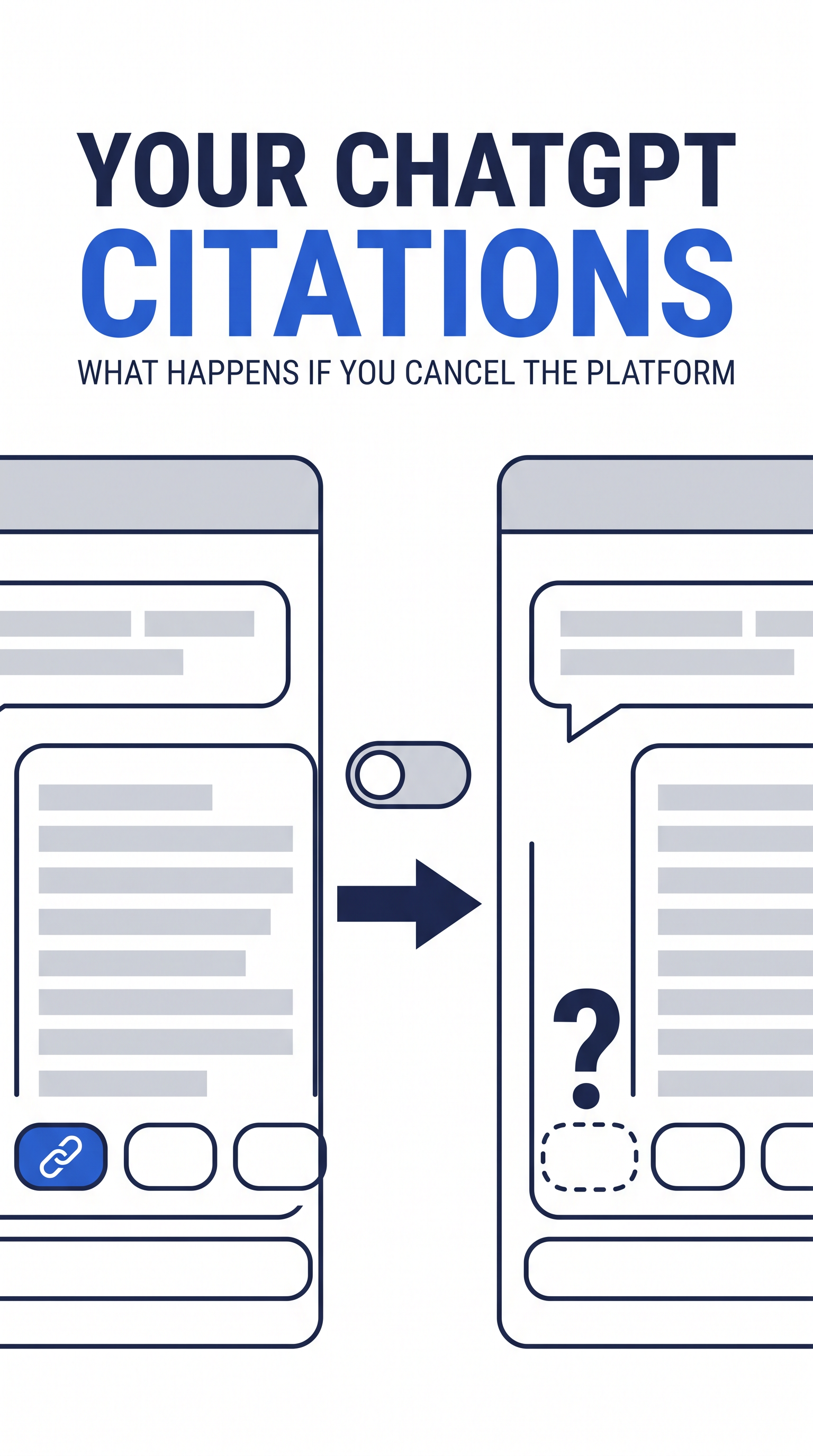

When the subscription ends, the page ChatGPT cited has to live somewhere you control.
Here is a question nobody asks in the demo. If you stop paying the platform, where do the pages go?
It sounds like a contract detail. It is actually the whole thing. A ChatGPT citation is a link to one address, and the address belongs to whoever runs the server. Write the best page in your category, publish it on someone else's subdomain, and you have built a very good page for them.
The traffic behind these links is no longer theoretical. In 2025, Graphite's Ethan Smith said ChatGPT traffic for his firm's clients had "started in January," and he pointed to two causes: more people using it, and answers becoming more clickable through cards, maps and shopping carousels. Clickable answers send people to a URL. The URL is the asset.
Platform roundups compare features, engines and price. Fair enough. They rarely ask where the optimized pages are hosted, or what happens to them on the last day of the subscription. I think that is the most expensive question in the whole purchase, and the cheapest to ask.
So this article follows one cited page, belonging to a fictional invoicing company, from the day it is published to the day its owner cancels. Along the way it explains what a citation is, why engines drop them, how fast that happens, and what to get in writing first. Nothing dramatic happens to the page, in the end. Unless it was never theirs.
Most platform roundups compare features. Engine coverage, dashboards, price. Very few ask the question that matters on the day you leave: where do the optimized pages actually live?
That answer decides what happens to your ChatGPT citations. Answer engine optimization (AEO) is the practice of shaping pages so AI engines such as ChatGPT, Claude, Perplexity and Google AI Overviews choose them as sources. A citation only appears when the engine goes out to the live web for its answer. One podcast on AI search made the point neatly: answers drawn from training data alone carry no live citations at all. So the first question to put to any vendor is plain: if we leave, whose server answers when an engine requests this URL?
If a platform publishes to a subdomain or network it controls, that address is its property. If it commits pages into your own CMS or repository, the address is yours. I think of the first arrangement as renting a shop front with your name painted over the door. The paint is yours. The shop is not.
Cancellation is when you find out which one you signed for.
Who actually owns the page ChatGPT cites?
Whoever controls the address owns the citation. Our team got Seamless Chex linked in 28 of 40 buyer questions after publishing 164 articles, and every one of those links pointed at a URL.
Before you compare any platforms, ask three things about one cited page:
- Whose domain sits in the address bar when you open it?
- Who can delete, redirect or rewrite it tomorrow morning?
- Where does the source file live: your CMS, your repo, or the vendor's server?
Some definitions first, because the words get slippery. A citation is the link an AI engine such as ChatGPT, Perplexity or Google AI Overviews attaches to its answer, pointing at the page it drew from. A vendor-hosted page is one served from servers and accounts the vendor controls, whether on a subdomain dressed in your name or on a content network of sites the vendor owns. An owned page lives in your own CMS or code repository. Citation equity is the trust an engine has built up in one specific URL over time.
There are two kinds of ownership, and people mix them up. The common assumption is that cancelling means worrying about what a chatbot keeps from your conversations. That is a privacy question. A fair one. It is just not this one.
Here is the example we will carry through the whole article. Kola Ledger is a fictional mid-market invoicing company. It publishes a page answering how to reconcile vendor invoices, and ChatGPT starts citing it. Everyone is pleased. Nobody checks the address bar, which is how these things usually go.
The engines appear to reward owned pages. Promptwatch data reported in August 2026 found that 32% of ChatGPT citations now come from docs and help centers, the kind of page a company keeps on its own domain. The same data showed small company pages falling from 66% to 32% of citations, so the share that remains is worth guarding. One podcast guest also noted that the same question, asked again a few minutes later, can return different citations.
Combining 4 sources points to one pattern: citations are attached to addresses, and addresses belong to whoever pays for the hosting. In practice, the page Kola Ledger thinks of as its own may not be.
Source material matters too. In our repo-based knowledge-base pilot, we wrote the same two questions twice, and in the first round, with web research still allowed, 30 to 38 web sources entered each article. What you publish from, and where you publish to, are both ownership choices. Our AEO knowledge base guides cover how engines pick sources in more detail.
Here is a check you can run on Kola Ledger's invoice page today. Open the cited URL. Read the hostname, all of it, not just the brand word in the middle. A page at help.kolaledger.com may still be served by a vendor, and a page at kolaledger.com/guides may still be built inside a vendor's account. The hostname tells you whose name is on the door. The DNS record and the hosting account tell you whose keys open it.
So ask about both. Who holds the DNS record for that subdomain? Who pays for the server behind it? If the answer to either question is the vendor, the page is rented, however familiar the address looks.
Our own scoring works at the level of the domain. We have scored 11,000+ domains across 15 sectors and 28 categories, and every one of those scores was attached to an address, not to whoever wrote the pages on it. Move the pages to a new address and you start again with a new address and no history at all.
The citation is not loyal to the writer. It is loyal to the URL. Keep that in mind, because the next step is cancellation day.
How fast do ChatGPT citations disappear when pages move or change?
Faster than most contracts assume. A citation is a live signal the engine recalculates, not a ranking you keep, and one whole source category lost most of its share in four days.
Promptwatch figures, reported in August 2026, showed Reddit's share of ChatGPT Search citations falling from 3.83% to an average of 0.52% between Aug. 14 and Aug. 17. That is roughly an 86% loss of visibility in four days. Google AI Overviews and AI Mode showed only a gradual slide over the same stretch.
Nobody at Reddit cancelled anything. No invoice went unpaid. The engine simply changed its mind, and the citations went with it.
I find that the most useful fact in this whole subject, because it tells you how citations behave when nobody is watching. They are not filed away somewhere safe. So ask any vendor how quickly they would tell you if one of your cited pages stopped resolving.
A second piece of the puzzle: the same question, asked again a few minutes later, can return different citations. Answers drawn purely from training data show no live citations at all. Questions that trigger web retrieval do. So before anyone edits a cited page, write down which questions it is cited for in each engine. That record is what lets you tell a real drop from ordinary noise later.
Now the uncomfortable part. A practitioner writing on the r/aeo forum in April 2026 described pages cited about 2-3 times a week across ChatGPT, Perplexity and Claude. The team "added some new sections, refreshed a few stats," and citations "dropped… significantly." Some pages "basically disappeared from the results entirely for a few weeks," then came back slowly, and not to where they had been.
Those were modest edits. On an owned page. With nobody leaving.
Apply that to Kola Ledger's invoice page and you get three ways for its citation to go:
- Removed: the page is switched off, so there is nothing left to retrieve and nothing left to cite.
- Moved: the page reappears at a new address, and the trust built up in the old URL does not automatically follow it.
- Changed: the page stays put but is rewritten, which the r/aeo account suggests can cost weeks.
Cancellation on a vendor-hosted setup tends to trigger the first or second. Sometimes, if a hurried rescue copy goes up elsewhere, both at once, with a rewrite thrown in for good measure. If a move really cannot be avoided, plan it the way you would plan any website migration built for AI engines, page by page, with the wording left alone.
Ask any provider which of those three its exit process would cause, and get the answer in writing. Which leaves one practical question for anyone still at the signing stage, and it is not about features.
Once ChatGPT drops a page, does the citation come back?
On a panel of 40 questions put to six AI engines in the same week, Gemini cited Reddit on 22 of them. ChatGPT cited it on one at most, and nobody has proved why.
The panel comes from a commenter on Reddit's r/SaaS forum who builds a citation measurement tool and says so up front: "weigh it accordingly." Both weeks of the commenter's data fall after mid-August 2026. In that stretch, Reddit's share of ChatGPT Search citations fell from 3.83% to an average of 0.52% between 14 and 17 August, according to an AI citation-tracking company's data cited by the Stacked Marketer newsletter. Over the same period, the newsletter noted, Google's AI Overviews and AI Mode "showed only a gradual slide."
The panel shows something the share figures cannot. A source can all but vanish from ChatGPT while staying prominent on Google's surfaces at the same moment. A single blended visibility score would show a dip. ChatGPT on its own showed a cliff.
So why would one engine drop a source the others kept? The commenter keeps coming back to a date. On 14 August, the first day of the four-day fall, Reddit "started refusing automated access at the server." Google's licensing deal with Reddit, the commenter suggests, would explain why Google's surfaces still lean on it. Then comes the caveat: "I can't prove either from 40 prompts and I'm not going to pretend I can." The newsletter put it more bluntly: "The data shows when, not why."
OpenAI's own documentation fills in the part nobody disputes. ChatGPT search relies on a crawler called OAI-SearchBot, and "Sites that are opted out of OAI-SearchBot will not be shown in ChatGPT search answers," except as navigational links. The effect is quick, too: after a site updates its robots.txt file, "it can take ~24 hours" for OpenAI's systems to adjust. The documentation only covers sites that block the crawler. It says nothing about pages that stop existing, and none of our sources measured what happens to citations when a vendor takes pages offline. Under OpenAI's own rules, though, a page has to be reachable before ChatGPT search will show it.
The evidence on recovery is thinner. In an April 2026 thread on Reddit's r/aeo forum, one practitioner described pages that ChatGPT, Perplexity and Claude had cited two or three times a week. The team then made what it saw as modest improvements.
One team's account, April 2026
- Pages are cited "pretty consistently" across three AI engines.
- The team "added some new sections, refreshed a few stats."
- Citations drop, and some pages disappear "entirely for a few weeks."
- Citations return slowly, "but not to the same level."
One practitioner's report on r/aeo, with no controlled comparison.
Others in the thread had seen something similar. One said citations came back once their team cut a page back to "punchy, direct answers with clear structure." A commenter from an AEO agency said a SaaS client's AI citations "tanked 40%" after a content refresh. The original poster wondered aloud about "just seeing patterns in noise," and several of the commenters sell AEO services. These are anecdotes. They show a recovery can happen, and that in these cases it was slow and incomplete. They cannot tell you how often citations come back, or how fast.
Side by side, the cases suggest a citation lasts only while the engine keeps finding the page it cited, in the form it cited. The sharpest collapse in this record coincided with a change in access, though nobody has proved the two are linked. OpenAI's rules make reachability a condition for appearing in ChatGPT search. And the slow, partial recoveries practitioners describe followed changes far smaller than a page disappearing. None of our sources measured a cancellation. On this evidence, though, a vendor-hosted page that goes offline when the contract ends is best treated as a lost citation, with no assurance it will return.
- Before you cancel, ask the vendor in writing whether every cited URL will keep resolving at the same address once the contract ends.
- Check your citations one engine at a time. A collapse in ChatGPT can sit next to steady numbers on Google's AI surfaces, and a blended score can hide it.
- Make sure your robots.txt lets OAI-SearchBot reach the pages you want cited, and check again about a day after any change.
- If a cited page needs an update, change one thing at a time, keep the answer structure intact, and track the page for weeks rather than days.
- Ask anyone who promises a recovery what evidence they have that citations came back to their earlier level.
How we checked this
We used four sources: tracking data on Reddit's ChatGPT citations as reported in a marketing newsletter, two Reddit discussion threads from practitioners, and OpenAI's crawler documentation, which we retrieved on November 8, 2026. The share figures come from a citation-tracking company, and we did not see its raw data. The 40-prompt panel is one commenter's measurement. It ran once per engine per week and started after the August change, and the commenter builds a measurement tool. The recovery accounts are anecdotes, several from people who sell AEO services. None of the figures in this section come from our client data. We sell AEO content work, so we have a stake in how this question is answered. Still unknown: why ChatGPT dropped Reddit, whether those citations will return, and what happens to citations when a page is taken offline. None of our sources measured that last question directly.
- Stacked Marketer newsletter, report on Reddit's ChatGPT citations, August 24, 2026.
- r/SaaS, thread on Reddit citations in ChatGPT, September 12, 2026.
- OpenAI, overview of OpenAI crawlers, retrieved November 8, 2026.
- r/aeo, thread on citations dropping after page updates, April 28, 2026.
What should you require from an AEO provider before you sign?
Get four things in writing: pages on your domain, no lock-in, cancel-anytime terms and a measurable outcome. We put ours plainly: named in AI answers within 100 days, or we keep working free.
Protection has to be written into the engagement before it starts. It cannot be negotiated after you cancel, when the vendor holds the pages and you hold a grievance.
Here is what I would ask for, in order:
- Pages published on your domain. Ask to see where the first article will go live and whose account it is committed to.
- No contract that locks the pages in. If leaving means losing the URLs, the contract is the hosting plan.
- Cancel-anytime terms. The right to leave is only real if what you paid for stays where it is.
- A visibility outcome you can measure. Named in AI answers, on your target questions, by a date.
For Kola Ledger, the two setups look like this side by side:
| Question | Vendor-hosted pages | Pages in your own CMS or repo |
|---|---|---|
| Where the cited page lives | Vendor servers, vendor subdomain or content network | Your CMS or code repository, on your domain |
| Who controls the URL | The vendor | You |
| What happens at cancellation | Page can be switched off or moved | Page stays live, unchanged |
| Citations after cancellation | Depend on the vendor's choices | Stay attached to your URL |
| Rescue work needed | Rebuild, republish, wait | None |
The evidence in front of me does not include a count of how platforms split between those two columns. So check each one yourself, in the demo, with a real page.
Price is no guide to which column you are in. One marketer on r/AskMarketing wrote in March 2026 that agencies were pitching AEO services at $3-5k/month, with deliverables that looked like a checklist the team could probably handle itself. A retainer that size can still leave the pages on someone else's server. Nobody mentions it, of course. It is not on the slide.
Our own publishing model is the second column. AEO Content's pipeline commits finished pages into the client's GitHub or Bitbucket repository, or publishes them to WordPress, Shopify or Ghost, so the file and the URL are the client's from the first day. We have run 26,577 real AI-visibility audits, and the lesson I take from that volume is dull: an audit only matters if the thing audited still belongs to you next year. The AEO questions we answer most often cover contract terms in more detail.
One more item belongs in the contract, and it is the one people skip: a written exit plan. It should say what you receive on the last day (the source files, the images, the structured data), who holds the DNS records for any subdomain carrying your name, and whether every cited URL will keep resolving while you move. If the vendor hesitates, you have learned something useful before you signed, which is the cheap time to learn it.
I say this from the operating side of software. I founded LiveHelpNow, which was recognized on the Inc. 5000 at number 84, and running a SaaS company teaches you that customers judge you on the day they leave as much as on the day they join. At AEO Content, Alex and I bring a combined 40+ years of SEO and content infrastructure experience to this work, and the plainest lesson from those years is that infrastructure outlives campaigns. So ask who on the vendor's side will run the handover, by name, and what exactly they will hand over.
Ask the hosting question before the pricing question. Kola Ledger did not, and its next move tells you what that costs.

So what happens to Kola Ledger's citations after it cancels?
That depends entirely on where the invoice page lives. On Kola Ledger's own domain, the page stays, the URL stays, and the citation keeps its chance. On the vendor's, it goes when they say so.
I expect this to matter more each year, not less. When ChatGPT dropped most of Reddit's citations within a single week, one founder tracking the shift on r/SaaS also saw more documentation and company-owned domains being cited. Owned pages are where the engines seem to be heading.
Results from citation-ready pages can come quickly, too. One of our clients went from a quiet site to 10 booked calls in 3 weeks. Nice, of course. Nicer still when the pages that did it are yours to keep.
Cancel-anytime terms are only worth having if leaving costs you nothing. So before the next renewal, open one cited page and look at the address bar. Then decide.
Frequently Asked Questions
What else do people ask about citations after cancelling?
Do I own the content an AI content platform writes for me?
Read the contract, then check the hosting. Owning the words is little help if the vendor controls the URL that engines cite. Ask for both in writing.
What is a vendor-hosted subdomain?
A vendor-hosted subdomain is an address carrying your brand that runs on the vendor's servers and accounts. It looks like yours. It is switched off by them.
Will a redirect save my ChatGPT citations if pages move?
Possibly in part, though the evidence here does not measure it. A citation attaches to the address the engine trusted, and the trust built in the old URL does not automatically follow. Keeping the original URL is safer.
Should I rewrite pages right after switching providers?
I would wait. Practitioners report cited pages dropping out for weeks after modest edits. Leave the wording alone until the new setup is stable.
How do I check whether citations survived?
Ask the same target questions in ChatGPT, Perplexity, Claude and Google AI Overviews, more than once. One AI search podcast noted that citations can change within minutes, so a single check proves little.
How do I talk to AEO Content about where my pages live?
Book a conversation through aeocontent.ai/contact. We will look at where your cited pages are hosted before anything else.
Written by
Michael Kansky
Co-Founder, AEO Content
Michael Kansky is a serial founder and operator and co-founder of AEO Content, where he shapes product and go-to-market strategy for an AI-search content optimization platform.
Connect on LinkedIn