
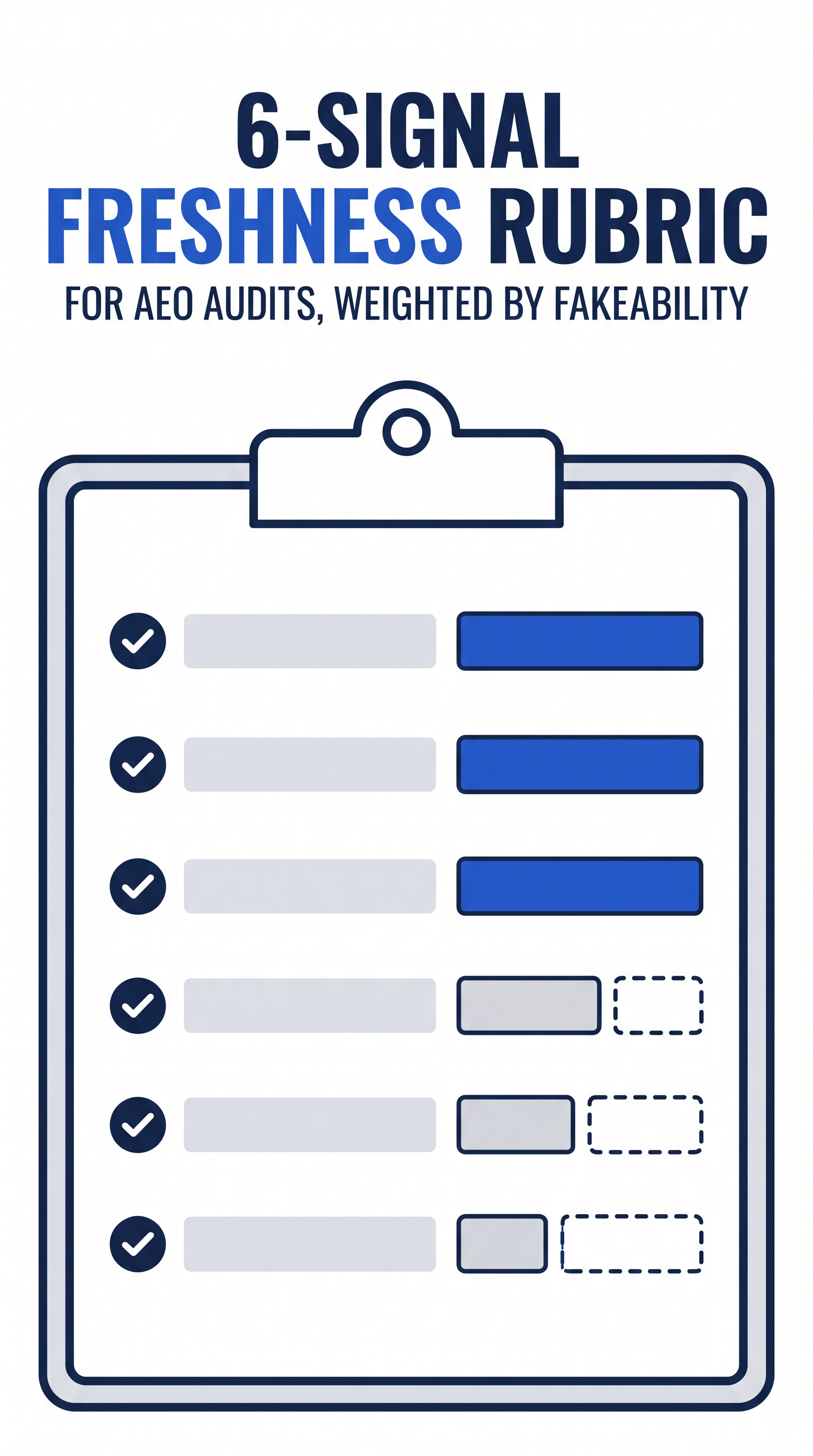
A 6-signal freshness rubric for AEO audits, weighted by fakeability

On this page
Quick Answer
Weight six freshness signals by how hard each is to fake. Updated statistics, new dated sources and changed answer text carry the weight; modified dates, sitemap lastmod and year strings barely count.
A date that moves with nothing changed beneath it gets flagged, not credited. The check is plain. Compare two crawls and see what moved. Crawler access, schema and server-side rendering tell you a page can be read, but not whether anyone rewrote it, which is closer to what ChatGPT and Perplexity are weighing.
Key Points
- Pew Research Center found that in March 2025, US adults clicked a traditional result in 8% of visits carrying an AI summary, against 15% without one.
- In the KDD 2024 GEO research by Pranjal Aggarwal and colleagues, adding quotations, statistics and cited sources raised visibility in generative answers by up to roughly 40%.
- Google's guidance for AI Overviews says structured data should match the visible content, so a dateModified change with no substantive update deserves a flag, not credit.

A new date on the sign says nothing about what changed on the shelves.
It should check whether a page's substance changed when its date did. Crawler access, schema and rendering show a page can be read; freshness shows whether it deserves rereading.
Buyers keep asking answer engines for technical AEO audit services that test AI crawler access, schema and server-side rendering, and for the companies that specialize in this work. Those are fair questions. They are also incomplete. A page can pass every one of those checks and still be a repainted facade, the same old storefront with a new date stenciled over the door, and an audit that reads only the paint will grade it as new.
I borrowed the remedy from our own plumbing. Our knowledge-base indexer re-reads a product's code repositories every night, but only the files that changed since the last commit. In the first pilot, run in October 2026 for a live-chat software company, we indexed 1,368 text files across two Bitbucket repositories and excluded 367 backup and retired template files on purpose. Search across both repositories then answered support questions in 5 to 16 milliseconds. It seemed to me, watching that log, that a website audit could work the same way: compare two crawls, keep what moved, ignore what was merely resaved.
The comparison needs a rhythm too. Our Growth plan tracks 5 prompts weekly. Premium, at $250 a month, tracks 20 prompts daily. The cadence decides how soon you learn whether an update held its place in ChatGPT or Perplexity, and that is where the rubric begins, with the signals anyone can fake in an afternoon.
Pew Research Center watched 900 US adults browse in March 2025 and found they clicked a traditional result in 8% of visits that carried an AI summary, against 15% without one. They clicked a link inside the summary about 1% of the time. Seer Interactive, tracking AI Overviews across more than 100 clients, reported organic click-through falling about 70% when an Overview appeared. Clicks are thinning. A refresh can no longer be judged by traffic alone; it has to be judged by whether ChatGPT, Perplexity, Claude and Google AI Overviews keep naming you afterward.
That changes the decision on your desk this morning. Every refresh costs writer hours. Some of those hours buy new evidence. Some buy only a new date. An AEO audit, meaning an assessment of how readily answer engines can find, trust and quote a page, should be able to tell the two apart, and a checklist built on date fields cannot.
Before reading on, open one page you refreshed this quarter and ask a plain question: besides the date, what changed?
What is a freshness signal in an AEO audit?
A freshness signal is any mark on a page that claims its information is current. An audit should ask whether each one is present, and how cheaply it could be faked.
Before you approve another refresh budget, put every signal your current audit checks through three plain questions:
- Can someone change it without touching a sentence a reader actually sees?
- Would a returning reader notice anything new on the page?
- Could ChatGPT, Perplexity or Google AI Overviews lift the new material into an answer?
A signal that fails all three is a costume. It changes how the page dresses, not what it knows.
Our AEO Rank standard scores every site on 53 criteria across 5 pillars, and we have applied it to 11,000+ domains across 15 sectors and 28 categories. A criterion in a standard like that is only as honest as the evidence it reads. I think of freshness as the criterion where that honesty is tested hardest, because the cheapest proof of currency and the most expensive one can look identical in a crawler's report, two lines of the same height on the same screen.
Tim Mitchell and Jonathan Green of Incubeta, in their 2026 blueprint for answer engine optimization, put one question into their benchmark audit that has stayed with me: are the engines citing your preferred URLs, or are they "scraping outdated press releases and third-party forums"? I thought, for a moment, of an old storefront sign on a city street, the shop long closed, the painted lettering still catching the late light. A passerby reads it as an invitation. A stale page in an index works the same way, and the date stamped on it says nothing about whether anyone is still inside.
The common assumption is that freshness means a recent date. It does not. Ask your CMS team which date fields move on every save, whether or not a word changed. In software, where I have spent my working life (LiveHelpNow was an Inc. 5000 inductee at number 84 from 2015 to 2018), a field that changes without a cause is called a bug, not a release. The research section below walks through what happened when teams changed the substance itself.
If the schema vocabulary is unfamiliar, our AEO knowledge base guides cover the underlying terms. This week, list every freshness check your audit runs and mark which ones a junior editor could satisfy in under a minute. That list is where the rubric starts, and it leads straight to the most common of those checks, the modified date, and to what a bumped date can and cannot prove.
Why does a bumped date prove nothing about an update?
A bumped date proves that a file was saved, nothing more. It cannot tell an auditor whether a single fact, source or answer on the page actually changed.
Consider what the date fields are. The dateModified property in Article schema, the lastmod entry in an XML sitemap, the small "updated" line under a headline: each is a string. A content system can rewrite that string on any save, whether the save fixed a comma, swapped an image or rebuilt the argument from the ground up. To a crawler, the three look alike.
We have run 26,577 real AI-visibility audits, and a number of that size makes the design question unavoidable. An audit that reads date fields at face value will repeat whatever error those fields carry, at that scale, without noticing. What our records do not yet show is how often a modified date moved while the visible text stood still. That count is worth collecting. Once it exists, it would tell a marketing director what share of their refreshed pages were refreshed in name only.
There is an honest reason audits lean on dates. They are machine-readable, consistent across platforms and quick to verify across thousands of URLs. That convenience cuts both ways, because the same field is just as quick to set. The safeguard belongs before publishing, not only in the audit. When our pipeline writes an article from a product's code, a deterministic check flags any leaked code and any outside link before the page goes live; nothing ships on the writer's word alone. A date deserves the same gate. Ask whoever runs your CMS to refuse a new modified date unless the visible body changed since the last version, and to log which statistic, source or answer moved. That log becomes evidence an auditor can read. It also turns a quiet habit, re-saving old posts to look current, into a decision someone has to sign. For any page marked as refreshed, ask one question: which sentence on it would be wrong today if the update had never happened? The trade-off is plain enough: what is cheap to verify is usually cheap to fake. An audit built for its own convenience ends up grading the paperwork.
In enterprise systems, the kind our team's full-stack engineer and content infrastructure architect has spent 20 years building, a timestamp records that a write happened, not what the write meant. I find that distinction quietly clarifying. It is the difference between a building's inspection sticker and the wiring behind the wall, and anyone who has walked an old city block knows which of the two is easier to replace.
The outcomes that matter sit somewhere else. One line in our own record reads: from a quiet site to 10 booked calls in 3 weeks. That is the kind of result a refresh budget should be measured against. A modified date, however recent, cannot be entered in that ledger.
Our approach to research-driven content built on evidence starts from the same suspicion of self-reported signals. A page that tells you it is new has told you very little. So when an agency or auditor reports a page as refreshed, ask to see the before-and-after text, not the timestamp.
This week, pull five pages your team marked as refreshed last quarter and read them beside their previous versions. Note what actually changed. The exercise sets up the real question, which is which signals a save button cannot produce, and there turn out to be three of them, set against three that it can.
Which 6 freshness signals should an AEO audit weight, and how heavily?
Put most of the weight on updated statistics, new dated sources and changed answer text; date fields earn little. Being named in AI answers within 100 days depends on substance.
Here are the six signals an audit can read, sorted by how cheaply each can be produced without new information:
- Modified date (the
dateModifiedfield and any visible "updated" line): light weight, because one field changes it. - Sitemap lastmod: light weight, because many systems rewrite it on any save.
- Year in the title or copyright line: light weight, because it is a single string.
- Updated statistics with a stated period: heavy weight, because a new figure needs a new source behind it.
- New dated sources in the references: heavy weight, because someone had to find and read them.
- Changed answer text in the passage directly under each question heading: heavy weight, because the change is visible, diffable and quotable.
The scoring rule follows from the list. Credit a light signal only when a heavy one moved with it. A modified date that no heavy change supports is not neutral; the audit should flag it.
The heavy three are not an arbitrary choice. In the original GEO research, published at KDD 2024 by Pranjal Aggarwal and colleagues at Princeton and IIT Delhi, adding quotations, statistics and cited sources raised visibility in generative answers by up to roughly 40%, while keyword stuffing performed worse than doing nothing. The engines rewarded evidence. A rubric should reward the same thing, and it should treat cosmetic signals with the indifference the research gave to stuffing.
Our own promise is written in those terms: named in AI answers in 100 days, or we work free until you are. A promise like that cannot be kept with a timestamp. It can only be kept with pages that say something new.
Detecting an unsupported date is a solved problem in other settings. When AEO Content connects a software company's code repositories, it re-indexes them every night and reads only what changed since the last commit. A page audit can borrow the method whole: store each answer passage, statistic and reference list at one crawl, compare them at the next, then hold the result against the modified date. If the date moved and the comparison is empty, the page has dressed for an occasion it never attended.
Alex and I bring a combined 40+ years of SEO and content infrastructure experience to AEO. I mention it only because the habit of distrusting a self-reported field is old in both trades. It seemed to me, reading the GEO results for the first time, that answer engines had arrived at the same suspicion by a different road, the way two travelers from distant cities sometimes describe the same square.
Our answers on AI search optimization cover the schema fields in more detail. This week, rescore your last audit with the light signals counted only when a heavy one changed, and see which pages fall first.
Which updates keep a page cited by AI, and which only look fresh?
One team on a practitioner forum made the kind of update SEO best practice calls good: new sections and a few refreshed statistics. Then its AI citations fell, and some pages vanished for weeks.
The thread was posted to Reddit's r/aeo community in April 2026. The pages had been showing up as a source "2-3 times a week" in ChatGPT, Perplexity and Claude, and the edits were "Not huge rewrites." Afterward, some pages "basically disappeared from the results entirely for a few weeks before slowly coming back (but not to the same level)." The poster admits to lacking "enough data to say anything confidently yet" and still counts coincidence, such as shifting queries or competitor content, as possible.
At first glance, the story contradicts the KDD 2024 research on generative engine optimization, which credits sourced substance with lifting visibility in generative answers. Fresh statistics are exactly what the forum team added. So why would they cost citations?
The replies point to a more specific cause. One commenter "improved" a page by adding context and background and saw citations drop. "When we simplified back to punchy, direct answers with clear structure, they came back." Another, affiliated with a company that sells AEO services, said a SaaS client's citations "tanked 40%" after a refresh that "buried their Q&A section under new paragraphs." A third drew the line an auditor needs: "Refreshing stats and adding sections without touching the core answer structure is very different from reorganizing the page architecture and the citation impact of each is likely very different too."
Several commenters called structural disruption the likeliest cause, with re-crawl delay "probably a factor too." None of these accounts is verified, and some come from people with services to sell, so they cannot prove what caused any drop. They do suggest how the reports and the research fit together. In the research, gains came from adding substance. In the reports, losses followed edits that buried or reshaped the answer an engine had been pulling from.
Google's guidance points the same way. Its helpful-content self-assessment asks whether you are "changing the date of pages to make them seem fresh when the content has not substantially changed," or adding and removing a lot of content mainly to seem fresh. Will that help rankings? "(No, it won't)."
Dates still carry some weight on at least one engine. Duane Forrester, who writes about search and AI visibility in his newsletter, observes that Perplexity routinely cites its sources, "often favoring pages with structured data, clear headings, and current publication dates." He adds that "Outdated information, dead links, or references to old data quietly undermine trust." He offers no data, but his observation is a reason to keep dates honest instead of writing them off.
Here is each kind of update beside its evidence:
| Update | What the evidence says | Kind of evidence |
|---|---|---|
| New statistics, quotations or cited sources | Visibility in generative answers rose by up to roughly 40% | Peer-reviewed research (KDD 2024), read through a secondhand summary |
| Keyword stuffing | Did worse than making no change | Same research |
| Added sections, context or background | Citation drops followed in several reports. Google says adding content to seem fresh won't help | Practitioner anecdote, plus Google guidance |
| Burying or reorganizing the answer block | Suspected cause of the drops, including a reported 40% fall | Practitioner anecdote, partly from vendors |
| Current publication date | Perplexity often favors current dates. Google warns against changing only the date | Expert observation, plus Google guidance |
| Removing old data and dead links | Outdated material quietly undermines trust | Expert observation |
Read side by side, the sources mostly agree. Adding substance has research behind it. Disrupting the answer may cost the citations a page already has. Picture two refreshes that add the same sourced statistic: one places it beneath an intact answer, the other rewrites the answer around it. The second carries more risk, even though both move the date by the same day.
We have a stake here, because we sell AEO audits and content. Across 26,577 audits, our AEO Rank standard has tracked whether ChatGPT, Claude, Perplexity and Google AI Overviews name a client. That kind of tracking makes one commenter's suggestion practical: "Tracking section level citations before and after would give you the cleanest signal on which theory is actually driving the drop."
Before an audit credits a refresh
- Look for what arrived with the new date: a new statistic, quotation or cited source with its origin named. Credit those first.
- On a cited page, mark the answer block before editing and confirm afterward that it is intact and easy to find. Flag any refresh that pushes it down or breaks it up.
- Record which engines cite the page, and for which questions, before the change. Recheck afterward, allowing a few weeks, since reported recoveries took about that long.
- Change one thing at a time on cited pages so that a drop can be traced to its cause.
- Ask whether your target questions lean on Perplexity. If so, keep visible dates accurate, move them only with real changes, and clear out dead links and old figures.
How we checked this
We used five sources: a practitioner forum thread from April 2026, a 2026 article that summarizes the KDD 2024 research on generative engine optimization, a newsletter essay by search writer Duane Forrester, Google's own guidance on helpful content, and our own audit figures.
The 26,577 audits and the list of engines we track come from us. We read the GEO paper's findings only through that secondhand summary, not in the paper itself. The forum accounts are unverified, and some commenters work for companies that sell AI visibility services. We sell AEO audits and content, so we have a stake too.
Still unknown: no source ran a controlled comparison between refreshes that keep the answer structure and refreshes that change it. None measured how long re-crawl lag lasts, either. Beyond Forrester's comment about Perplexity, we found no evidence on how each engine weighs dates.
- Reddit r/aeo, thread on AI citations dropping after page updates, April 28, 2026.
- Nishkarsh Gupta, article on AEO, GEO and SEO summarizing the KDD 2024 GEO research, Medium, October 20, 2026.
- Duane Forrester, essay on brand authority and trust in AI answers, Duane Forrester Decodes, November 16, 2025.
- Google Search Central, guidance on creating helpful, people-first content, retrieved November 9, 2026.
- Our AEO Rank audit records and tracking coverage, November 2026.
What should change in your next freshness audit?
Start by listing which of your pages carry citations today. Add a column to your audit sheet that records, for each page, whether anything besides the date moved since the last crawl.
Google's guidance for AI Overviews already points this way: any structured data should match the visible content. A modified date that no visible change supports fails that test quietly. Before you refresh a page that is already cited, save a copy of its opening answer so you can restore it if citations slip.
The method is not exotic. In our first repository pilot, a re-index after a day of commits re-read only the 14 files that changed. Pages deserve the same attention. The research section above walks through these findings.
I expect the audits that matter next year to read a page the way a careful walker reads an old street, noticing which facades were repainted and which buildings were actually rebuilt. Begin that walk this week, with your most cited page.
Summarize This Article With AI
Open this article in your preferred AI engine for an instant summary.
Frequently Asked Questions
What else do people ask about AEO freshness audits?
Does updating dateModified help AI citations?
Not on its own. dateModified is a schema property that records when a page was last changed, and any save can move it. I would credit it only when a new statistic, source or answer moved with it.
How long do citations take to return after a refresh?
The evidence is thin and anecdotal. In an April 2026 r/aeo thread, one practitioner said some updated pages vanished from AI results for a few weeks, then recovered slowly and not to their previous level.
Should I stop refreshing pages that are already cited?
Not entirely. Change them deliberately. One commenter in that thread said citations came back after the page was simplified to "punchy, direct answers with clear structure," and another advised: "Test changes incrementally, not all at once."
Why does freshness affect trust at all?
Google's Search Quality Rater Guidelines call trust "the single most important quality of a high-value page." Outdated figures, dead links and old data quietly erode it. Fresh evidence repairs it.
Does a technical AEO audit check freshness?
It should, beside crawler access, schema and server-side rendering. A technical AEO audit is a review of whether answer engines can reach, parse and trust a site. Freshness belongs in the trust part, scored by what changed in the prose.
How do I get my own pages scored?
Start with the Free AEO Readiness Audit, or reach AEO Content directly through the contact page at aeocontent.ai/contact. Bring your five most cited URLs, since those are the pages where a careless refresh costs the most.
Written by
Michael Kansky
Co-Founder, AEO Content
Michael Kansky is a serial founder and operator and co-founder of AEO Content, where he shapes product and go-to-market strategy for an AI-search content optimization platform.
Connect on LinkedIn