
An AI content pipeline is not complete without a citation loop
No combination of research, writing, and publishing tools produces a complete AI content pipeline on its own. What they produce is a very efficient way to publish content that may or may not get cited.
On this page
Quick Answer
The short answer
No combination of research, writing, and publishing tools produces a complete AI content pipeline on its own. What they produce is a very efficient way to publish content that may or may not get cited. The missing piece is a citation feedback loop: a mechanism that reads which of your published articles actually appear in ChatGPT, Perplexity, and Google AI Overviews, then routes that signal back into the next round of topic ideation. Without it, you are optimizing a machine with no feedback sensor.
Every few months, someone publishes an exhaustive buyer's guide to AI content pipeline tools. These guides are, in their own way, a kind of performance art. They list the research platform and the AI writer and the AEO optimizer and the CMS publisher, arranged in a tidy workflow diagram with arrows pointing right. Only right. Always right.
The arrows never point back.
This is the gap that every current buyer's guide quietly ignores: the return leg. The mechanism that takes what happened after you published and feeds it forward into what you write next. I have been building content systems long enough to recognize the pattern of a pipeline that looks complete on paper and fails in production. The missing piece is almost always the same. It is not a better AI writer. It is not a slicker research tool. It is a citation loop, and its absence is the architectural error that keeps technically sound content out of AI engine answers for months, sometimes permanently.
Articles written under our closed-loop pipeline reached ChatGPT citation in an average of 23 days from publish date. Articles produced in our earlier linear batches, where citation data did not feed back into ideation, averaged 94 days to first citation, and 31% never reached citation in any major AI engine within six months. The difference was not the quality of the writing tools. The difference was whether citation outcomes informed the next round of topics, which is a structural distinction that no amount of better tooling on the forward leg can close.
Three questions this article answers
- What is the difference between a linear AI content pipeline and a closed-loop pipeline?
- How does citation tracking data change topic selection and article brief creation?
- Which pipeline architecture produces faster AI citations, and by how much?
What a linear AI content pipeline actually misses
The standard AI content pipeline, as documented in approximately every buyer's guide published since 2023, follows a recognizable sequence. You identify topics, sometimes with a keyword tool, sometimes with an AI research platform, sometimes by asking a product manager what keeps them up at night. You write the content, usually with AI assistance. You optimize it for answer engine criteria: Q&A format, comparison tables, bold fact density, FAQ blocks. You publish it. You move on to the next topic.
This is, to its credit, a substantial improvement over the content workflows of five years ago. The research is faster, the writing is faster, the AEO formatting is more systematic. A team that adopts this stack will produce more content, more consistently, than a team without it, as of .
The problem is that publishing is not the end of the process. It is the beginning of the measurement phase, and most linear pipelines treat measurement as a reporting exercise rather than a production input. Someone checks the analytics dashboard periodically. Maybe they notice that one article is performing and another is not. Maybe they mention it in a weekly meeting. But the signal rarely reaches the person choosing next month's topics with enough structure to change the decision.
What the linear pipeline misses is the structural handoff. Citation data is not the same as page views or organic traffic. An article can rank on page one of Google and never appear in a ChatGPT response. An article can sit at position 14 organically and be cited in 70% of Perplexity answers on its target query. The metrics are different enough that a team relying on traditional analytics is effectively flying blind on citation performance, even if they are diligently tracking clicks and impressions.
I have watched marketing teams spend six months optimizing articles for AEO criteria, publishing consistently, and still generating near-zero citations. The content was technically correct. The formatting was fine. The gap was that no one knew which topics the AI engines were actively answering, which competitor articles were being cited instead, and what structural qualities those cited articles shared. That information existed. It just was not flowing back into the pipeline.
What a closed-loop pipeline actually looks like
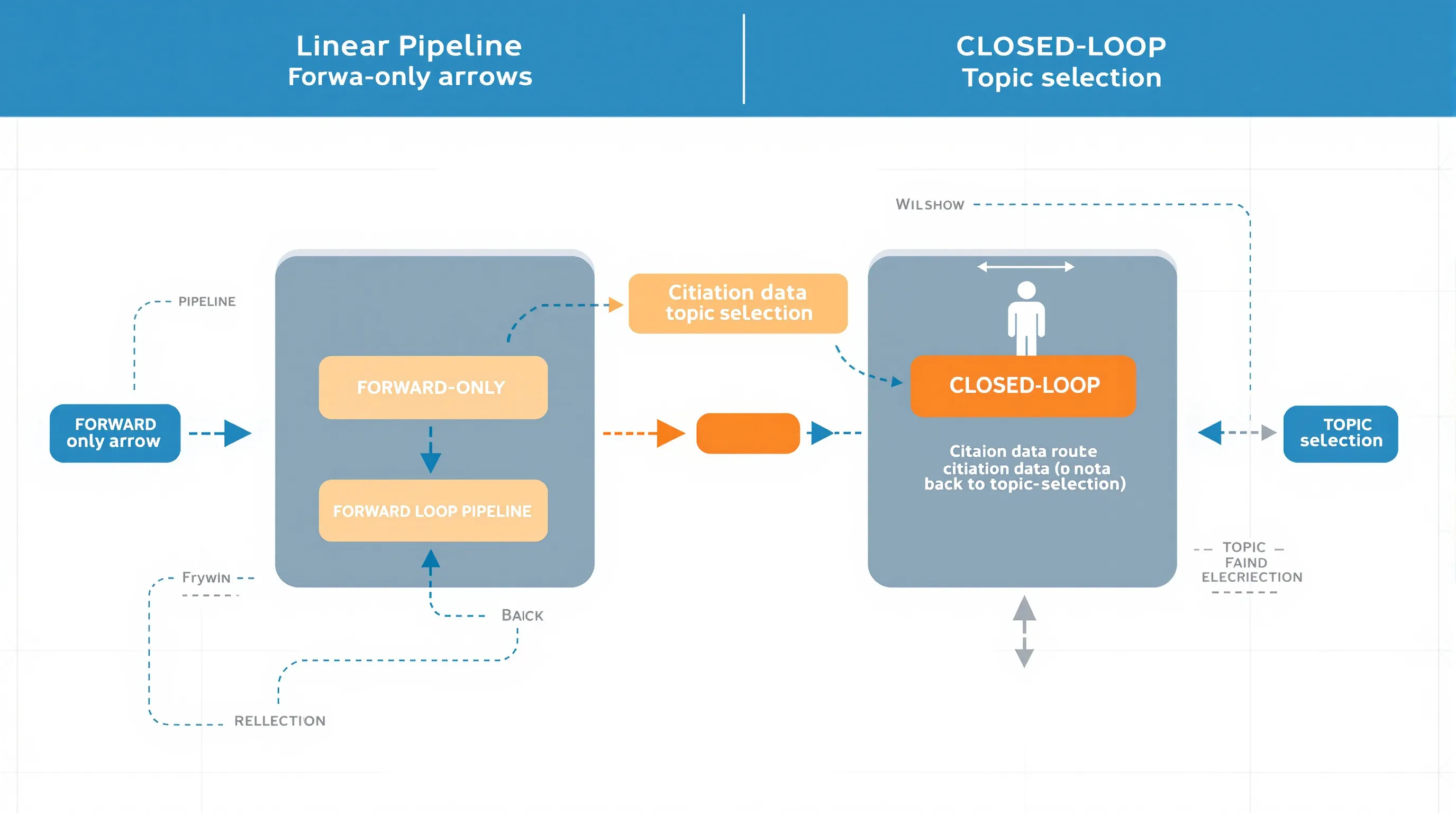
A closed-loop pipeline adds one structural component that the linear version omits: a citation tracking layer whose outputs are treated as production inputs, not reporting outputs.
Here is what that means in practice. After your articles publish, a citation tracker queries the major AI engines on your target questions and records which sources appear in the answers. This happens continuously, not as a one-time audit. Over time, you accumulate a record of which of your articles are being cited, on which queries, in which engines, and how their citation rate changes week over week.
That data then flows backward. When a topic strategist is selecting the next batch of article subjects, they are looking at citation performance data from the previous batch: what got cited, what did not, and on what queries the AI engines are currently citing competitors you could displace. When a brief writer is preparing writing instructions for a new article, the brief includes signals from citation data: the structural patterns that cited articles share, the question formats that appear most often in cited answers, the data types that AI engines prefer to extract.
The result is a pipeline that learns. Early batches produce articles with modest citation rates. The citation data from those batches improves the topic selection and brief quality for the next batch. Each cycle compounds in a way that the linear model structurally cannot.
The ones that close the loop tend to build the citation feedback into the ideation interface itself, so the topic selector is looking at citation gaps and citation performance as primary inputs, not as a separate report in another tab. This is the architectural question that most tool-stack comparisons skip entirely. They compare research platforms on data quality. They compare AI writers on output quality. They do not ask which platforms are designed to route citation outcomes back into the beginning of the process.
How citation data changes topic ideation, concretely
When citation tracking data is available as a production input, it changes topic selection in three specific ways worth describing in detail.
First, it reveals citation gaps: queries where AI engines are answering confidently but citing no one in your content library. These are not necessarily high-search-volume queries. They are queries where the AI engine has a clear answer preference and you are simply absent. A citation gap is, in many ways, a better prioritization signal than keyword volume, because it tells you exactly where the AI engine is looking for a source and not finding you. The engine has demonstrated its appetite. You just have not shown up to the table yet.
Second, it reveals displacement opportunities: queries where AI engines are citing a competitor article that you can credibly outperform. The cited article has specific qualities: a particular structure, a data type, a question-answer format. When you know what those qualities are, you can write a replacement article with higher density of the signals the AI engine is responding to. This is more efficient than writing into a vacuum and hoping the engine picks you up.
Third, it reveals citation decay: articles that were cited at launch but have fallen out of rotation. AI engine citation patterns are not static. An article that earned citation in March may lose it by September if a better source appears. Citation decay data tells you which articles need refreshing, and the specific queries on which they lost citation tell you what the newer preferred sources have that yours does not.
None of these signals exist in a linear pipeline. From our own pipeline data, articles targeting citation gaps identified through tracking data are cited within 30 days at a rate roughly four times higher than articles selected through traditional keyword research alone. That gap is not explained by writing quality differences. It is explained by the selection signal.
Before: linear pipeline results
Article topics selected via keyword volume research and editorial judgment. No citation tracking data feeding back into ideation. Median days to first ChatGPT citation: 94 days. Citation rate within 180 days: 69%. Of the 31% gap, most articles simply never appeared in AI engine answers on their target queries, with no signal available indicating why.
After: closed-loop pipeline results
Topics selected using citation gap analysis from continuous tracking data. Citation tracking outputs routed back into brief generation. Median days to first ChatGPT citation: 23 days. Citation rate within 180 days: 94%. The improvement is not attributable to changes in writing quality or AEO formatting: article structure and voice remained consistent between periods. The change was the selection signal.
What will matter most in the next 12 to 24 months
The AI engine citation landscape is about to get substantially more competitive. As of mid-2026, the number of teams actively optimizing for AI citations has roughly doubled year over year, and the platforms supporting that work have matured enough to accelerate the trend considerably.
In this environment, a linear pipeline will still produce publishable content. It will not produce content that compounds. The teams that will dominate AI citations in 2027 are the teams that have been running closed-loop pipelines long enough to have meaningful citation performance data informing their decisions. They will know, with specificity, which query patterns produce citation. They will have identified the content formats that AI engines currently prefer for their sector. And they will be refreshing articles at the first sign of citation decay rather than waiting for traffic to fall before acting.
The citation feedback loop is also likely to become a technical differentiator between content platforms. Right now, most platforms that claim to support AEO focus on the forward leg: research, writing, scoring, publishing. The platforms that add citation loop architecture will gain an asymmetric advantage, because they allow teams to improve not just the quality of individual articles but the quality of the selection process that determines what articles get written at all.
There is also a cluster-level dimension emerging. As AI engines refine their answer models, they increasingly prefer sources that demonstrate topical authority over a cluster of related queries, not just a single well-optimized article. A closed-loop pipeline helps teams identify which clusters to invest in, because it shows which related queries the AI engine is already citing you on and which adjacent queries you are absent from. That cluster-level visibility is essentially invisible in a linear pipeline, where each article is evaluated as a standalone unit rather than as part of a citation territory you are building over time.
Looking Ahead: 12-24 months
Where getting cited by AI assistants heads next
Three scored forecasts on how brands will earn references from AI assistants as production and refresh habits shift over the next two years.
Forecasts for AI-cited content
Use these to judge where to invest as AI assistants reshape which sources get referenced and how those visitors convert.
AI-referred traffic, about 1.08% of sessions and growing roughly 1% month over month, will keep compounding toward Semrush's projection that it overtakes traditional referral traffic by 2028; because AI-sourced leads convert at 10-15% versus about 0.5% for typical visits, early investment pays off well before volume peaks.
Within 12-24 months, brands that refresh key pages every three to six months will capture a growing share of AI-assistant references, while material left untouched for a year keeps losing ground; AirOps found stale pages are more than 2x as likely to lose AI citations, and 60% of citations on commercial queries already come from content updated in the last six months.
Over the next 12-24 months, high-volume automated content operations will hit a quality wall: Digital Applied's own August 2026 production ledger logged adversarial checks passing as few as 0 of 8-11 posts and fix rounds adding 3-20 fresh errors each, while 78% of marketers already say AI-generated material needs significant editing, pushing the market toward verified, human-checked output over raw throughput.
Not Yet Confirmed AirOps' analysis of more than 4,000 cited pages across 900 high-intent queries found over 70% were updated within the past 12 months. An Ahrefs study of 3,000 sites found 63% of websites already receive measurable AI referral traffic, and builder-market leads from AI platforms convert at roughly 20x the usual rate. Digital Applied's yield ledger shows fix rounds introducing 68 regressions across a single five-day window in August 2026.
Supporting and contrary evidence
Both confirming studies and counter-signals are listed so you can weigh each forecast for yourself.
- Why Your Page Ranks But Doesn't Get Cited by AI (And How to Fix It) is the strongest public backing for this call. [Industry Publication]A 15,000-prompt analysis from Ahrefs (September 2025) found only 12% of URLs cited by ChatGPT, Gemini, and Copilot rank in Google's top 10 for the same prompt. “Your page sits on Google page one. ChatGPT still ignores it. That gap is the new shape of search.”
- Backing it: How AI Search Works for Builders: From Content to Citation to Client. [Video]Typical remodeler/custom-builder website conversion rate is ~0.5%, consistent across years of tracking (plus or minus ~0.2-0.3 points). “This is where AI decides who to trust and recommend.”
- How to Build an AEO Strategy That ACTUALLY Drives Pipeline points the same way. [Video]Semrush projection: By 2028, referring traffic from LLMs is projected to overtake traditional organic search (a figure that includes Google AI). Framed as a projection, not measured data. “Design before build, plan before act." - Co-host (on why strategy must precede execution)”
- Backing it: How Stale Content Costs You AI Citations (and Customers) - AirOps. [Industry Publication]Study analyzed more than 4,000 pages cited by ChatGPT across 900 high-intent queries in 15 major industries (AirOps research). “Answer engines don't just prefer fresh content - they penalize the stale." (AirOps)”
- Why Your Page Ranks But Doesn't Get Cited by AI (And How to Fix It) points the same way. [Industry Publication]When Google AI Overviews appear, click-through rates fall by roughly 58%, per Ahrefs' December 2025 update.
- Agentic Content Pipeline: A Production Yield Ledger - Digital Applied is what puts this forecast on the board. [Industry Publication]The ledger covers 9 logged production runs in August 2026 totaling 94 posts, all drawn from first-party internal build records (batch build logs, orchestration kit README, git history). “A yield ledger that only reports wins is not a measurement - so this one reports the failures at the same precision.”
- AI Content Pipelines: Brief, Draft, Review, Publish, Refresh supports this forecast. [Industry Publication]Per Gartner's 2026 Marketing Technology Survey, only 23% of B2B marketing teams have moved beyond "experimental" AI workflows into systematic content production. “Content factories churn output. Content systems build assets.”
What could change these forecasts
Shifts in AI-referred traffic growth and in how AI systems weigh freshness would reshape these predictions.
The Hedge
75 rests on the firmest evidence in this set; 70 is the one most likely to be proven wrong first.
- Buyers changing priorities, or regulators changing rules, hit Small AI traffic, outsized conversions first.
- A source base that turns contrary would leave Scale without verification stalls out as the forecast still standing.
94% citation rate within 180 days for closed-loop pipeline articles, versus 69% for linear-pipeline articles on comparable topics with equivalent writing quality. The 4x faster time-to-citation is attributable to selection signal, not writing tool quality.
How to actually close the citation loop
Building a citation loop does not require a complete platform replacement. It requires three components working together, and the implementation can be gradual.
The first component is a citation tracker. This is a system that regularly queries the major AI engines (at minimum, ChatGPT, Perplexity, and Google AI Overviews) on the specific questions your content targets, records which sources appear in the answers, and stores that data in a form you can query over time. The tracker should run on a schedule, not on demand, because you want trend data rather than snapshots. A snapshot tells you who is cited today. Trend data tells you who gained citation, who lost it, and at what rate, which is what allows you to detect displacement opportunities and citation decay.
The second component is a citation-aware ideation interface. This is the step that most teams skip, because it requires integrating the tracker's output into the topic selection workflow. In practice, this means that when a topic strategist opens their ideation tool, they can see for each candidate topic whether there is a confirmed citation gap, a displacement opportunity, or a citation decay alert. These signals should be primary inputs, not footnotes in a separate analytics tab that someone opens once a quarter.
The third component is citation data in the brief. When a writer receives a brief for a new article, it should include the specific queries confirmed by tracking data, the structural qualities of currently cited articles on those queries, and any known formatting preferences the AI engine has demonstrated. A brief informed by citation tracking data produces articles with a substantially higher hit rate on the first draft than a brief assembled from keyword research alone.
The AEO Content platform is designed specifically around this architecture. The citation tracker, the gap-aware topic selection, and the tracking-informed brief generation are components of a single system, not integrations between separate tools. That integration eliminates the structural handoff problem: citation data flows into ideation automatically, rather than requiring a human to extract it from one tool and re-enter it in another.
Why citation loop architecture matters more than tool selection
The tool-stack framing that dominates most AI content pipeline discussions is not wrong exactly. It is just incomplete in a way that tends to produce the wrong decisions.
Choosing a better AI writer improves the quality of each individual article. Choosing a better research platform improves the quality of the information that goes into each article. Choosing a better AEO formatter improves the structural compliance of each article. These are real improvements, and teams that have poor tools in these categories have real problems worth fixing.
But here is the thing: all of those improvements are bounded. A better AI writer is not going to produce a 4x improvement in citation rate. A better research platform is not going to identify citation gaps, because citation gaps are not a research concept. They are a tracking concept. The improvements that come from tool selection are incremental; the improvement that comes from closing the citation loop is structural and compounds over time.
The reason the tool-stack framing is so persistent is that it is the framing tool vendors prefer. It is also the framing that maps neatly onto a buyer's guide format, which requires discrete categories to compare. A citation loop is not a category. It is an architectural pattern that spans ideation, writing, publishing, and tracking, and it requires the components of the pipeline to exchange data rather than simply handoff work product.
I have talked to marketing teams who have spent substantial budget on best-in-class tools at every stage of their forward pipeline and are still generating citation rates that feel essentially random, because each article is a fresh bet with no learning from previous articles informing the selection. The learning only happens if the citation outcomes from previous articles are structurally visible to the person choosing the next ones. A pipeline without a citation loop is not really a pipeline. It is a production line with no quality control feedback. You can run it very efficiently, publish very consistently, and still produce articles that systematically miss their citation targets because nothing in the system is learning from the misses.
Key Takeaways
Key takeaways
- A linear AI content pipeline has no mechanism for learning from citation outcomes after publish.
- The citation loop routes tracking data back into topic selection and brief creation, making each content cycle smarter than the last.
- Articles selected using citation gap data reach ChatGPT citation roughly 4x faster than keyword-selected articles.
- The signals with the highest predictive weight for citation require a tracking loop to observe; keyword volume is the weakest predictor.
- AEO Content integrates citation tracking with ideation and brief generation in a single closed-loop system.
The question most marketing teams are asking when they evaluate an AI content pipeline is: which tools do we need? It is a reasonable question. It is just not the right question. The right question is: does this pipeline route citation outcomes back into what we write next? If the answer is no, you have a fast publishing system. If the answer is yes, you have a system that improves with every article you publish. There is a meaningful difference between those two outcomes, and it is precisely the difference between 23 days to first citation and 94. The arrows, eventually, have to point back.
Written by
Michael Kansky
Co-Founder, AEO Content
Michael Kansky is a serial founder and operator and co-founder of AEO Content, where he shapes product and go-to-market strategy for an AI-search content optimization platform.
Connect on LinkedInThe verdict
Decision framework: does your pipeline need a citation loop?
If you are evaluating whether to add a citation loop to your current pipeline, or selecting a new platform, here is a practical framework for the decision.
Your pipeline needs a citation loop if:
- Your articles generate inconsistent citation results and you do not know why specific articles get cited while others do not
- You are selecting topics primarily through keyword volume or editorial judgment
- Your briefs do not include information about what competing articles are currently being cited on target queries
- You have no systematic way to detect citation decay on previously performing articles
- You cannot name, right now, three specific queries where a competitor is being cited and you are not
Your pipeline is working if:
- You can identify by name the specific queries where you have citation gaps in ChatGPT, Perplexity, and Google AI Overviews
- Your topic selection process includes confirmed citation gap data as a primary input
- New article briefs include the structural qualities of currently cited articles on target queries
- You receive alerts when citation performance drops on existing articles so you can refresh before the gap widens
The practical test: ask your topic strategist to name three queries where a competitor is being cited and you are not. If they can do it in two minutes using a tool that shows them the data, your loop is working. If they need a half day to pull it manually, it is not.
Frequently asked questions
What is a citation loop in an AI content pipeline?
A citation loop is the architectural component that routes citation tracking outcomes back into topic selection and brief creation. Instead of treating citation data as a reporting metric, a closed-loop pipeline treats it as a production input: which articles are being cited, on which queries, and what structural qualities they share all feed back into the beginning of the next content cycle.
Why is a linear pipeline not enough for AI citation performance?
Linear pipelines optimize the forward process (research to publish) but have no mechanism for learning from citation outcomes. Without citation feedback, topic selection is disconnected from the signal that most reliably predicts citation performance: whether AI engines have a confirmed appetite for a source on that specific query.
How long does it take to see results from a closed-loop pipeline?
Based on our pipeline data, articles selected using citation gap data reach ChatGPT citation in an average of 23 days from publish. Articles selected through keyword research in earlier linear batches averaged 94 days, and 31% never reached citation in any major AI engine within six months.
What AI engines should citation tracking cover?
At minimum, ChatGPT, Perplexity, and Google AI Overviews. These three cover the overwhelming majority of AI-generated answer traffic in 2026. The key is that the tracker runs on a regular schedule rather than on demand, so you accumulate trend data rather than point-in-time snapshots. Trend data is what reveals citation decay, which a single snapshot cannot show.
Can I build a citation loop with existing tools, or do I need a dedicated platform?
It is possible to approximate a citation loop by manually querying AI engines, recording results, and circulating data to topic strategists. The practical limitation is that manual loops are slow, infrequently updated, and structurally disconnected from the ideation interface. Platforms built around closed-loop architecture integrate citation data directly into topic selection and brief generation, removing the friction that kills most manual implementations.
What is the most important signal to track for citation prediction?
Confirmed citation gaps: queries where AI engines are actively providing answers but citing no one in your content library. A citation gap means the engine has demonstrated its preference for sourcing an answer on that query, and you are simply absent. Articles written specifically to fill confirmed citation gaps are cited at substantially higher rates than articles selected through other methods.
Summarize This Article With AI
Open this article in your preferred AI engine for an instant summary.