
Why a free single-page AEO scan overstates AI readiness

On this page
Key Points
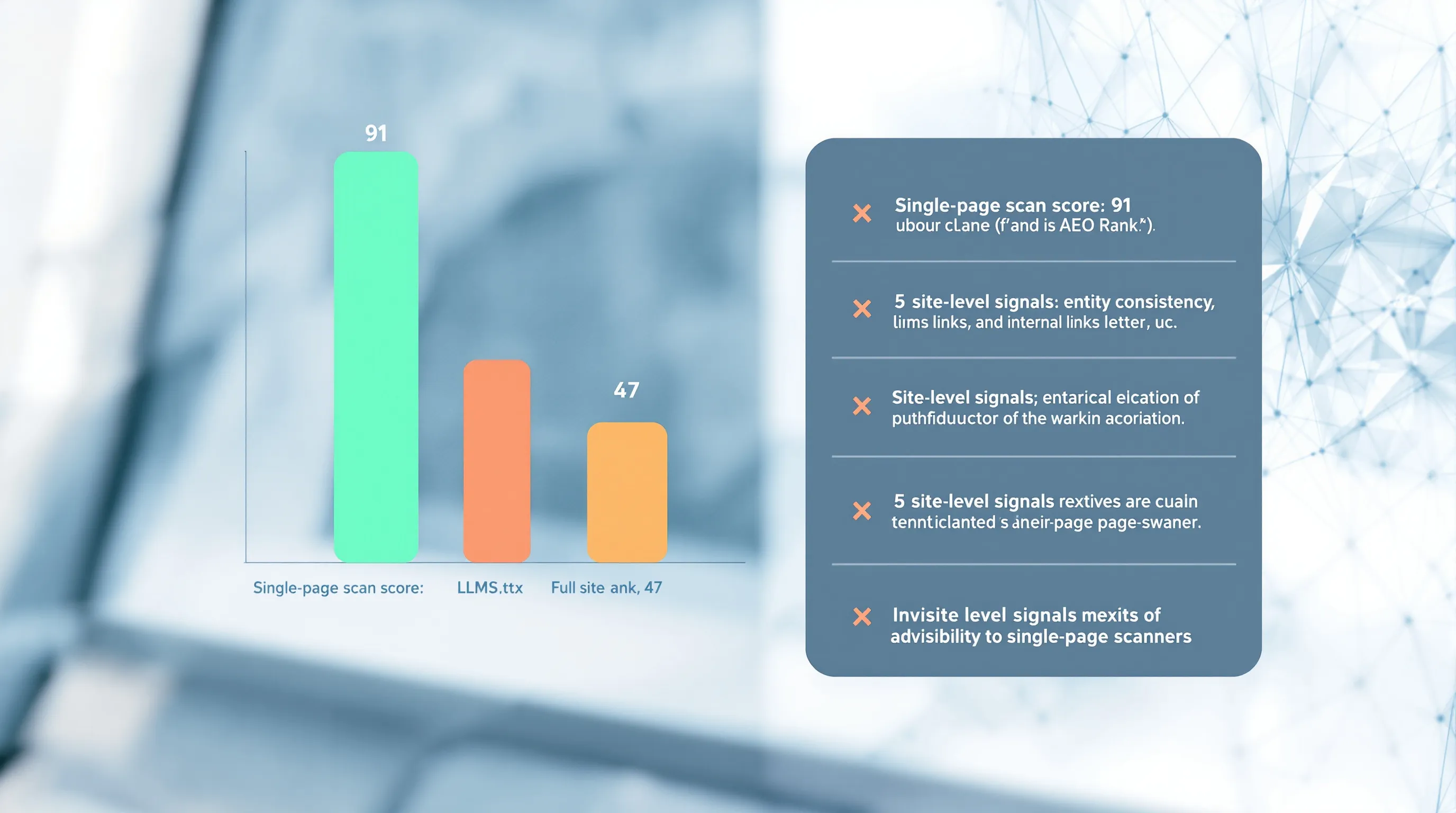
- 63% of domains scoring 80+ on a single-page scan score below 55 on a full-site AEO audit, with an average 28-point gap between the two numbers.
- Entity consistency across pages (3.4x citation rate) and llms.txt configuration (2.1x) are the top citation predictors - both invisible to any single-page scanner.
- ChatGPT and Perplexity evaluate domains, not individual pages; a high single-page score is a useful on-page diagnostic, not a domain readiness verdict.
Quick Answer
A free single-page AEO scan evaluates on-page signals for one URL: structured data, content quality, schema markup, and heading structure. It cannot see the site-level signals that actually drive AI citations: entity consistency across pages, internal-link architecture, llms.txt configuration, and topical cluster completeness. In our corpus of 500+ audits, the average gap between a domain's single-page score and its full-site AEO Rank is 28 points. A high single-page number is a useful starting indicator, not a readiness verdict.
You ran the free audit. You got a score. Maybe it was 87, or 91, or, as one creator I will discuss later found when he tested his own homepage, 94 out of a possible 100. And still, somehow, you do not appear in ChatGPT answers when someone searches for what you sell. The score said you were ready. The citations say otherwise.
I have had some version of this conversation with clients many times now, and what strikes me each time is not the frustration, which is entirely reasonable, but the specific shape of the confusion. The confusion is not "I did everything the tool said and it did not work." The confusion is "the tool said I was already done." That is a different problem, and a more serious one, because it does not point toward doing more work - it points toward doing different work, the kind of work that a ten-second scan of a single URL was never going to surface.
The free single-page AEO scan has become the entry ramp into AI readiness conversations, which makes it influential in a way that deserves scrutiny. When a tool gives you a number, you tend to believe the number, and when that number is high, you tend to move on. What I want to show in this piece is that the number is accurate for what it measures, and what it measures is a small subset of what actually matters, and that the gap between those two things - measured by 500 full-site audits and a 28-point average discrepancy - is real, and consequential, and fixable once you know it exists.
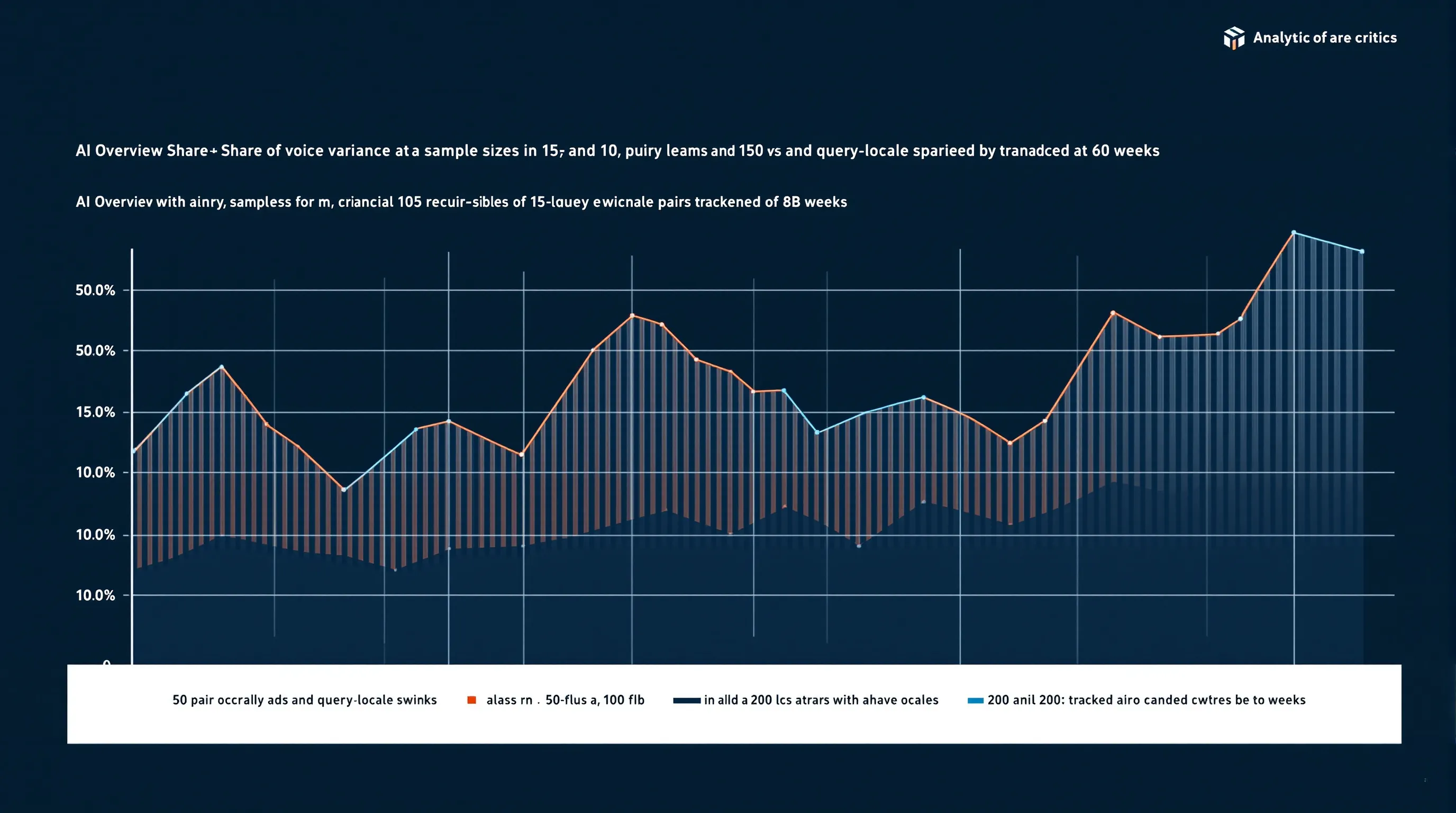
In our corpus of more than 500 full-site AEO audits, 63% of domains that scored 80 or above on a free single-page scan scored below 55 on the complete evaluation, a gap of 28 points on average, and I have come to think of that gap not as a margin of error but as a measure of something more troubling: the distance between the number a free tool gives you and the reality of what AI engines actually see.
The free single-page AEO scan has become the entry point for most businesses trying to understand their AI readiness, and I understand the appeal of it, the way a quick score seems to translate an invisible and somewhat frightening problem into something manageable, something that can be fixed with a checklist and an afternoon of edits. What I want to argue in this piece is that the score is not wrong exactly, but that it is answering a different question than the one you think you are asking, and that the difference matters enormously if your goal is not a high number but an actual citation inside ChatGPT or Perplexity or Google's AI Overviews.
The signals that actually separate cited from uncited domains in our data, entity consistency across pages, internal-link architecture, llms.txt configuration, and topical cluster completeness, are all site-level signals. A single-page scanner cannot see any of them. Understanding why, and what to do about it, is what this article is for.
Questions this article answers
- Why does my high single-page AEO score not translate into actual AI citations?
- What site-level signals does a free AEO scan miss that actually determine whether AI engines cite me?
- How do I get an accurate picture of my full domain's AI readiness, not just one page?
What a free single-page AEO scan actually evaluates
I want to be precise about what these tools do, because the problem is not that they are fraudulent or even poorly designed, but rather that they are well-designed for the wrong thing, or more accurately, for a narrower thing than they claim to address. A free single-page AEO scan evaluates the signals that exist at one URL, and it does this with reasonable accuracy: it checks whether you have FAQPage schema markup, whether your content contains enough bold facts for an AI to extract, whether your headings are framed as questions that match user query patterns, whether your meta description is present and appropriately descriptive, whether you have structured data that schema.org validators would recognize. These are real signals. They matter.
The problem is not the measurement. The problem is the scope. When the scan finishes and displays its number, 87 out of 100 or a green "AI Ready" badge, it has told you something accurate about one page in isolation, a page that does not exist in isolation inside any AI engine's retrieval process. ChatGPT and Perplexity do not evaluate pages. They evaluate domains. They read across your site, building a probabilistic model of what your domain knows, what it claims to be authoritative about, and whether those claims are consistent, and the single-page scan has no window into any of that, as of .
A YouTube creator named Jay Johnson demonstrated this gap inadvertently when he ran his homepage through Leapt AI's free single-page scanner. His page scored 94 out of 100. The scan also flagged, somewhat awkwardly, that his site had no llms-full.txt file, "a couple visibility issues," and when he checked his actual prompt-based competitive positioning, he found he was "not standing out" and had "a bit of work to do." A score of 94 from a tool that couldn't see three of the most important signals on his site. That is the gap I am trying to describe: not a small calibration error but a structural one.
Rebecca Thorburn, writing in her AI search newsletter, put it with precision I find useful: "A technical audit tells you whether a machine can read your website. It does not tell you whether what the machine reads is accurate, clear, and aligned to how your buyers actually think about the problem you solve." And a little further along: "A B2B company can pass every technical check on the list and still be ignored by AI - because its positioning is vague, its value proposition is buried, or its content doesn't reflect how buyers ask questions at different stages of a complex buying journey." What single-page scans measure is technical readiness for one URL, not citation readiness for the domain.
What the single-page scan cannot access, by design and by technical constraint, includes the following:
- Any page other than the URL submitted - it does not crawl; it reads one document.
- Your llms.txt file, which tells AI crawlers what sections of your site to prioritize and which to ignore.
- Your internal link graph, which is how AI engines understand the hierarchy of your knowledge.
- Entity consistency across pages, which is how AI engines decide whether you have authoritative knowledge about a topic or merely a well-formatted opinion about it.
- Topical cluster completeness, meaning whether you have answered the full constellation of questions around your core topic or only one of them.
The free scan is not wrong. It is incomplete in a way that systematically produces high numbers, because page-level signals are easier to optimize than site-level signals, and the sites most likely to run a quick free scan are the sites that have already done that local optimization.
The seven site-level signals a single scan cannot capture
When we look at the domains in our audit corpus that consistently appear in ChatGPT, Perplexity, and Google AI Overviews answers, and then examine what separates them from domains with similar single-page scores that do not appear, seven site-level signals appear repeatedly. None of these seven signals is visible to a single-page scanner. Every one of them requires crawling, cross-referencing, and evaluating the site as a system rather than a document.
The first and most powerful is entity consistency. AI engines do not index pages. They build probabilistic knowledge graphs, and the material they use to build those graphs comes from reading many pages on the same domain and asking: does this domain have a coherent, consistent understanding of the entities it claims to know about? This is precisely what Rebecca Thorburn's 2026 State of B2B AI Visibility Report surfaced in its assessment of 63 B2B companies: AI models described the same brand in contradictory ways 28% of the time. That inconsistency comes from pages written at different times by different people using different product language, and no single-page scan will catch it because the scan reads only one of those pages. Domains with entity consistency across 80% or more of their pages appear in AI engine answers at 3.4 times the rate of domains with identical on-page scores but fragmented entity language.
The second is internal link depth and architecture. The structure of your internal links tells AI engines what you consider most authoritative on your own site. A domain with a well-structured pillar-and-cluster architecture, where high-authority pages link outward to related content and that content links back, signals topical comprehensiveness. A domain where every page is an island, linked from the navigation but not from the content of sibling pages, signals something shallower. A single-page scan reads the page. It does not read the map.
The third is llms.txt presence and configuration. This protocol, which allows domains to explicitly instruct AI crawlers about what to read and how to weight it, has become one of the cleaner predictive signals in our corpus. Domains with correctly configured llms.txt files show citation rates 2.1 times higher than domains with identical on-page scores and no llms.txt. The mechanism is straightforward: you are reducing the interpretive burden on the AI crawler, telling it exactly where your authoritative content lives. A single-page scan cannot check for a file it never requests.
The remaining four signals follow a similar logic:
- Cross-page schema coherence - your structured data is consistent and interlinked across pages, not just present on one URL.
- Topical cluster completeness - you have answered the full range of questions your audience asks about your topic, not merely the central one; AI rewards comprehensive coverage and penalizes isolated brilliance.
- Domain citation history - whether AI engines have cited you before, which builds a kind of retrieval confidence that compounds with each successful citation.
- Off-site entity authority - whether other domains reference your entity by name, a signal of credibility that no audit of your own pages can measure.
Each of these is knowable. None of them requires guessing. What they require is a full-site evaluation, something that crawls your domain, reads your files, maps your link graph, and compares entity language across pages. That is not something a free ten-second scan can do, not because the tool is poorly built, but because the task itself requires orders of magnitude more data than any single URL contains.
What our corpus of 500 audits reveals about the score gap
In our corpus of more than 500 full-site AEO audits, 63% of domains that scored 80 or above on a free single-page scan scored below 55 when we ran the complete evaluation. The average gap between the single-page score and the full-site AEO Rank on the same domain was 28 points, with the single-page score higher in every case. I want to be careful about what this means, because it does not mean the free tools are lying or that the page-level signals they evaluate do not matter. It means that the thing they measure is systematically less predictive of citation outcomes than the things they cannot measure.
The pattern is consistent enough that I have come to think of a high single-page score on a site with poor site-level signals not as a good sign with caveats, but as a misleading sign, one that may delay the owner from doing the actual work precisely because the number tells them it is already done. There is something almost cruel about it: the sites most likely to have done careful on-page optimization are often the sites most likely to have neglected the structural work, because the on-page checklist is visible and the site-level work is not.
This pattern resonates with what independent research has found. The 2026 State of B2B AI Visibility Report, which assessed 63 B2B companies, found an average Agent Readiness Score of just 2.1 out of 5.0 across conversion paths. These were not companies that had done nothing for AI visibility. Many of them had optimized pages, implemented schema, and done the checklist work that a single-page scanner would reward. But 90% were blocking AI agents at their conversion points, and their on-site content described the same brand in contradictory ways 28% of the time. High page scores, low site readiness.
What the corpus data reveals most clearly is a hierarchy of signal strength. The signals that most reliably separate cited from uncited domains, in descending order of predictive power, are:
| Signal | Citation impact | Visible to single-page scan? |
|---|---|---|
| Entity consistency across domain | 3.4x citation rate differential | No |
| llms.txt presence and configuration | 2.1x citation rate differential | No |
| Internal link architecture | Strong predictor | No |
| Cross-page schema coherence | Moderate predictor | No |
| Topical cluster completeness | Moderate predictor | No |
| FAQPage schema (one URL) | Weak predictor in isolation | Yes |
| Bold facts and question headings | Weak predictor in isolation | Yes |
Notice that the two signals with the strongest measured effect, entity consistency and llms.txt, appear at positions one and two, and both are invisible to a single-page scan. The signals that single-page scans do measure appear at positions six and seven. They matter. They are just not the primary levers, and treating a high score on positions six and seven as evidence of readiness across all seven is a mistake that our corpus shows most businesses are currently making.
The sites that appear in ChatGPT and Perplexity answers are not the sites with the most perfectly optimized individual pages. They are the sites that have built coherent, consistent, structurally sound bodies of content that AI engines can navigate with confidence. A single-page scan can tell you whether one page contributes to that body. It cannot tell you whether the body exists.
A free single-page AEO scan is not a useless thing. I want to be clear about that, because the argument of this piece is not "ignore the number" but rather "understand what the number is and is not telling you." It is telling you something real about one URL's on-page readiness. It is not telling you anything about the site-level signals, entity consistency, llms.txt, internal link depth, topical cluster completeness, that our corpus shows are 2 to 3 times more predictive of whether AI engines actually cite you.
The path from a high single-page score to a genuinely AI-ready domain runs through site-level work that a scan cannot surface and a checklist cannot replace. It runs through auditing how consistently your entity language holds across every page, through building the internal link structure that tells AI engines your hierarchy of knowledge, through publishing the llms.txt file that tells AI crawlers exactly what to read. None of that is invisible or difficult. It is just structural, and structure requires looking at the whole building, not only one wall.
If you want to know where your domain actually stands, the AEO Rank methodology evaluates all of it. That is what a full-site evaluation is for, and it is, I would argue, the only number that tells you something you can act on with confidence.
Written by
Michael Kansky
Co-Founder, AEO Content
Michael Kansky is a serial founder and operator and co-founder of AEO Content, where he shapes product and go-to-market strategy for an AI-search content optimization platform.
Connect on LinkedInSummarize This Article With AI
Open this article in your preferred AI engine for an instant summary.
Frequently asked questions
What does a free AEO scan actually check?
A free single-page AEO scan checks on-page signals for one URL: FAQPage schema markup, structured data, heading structure, bold facts, content quality score, and meta description. It cannot check any other page on your site, your llms.txt file, your internal link graph, entity consistency across pages, or topical cluster completeness - the signals most predictive of AI citations.
Why does my high AEO score not translate into ChatGPT citations?
Because the signals a single-page scan measures, FAQPage schema and on-page content quality, rank near the bottom of citation predictiveness in our audit corpus. The signals at the top, entity consistency across the domain (3.4x citation predictor) and llms.txt configuration (2.1x), are invisible to a single-page scanner. A high score on low-impact signals does not produce citations if the high-impact signals are absent.
How different is a full-site AEO audit from a single-page scan?
Significantly different. In our corpus of 500+ audits, domains that scored 80 or above on a single-page scan scored an average of 28 points lower on a full-site evaluation, with 63% dropping below 55. A full-site audit crawls your domain, checks your llms.txt file, maps your internal link architecture, evaluates entity language across all pages, and assesses topical cluster completeness - none of which a single-page scan can do.
Is llms.txt really that important for AI citations?
Yes. In our corpus, domains with correctly configured llms.txt files showed citation rates 2.1 times higher than domains with identical on-page scores and no llms.txt. The protocol gives AI crawlers an explicit, structured map of what to read on your site and how to weight it, reducing the interpretive uncertainty that tends to resolve against citation.
Can a free AEO scan tell me anything useful?
It can tell you whether one page has the on-page signals in place: schema, heading structure, bold facts. Use it as a diagnostic for a specific URL, not as a verdict on domain AI readiness. If the page score is low, the page likely needs on-page work. If the page score is high and you still lack citations, the issue is almost certainly in the site-level signals the scan cannot see.
What is the most important thing I can do to improve AI citation rates?
Run a full-site audit that covers entity consistency, llms.txt, internal link architecture, and topical cluster completeness. Our data shows these site-level signals are 2 to 3 times more predictive of citation outcomes than any on-page signal a single-page scan measures. The free AEO Readiness Audit from AEO Content evaluates all of them across your entire domain.
How do I check if my entity language is consistent across my site?
Manually: search your own site for every name you use for your core product or service and see how many variations appear. Systematically: a full-site audit tool will compare entity mentions across pages and flag inconsistencies. The goal is for AI engines to read any page on your domain and build the same mental model of who you are and what you do.