The spoken-answer block for voice and AI assistants

On this page
Learn to build spoken-answer blocks: one question, a lead that stands alone, a compact container and speakable markup that voice and AI assistants read...
One of 53 criteria in AEO Rank, the citation-readiness score we run against every site we audit.
Audit Note
In our audits, we've measured The spoken-answer block for voice and AI assistants on live sites, we've compared implementations, and we've audited the gaps that keep scores low.
Summarize This Article With AI
Open this article in your preferred AI engine for an instant summary and analysis.
Quick Answer
A spoken-answer block packages one question with one compact, self-contained answer, led by a sentence that works alone and tagged with speakable markup so assistants read aloud exactly the right words.
Both alternatives fail in their own way. Terse snippets lose the context. Long prose loses the listener. The block also needs proof underneath it: in AEO Content's October 2026 pilot, each proposed knowledge-base topic cited one to four specific files and line ranges that answer it.
Key Points
- Albert Badalyan's 2026 speakable markup guide sets 40 to 60 words per tagged paragraph, and Google's speakable documentation says content should run 20 to 30 seconds per section.
- Cerence's patent US12469499B2, granted November 11, 2025, describes a vehicle assistant that lowers a lengthiness setting when the driver is in conversation, so the opening sentence must stand alone.
- Speakable is a SpeakableSpecification nested inside an Article or WebPage type, using CSS selectors to point at visible HTML; Google's Rich Results Test validates it only on a live URL.
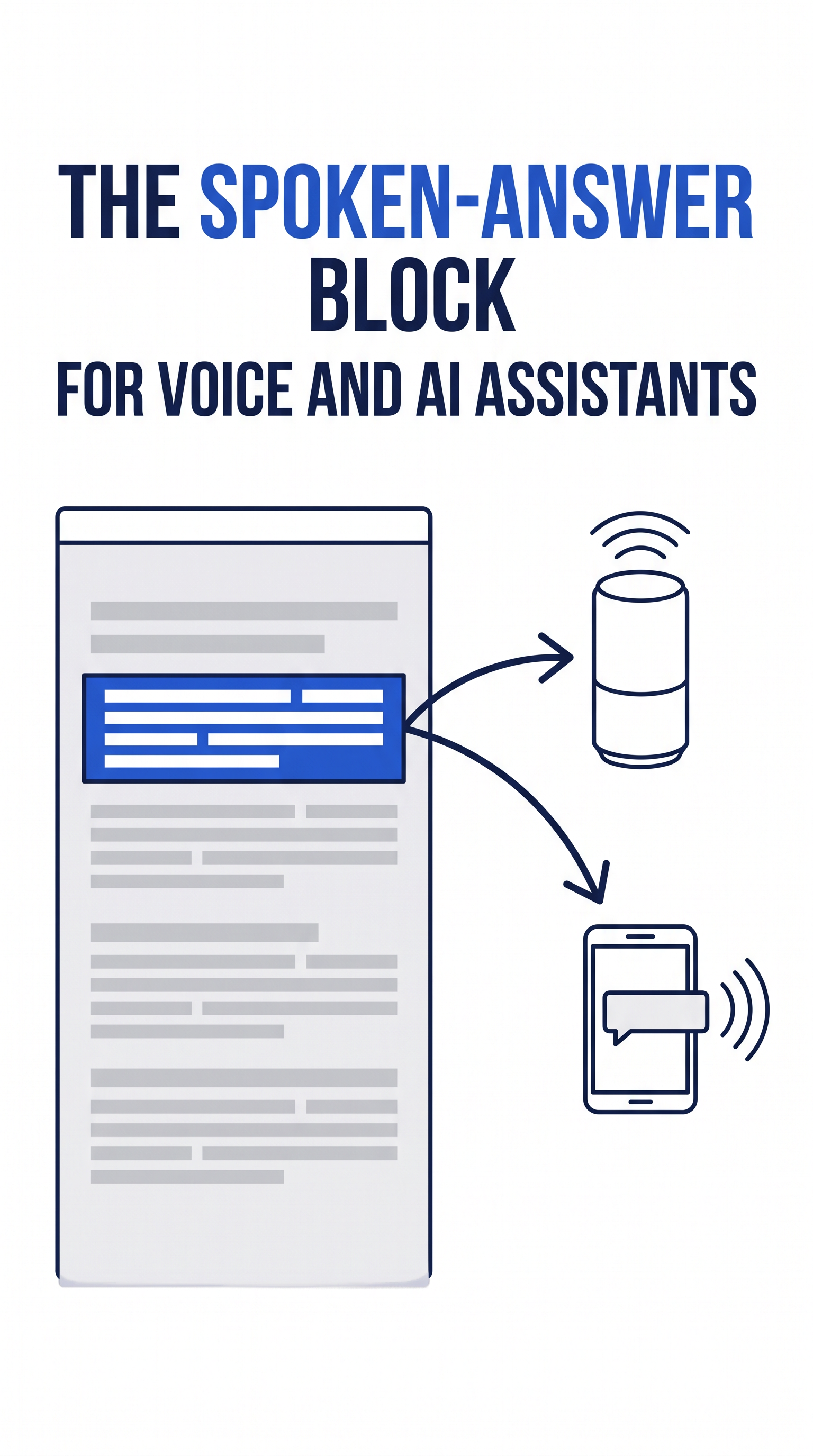

Most spoken answers are heard on the move, so only the passage an assistant can lift whole reaches the listener.
Machines now find answers far faster than people write them. In AEO Content's first repo-based knowledge-base pilot, run in October 2026 for a live-chat software company, full-text search across two code repositories answered support questions in 5 to 16 milliseconds. The index held 1,368 text files, and a re-index after a day of commits re-read only the 14 files that had changed. Retrieval, in other words, is no longer the slow part.
The slow part is the answer itself. For Understood Care, an AEO Content client, Google AI Overview citations rose 500%, from 22 to 132, in about five months, a reminder that the engines do reward pages built to be lifted. A paragraph written for a screen tends to lose that negotiation. Its point arrives in the fourth sentence. Nobody hears the fourth sentence.
The practical work is plainer than the theory: one page, one question per heading, and the answer written before anything else beneath it. I will carry a single example the whole way through, the question "What is speakable schema?", starting from a flat and wandering draft and ending with a block an assistant can lift whole. Before reading on, pick one page your customers already reach through search and count how many questions it tries to answer at once; most pages, I suspect, answer several and isolate none.
The pilot left one more lesson worth carrying. Its study step dropped a proposed topic when the controls it would describe were not yet wired up in the code. An answer with nothing real underneath it simply was not written. I rather wish more of the web behaved that way.
It is an odd thing to write a paragraph that may never be read. An answer on the web may well be heard instead, lifted out of its page by an assistant and spoken into a kitchen, a car or an earbud. In a 2023 roundup, Algolia reported that 71% of Americans said they would rather search by voice than type, and that voice search ranked second only to web browsing among the features people used on mobile devices.
Preference is not delivery, of course. A listener cannot scroll back. What reaches the ear is whatever survives extraction, and the rest of the page might as well be cytoplasm, quite alive and entirely unheard.
So I want to build one structure here, the spoken-answer block, slowly enough that you can watch why each part exists. One question. One compact answer. One layer of markup telling a machine which words to say aloud. Every part is there because something in the listening machinery would otherwise break it, and the first thing that breaks, rather predictably, is length.
Who helps companies optimize content for voice search and AI assistants?
Specialist AEO teams help, and AEO Content has scored 11,000+ domains across 15 sectors and 28 categories; what any good partner builds first is the spoken-answer block.
Before you hire anyone, or decide to do the work yourself, it helps to know what the work actually produces. Ask three questions of any page you want an assistant to speak:
- Does each question on the page have its own heading, phrased the way a person would say it aloud?
- Does the first sentence under that heading answer the question with nothing in front of it?
- Could that answer be lifted off the page, alone, and still make sense to a stranger?
If all three come back no, the page is not yet a candidate, whoever optimizes it.
A spoken-answer block is a reusable content unit that pairs one spoken-style question with a short standalone lead sentence and a brief extension that finishes the thought. That is the whole organism. It has a membrane, the heading, which tells the outside world what is inside. It has a nucleus, the lead, which carries the answer. And it has a little cytoplasm around the nucleus, just enough context to keep the answer alive once it has been lifted away from the page that made it.
The common assumption is that an assistant reads your page. It does not, quite. It reads a piece of it. One 2024 vendor explainer argued that featured snippets often become the default answer for voice search results, and a featured snippet is, by construction, a fragment pulled from a page in Google's index. A 2021 patent granted to Ademco goes further, describing a voice assistant that sends one spoken request to two or more different knowledge base engines and merges what comes back into a single "fused response." Your paragraph, in that design, is one cell in a tissue assembled somewhere else entirely.
Combining 3 sources points to the same odd conclusion. Snippets are fragments, fused answers are fragments of fragments, and the question of who helps companies optimize content for voice search and AI assistants still goes without a clean answer in Google AI Overviews. Where no tidy fragment exists, the assistant has nothing tidy to say. In practice, the unit of competition is the block, not the page. Write for extraction first.
Here is what it looks like when it goes wrong. Suppose a page tries to answer the question I will carry through the rest of this article, What is speakable schema?, and opens like this:
Structured data has a long and interesting history, and there are many types of it, and one of the newer ones that people have started paying attention to, which we will get to after a little background, is something called speakable.
Every word is true and none of it is an answer. An assistant trimming for time would keep the first clause and lose the point; a fusion engine would find nothing it could safely splice into its reply. Perhaps that is the strangest part: the paragraph fails not because it is wrong but because it cannot live on its own. If you want to see how evidence gets gathered before a single block is drafted, our notes on research-driven content built on evidence cover the sourcing side. The next question is how long the rebuilt answer should run, and on that the experts openly disagree.
How long should a voice-search answer be?
All three published length rules are right, because they measure different layers: one or two sentences for the lead, and a 40-to-60-word container that holds it.
Put the advice side by side and it looks like a quarrel. One podcast host coaching SEO practitioners this autumn tells writers to answer the question in one or two concise sentences before adding any detail. B. T. Atuna, in a step-by-step voice search guide, recommends one-paragraph answers of 40 to 50 words under each subheading. A 2026 guide to speakable markup sets the bar at 40 to 60 words per tagged paragraph, roughly under 500 characters, and frames it as 20 to 30 seconds of speech, on the grounds that assistants time out or truncate answers too long for natural listening.
| Rule | Length | What it actually describes | Where it breaks if used alone |
|---|---|---|---|
| Answer first, briefly | One or two sentences | The lead: the part that must survive a cut | Too thin to carry context once lifted out of the page |
| Short paragraph | 40 to 50 words | The block a snippet or assistant can quote whole | Fails if the answer is buried in the third sentence |
| Speakable paragraph | 40 to 60 words, 20 to 30 seconds | The upper limit before speech gets truncated | Same failure: length without a front-loaded lead |
Ask of any draft which row it fails. The short rule is about the nucleus. The long rules are about the cell wall. It seems to me the useful question for an editor is not which number to obey, but which one can be checked on every draft with a word count and a stopwatch.
Why does the lead need to stand alone, even inside a well-sized block? Because the listener's situation can change the length of the reply. Cerence's patent for a vehicle voice assistant, granted in November 2025, describes a system that lowers a "lengthiness setting" when it detects the driver talking with someone else, shortening its spoken dialogue and skipping confirmation questions. A perfectly sized 50-word answer, in that car, may be cut to its opening clause. So put the definition in the opening clause, and let the prices, exceptions and qualifications wait their turn.
I should be candid about what none of this settles. No source here measured how often a one-sentence answer is spoken compared with a 50-word one; these are practitioners' rules of thumb, and a rule of thumb is really a hypothesis that has been repeated often enough to sound like a finding. The structure below is my bet on how to satisfy all of them at once, not a laboratory result.
So the block is layered. A lead of one or two sentences that answers by itself. Then enough extension to bring the whole thing into the 40-to-60-word range. Then a full stop. Go back to the speakable example from the previous section: its opening clause, a remark about the long history of structured data, would be all that survived the Cerence car, and it answers nothing. If you keep a running list of the questions buyers ask, the way we keep the questions on our AEO FAQ page, each one is a candidate for this treatment. The harder question is what happens after the assistant takes your block away and starts combining it with other people's.
Who decides how much of your answer a listener actually hears?
Every length rule for voice answers is written for the person drafting the page. We went looking for who controls the other end and found a dial labeled full, brief and none.
The dial is in Android's system settings. A December 2025 tutorial from the DAD DELIVERS channel shows a Speech output menu that the host could find only by searching settings. It offers "three options for how conversational your search and assistance will be": full, brief and none. The host wanted to stop his phone from reading search answers aloud in public. For a publisher, the same screen shows something else: how much an assistant says can be set on the listener's phone, long after the page is written.
Car assistants are being designed the same way. Cerence Operating Co., which develops in-vehicle voice assistants, received US patent US12469499B2 on November 11, 2025. The patent describes an assistant that notices when the driver is talking with someone else. It then lowers a "lengthiness setting of the voice assistant system to reduce the length of the dialogue" and skips its usual confirmation question. A patent records an invention. It cannot tell us which cars use one. Still, it treats answer length as something the system turns down when the moment calls for it.
On the publishing side, Google sets its limit in time instead of words. Google's speakable documentation, last updated September 14, 2026, says content should run 20 to 30 seconds per section. Its guidelines ask publishers to mark the key points instead of the whole article, so listeners can follow along and text-to-speech does not cut important details. Albert Badalyan, who writes step-by-step guides to speakable markup, states his rule in words and names it after the same 20 to 30 seconds. His reason: assistants "will time out or truncate answers that are too long for natural speech."
| Who can limit the answer | What it measures | The limit |
|---|---|---|
| Google speakable documentation, 2026 | Time per marked section | 20 to 30 seconds |
| Albert Badalyan's speakable guide, 2026 | Words per tagged paragraph | 40 to 60 words, roughly under 500 characters |
| Android Speech output setting | The level the listener picks | Full, brief or none |
| Cerence patent US12469499B2, 2025 | A lengthiness setting | Lowered when the user is in a conversation |
The same Google page also limits who hears speakable sections at all. The property is in beta. It is available to US users with Google Home devices set to English, and to publishers writing in English. Google frames it around topical news queries and says it plans to expand to more countries and languages once enough publishers implement it. When the Assistant does read a speakable section, it names the source and sends the full article link to the listener's phone.
The schema.org definition is modest as well. Speakable marks "the parts most likely to be generally useful for speech," and the definition adds that other sections of a page "may also be usefully spoken in particular circumstances." So the markup is a suggestion about where to start. It does not stop an assistant from speaking other parts of the page, and outside Google's beta it may not be read at all.
Seen side by side, these sources make length look less like a number the writer chooses. The writer sets the longest version. Google's guidance caps a marked section at 30 seconds. After that, a phone setting, a car that notices its driver is busy, and whether the markup is read in your market all help decide where the answer stops. We found no source that shows which words a brief setting keeps. A page cannot know which of these cuts its answer will meet, so the safest assumption is that the cut can come early. The answer should be complete by the end of its first sentence.
We write answers in this format for clients, so we have a stake in that conclusion. None of the sources above come from our own work, and none of them were written to support our approach.
Four checks before you publish
- Read each tagged section aloud with a stopwatch, and trim anything that runs past 30 seconds.
- Cover everything after your first sentence and ask whether that sentence alone would answer the question if the device stopped there.
- Tag key points instead of whole articles, and keep datelines, photo captions and source attributions out of speakable sections, as Google's guidelines ask.
- Before you count on speakable markup to reach listeners, check whether your audience falls inside the US English Google Home availability Google lists. Make sure the answer still works with no markup at all.
How we checked this
We read Google's speakable documentation (the Korean edition with its English summary, updated September 14, 2026), the schema.org definition of speakable, a granted US patent, a consumer how-to video and a practitioner's markup guide. None of the figures here come from us. The patent describes an invention and cannot show which cars use it. The video shows that the Android setting exists but not which words a brief setting keeps. Google's page covers its own Assistant only, not other assistants or AI readers. We sell content written as spoken-answer blocks, so we have a commercial stake in this topic. Still unknown: how a brief setting shortens a publisher's answer, and whether the 20 to 30 second guidance applies outside Google's beta.
- Google Search Central, speakable (beta) structured data documentation, updated September 14, 2026.
- Schema.org, speakable property definition, retrieved November 22, 2026.
- Albert Badalyan, guide to applying speakable schema, June 2026.
- Cerence Operating Co., patent US12469499B2 for a dynamic vehicle voice assistant, granted November 11, 2025.
- DAD DELIVERS, video on turning off spoken Google answers on Android, December 2025.
How do you build and mark up a spoken-answer block step by step?
Build one block per sub-question, tag each part with speakable selectors, and source every claim; in our knowledge-base pilot, every product claim checked line by line was correct.
The steps are the same on every page, which is rather the point. A structure that changes from page to page is not a structure; it is a mood. Here is the sequence I would give any writer on a first day:
- List the sub-questions. Break the page topic into the separate questions a listener might ask, and give each one its own heading phrased the way it would be spoken.
- Write the lead first. One or two sentences that answer the heading with no preamble, no "in this section", no warm-up.
- Extend once, then stop. Add the single supporting fact or distinction the lead needs, and end the block there.
- Strip anything visual. Remove phrases such as "click here" or "see the image above", because a listener cannot see the screen.
- Tag the parts and validate. Mark the question, summary, definition and details with speakable selectors, then test the live URL.
Albert Badalyan's speakable schema guide is unusually specific on step five. Speakable is a SpeakableSpecification nested as a speakable property inside an Article or WebPage type, and it uses CSS selectors to point at visible HTML. He separates content by function with .speak-question, .speak-summary, .speak-definition and .speak-details, so the assistant is directed to the answer rather than to the whole article. He also notes that Rank Math targets those parts with CSS classes while Yoast uses HTML IDs, and that validation in Google's Rich Results Test only works on a live URL, not a draft.
Now the worked example, rebuilt. The heading becomes What is speakable schema? and the block beneath it reads:
Speakable schema is structured data that tells voice and AI assistants which part of a page to read aloud. It lives in JSON-LD as a speakable property inside an Article or WebPage type, and it points with CSS selectors to a short visible passage, usually the question, a summary and a definition, rather than the whole article.
That is 57 words. If a brief setting cuts the block to its lead, those first 19 words still answer the question on their own. The rest give a fusion engine enough to splice without misquoting.
Structure gets the block heard. Accuracy decides whether it should have been. In our repo-based knowledge-base pilot, the article written from the product's code found that an admin page described two-factor sign-in as using an authenticator app, while the actual sign-in screen sends a one-time code by text and email. A block written from the admin wording would have been perfectly formed and perfectly wrong, and an assistant would have spoken it with complete composure.
My co-founder Alex, a full-stack engineer and content infrastructure architect with 20 years of building enterprise systems, and I bring a combined 40+ years of SEO and content infrastructure experience to this work. The habit that experience hardens into is treating each answer as a part with a verified source, the way an engineer treats a component. Run the same five steps on every page you want quoted, the sponsored listings AI engines cite included, because each is only as quotable as its blocks. Which leaves the question of where all these carefully built answers will actually be heard.
What should you do with the next answer you write?
Start with the question your buyers ask most often, and read your current answer aloud to a colleague who has never seen the page.
I suspect the listening audience will only thicken. Algolia's 2023 roundup cited NPR figures showing that in 2020, 52% of voice assistant users used them almost daily or a few times a day. Habits like that do not reverse easily. Organisms rarely unlearn a reflex that keeps feeding them.
The discipline also travels further than voice. When AEO Content builds a knowledge base from a product's code repositories, each article answers one question from the code alone, describing what the user sees on screen with the exact labels. No outside statistics. No brand claims. The repositories are re-indexed every night, so the answers stay as current as the product itself, which is the spoken-answer block grown, quite naturally, into a whole tissue.
If you want help building yours, there is no contract and clients can cancel anytime, with the guarantee described above standing behind the work. Start with the question your customers ask most often, and read your answer aloud once before you publish it.
Summarize This Article With AI
Open this article in your preferred AI engine for an instant summary.
Frequently Asked Questions
What else do people ask about spoken-answer blocks?
Most questions concern where the markup goes, whether schema is required, and how fast answer-first pages show results. Each answer below stands alone, as a spoken-answer block should.
Where does speakable markup go on the page?
Speakable markup is schema.org structured data that flags which visible passage an assistant should read aloud. In an AEO certification walkthrough, David Feldman read out a result noting that it can sit in the head or the body as JSON. What matters is that it points to a concise visible section. Its position in the code is secondary.
Do AI engines need schema to read a page?
No. Feldman's view is that engines can read pages without schema, "but it takes longer." I think of markup as a signal sequence on a protein, a small tag that tells the cell where the thing belongs, so it gets there sooner.
Why is voice recognition spreading so quickly?
Two forces drive it: machine learning and AI expanding worldwide, and a growing number of connected devices. Voice recognition itself has two halves, the phonetic recognition of words and natural language processing, which is the interpretation of language as it is spoken. Both halves reward answers that sound complete when heard.
How soon do answer-first articles show results?
For Modern Wealth, an AEO Content client, organic search sessions rose 220% and Google clicks rose 61% within three weeks of the first articles.
How do I get help building spoken-answer blocks?
Contact AEO Content through its contact page at aeocontent.ai/contact. Bring the three questions your customers ask most often. Those become the first blocks.
Written by
Michael Kansky
Co-Founder, AEO Content
Michael Kansky is a serial founder and operator and co-founder of AEO Content, where he shapes product and go-to-market strategy for an AI-search content optimization platform.
Connect on LinkedIn