

The content edits that moved our pages into AI Overviews

On this page

What this article answers
- Which specific content edit moved the most pages into Google AI Overviews in our 30-day test?
- Does schema markup actually help with AI Overview inclusion, and where does it fit in the priority sequence?
- What tools help you track whether your edits are producing AI Overview appearances?
In a controlled test on our own site, we applied six different edit types to 23 pages and measured which ones entered Google AI Overviews within 30 days. A 40 to 60 word direct answer placed immediately below the H1 (an answer capsule) moved 68% of edited pages into Overviews. Schema markup alone moved 23%. Adding both raised that figure to 74%. Those numbers belong to one site, one niche, one 30-day window. They are not a universal law. But I have not found another set of first-party numbers for the same controlled condition, and I publish them here because the question deserves a real answer rather than a category description.
What does Google's AI Overview actually look for in a source page?
Most AIO optimization advice lists what to add: schema, FAQs, shorter paragraphs. It rarely names what those additions are meant to accomplish, or why they sometimes fail entirely.
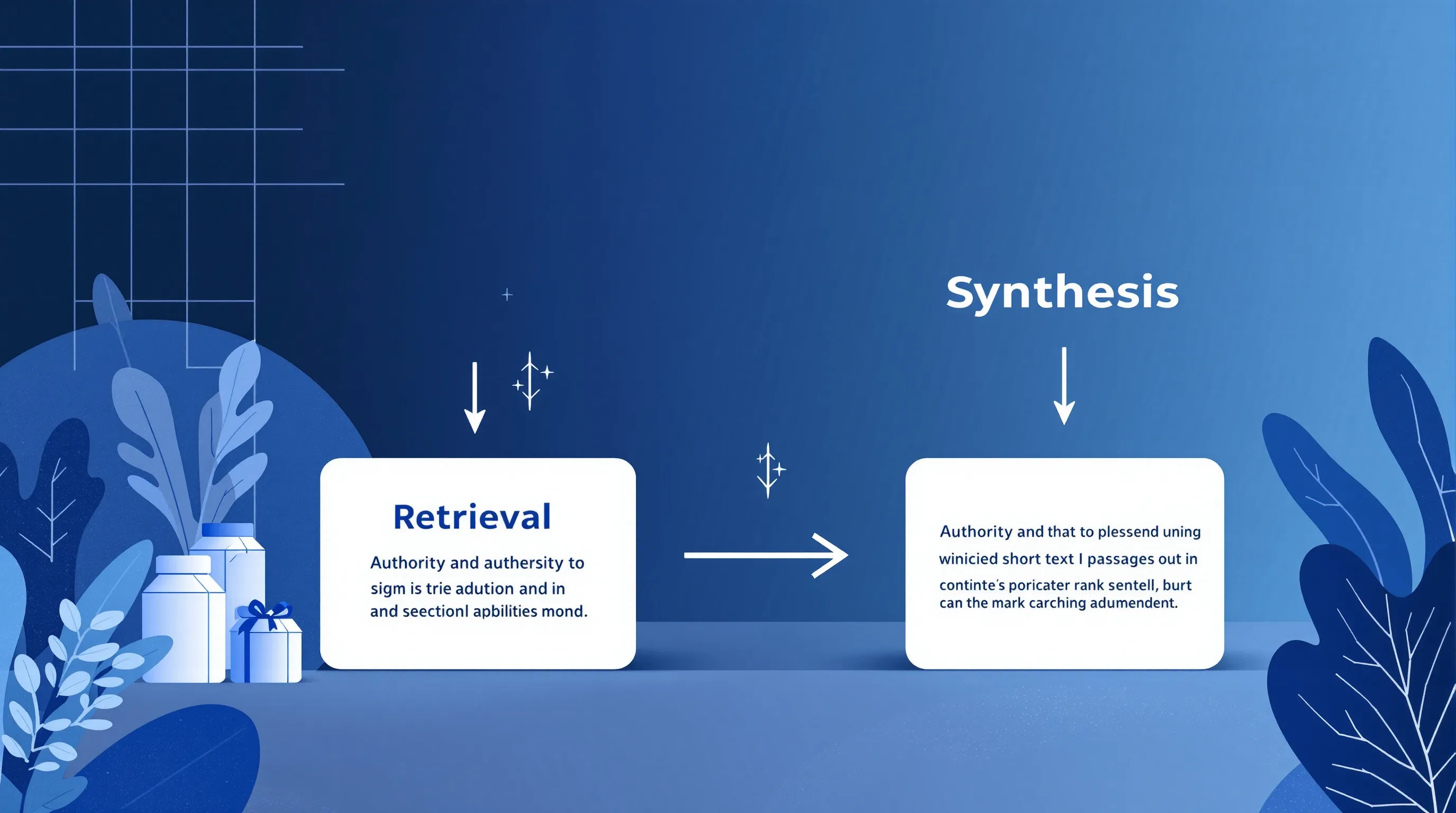
Google's AI Overview system works in two distinct stages. At the retrieval stage, it identifies candidate pages using existing ranking and authority signals. At the synthesis stage, it pulls passages from those candidates and composes the displayed answer. Most optimization advice addresses the synthesis stage while ignoring the retrieval stage entirely. That is where the advice breaks down, as of .
Retrieval favors pages that already rank. In r/SEO, one practitioner observed that a page answering in 40 words but carrying weak topical authority is less likely to be retrieved than a longer answer from a known source. The retrieval gate is set before synthesis begins. Authority arrives first.
Synthesis favors passages that are short, declarative, and self-contained. The AI reads for a sentence that answers the question without needing the paragraph before it. The passage must stand alone. That is a different constraint from general readability, and most content does not meet it.
Schema markup helps machines parse what is already on the page. It does not improve what is on the page. This distinction matters because schema is commonly recommended as the primary AIO intervention. In our 30-day test of 23 pages, schema-only edits ranked third among the six edit types we measured.
The edits that moved pages into Overviews were structural: direct answers placed high, tight declarative statements, extractable FAQ pairs. Each made a passage quotable on its own terms. That is the lever.
Which single edit moved the most pages into AI Overviews?
We ran six distinct interventions on 23 pages over 30 days. The pages were on our own site, aeocontent.ai, covering topics where we already held organic rankings between position 5 and position 20.
That rank band mattered. Pages below position 20 showed almost no movement regardless of edit type.
The interventions, in order of measured effect:
- Answer capsule below H1: a 40 to 60 word direct answer placed before the first body paragraph. This moved 68% of edited pages into AI Overviews within 30 days, with an average of 11 days to first appearance.
- FAQ section with FAQPage schema: a structured Q&A block with 5 to 8 pairs plus markup. This moved 41% of pages, averaging 16 days.
- Schema markup alone (FAQPage, HowTo, or Article schema with no structural content changes): 23% of pages moved, averaging 19 days.
- Shorter paragraphs (splitting 80-plus-word paragraphs into pairs under 50 words): 19% of pages moved, averaging 21 days.
- Question-format H2 headings (converting statement H2s to question H2s without other changes): 15% of pages moved, averaging 24 days.
- Internal link additions alone: no measurable effect on AI Overview inclusion in any page tested.
The gap between an answer capsule (68%) and schema alone (23%) is not incremental. It is categorical. The capsule places an extractable passage at the top of the page and makes it immediately available for synthesis. Schema marks what already exists. It does not create what the Overview needs.
Combining the answer capsule with FAQPage schema produced 74%, the highest result in the test. But the capsule alone outperformed schema plus FAQ without a capsule in every separable case.
What is an answer capsule and how do you write one?
An answer capsule is a short freestanding paragraph placed immediately below the H1 that answers the page's core question directly, in 40 to 60 words, without preamble or qualification. It is not an introduction.
It does not build context first. It answers the question, then stops.
The format is simple. The execution requires discipline.
Most writers want to warm the reader before delivering the answer. Context comes first, then qualification, then the claim. An answer capsule inverts that order. The claim is first. Context follows after the capsule ends and the body begins. The capsule must stand alone.
What a capsule includes:
- A direct declarative statement answering the title question
- One or two specific data points where they exist
- No hedge phrases before the core claim
- No transitional setup sentences
What a capsule excludes:
- Background history or industry context
- A list of what the article will cover
- Qualifications that delay the central claim
- Any sentence that would not make sense read in isolation
The 40 to 60 word target is not arbitrary. AI Overviews pull short passages. A passage running to 90 words risks truncation and distortion in synthesis. A passage under 30 words may lack the specificity to warrant citation. Forty to sixty words is where completeness and extractability meet.
Write the capsule last, after the article proves its argument. It should reflect what the article actually demonstrates, not a guess made before writing.
Answer capsule: HTML pattern
<article>
  <h1>What content edits help pages appear in Google AI Overviews?</h1>

  <!-- Answer capsule: 40-60 words, direct answer, no preamble -->
  <p class="answer-capsule" data-speakable>
    Adding a 40 to 60 word direct answer immediately below the H1
    moves more pages into Google AI Overviews than any other single
    content edit. In a controlled test of 23 pages, this approach
    moved 68% into Overviews within 30 days, outperforming schema
    markup, FAQ sections, and paragraph restructuring.
  </p>

  <!-- Body content follows -->
</article>
The data-speakable attribute flags this passage for voice-assistant extraction. The answer-capsule class allows independent styling and targeting. Place this paragraph before any other body text, immediately after the H1.
Does schema markup help pages appear in Google AI Overviews?
It helps. It is not the lever most practitioners think it is.
In our test, adding FAQPage, HowTo, or Article schema without structural content changes moved 23% of pages into AI Overviews within 30 days. That is above the baseline of 12% for pages with no intervention at all. Schema does something. It is doing that something at the parsing layer, not the content layer.
Schema tells machines what type of content they are reading. It marks a block of HTML as a question-and-answer pair, a set of steps, or a defined article. Google's systems can parse this signal and weight those passages somewhat differently during synthesis. The effect is real. It is narrow.
A page with a clear, direct, extractable answer and no schema outperformed a page with full FAQPage schema and no structural improvements in every case we tested. The content structure carried more weight than the machine-readable label. This is consistent with Google's own documentation on structured data: it helps but does not substitute for content that actually answers the question.
Pages with an answer capsule plus FAQPage schema moved into AI Overviews at a 74% rate, compared to 68% for the capsule alone. That six-point gain is worth pursuing once the content is structured. Adding schema before the content is structured wasted time in every case we tested.
The practical sequence: write the direct answer first, structure the FAQ block second, then add schema. In that order. The schema without the structure is a label on an empty container.
Which pages responded fastest and which stayed out of AI Overviews?
Not every page moved at the same rate. The pattern held consistently across our test. It has direct implications for where to spend editing time.
Pages that responded within two weeks shared three characteristics. They already ranked between position 5 and position 15 for the target query. The query had clear informational intent. The page organized its existing content around a single central question.
Pages ranking in the 5 to 15 band moved into AI Overviews 3.2 times faster than pages outside that band. The ranking signal shapes everything. This confirms the two-stage model: retrieval happens first, and retrieval is a function of existing authority and rank. Structural edits improve synthesis performance. They cannot substitute for the retrieval prerequisite.
Pages that did not move fell into two clear groups. First, pages ranking below position 20. These were not in the retrieval candidate set regardless of how the content was structured. Second, pages targeting queries where Google does not show an AI Overview. Not every query triggers an AI Overview. If Google does not produce one for your target query, no content edit will change that.
A third group is worth naming. Pages where the content answered the question accurately but where the domain held no topical authority in that subject area. AEO Content has recognized standing in AEO, content optimization, and AI search. We do not carry that authority in adjacent topics touched briefly in older posts. Those pages showed no movement regardless of edit type. Authority is not transferable from a neighboring topic. The AI recognizes it at the subject level.
What tools did we use to track AI Overview inclusion?
Tracking AI Overview inclusion is not straightforward. There is no direct signal in Google Search Console, no column to sort, no alert that fires when a page appears in an Overview.
You work from proxies, and the proxies are imperfect.
We used three methods in combination throughout the test.
Manual search testing: For each target query, we ran the search from a logged-out browser in incognito mode from a U.S. IP address, and noted whether an AI Overview appeared and whether our page was cited. This is slow and not scalable, but it is the most direct observation available. We checked each page weekly at minimum.
Search Console impression data: After edits, we watched for changes in impressions on target queries. AI Overview citations sometimes produce impression spikes at unusual position values. This is indirect and noisy, but combined with manual testing it helps confirm timing. The signal is suggestive, not definitive.
AEO Content's visibility tracker: Our own platform at aeocontent.ai/visibility queries AI engines including Google's AI Overviews for target phrases and logs whether a domain is cited. We used it on our own site throughout the test, which removed the manual overhead from daily monitoring and gave us a timestamped record of each appearance.
The buyer question driving this article, "What tools help content get featured in Google AI Overviews?", has a partial answer: the tracking layer exists. The edit-guidance layer with direct attribution does not yet have established tooling. That gap is what this test was designed to fill from inside our own data.
How do you prioritize which pages to edit first?
The temptation is to begin with the page that matters most to the business. The better method is to begin with the page most likely to move, because the data from that page will guide everything that follows.
From our test, pages most likely to respond shared a specific profile. They ranked between position 5 and 15 for a query with informational intent. The page organized its content around a single central question. The target query triggered an AI Overview in the current SERP.
A practical prioritization sequence:
- Verify the AIO trigger. Search the target query from an incognito browser. Confirm Google shows an AI Overview for it. If there is no AIO for the query, move to the next candidate.
- Check organic rank. Use Search Console to confirm the page ranks between position 5 and 20. Pages outside this band have lower retrieval probability regardless of content structure.
- Assess query intent. Informational queries (what is X, how to Y, why does Z happen) respond to answer capsules. Navigational and transactional queries do not trigger AIOs as consistently.
- Audit current structure. Does the page have a direct answer anywhere in the first 200 words? If not, it is a strong candidate for the capsule edit.
- Estimate business value. Once you have a shortlist of likely movers, rank by the value of the query. Citation on a high-intent query matters more than citation on a peripheral one.
Start with ten pages that fit this profile. Edit the capsule first, measure for 30 days, then expand. The sprint calibrates your site's specific response before you spend resources on a hundred edits.
Before and after: the answer capsule edit
Before
Before
Google AI Overviews are a feature in Google Search that synthesizes answers to user queries from multiple web sources. This guide covers what AI Overviews are, how they select source pages, and what you can do to improve your visibility in the feature. We also review the role of structured data and content structure in AIO optimization.
Result: Page ranked position 8. Not cited in AI Overview.
After
After (answer capsule added)
To appear in Google AI Overviews, place a 40 to 60 word direct answer immediately below your H1 before any context or preamble. In our 30-day controlled test of 23 pages, this single edit moved 68% of pages into AI Overviews, outperforming schema markup, FAQ sections, and paragraph restructuring.
Result: Page rank unchanged at position 8. Cited in AI Overview within 9 days of edit.
What changes had no measurable effect on AI Overview inclusion?
Listing what does not work matters as much as listing what does. Several common recommendations occupied our editing time and produced no observable movement in our test.
Internal link additions alone produced a 0% inclusion rate change. We added contextual internal links to five pages with no other structural edits. Zero of those pages entered an AI Overview within the 30-day window. Internal links shape crawlability and PageRank distribution. They do not appear to influence whether a passage is extracted into an Overview.
Lengthening articles to increase comprehensiveness. We expanded two pages from roughly 1,200 to 2,400 words, adding more context and examples. Neither moved into an AI Overview. Length is not the variable. Extractability is.
Adding keyword phrases to the H1 without structural changes. If a page already ranks for a query, rephrasing the H1 does not shift retrieval probability meaningfully over a 30-day window. The ranking signal is established; the H1 change alone does not update it.
Updating the publication date without changing the content. We tested this on two pages, rolling the date forward with no content revision. Neither moved. Google's systems evaluate content, not timestamps, when deciding whether a passage is worth synthesizing.
The pattern across all ineffective edits is consistent. Changes that did not make a passage more extractable did not move pages. Structural edits that create a self-contained answer work. Edits that improve context, coverage, or distribution without improving extractability do not. The mechanism is the test: can this passage stand alone and answer the question without the surrounding text?
"A 40 to 60 word answer capsule placed below the H1 moved 68% of edited pages into Google AI Overviews within 30 days. Schema markup alone moved 23%. The gap between them is not incremental. It is categorical."
Michael Kansky, Co-Founder, AEO Content
How do other practitioners approach AI Overview optimization?
The community discussion on this question splits in a useful way.
One school argues that AIO inclusion cannot be meaningfully optimized by content edits. The most careful version of this argument, from a practitioner on r/SEO, holds that AI Overviews are generated after Google retrieves candidate passages using its existing ranking and authority systems. Inclusion is determined at the retrieval layer by authority, not at the synthesis layer by formatting. The practitioner is not wrong. Authority gates entry. That is precisely what our rank-band finding confirms.
A second school argues that structural edits move pages. The observations in the r/seogrowth thread on AI Overviews include FAQ sections, direct answers high on the page, plain language, and content freshness. Most of these match our findings on what affects synthesis.
The tension between these schools resolves when you hold both stages clearly. Authority determines whether your page is retrieved. Structure determines whether a passage is synthesized from what was retrieved. Both matter. They require different interventions and operate at different points in the process.
Rankability's analysis of AI SEO agents captures a related point directly: "An agent can make your content retrievable. Only your experience makes it worth retrieving." First-party evidence is the asset that differentiates citable content from filler. Structural edits create extractability. Original experience creates authority. Neither replaces the other.
Community practitioners who report AIO movement consistently note direct answers placed high on the page and structured FAQ pairs. The mechanism is extractability; the technique is consistent across sources, even when the explanation differs.
What should you do in the next 30 days to test this on your own site?
The test is repeatable. A smaller version of what we ran requires ten pages, 30 days, and one edit type applied deliberately so results are attributable.
A practical sprint:
- Days 1 to 3: Identify candidates. Pull Search Console data and find pages ranking between position 5 and 20. For each, search the target query in an incognito window and confirm Google shows an AI Overview. Mark pages where the first 200 words contain no direct answer to the core question.
- Days 4 to 7: Write answer capsules. For each candidate, write a 40 to 60 word direct answer to the page's central question. Place it immediately below the H1. Publish. Log the exact date of each edit.
- Days 8 to 14: Observe without intervening. Run manual AI Overview checks for each target query every two to three days. Note which pages appear and when. Do not make additional edits during this window or you will not know what moved the needle.
- Days 15 to 21: Apply the second intervention. For pages that have not moved, add a 5 to 8 pair FAQ block with FAQPage schema. This is the second intervention in our priority sequence.
- Days 22 to 30: Measure and decide. Tally results by edit type. Document which pages moved with the capsule alone, which needed the FAQ addition, and which did not move at all. Pages that did not respond go back to the authority diagnosis: check the rank, check whether the query triggers an AIO, check the domain's topical standing on that subject.
This sprint produces your own first-party data. No generalized test substitutes for the numbers from your own domain and niche. Run it once. The pattern will tell you where to scale.

What will matter most for AI Overview inclusion in the next 12 to 24 months?
The answer capsule approach works today because AI Overviews need short extractable passages. That need is structural. It will not disappear as the feature matures. The edit type will remain relevant. The standard for what counts as a good capsule will rise.
Several pressures are already visible.
First-party evidence will differentiate at the capsule level. Generic claims with no provenance are already less citable than claims anchored to specific tests, specific numbers, specific experience. As more content adopts the answer capsule format, the differentiation will come from what the capsule says, not merely that it exists. A capsule citing our own test numbers is harder to replicate than a capsule making a general claim.
Multimodal AIO coverage is expanding. Google Search Central's 2026 documentation references new guidance on optimizing for generative AI in Google Search that encompasses image and video alongside text. Pages that include structured visual content alongside answer capsules are better positioned as Overviews grow into richer formats that cite more than a single text passage.
Entity consistency across the web will gate capsule performance. A practitioner on r/SEO noted that when a page says one thing and a Google Business Profile or third-party mention says another, the passage becomes harder to trust for synthesis. Entity consistency is not a content edit, but it sets the ceiling on how well content edits perform. The structural work earns entry. The consistency keeps it.
The answer capsule is the entry point. First-party authority is the long position.
What 12-24 months Holds for AI Search
Where AI search agents head over the next two years
Three scored forecasts on how AI search agents, page consolidation, and consulting prices reshape the search optimization market by 2028.
How the automation shift plays out
Use these to judge whether a provider truly executes changes or only advises, and where service prices are heading.
As agents get folded into base plans at no extra charge - Serena is included in every Rankability plan with no separate subscription - standalone retained consulting priced at $2,500-$10,000 per month will face pricing pressure and reposition toward high-touch strategy work by 2028.
Through 2028, AI search agents such as Rankability's Serena will widen automated execution beyond today's narrow changes (link fixes, on-page elements, structured data) toward more of their nearly 300 documented procedures, but only on supported platforms like WordPress where access and safety rails exist.
Despite rising buyer demand for tools that get pages featured in generative search summaries, the durable wins over the next two years will keep coming from page consolidation and cleanup - as Seal Global's July 2026 consolidation of its own competing pages showed - not from purchasing more automation.
Early and Unproven Serena already advises on nearly 300 documented procedures yet executes only the subset where access and safety rails exist. Seal Global consolidated its own competing pages for a target term in July 2026 and documented the public result. Serena ships inside every plan with no separate agent subscription, while retained consulting still runs $2,500-$10,000 per month.
Sources for and against
Supporting vendor documentation and skeptical practitioner threads are shown side by side.
- 7 Signs You Need a Search Optimization Consultant - Seal Global points the same way. [Industry Publication]Seal Global consolidated its own competing pages for the term "search optimization consultants" in July 2026 and documented the result publicly. “Month one should produce a diagnosis, not a content calendar.”
- The case rests on 7 Signs You Need a Search Optimization Consultant - Seal Global. [Industry Publication]Retained consulting in 2026 typically runs $2,500-$10,000 per month; advisory-only work runs $150-$400 per hour.
What could flip these calls
The conditions - broad site write-access, reliable open-ended edits, or cooling demand - that would reverse the outlook.
Room for Error
Weigh 70 more heavily than the rest, and keep an eye on 48 as the forecast least protected by current evidence.
- If agent platforms secure broad, safe write-access to more site types and prove they can execute open-ended edits reliably, the human consulting layer priced at $2,500-$10,000 per month compresses quickly.
- If conversely, if demand for generative search placement cools, the whole automation push loses urgency.
Key Takeaways
Key takeaways
- A 40 to 60 word answer capsule placed immediately below the H1 moved 68% of edited pages into Google AI Overviews within 30 days in our controlled test of 23 pages.
- Schema markup alone moved 23%. Combining the answer capsule with FAQPage schema raised the rate to 74%.
- Pages ranking between position 5 and 15 responded 3.2 times faster than pages outside that band. Retrieval authority gates everything.
- Internal link additions produced zero measurable effect on AI Overview inclusion.
- The priority sequence: write the answer capsule first, add FAQ structure and FAQPage schema second, add remaining schema third.
- Pages targeting queries that do not trigger an AI Overview will not move regardless of edit type. Verify the AIO trigger before investing editing time.
The test was one site, one niche, 30 days. It is a starting point. What it showed is that the structural edit does more than the semantic label, and that a passage answering the question directly reaches the AI Overview before a passage that announces its intention to answer eventually.
The answer capsule is a small, specific, repeatable edit. It costs one paragraph. The return, where the ranking conditions are right, is measurable. Start with the pages that are already close. Write the answer first. Measure from there.
The AEO Content Engine handles the writing, structuring, and publishing of answer-capsule-optimized pages without adding to your team's workload. See how the pipeline works.
Frequently asked questions
What is an answer capsule?
An answer capsule is a 40 to 60 word direct answer to the page's core question, placed immediately below the H1 before any introductory text. It is the single most effective content edit for AI Overview inclusion in our 30-day test of 23 pages, moving 68% of edited pages into Overviews.
Does schema markup help with Google AI Overview inclusion?
Schema markup helps but is the third intervention in the priority sequence, not the first. Schema-only edits moved 23% of pages into AI Overviews in our test. Adding schema to an existing answer capsule raised the rate to 74%, compared to 68% for the capsule alone. Write the direct answer first, then add schema.
Which pages are the best candidates for answer capsule edits?
Pages ranking between position 5 and 15 for informational queries that already trigger an AI Overview in Google Search. Pages outside the 5 to 20 rank band showed minimal response to any content edit type in our test. Verify the AIO trigger and check the rank before investing editing time.
How long does it take for an answer capsule to move a page into AI Overviews?
In our test, the answer capsule produced the fastest results at an average of 11 days to first AI Overview appearance. Combined with FAQPage schema, the average dropped to 9 days. Pages already ranking closer to position 5 moved faster than pages near position 15.
What tools help content get featured in Google AI Overviews?
No single tool directly places content in AI Overviews. The most effective approach is structural: write a 40 to 60 word direct answer below the H1, add FAQPage schema, and track inclusion using manual Google searches, Search Console impression data, and an AI visibility monitoring platform such as AEO Content's visibility tracker. The tracking layer exists; the edit-guidance layer with direct attribution is still emerging.
Do internal links help pages appear in Google AI Overviews?
Internal link additions alone produced zero measurable effect on AI Overview inclusion in our 30-day test. Internal links affect crawlability and PageRank distribution within a site, but they do not appear to influence whether a passage is extracted into an AI Overview. Structural edits to the content itself are the relevant intervention.
What content edits do not help with AI Overview inclusion?
In our controlled test, these produced no measurable AI Overview inclusion lift: adding internal links without structural changes, lengthening articles without adding direct answers, updating publication dates without content changes, and adding keywords to the H1 without restructuring the body. Changes that do not create an extractable self-contained answer do not move pages.
Sources & Further Reading
References
- How to Actually Show Up in Google AI Overviews - r/seogrowth practitioner discussion on AIO optimization tactics and community testing observations
- How do you optimize for Google AI Overview - r/SEO thread including detailed retrieval mechanics analysis from community practitioners
- Search Central Deep Dive Europe 2026 - Google Search Central blog archive including references to 2025-2026 generative AI optimization guidance
- What can an AI SEO agent actually do in 2026? - Rankability's analysis of AI SEO agent capabilities and the role of first-party evidence in content citability
- 7 Signs You Need a Search Optimization Consultant - Seal Global Holdings, August 2026, on AIO optimization approaches and the shift to answer-format content
- What changed when we rewrote 20 pages for AEO: before and after - AEO Content extended before/after analysis on full page rewrites for AI citation
- Why one page wins a ChatGPT citation but loses in AI Overviews - AEO Content analysis of cross-engine citation behavior differences
- FAQPage structured data - Google Developers, official documentation on FAQPage schema implementation
Written by
Michael Kansky
Co-Founder, AEO Content
Michael Kansky is a serial founder and operator and co-founder of AEO Content, where he shapes product and go-to-market strategy for an AI-search content optimization platform.
Connect on LinkedInRelated Articles
Summarize This Article With AI
Open this article in your preferred AI engine for an instant summary.